A Day in the City

5%

Seventh-day Adventist Publishing Association · Battle Creek, Mich. · Nov 11, 1902

FromReview and Herald, Vol. 79, No. 45.

Read the full edition

A Day in the City

A Trip to Canton — No. 2

A Day in the City
MRS. J. N. ANDERSON
ACROSS the bridge from the shameen, past the military guard, the gates of Canton opened to us; and we entered full of expectation, but not without some inward shrinkings; for the streets were thronged with people, many of whom gazed at us with unfriendly brows, and some uttered low imprecations. In this respect the atmosphere is very different from that of Hongkong. There, the European belongs to the higher class, and everything makes way for him; here, he is only one of the fan gwi (foreign devils), as he will doubtless hear for himself within a few yards of the entrance. Still, not a few manifest an entirely courteous attitude, especially those who hope to be benefited commercially by the coming of the foreigner.
“The city is much cleaner than in former years,” the guide said, as he led the way down a series of stone steps into a narrow alley where fearful odors arose from the half-open drain. “When Li Hung Chang was viceroy of the Kwang Provinces, he compelled the people to clean it up,” he continued. Thankful for what improvement had been made, we still recognized an urgent demand for a second edition of Li Hung Chang’s sanitary reforms.
And yet, how can there be much reformation? The city seems to have been built with a direct view to the propagation and dissemination of vice and disease. There is no municipal water supply. Most of the water used is taken from wells sunk in the street, or wherever there happens to be space. Much is carried into the city by coolies, and sold by the two bucketsful; but as we saw them slipping along with their burdens, we wondered what it ever could be used for,—so cloudy and yellow it looked. Those who can afford it may obtain drinking water from springs in the hills. The guide pointed out the location of one of these hillside springs from which a continual stream of carriers was issuing. This water is considered especially good, and costs ten cents a bucket at the well, fully one mile outside the wall. But even this lies in the natural drain of the surrounding hills, which are filled with graves of human beings.
The two-story houses are without windows or other means of light and ventilation, except as the wooden doors are taken off and set aside during the day; and the tile floors are often damp and moldy. One sees no pleasant cottages with surrounding trees and lawns, but the nature-loving people have tried to supply their absence by roof and veranda gardens, and by potted shrubs and plants tucked in wherever a bit of vegetation can thrive. The coarse brick walls hug one another without so much as a path between, and frequently the business for support of the family is carried on in the same room in which the family lives. Some idea of the density of the population can be gathered from the fact that within a circuit of ten miles a population of two and one-half million maintain an existence.
The guidebook says that the streets are from three to ten or twelve feet wide. Passing down one of average width, I stretched out my arms in an attempt to measure it, but was unable to straighten them for the abutting walls on either side. The coolies who carried the chairs kept up a constant shouting to clear the track. Foot passengers and burden bearers were obliged to hug the walls in order for us to pass. Still other streets, if a mere crack between the walls may be so dignified, were too narrow to admit chairs, or even to allow the passing of foot passengers except as each turned his body sidewise. Some of the best streets are from twelve feet to one rod wide, and these are lined with first-class shops tastefully arranged, and displaying elegant fabrics and beautiful wares to be seen at their best only in native markets. In the provision stores may be seen Columbia River salmon, sugar corn from Iowa, tinned fruits from California, cheese from Hollandand Switzerland, baked goods from England, Scotch whisky, French wines, Manila tobaccoes, etc.
The Canton blackwood, famous the world over, is here seen in all its ebony richness. The Chinaman may delight in tinsel and vanities in the make-up of trumpery for joss; but when it comes to furnishing his home, things of a substantial and enduring character are preferred to the limit of his means; and the heavily carved, beautifully polished furniture, often profusely inlaid with variegated pearl, displayed in the blackwood shops, is intended to last a succession of generations.
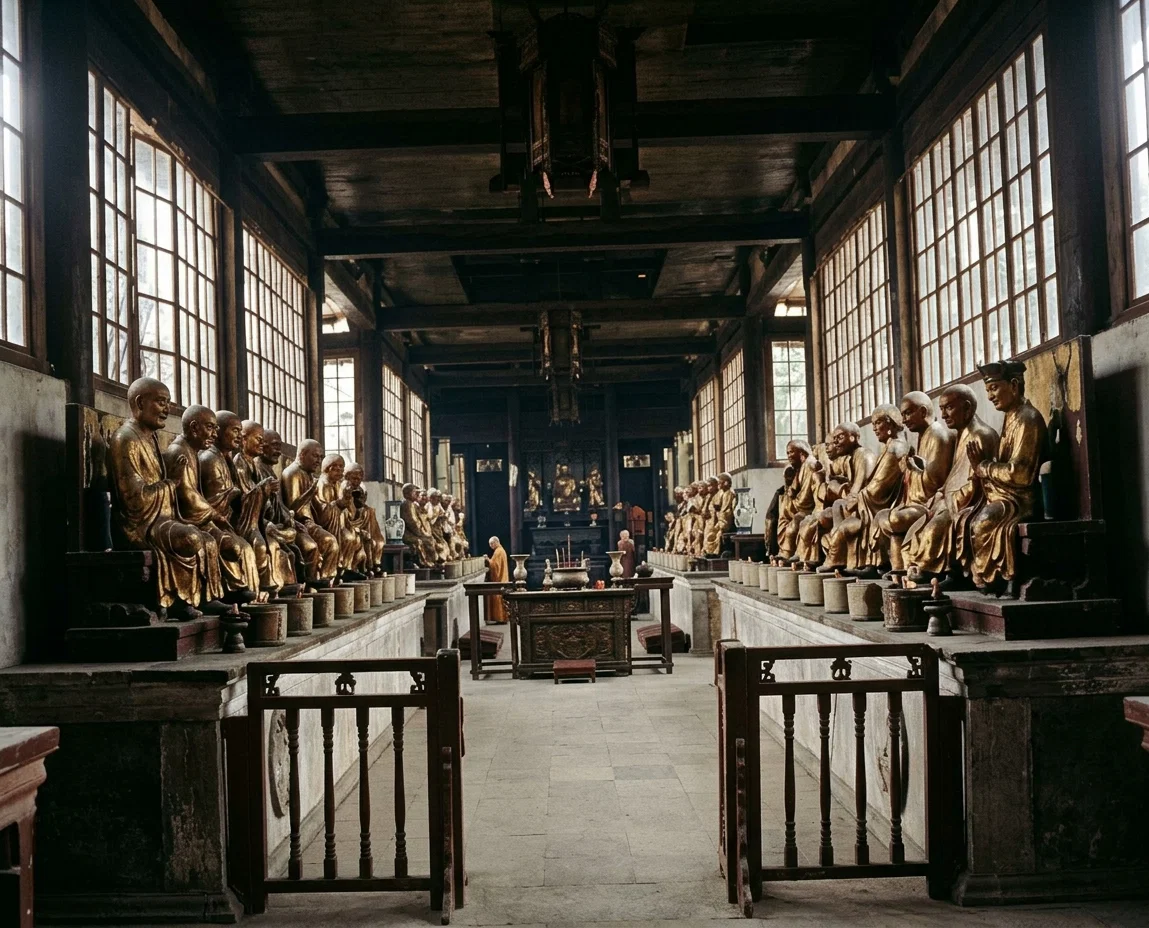
TEMPLE OF THE HOLY FIVE HUNDRED.
“This is a place for the manufacture of kingfisher jewelry,” the guide said, dismounting and leading the way into a small room where eight or ten men were at work on ornamental trinkets. Tiny bits of the plumage of the kingfisher in varying and harmonizing shades of blue, green, and purple, are inlaid by hand on delicate settings of silver of artistic designs. But there is, no doubt, a cruel history back of these pretty baubles; for the glossy, silken tufts from which these clippings are made give evidence of having been torn from the quivering form of living birds.
The linen factory was a large, well-ordered plant for the production of the popular Chinese grass cloth. Embroidering is also carried on in the same establishment. Silk portières, coverlets, scarfs, shawls, and garments, tastily wrought with marvelous skill by men and women who make it a life work, were displayed in bewildering profusion. Such of these establishments as are under the management of Europeans have introduced the manufacture of thread and silk laces, Battenberg, drawn work in linen, etc.
The wages paid to women and girls for such labor probably does not exceed ten cents (United States money) a day; but this is more than they might expect to realize from, to them, more menial labor in some more useful calling.
Having consented to the guide’s proposition first to see the Chinese water clock, and then take tiffin (the common term in the East for the midday meal) at the five-story pagoda, we mounted a series of stone flights to a small house on top of a high mound. Inside, the guide said, “This is the way Chinese measured time in ancient days,” pointing to a tier of jars, arranged so that water poured into the top one, drips from a well-worn copper spout into the second, from that to a third, and thence to a fourth at the bottom, in which is set on a float a graduated brass scale resembling the scale on a thermometer. Every drop increases the depth of the water, and lifts the indicator. “It is now twenty minutes to twelve,” he said, and our watches tallied. For five hundred years the unceasing drip of this primitive contrivance has measured off the span of men’s lives. Presently the musical drops seemed to become vocal and pleadingly eloquent for the four hundred million of darkened souls outside, who are passing away at the rate of one for each crystal drop, passing away without God and without hope in the world.
The five-story pagoda is an old-time watchtower built on a hill overlooking the plain at the highest point of the city wall, and commanding a view of the city and surrounding country which fully repaid us for the hard climb up the ascent.
After tiffin we went first to the “City of the Dead.” From the name, one might expect to be taken to a cemetery, but instead we were let down before a well-kept inclosure filled with long rows of one-story buildings. These structures are divided into sections, and rented out for the deposit of the bodies of well-to-do Chinamen, waiting an opportunity for interment in “lucky ground.” Each section contains two rooms. In the second the body or bodies are deposited in sealed coffins. The first is a reception room for the friends who come to worship the departed, and is fitted up with seats, a tiny oil lamp perpetually burning, and a table on which is set an incense urn, a cup of tea, a bit of food, and frequently a floral offering.
All visitors to Canton are taken to the Temple of Five-hundred Buddhas. Five hundred wooden images, adult size, all different representations of the Indian Gautama Buddha, each with an incense urn before it, are set in a row around the principal room. Among them is a figure of Marco Polo, who is erroneously believed to have introduced Buddhism into China. Almost at the entrance is placed a Buddha with several infants in its lap and arms. This is a special object of devotion by childless wives, who, because childless, are often neglected and desolate in this land of polygamy and concubinage.
As we left the temple, a half-crazed opium sot rushed frantically after us, begging piteously for a few cents with which to gratify his vice.
Chinese are very devoted to their system of medicine, and apothecary shops are abundant. Dried lizards, bugs, toads, snake skins, hartshorn shavings, silkworms, asbestos, oyster shells, together with all manner of seeds and dried herbs,—some otherwise valueless rendered effective by being gathered on festival occasions,—anything that is disgusting enough to be considered good for medicine, and some things known to Western materia medica, are at hand at prices to suit. These failing, the seeker after health may have recourse to the wisdom of his gods at the Doctor’s Temple. Here are stored very ancient and therefore highly prized prescriptions. The inquirer takes his place at the altar before the elaborate throne on which are seated three medical deities, picks up a cylindrical bamboo box containing strips of bamboo wood, each numbered, corresponding to a prescription in the books. This he shakes till one falls out. The number on the fallen piece indicates his remedy. He burns a bit of incense on one altar, and, by way of paying his doctor’s bill, a bit of joss money (mock bills of red and gilt paper) on another, pays the attendant ten cents in more substantial currency, and goes off to get his prescription filled.
The building itself is quite elaborate in architectural design, for China. The massive columns supporting the portico of a recent addition are of single pieces of granite, entwined with chiseled forms of the Great Dragon, to us quite suggestive of the superstition and idolatry for which the edifice stands.
One of the offenses of which the foreigners are accused is that of stealing Chinese children, and gouging out their eyes for use in compounding their medicines. Any of this administered to a Chinaman is supposed to cast over him a spell, bringing him forever under the influence of the foreigners. The great number of blind beggars wandering about the streets in pairs or in small groups might strengthen this suspicion were there no more obvious causes.