Rev. Curtin G. Roop, in The Missionary Review of the World
The history and state of religion in the Philippines is so identified with the history and state of the races there found that an account of the former involves an account of the latter. And in order to be at all definite in this required ethnographical treatment of the islands, we must also point out the general geographical features. The archipelago stretches northwest and southeast, from twenty-one degrees to four degrees forty-five seconds north latitude; that is, from the latitude of the southernmost point of Cuba, one thousand one hundred miles southward. In extent the archipelago is a little more than equal to our own country from Maine to the Potomac, excluding Pennsylvania. The actual land area is estimated at fifty-two thousand five hundred square miles—not far from that of Florida or Arkansas. The islands are hundreds in number. I shall speak of but two by name. The first is Luzon, most important and northernmost, practically the only part of the group with which the Americans have had to do thus far. From Luzon, islands of greater or less size stretch southward to Mindanao, the second largest in the group. From Mindanao southward extends the subordinate group of the Sulu, belonging to the Philippines and reaching to Borneo. The relation between the history and state of the religions and the ethnography and geography of the archipelago will appear throughout our treatment.
Scanty burial relics are found, indicating a prehistoric pre-Malay race. These relics bear Chinese and Japanese resemblances, and, as compared with the most original surviving tribes of to-day, indicate a more advanced race. Such a race is supposed by some to have occupied a Malay continent of prehistoric times, now submerged, and to have been a considerably developed people. No traces, however, indicating the religion of these pre-Malays in the Philippines are found, except that the burial relics are such as show a belief in continuance of a life subject to want of food after death, and indicate such reverence as to suggest worship of the dead; especially is this seen in the fact that these relics seem to have been very sacredly—that is, superstitiously—guarded from disturbance.
Aboriginal Religion
Of the people now surviving, the Aetas, or Negritos, are considered to have been the aborigines of the archipelago. They are a small, black race, in height about four feet ten inches. They are spiritless and cowardly, and of a very low mentality. They climb trees like monkeys, swiftly chase the deer afoot, have voices similar to the voices14of monkeys, herd together in fifties and sixties, and, in order to protect themselves from the scourge of fleas, sleep scattered about in ashes. One writer says of them: “Their religion seems to be a kind of cosmolatry and spirit worship. Anything which for the time being, in their imagination, has a supernatural appearance is deified. They have profound respect for their dead.” Another writer says of these aboriginal Negritos: “They neither worship sun nor stars, nor bow before permanent idols, but adore for the day any rock or tree trunk in which they trace a resemblance to an animal. They have great respect for the aged and the dead. For years after the decease of one of them they place betel-nuts upon the grave, above which the deceased’s bows and arrows are hung.” Every night, so they believe, he quits his grave to go hunting. They have no funeral ceremony, but simply lay the corpse at full length in the grave, and cover it with earth. When one is afflicted with a malady deemed incurable, or has been smitten with a poisoned arrow, they bury him alive. In view of their high regard for the dead, and their reverence for old age, which borders toward that state, it is reasonable to suppose that they consider the fatally wounded to be candidates for the awe-inspiring after-state, and therefore to be dismissed from the midst of the living at once by immediate consignment to the grave. One writer says of their religion, that it seems to be, indeed, a kind of ancestor worship. Summing up, it would seem that these aboriginal Negritos, under the influence of a sort of animism, deified natural objects (trees, stones, etc.), and worshiped them, and that they also accorded their dead such awe and regard as with them was equivalent to worship.
These aborigines are now found only in the interior of the islands among the mountains, whither they were driven by the incoming Malays. They number about twenty thousand (some say only ten thousand), and are destined to disappear entirely.
The Malay Period
The Malays, at a time unknown, came to these islands, probably from Malaysia. Long before Spain’s arrival they had driven the Negritos back, and were themselves occupants of the coasts and of considerable territory inland—perhaps most of the territory. What the religion of these people was we of course can only partially gather, as we find it spoken of by the first and later visitors to the islands, and as we find it illustrated in the more or less undomesticated tribes of to-day. Let us go to the north and proceed southward.
The Gaddanes are a fierce tribe in the north of Luzon, whose conquest has never been attempted, of whose habits something is written, but of whose religion I found nothing, save at the season of the year when the tree popularly known to the Spanish as the “fire tree” bears its fire-red blossoms—these people celebrate their religious feasts, and gather scalps and trophies of war.
Proceeding southward, we next mention the Igorrotes. They are scattered over a considerable part of Luzon. As to their religion, the most noticeable thing distinguishing them seems to be that they are utterly impervious to Christianity—at least, to Spanish Catholic Christianity. The answer one of them made to a priest who was trying to teach him Christianity, and to explain to him the marvelous life of St. Augustine, was characteristic of the tribe when he said, “No colored man ever became a white man’s saint.” In the religion that never canonized the colored man the Igorrotes desired no “part nor lot.”
The Tinguianes are next in approximately geographical order southward. It is concluded from physical resemblances that this tribe is descended from the shipwrecked Japanese who sought refuge in the mountains. One writer says: “They are pagans, but have no temples. Their gods are hidden in the mountain cavities. They believe in the efficiency of prayer for the supply of their material wants. Hence if there be too great an abundance of rain, or too little of it, or an epidemic disease raging, or any calamity affecting the community in general, the anitos (images) are exhorted.” They highly regard their dead. According to one writer, they roast them into a dry state, and bury them (generally beneath their dwelling, in a sort of well) in niches, each person in a niche, above his father. They believe in the existence of a soul, and that it detaches itself at death, and remains with the family. They worship neither sun, moon, nor stars. When a chief sees a stone, tree, or any natural object of peculiar shape (as, for instance, the shape of a cow or buffalo), he tells the people of his village, and they go forth to worship it. They may, for instance, make a straw shelter over the object worshiped, and sacrifice a pig. After worshiping and feasting, they burn down the straw roof from over the fetish, and go their way, and the object is forgotten. From all that has been said, I conclude that the Tinguianes had originally a sort of fetishism and, perhaps, ancestor worship.
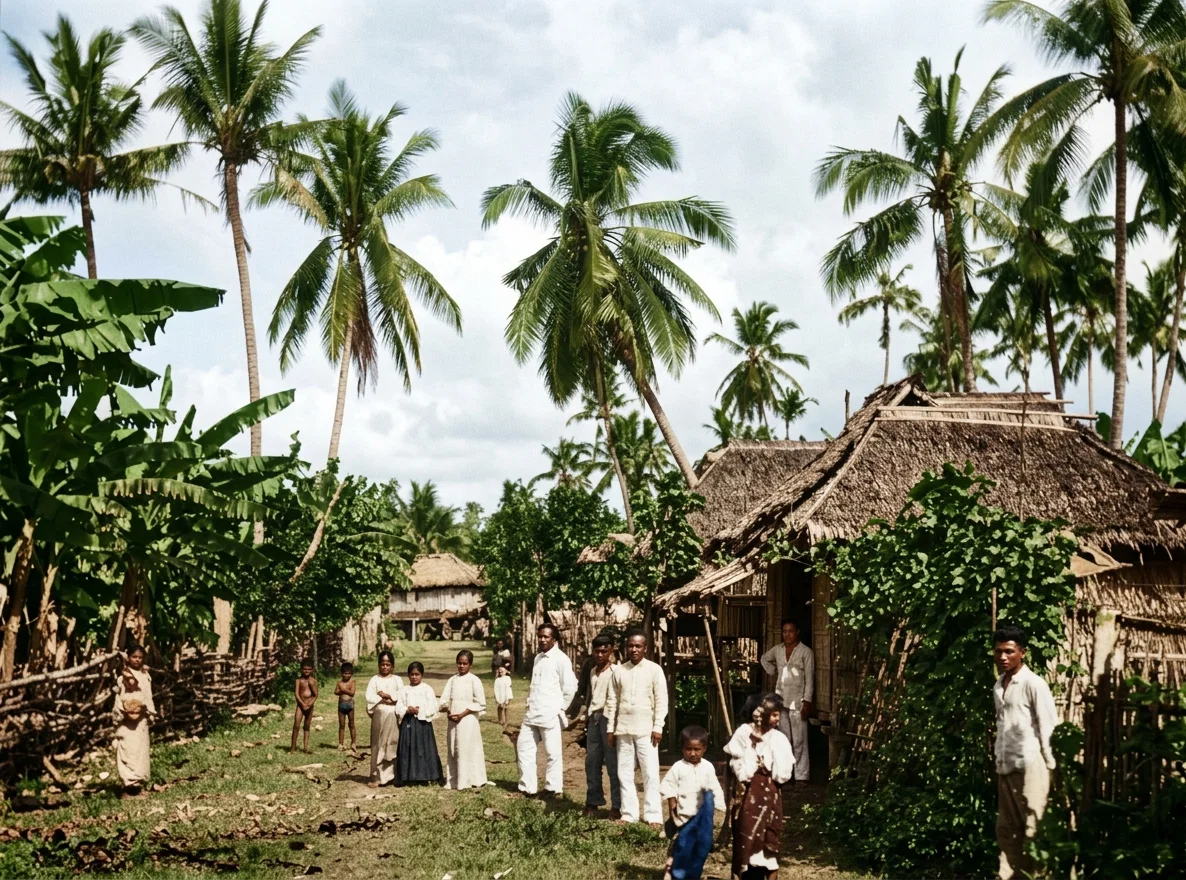
A VILLAGE IN THE PHILIPPINES.
Coming on farther south in the island of Luzon, we arrive among the Tagalogs (Tagalas, Tagals). They are at present inhabitants of Manila and the adjacent territory. They are Malays with a considerable blending of Chinese and Japanese—for it is to be borne in mind that the Chinese and Japanese have been on the islands from time immemorial. The Tagalogs are at present the most advanced people of the islands, and have been Christian for about five hundred years. Consequently their originally religion can be learned only from the very earliest accounts we have of the islands, and from surmises on their close similarity to surrounding tribes, which stretch back into the interior, and still retain, to some extent, their primeval customs.
Such a tribe are the adjoining Bicols, closely related to the Tagalogs in race and language. Such also are the Bisayans (Visayans), stretching still farther south, who, with the Tagalogs (and Bicols), will probably, on account of superior intelligence, ultimately absorb all the other tribes in the northern half of the archipelago. One writer says of the Bicols that they believed in good and evil spirits, witches, circumcision, divination by the stars. Of the Bisayans we have gathered much more. It is evident that they never had temples, but each man performed his religious ceremony in his hut. Some huts may possibly have been used as clan meeting-places—as it were, temples. They prayed to particular gods called “devatas” (anitos among the Tagalogs), and had one devata to govern the sea, and another to watch over the children and house. One writer says that they sacrificed to devata15as one who appeared to be in rebellion against the deity. A true interpretation would probably be that they sacrificed to devata as if to deity in hostile stage or anger. Hell was called “solad,” heaven “ologan.” Souls of the departed go to a mountain in the Province of Otou, called “medias,” where they are entertained and served. Alongside of the devatas, to which they sacrificed and prayed, they placed their deceased grandfathers and great-grandfathers. Also they reckoned among the gods all who came to death by the sword, lightning, or crocodile, believing that such went to heaven on a bow. They buried their dead in coffins hewed out, fitting closely, so that there should be no unoccupied space requiring to be filled by the death of additional members of the family. Trinkets were buried along, and a jar of rice and one of water were placed by. If distinguished slaves were killed and buried for attendance in the land of spirits, the coffins were placed in a grotto, or beneath the house where the treasures are kept, or on a high rock. The caves where they were buried were not disturbed; they were regarded as the dwelling places of spirits, which especially manifested themselves by precipitating storms upon sailors who passed by and did not reverence them. Sailors feared to pass by a burial cave, lest they also should be drawn after the dead. The aged chose to be buried on some promontory, where sailors passing by should worship them. Especially were those who had been distinguished by bravery worshiped. Such were called “humalagar,” which corresponds to the Latin “manes”—namely, deified ghosts of one departed. When a man died, all of the village were compelled to keep silence for a time, varying according to the rank of the deceased, sometimes until the relatives had killed a sufficient number of victims to appease the spirit of the dead. Such a practice would seem to be nothing more nor less than human sacrifice made to appease a worshiped spirit, the statement of some writers that human sacrifice was never practiced in the islands to the contrary notwithstanding. Some say that these Bisayans had idols, others doubt whether they had anything corresponding to a permanent image recognized by the whole community. The alleged idols are described as painted, with large teeth (boars’ tusks), large faces, concave or flat back, feet turned up. One writer gives this people’s account of the creation as follows: “A vulture, soaring between heaven and earth, was unable to alight (the sea mercilessly rose higher and higher), whereat Heaven in anger came to the vulture’s rescue by creating islands. The vulture then alighted, and split a bamboo, out of which sprang man and woman, who then begat children, and drove them forth from home.”
De Morga, a Spanish writer and traveler of the last part of the sixteenth century, says of the Bisayans: “In their religion they seem to have no notion of the true God. The devil appeared to them in various horrible and fearful forms and forms of savage animals, so that they feared and trembled at him, and adored him, usually by making figures of those forms, which they sometimes kept in caverns and special houses, where they offered perfumes and sweet smells and food and drink.” The “devil” of which De Morga thus speaks of being worshiped was evidently a god or gods, since he speaks of their representations of him by the anitos, which is the Tagalog name for images of their gods. “Others,” he says, “worshiped the sun and moon, making feasts and getting drunk. Some adored a mountain bird marked with yellow, which they called ‘batala’ (bathala being the Tagal name for God the Creator in contradiction to idols, which are called anitos and lic-has, or statues). In general they reverenced and adored the cayman, a mammoth crocodile of the rivers, falling upon their knees wherever they saw it, and raising their hands to it, under the notion that by this it would be appeased and withdraw.” They had no temples; each person made, and for the most part kept, his images, without solemnity or ceremony, in his dwelling. There were no priests, if we except a few old men and women (witches and sorcerers); these performed prayers and ceremonies to their idols for the sick, and believed in omens. “To those consulting them they answered a thousand absurdities and lies,” says De Morga. He says that they were never cannibals, nor did they offer human sacrifice. We have learned from other writers, however, that at least some families of these people killed human victims to appease their dead relatives. “They had little ceremony or outward religious institutions, which fact made them the more susceptible to Christian missionaries. They believed in another life, with rewards for those who had been valiant and done great deeds, and with punishments for those who had done evil; but they did not know how nor where this would be.” Their dead they buried in their own houses, and kept the bones, especially venerating the skull.
We have now traced the islands from the north southward, past their middle, to the borders of the Mohammedan rule, in Mindanao and the adjacent islands. Mutual hostility has always existed between the Moslem southern part and the Christian northern part of the archipelago. Hence Christian travelers have not been able to go through the southern islands so freely, and have not given to the Western world very complete accounts of the peoples in the south. We can only assume, therefore, that the primeval religion of the south did not differ materially from the more northern islands already described.
To sum up concerning the pre-Christian, pre-Moslem religion of the Philippines, then, we should say that in general it consisted in an amorphous mixture of fetish nature worship, spirit worship, and ancestor worship, and perhaps arose in some instances to the plane of the worship of spirits of more general cosmic control. Here were no temples, and the only approach to priests was a species of sorcerers and witches. Belief in the immortality of the soul seems to have been universal.