Our Matabele Mission

5%

Seventh-day Adventist Publishing Association · Battle Creek, Mich. · Sep 9, 1902

FromReview and Herald, Vol. 79, No. 36.

Read the full edition

Our Matabele Mission

G. W. REASER
The writer recently had the privilege of visiting the first missionary station established by our people in Africa. In making the journey from Cape Town to Buluwayo—a distance of thirteen hundred and sixty miles—four distinct classes of country are traversed: first, the charming Cape district, bounded on the north by the Hex River Mountains, justly noted for the grandeur of their scenery; then the barren karoo, reminding one of the desert regions of Arizona, extending nearly to the Orange River, where it merges into a vast expanse of “veld,” or grass-covered prairie, reaching to Mafeking, at the northern extremity of Cape Colony; and lastly, “the bush,” or, as it would be called in America, the “scrub-timber” belt, stretching from the point last named to Buluwayo, and unbroken even then till the Central African forests are reached.
Evidences are abundant of the conflict between Briton and Boer, happily now in the past. The labyrinth of barbed wire, stretched to ensnare the bold Boer who might attempt to destroy or cross the railway at any point; the pitfalls, the alarm guns, the earthworks and trenches connecting the thousand blockhouses; the embankments and terraces thrown up at these tiny forts, ornamented with white stones and fragments of colored glass laid in almost infinite design, including figures of men and animals, and mottoes, some of which contained the words, “God save the king,” “Long live the king,” and, “Papers, please”—the latter intended as an invitation to the passengers to throw out reading matter in passing; the populous native and Boer concentration camps; the columns of British soldiers in camp and on the march; the massive, well-filled storehouses of supplies for the British army,—all of these add interest to the journey.
The monotony of the trip was relieved by breaking the journey midway, at the diamond-mining center of the world, the city of Kimberley. Here colossal works are in operation for the separation of the precious stones from the débris; and excavations, said to be the greatest ever made by man, forming cavities a quarter of a mile or more in diameter, and to the depth of fourteen hundred feet, may be seen, from which it is said that gems to the value of seven hundred million dollars have been secured.
While here, I witnessed the presentation of a richly jeweled sword to General French, as a token of gratitude from the citizens of Kimberley, for the relief he brought to that city, thereby breaking the famous Boer siege. By way of contrast, this scene brought to my mind the reward of the soldiers of the cross who will now go to the relief of those who sit in darkness and in the shadow of death, besieged by Satan, when, instead of an emblem of war, the faithful will receive crowns of rejoicing, jeweled with stars, indicating souls rescued from the enemy.
During my stay of two and one-half days in Kimberley, three meetings were held. The splendid bath rooms, conducted in an able manner by Brother and Sister Wilson, were visited, and also the resting places of Brother Mead and Sister Tripp. As we stand by the tombs of these laborers, our hearts cry out, “How long shall Death, the tyrant, reign?” The answer comes promptly from him who passed through the tomb and now holds aloft the keys of death and the grave, “It is only till I come.”
Continuing the journey to Buluwayo, I was met at the station by Elder Sturdevant, who, with his family, and two of our native “boys” to drive the team of eight yoke of big-horned oxen, had come to take me to the mission. Arriving at the farm, thirty-five miles distant from Buluwayo, I received a cordial greeting from the workers, all of whom I met for the first time, and was made welcome to their homes.
The appearance of the mission farm was an agreeable surprise to me, as I had expected to see a barren, desolate region; but, contrariwise, although I arrived at the dry season of the year, I found the site of the homes on the farm very pleasing to the eye, as the view is extensive, and diversified with hills and valleys, kopjes, and an abundant growth of vegetation. In fact, as I wandered over the farm, it seemed to me that if this tract of twelve thousand acres were located in the suburbs of any of the great cities of the world, it would be considered almost a perfect natural park. Its great variety of flowers and grasses in their season, its many species of trees, including two varieties of mammoth cacti, and a like number of varieties of trees bearing edible oranges, inclosed in a shell, like a gourd, make it a place of interest to the botanist. Its picturesque, massive granite bowlders, many of them so delicately poised that apparently a slight touch would send them to the bottom of the hillocks which they crown, but held firmly in position by the law of gravitation; its numerous specimens of animal life; its many species of birds of beautiful plumage; and its agricultural possibilities,—all these combine to make it a place of interest to the student of nature.
But the mission farm is most attractive to persons who are interested in the science of salvation as applied to those who are in the depths of heathenism and superstition. All the other attractive features would fail to hold our workers there for a single year, as it is a place remote from civilization, and isolated from the great, busy world. Only the love of perishing souls causes our laborers to leave home and friends and native land, and devote their lives to the good work that is carried on at the mission farm.
The soil on portions of the farm will produce enyauti, a grain similar in every way to millet, but slightly larger, and much richer in flavor and nutrition, and preferred above all others by the natives for their staple dish—porridge; Kaffir corn and mealies (Indian corn), sweet potatoes, Irish potatoes, and Cape gooseberries (ground cherries) grow almost spontaneously. Nature has never caused anything like a famine at the mission since its occupancy by our people. The famine of which we have all heard was caused by the destruction of the crops and granaries of the natives by the British soldiers, as a war measure, at the time of the Matabele rebellion.
An industrial superintendent is greatly needed on the farm, to take charge of the agricultural department and the stock rearing, and to have the oversight of the native “boys” in the work which they perform to assist in supporting the school in which they are receiving an education to fit them as missionaries among their own people; thus relieving the evangelical laborers, and leaving them free to devote their undivided attention to the advancement of the spiritual interests of the mission.
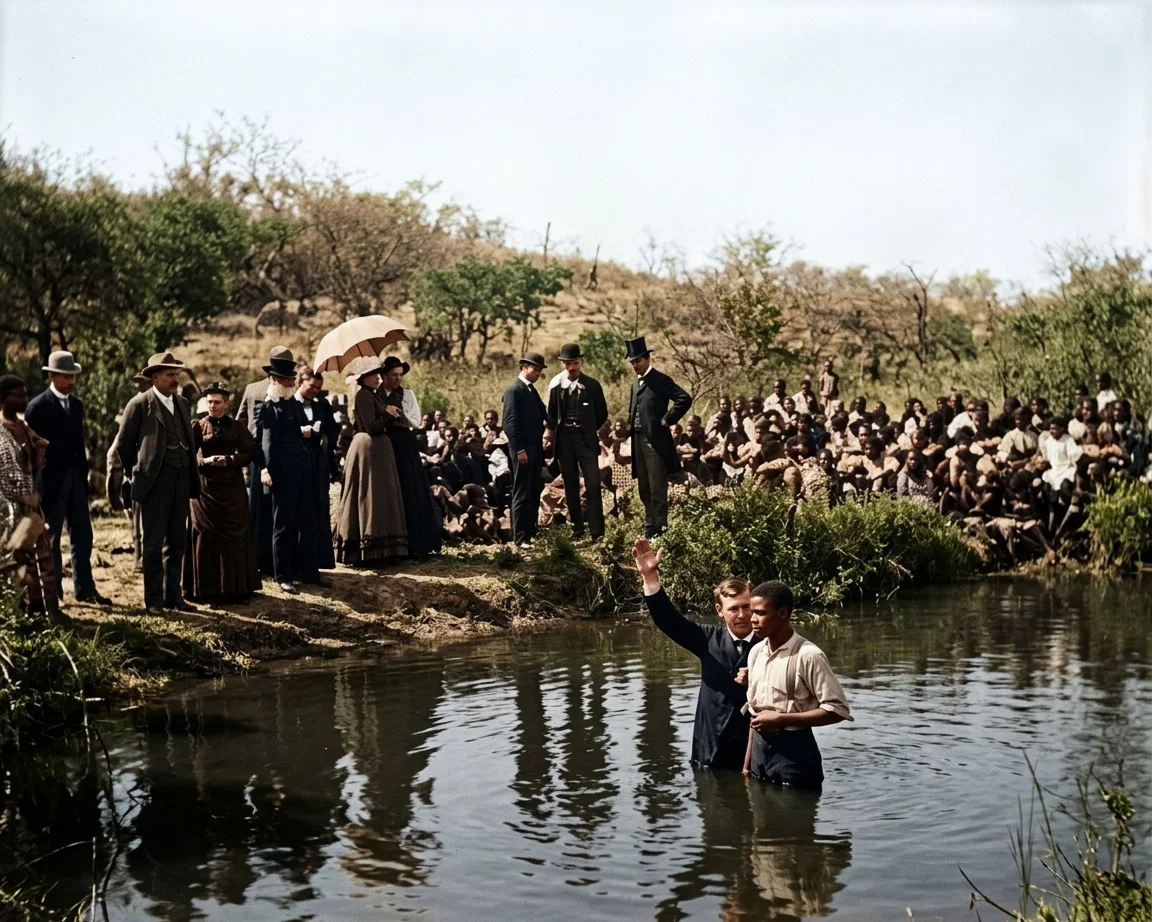
THE BAPTISM ON THE MISSION FARM
One thing which brings a shade of sadness to the visitor at the mission is the number of graves in the little cemetery near the church. It is considered by those who have been at the station longest that the death rate need not have been abnormal, in comparison with other lands, if certain safeguards had been known and properly regarded. Our brethren who have gone down in death have, as a rule, been sent to this field after they had passed the meridian of life, and it was more trying for the constitution of such than for younger persons to become acclimated to this high, subtropical climate; while some have overworked and otherwise unduly exposed themselves, thereby weakening their constitutions, so that instead of resisting the attacks of disease, they became its easy victims. All except native workers in the interior of Africa should have a change of climate for three or four months at least once in two years, and oftener if they feel that their condition requires such change. This can be secured at small expense in other portions of South Africa. We trust that the costly lessons learned will hereafter be applied, and thus hold the enemy at bay, and save lives, precious in themselves, and of great value to the cause of God.
Improvements are being made in the dwelling houses, which will make them more healthful. Packed earth floors are being supplanted by cement, which will keep out dampness in the wet season and prevent dust in the dry; and corrugated iron roofs are to take the place of the thatch now in use, as the latter holds moisture, and is, therefore, a germ incubator; nor is it rain-proof.
There is little hope of reaching the older natives with the gospel, but it is a matter of the greatest possible satisfaction to be an eyewitness of the transformation, both facial and spiritual, which the power of the gospel has wrought in their children. Some of the young men, who preach with as much freedom and power as our young white ministers, have entered the ministry. While at the mission station, it was my privilege to organize a church of twenty-nine members, twenty-two of whom were natives. Of this number, twenty-one were baptized at the time of my visit, one having previously followed the Lord in this blessed rite. There were about three hundred natives present who witnessed the baptismal scene, a number of these being indunas, who beheld their own children led into the water by Elder Sturdevant, to be planted together in the likeness of our Saviour’s death. Some came from the kraals to be baptized, well knowing that they must endure persecution on their return to their homes. Brother Sturdevant was chosen elder of this our first Matabele church, and Brother Anderson deacon.
We believe that the keynote of the true method for the evangelization of Africa has been struck at our Matabele Mission station. If it devolved alone upon the white people to carry the gospel to the millions of Africa, it would require all the workers and all the means in the denomination; but from our station a goodly corps of native missionaries will go out this year, to different parts of Rhodesia, to teach their own people the gospel, and to gather in other young men to attend the school. As these go out, they are freely supplied with homes and food at the kraals where they establish their schools, and thus with slight expense to the mission their support is assured. We should have at least one well-equipped training station, located in the most healthful and otherwise most favorable position among each of the nations of Africa, to be manned with white or educated colored laborers.
I had planned to visit Brother and Sister Armitage at Gwelo, but a severe outbreak of cattle sickness in the vicinity of their station made the risk too great in going there with the ox team, which was our only means of conveyance.
Never have I visited any branch of our work which gave me greater encouragement and more genuine satisfaction than that of our Matabele Mission station.
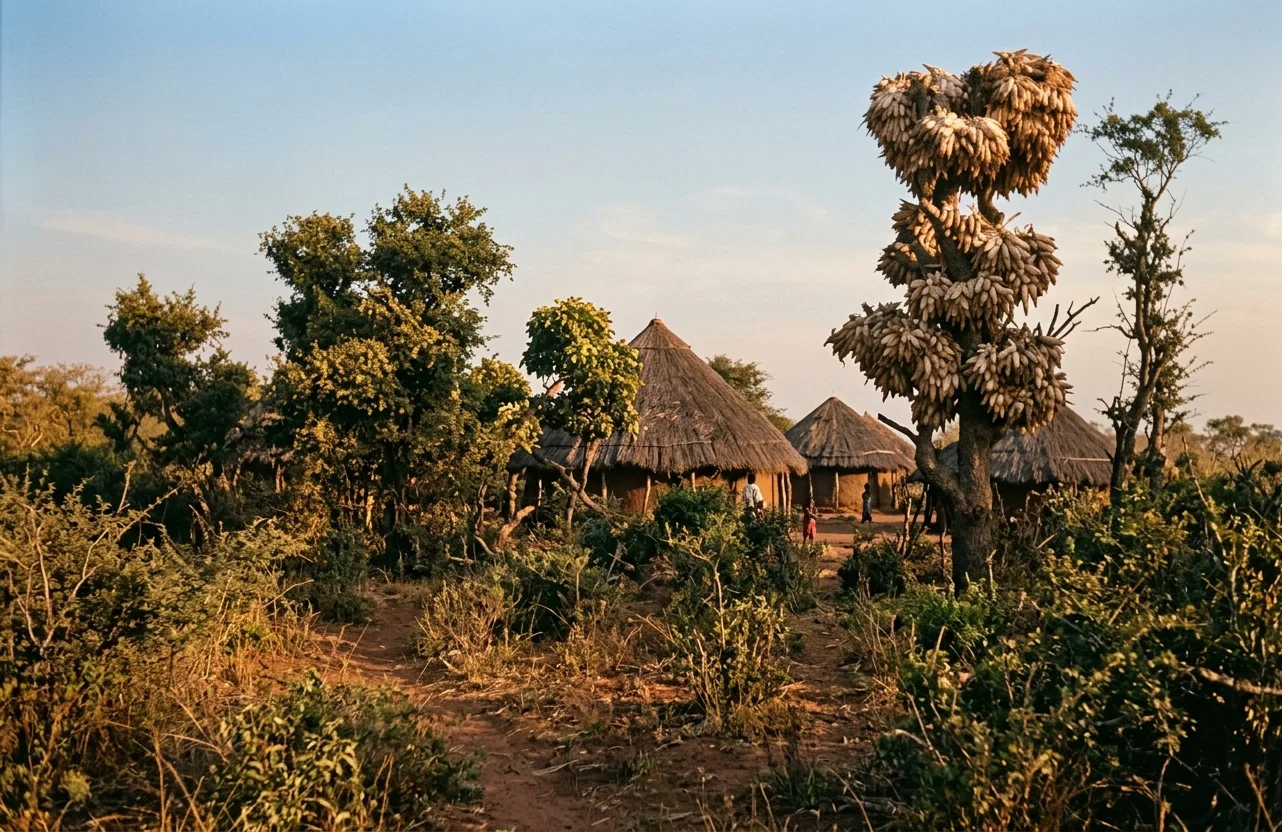
A native kraal, showing method of storing “mealies” (Indian corn). The smaller branches are cut from the trees, the mealies tied together in large clusters, and then suspended from the remaining branches.