THERE is, perhaps, no other word in the English vocabulary that so fully conveys to the mind the qualifications necessary to render one an efficient worker in the mission field as does the word “adaptability.” It is the qualification needed above all others; for without it one is almost out of place.
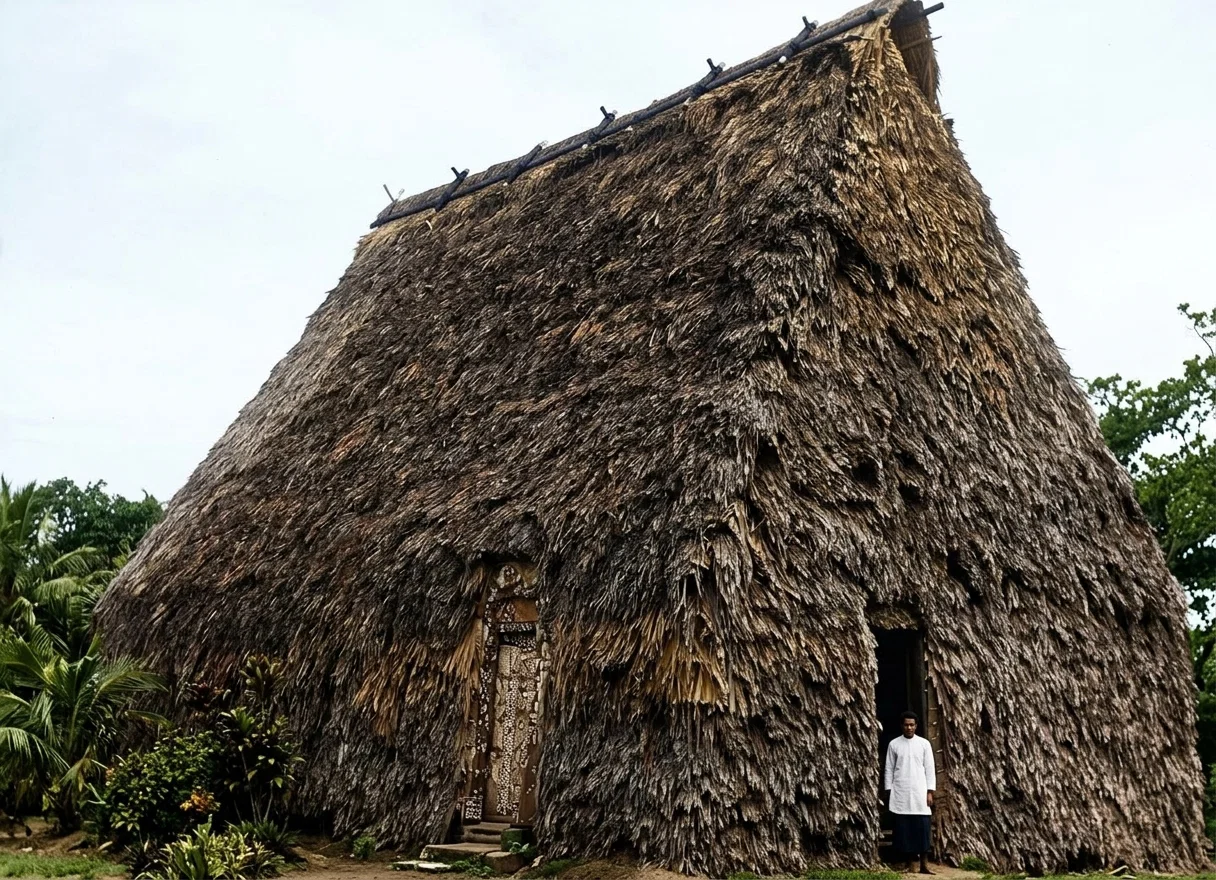
NATIVE HUT (EXTERIOR)
At every step of the way fresh and unexpected needs and difficulties arise, which must be met and overcome by the worker. He must turn his hands to work in building, in cultivating the soil, in sailing, in printing, in treating the sick, and in ministering the Word. One cannot obtain a clear conception of the duties that devolve upon the missionary in a foreign field, especially where civilization is but little advanced, unless he has had some experience of the kind.
The missionary has need of every useful branch of knowledge that can readily be put to good use in ministering to the wants of all around him. Unless he is a practical man, very little will be accomplished with the means usually at his disposal.
Somehow, the native has the idea that a missionary must be a doctor, or a person capable of advising him in everything, if he assumes to lead the people. And why not? It is with this in view that he rushes to the missionary for aid in case of accident or illness. A sketch of the work of a few days in the mission will show the truthfulness of this statement. While engaged at printing the paper, a cry is heard, “Come quickly; the buli [native district chief] has cut his finger off—mashed it to pieces—tried to stick it on—come! Come at once!” The next hour is occupied with a broken and mashed finger. The sufferer is eased, and a case is on our hands to attend to for a fortnight or more. We go on with the printing, finish it, send the papers away, get ready for another issue, as we intend to visit a group of islands seventy or more miles away, where there is a great stir about the new religion, and an effort is being made to expel the new lotu. We toil on until nightfall, rest awhile, then make ready to retire. Just as the light is about to be extinguished, a sudden cry is heard. The superintendent calls out in the still darkness, “A young man is bleeding from the lungs, and vomiting large quantities of blood; they want you at once!” “What can I do to help you?” cries another voice from an adjacent room. The inevitable reply is, “Get ready some hot water as soon as possible, and send it over.” We seize the vaporizer with a prayer that it will render assistance, lay hold upon a piece of cloth to serve as a compress, and hasten away to the native village, which is in deep anxiety.
We reach the house, stoop and enter; and what a sight is before our eyes! Twenty or more stalwart natives are squatting around in grim and hideous stillness, closely watching a fine young man slowly bleeding,—no, he bleeds rapidly,—supported by his aged father, who weeps at the sight. I glance around the corner where the young man is, and there large quantities of life fluid are spread on the floor mat. That is not all—he still coughs it up. It is impossible to get a definite idea of the loss of blood; but the situation calls for prompt action. The father and the brothers cast longing, desperate glances to catch any ray of hope afforded by our efforts. The word is given to heat plenty of water outside, the crowd is ordered outside, doors are opened wide, the vaporizer is applied with desperate energy, cold compresses being placed over the lungs. But there is no hot water as yet.
We labor on, looking up to heaven as we sense our helplessness. While we thus work, the natives begin crowding and chattering, and some enter, smoking the vile weed, tobacco. They are soon dismissed. In ten minutes or a little longer the treatment is having its effects. The hot-water bag arrives. It is quickly placed behind the lungs, the patient’s feet are placed in hot water, the cold compresses applied vigorously with fans in action all around. With what gratitude we see the sufferer becoming easier and the blood diminishing! We work steadily for an hour, and the breathing is slower and freer, the patient begins to sleep. Perfect silence is requested. It is now half-past eleven, and the bleeding is stopped; and but for an occasional cough, which brings up a little mucus slightly tinged, all seems well. We wait a little longer, he sleeps well, and we take our leave, giving strict injunctions that he be kept perfectly quiet, and that we be sent for at once should any further bleeding occur.
From the Scientific American
NATIVE HUT (INTERIOR)
With minds much relieved we return home, and retire. Early in the morning13we hasten to see our patient, and find that he has had an undisturbed rest. The relatives are again admonished to have quietness, and not to have him move about. Directions are given for nourishment, and he is left to the care of his friends. We return and continue our work.
At eleven o’clock, while just in the act of applying a fomentation to another patient at the mission, I pass the remark that it is “only a brittle thread that holds the life of that young man, and if he should move around carelessly, all would be over with him in a short time.” The words scarcely fall ere a messenger in great haste steps on the veranda, and calls in agony for us to come, as the hemorrhage is worse than before. Away we speed. The place is packed this time with eager, anxious persons, most of whom are waiting mournfully. A glance reveals the situation as hopeless. The young man has bled too much already, and he turns his face upward with an agonizing look, and says, gasping, “Sa oti, sa oti, talatola!” (“It is finished, preacher; it is finished.”)
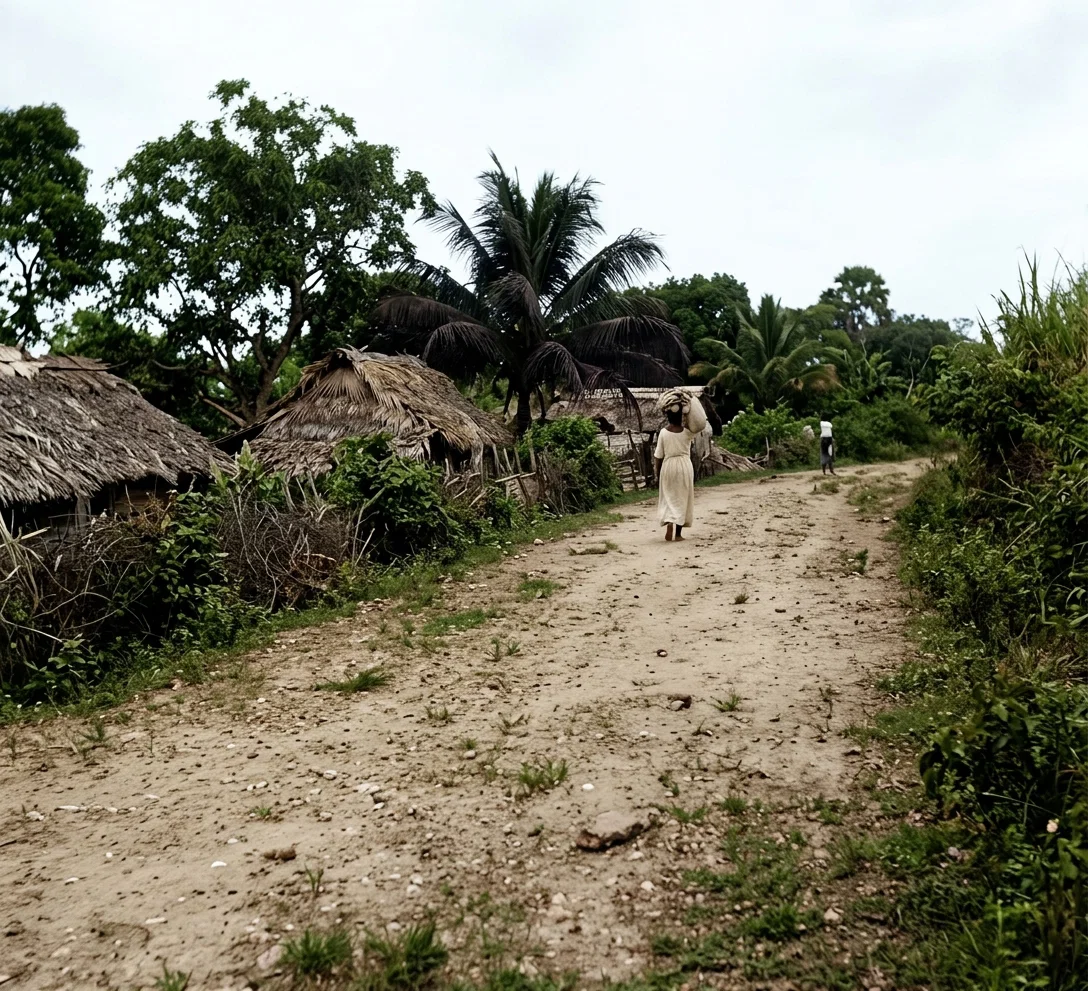
A VILLAGE IN BRITISH GUIANA
And so it was. He bled to death. But we had the privilege of making his last minutes easy. Even when so close to death’s door, the treatment had its desired effect in stopping the hemorrhage; but it was too late to save his life. We made inquiries before leaving, and learned that he had actually and willfully arisen, and walked up and down hill for some distance, intending to catch fish. The next day he was carried to his grave, and there he rests peacefully. In the morning he had been talked to about giving his heart to the Lord in gratitude for sparing his life. Apparently he took no heed, and in a few hours his probation ceased forever. It was with sad feelings that we took part in the funeral service the day following; but we felt that our garments, although stained actually with his blood, were free from guilt. It is true that we are a savor of life unto life, or of death unto death.
The foreign missionary must lay down his life for the sheep; he must die daily; he must count all things but loss, that he may win souls for the kingdom of God.