J. W. WESTPHAL

5%

Seventh-day Adventist Publishing Association · Battle Creek, Mich. · Aug 26, 1902

FromReview and Herald, Vol. 79, No. 34.

Read the full edition

J. W. WESTPHAL

From Buenos Ayres to Valparaiso

J. W. WESTPHAL
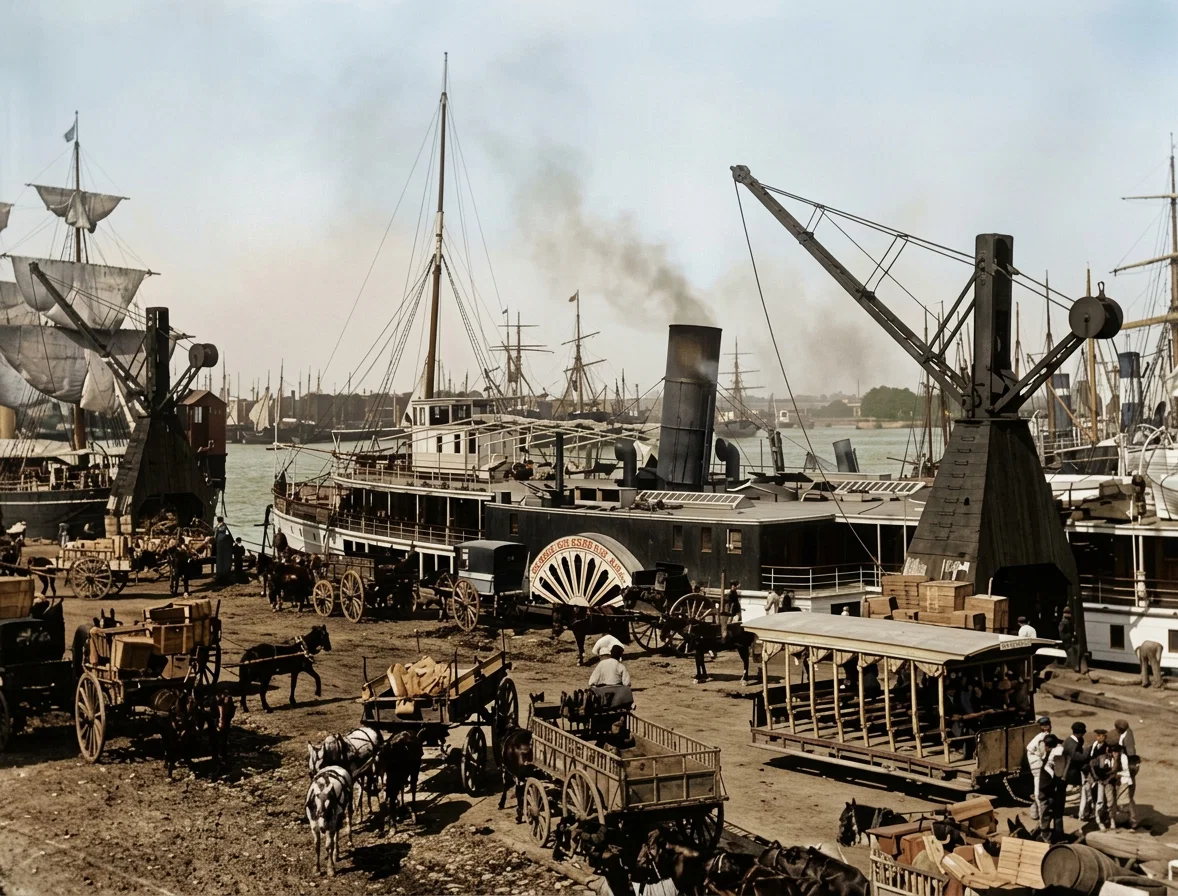
RIVER FRONT AT BUENOS AYRES
WISHING to become acquainted with our work in the South American West Coast mission field, and to counsel with the laborers there concerning its future, I left Buenos Ayres at 10 P. M., February 21, on an overland trip to Valparaiso, Chile.
Unlike most of the South American countries, Argentina is a great, level prairie. I have never seen land anywhere so flat. I have traveled for a hundred miles, and more, without seeing scarcely a perceptible rise or depression in the surface anywhere. Such was the condition of the country during the first part of our journey. Not until we were about three hundred and sixty miles west of Buenos Ayres was there a noticeable upgrade and the first trace of timber. The timber was small and scattering, and, after about fifty or more miles, again disappeared, and with it came another long stretch of level country. At this point two mountains to our right were passed. Although the soil was apparently fertile, and the conditions generally favorable to agriculture, with the exception of a short distance west of Buenos Ayres, none of it is under cultivation. Stock raising is the only occupation. The territory is divided into large ranches, well fenced, and in these are large herds of cattle, horses, and flocks of sheep, and farther west mules and goats. These, together with some ostriches, a deer, wild fowl on a few shallow ponds, and an occasional house or village, were the only things to break the monotony of the scene. But one small stream was crossed from Buenos Ayres to the Andes. Argentina is a country capable of yielding immense wealth from agricultural pursuits, but as yet it has only been touched.
At 5:15 A. M., February 22, we reached Mendoza, a city of about forty thousand inhabitants, at the foot of the Andes Mountains, or Cordilleras, as they are called here. On reaching here, I learned that I must lay over twenty-four hours. The several companies transport the passengers across the mountains only three times a week; accordingly, I sought to make the most of it by writing, viewing the city, and making inquiries as best I could concerning the city and our trip across the mountains. It is not the most pleasant thing to travel among a people whose language one does not understand, whose methods of travel and business are strange, and who always seem ready to take advantage of a foreigner. To make sure, one feels inclined to make repeated inquiries with continual mental reservations.
In February, 1861, an earthquake shook all Argentina, and, in fact, all the southern part of South America. It was most severe and destructive along the east side of the Andes, and Mendoza was the greatest sufferer. Ten thousand of her inhabitants perished. As in the great earthquake of 1755 at Lisbon, the people sought refuge in the church buildings at the shrines of the virgin and the saints at the first shocks, only to share their ruin. Two churches, San Augustine and San Francisco, are still in ruins. Otherwise the traces of the earthquake have disappeared.
Grape growing is the principal industry in the country around Mendoza. There are hundreds of acres of the most beautiful vineyards. As it seldom rains there, the land is irrigated from the Mendoza River, a small stream issuing from the mountains. When storms do arise, they are usually of such severity that great damage is done to the vineyards, and to protect them cannon arefired to scatter the storms. Peaches, pears, and figs also grow there. Just back of the city are the lofty, snow-capped Andes, which we must climb on the morrow.
A PATHLESS PASS
A PATHLESS PASS
Promptly at 5:45 the next morning our train of three small coaches on a narrow-gauge track left the station to follow the narrow, winding Mendoza valley into the mountains. There were about thirty-five passengers, but these were divided between two companies under whose guidance and protection they were traveling; and after leaving the train, they divided into two separate parties. In our party there were, including guide and drivers, about twenty. English, French, Germans, North Americans, and others were represented in the party. Among them was a young German army officer on his way to Chile to instruct the Chileans in war tactics. By him I was informed that there were seven or eight German army officers in the Chilean service for purposes similar to his own, and that there were twenty-two Chilean officers in the German service for the purpose of the training. He predicted a bright future for Chile. Surely, the messengers of peace need to hasten to the aid of the people ere the sound of their voice is drowned by the din of war.
On either side were barren mountains, each successive one seemingly higher than the one before it, silent monuments of the majesty and power of their Maker. In places the ascent was so steep that a cog-wheel track was used. We passed a number of small stations; among them Punta Vacas (Point Cows), which we at once recognized by the cows in a triangular level patch of land in the mountains. At 1 P. M. we reached Puente Inca, the railway terminus. At this place the most of the passengers took refreshments in a hotel which constituted the place. There are a number of mineral springs of warm water here.
Without waiting for dinner, the baggage was at once loaded on to pack mules, and sent on ahead. In one hour the passengers proceeded on their journey in coaches, each drawn by four horses driven after the order of Jehu. In one hour we reached Las Cuevas. This station was composed of a number of mules driven into a corner, saddled and ready for the passengers. In fifteen minutes we were climbing a mountain, and in one and one-half hours we had again descended to the valley at La Cumbre at the foot of the mountain, the summit of which is the dividing line between Argentina and Chile, marked by a signboard with Argentina on the one side and Chile on the other. The grade is already made, and the train will soon run to La Cumbre within two or three miles of the Chilean border.
The ascent was very steep, indeed. It was a marvel how the mules would climb these mountains with their heavy loads. Two large, heavy trunks were carried by one mule. They were urged on, sometimes, as we descended on the other side, into a run. It was necessary to hold one's self in the saddle by holding to it with the hands. The mule I rode, a gray Palomito (little dove), seemed to be the slowest in the lot, and I had hard work to keep up. On ascending, one little girl took sick on account of the altitude. We soon passed the snow line. Our overcoats, which were a burden before, were a comfort now. With the altitude of 12,700 feet at the summit, and a good, strong wind blowing, the temperature was in marked contrast with that of the warm valley which we had left an hour or two before.
No sooner had we reached the summit, and the few Chileans in the party had cheered, “Viva Chile!” than we began the descent, which was much more steep and rough than the ascent. The skeletons of mules on the sides of the mountains indicated that they had made a fatal misstep. Once a lady slipped over the saddle horn, but held herself until she was helped back. As it was growing dark, the mules were urged on faster. The pack mules made many cross cuts where the passengers could not ride. A coach met us to take the ladies in the party the last hour's ride before reaching our stopping place. Nearly the whole distance that we went by mule back may be made by coach, but the coach road zigzags back and forth so that it makes it much farther. At 8:45 P. M. we reached El Juncal, a hotel on the way, where we were glad to rest for the night. Supper and lodging was only eight pesos, or about $2.60 in gold. At this place also the customs officers went through our luggage. The hotel, built against the mountains, with a beautiful, purling brook in front of it, was all there was to the place.
Many make this whole distance through the mountains on mules, which occupies five days. However, there are many dangers connected with it. The mountains are said to be infested with bandits, who are ready to hold up any lone traveler. I met a person in Mendoza who had crossed on foot. He was twice held up by robbers. Losing his way, he was without water until a large dog that he had with him died of thirst. His chapped lips and face still indicated the experience through which he had passed.
Along the way were great rocks, under whose projecting sides the travelers find a shelter for the night and from the elements. In some instances they were still asleep as we passed, or were cooking their meal on an open fire close by. Isa. 32:2 meant more to me than ever before,—“As the shadow of a great rock in a weary land.”
By six o'clock the next morning we were on our way again, for the first hour, by coach. A recent storm had washed out the way so that it was necessary to go on mule back one hour. After this, another hour by coach brought us to Salto Soldado, the end of the Chilean railway. Here we took the train, and, passing down the narrow valley with a beautiful, swift little stream by our side, and through two tunnels, one of which was curved, we reached Los Andes at 11:15 A. M., half an hour late. We were across the Andes, but not across the mountains. These are crossed only when one has reached the Pacific Ocean.
We transferred here to another road, and again at Llaillai, a little farther down. Passing down the valleys after a warm and dusty ride, we reached Valparaiso at 6 P. M., one hour late, glad to reach our destination, and to get a breath of the cool ocean breeze. As I came on a day when I was not expected, I found no one at the depot to meet me, but I soon found my way to the hospitable homes of Elders Ogden and Ketring, glad indeed to meet them in this distant land after their separation from us in Argentina four months before.
Buenos Ayres, Argentina.