OUR field of labor is called the Society Islands, which are found in the Pacific Ocean, about eighteen degrees south of the equator. But we do not regard our field to be this group alone, for there are several other groups lying near by which are almost as closely related to this through commerce and the intercourse of the people as its own islands are related to one another. The adjacent groups are the Marquesas, Tuamotu, Gambier, and Austral, which, like the Society Islands, are French possessions.
There are also several lone islands belonging to France, and some to Great Britain, among which is the famous Pitcairn Island. At present, our corps of laborers is operating in the Society Islands, with the exception of Brother Jones, who has gone to Pitcairn and the Gambier Islands. Sister Jones will follow him soon.
The most important island is Tahiti, the largest of the Society Group. It is also the headquarters of the French government for this part of the world. It has a population of about twelve thousand, consisting principally of native Polynesians and half-castes, French, English, Americans, and Germans. There are also a large number of Chinese here.
This group is divided into the Windward and Leeward Isles. The Windward are composed of Tahiti, Moorea, Tetiaroa, Meatia, and Maiao; and the Leeward are Raiatea, Huahine, Borabora, Tahaa, and Maupiti, all lying within a radius of two hundred and fifty miles. Each division also has other small islands of minor importance.
The only town of any size is Papeete, Tahiti, which has about five thousand inhabitants, and is the principal seaport among these islands. Only small villages or settlements are found upon other parts of Tahiti and in the surrounding islands. Most of the foreign population of the group is located in Papeete, and strangers arriving here are often surprised to find so much civilization in such an out-of-the-way place. Viewed from the harbor, the city presents a very pretty appearance, with its abundance of ever-green foliage, and smooth, well-kept roads. Though the buildings are not fine, and many of them are old and rickety, they are so hidden by the shrubbery that their condition is not usually noticeable. In this tropical clime, where the earth is clothed in beauty, and the bright sunlight brings out the beautiful colors of earth, sea, and sky, and makes them appear at their best, though the scenery may not be considered grand, it is certainly beautiful.
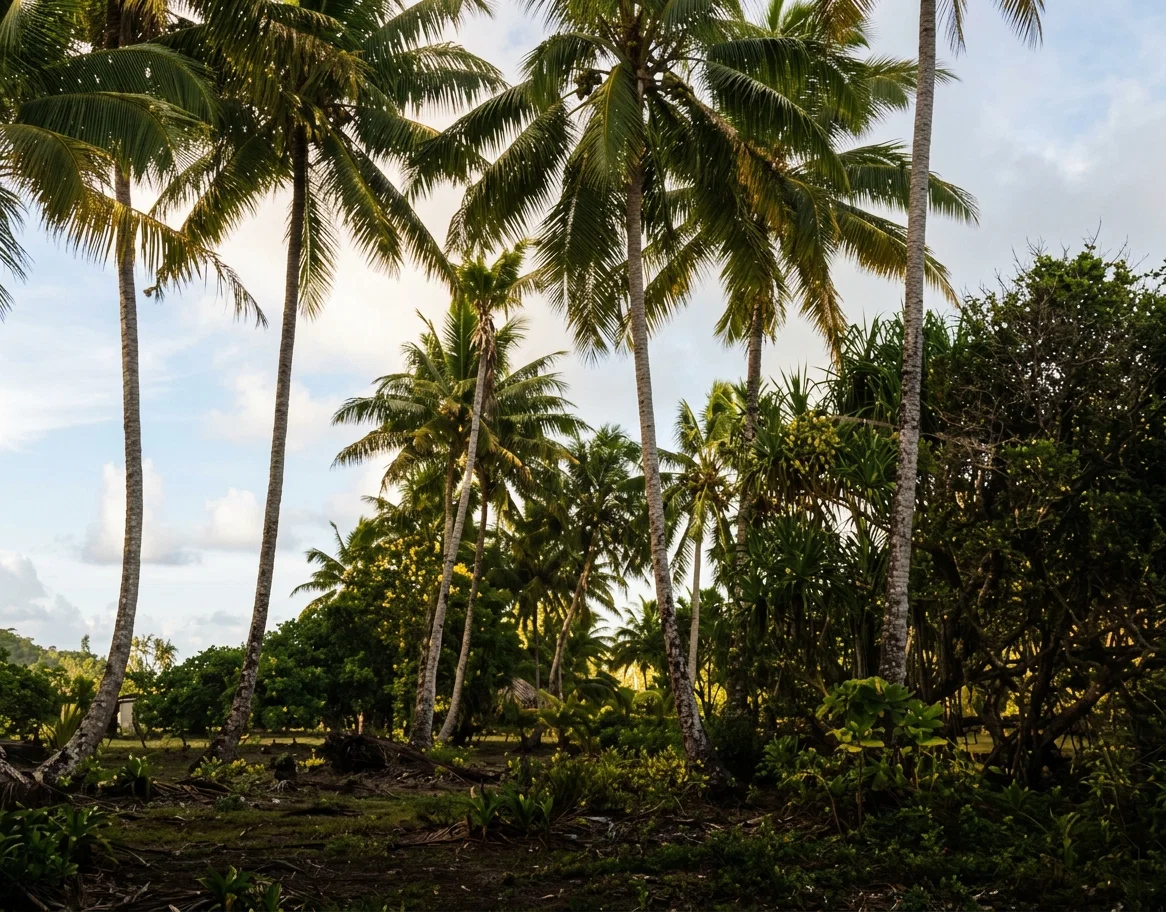
A SCENE IN TUAMOTU
The Society and most of the surrounding islands are high and mountainous, and the mountains are covered with verdure even to the very summit. The most important of the tropical fruits and vegetables may be found here, though we have not as great a variety as have the larger tropical countries. The islands are usually blessed with an abundance of rain, and vegetation grows rapidly and luxuriantly.
But many of the Tuamotu Isles are simply of coral formation, and are so low, and possess so little soil, that but few fruits and vegetables can be raised there. The cocoanut, however, will grow wherever it can find a footing in the sand, and it flourishes upon every island, and is very useful to the people. The Tuamotu natives subsist chiefly upon fish and cocoanuts, using the fish either raw or cooked, except as they are able to buy bread and preserved meats from the store.
The people of the last-mentioned group are nearly all either Roman Catholics or Mormons; both the Salt Lake City and the Reorganized Church of Mormons being represented among them. The Gambier Islanders generally adhere to the Catholic faith, and have not had much labor from other denominations. The natives of the Society and Austral Islands regard themselves as Protestants, and usually make a high profession of Christianity, though possessing but little of the power of godliness. The Marquesas natives still cling to heathenism, with the exception of a very few.
For the past four years, we have had a small steamer, which made monthly trips between Tahiti and the Leeward Society Islands, and also between Tahiti and the Marquesas and some of the Tuamotus, completing these two trips in four weeks. Quite recently, it has begun another trip, taking in the Austral Islands and Mangareva, the principal islands of the Gambiers. It now takes about forty days for it to get around. This affords a good way for our laborers to go back and forth among the islands, and to reach those where the truth has not yet been presented. It also takes us within three hundred miles of Pitcairn Island. A cutter of fifteen tons has recently been procured for the Pitcairn people, which will run between Pitcairn and Mangareva, and occasionally make a trip to Tahiti. We hope this little boat may be run in such a way that it may be a blessing and an honor to the Master's cause. It sailed from Tahiti June 1, bound for Pitcairn Island, with Brother Jones as captain. He does not expect to remain with the boat permanently, but will teach navigation to some of the Pitcairn people, so that they can look after it themselves.