On Dec. 1, 1901, I left Asia Minor. My first visit was to the province of Cilicia. This is the province through which Paul and Silas traveled, confirming the churches. Paul was born in Tarsus, now a city of twelve thousand inhabitants — a mixed population of Turks, Greeks, and Armenians. We have about fifteen church members scattered throughout this province, besides probably ten others who keep the Sabbath.
My labors were chiefly confined to Adana, a city of about fifty thousand inhabitants, near Tarsus, where we have fifteen members — Greeks and Armenians. The company in this city has been frequently persecuted. Last summer seven brethren were arrested and imprisoned for holding meetings on the14Sabbath. Since then they have been compelled, by the existing circumstances, to hold their meetings in different places, sometimes along the river, where they could praise the Lord with perfect freedom. A few had promised the government officials that they would not attend the meetings; but when they heard that I had come, they could not keep their promise any longer, but attended the meetings again.
Our Bible workers and Brother Baharian have frequently had great opposition here. Some have been arrested and imprisoned. The American Protestants — not the Turks — are usually the accusers. Some time ago they passed a resolution not to bury any Sabbath keeper in their cemeteries. Since I left them, two of our brethren died there. One, an Armenian, was buried in the Armenian cemetery; the other, a Greek and former Protestant, was only accepted after long entreaty by his family, who are yet members of the Protestant Church. We were told, however, that he is the last one who will be accepted.
The members had not been visited by any of our laborers for three years, and yet they seemed contented. After five weeks of joyful labor, I had the pleasure of baptizing four souls in the historic Sarus River. I am glad to state that the young Greek sister, who interpreted my lessons from the English into the Turkish, was among this number.
Constantinople
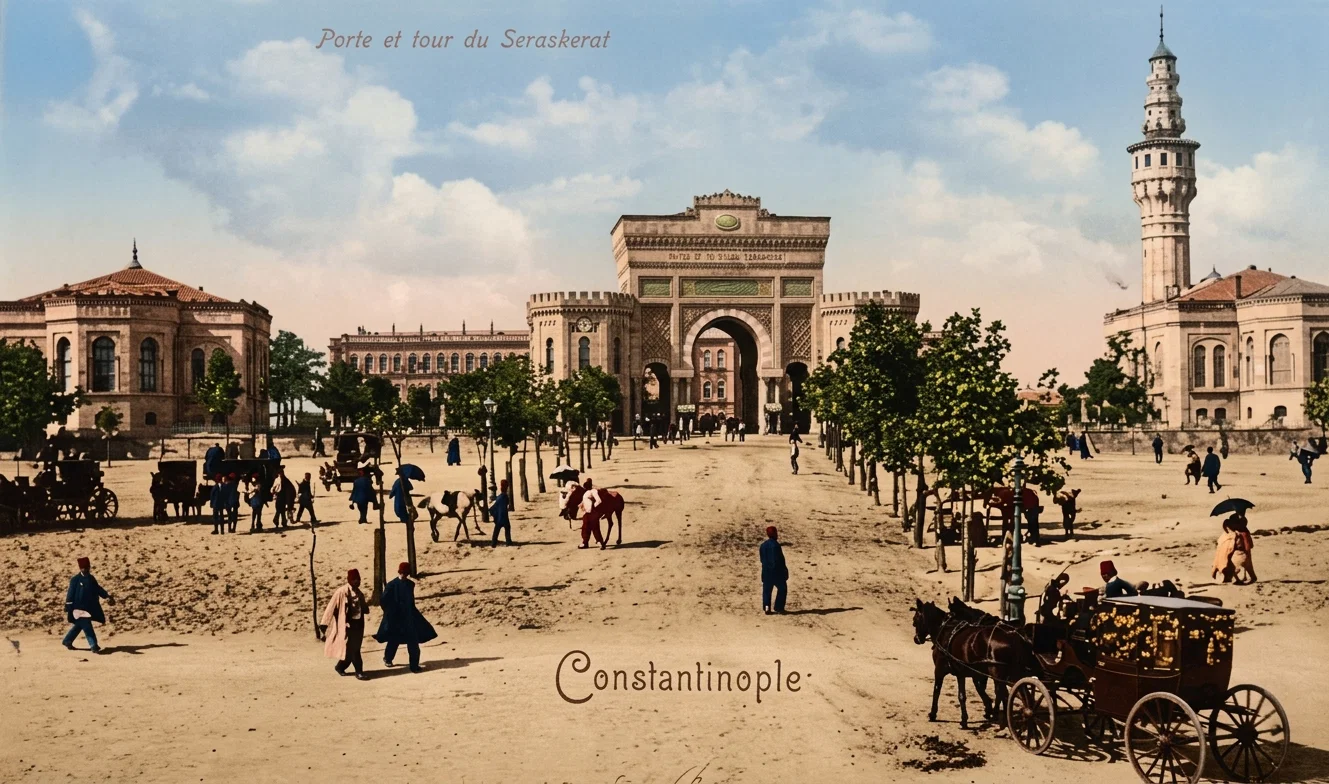
Jan. 31, 1902, I arrived in Constantinople, where I met Brother Baharian for the first time. Owing to the fact that the officials three years ago forbade him to leave the city, and his repeated efforts to do so have met with refusal, it was decided that I should visit our churches in the provinces of Brusa and Bithynia. On the seventh of February, Sister Azniv Inedjian, our medical missionary of Constantinople, accompanied me to Broussa, the first capital of the Osmanlis, as my interpreter. This city is famous for its natural hot baths, and for its large silk industry. There also the beautiful Turkish towels are made. Our church elder and his family, besides other members of our church there, are engaged in weaving different fabrics. We found the believers and many interested friends ready to receive the Word.
After remaining one week, we were permitted to baptize a Greek sister away up in the mountains, where a large spring sends forth its living waters. We also accepted an Armenian sister by vote. From twenty to thirty attended our meetings here.
February 14 we drove in nine hours to an Armenian village called Sellous. At this place the interest was good, as many as one hundred persons attending the meetings, although we have only nine members there. The Spirit of God was at work, and we were encouraged. At this place enemies accused us before the government officials. But before the officers arrived from the neighboring seat of government, we had left for Chenkeler, where one brother resides. On the third day after our departure they also arrived in Chenkeler, and required us to appear before the kaimakam. I politely requested the officer to send his sabdiye down to the kaimakam to request him to allow us to proceed on our journey, as our papers were all right. But after about four hours he returned, accompanied by three officers of higher rank, with the news that we must come down. We arrived there on horseback, after two and one-half hours, and had an interview with the kaimakam, who charged us with preaching a forbidden religion. Of course my Biblical argument availed nothing, as he said that he must obey his instructions. We were politely allowed to live in the hotel until instructions should be received from his superiors. However, there were soldiers watching in the hotel corridor night and day, and when any of us wished to go out, a soldier was sent with us.
On the evening of the second day a telegraph message came, instructing the kaimakam to let us proceed, but accompanied by a soldier, to the next government town, called Yalova. When we arrived there, we tried to proceed to Shagshag, where we have nineteen members. But the officials refused, even after we had appealed to them five times. The next day, being Sabbath, about seven members came down to the hotel where we were stopping, and we improved the time by holding meetings there several days.
On March 4 we took a steamer for Ismed (Nicomedia), the capital of Bithynia, situated near the head of the Gulf of Ismed. The city was the residence of Diocletian. Here he began his persecutions of the Christians; here he afterward abdicated. Constantine frequently visited the city, and it was in his villa in the suburbs that he died. We have four members in this city. When we landed here, our Bibles were taken by the customhouse officials, and not returned until the next day. We held three meetings here with an attendance of thirty-five.
The next day we went across the gulf to the village of Bardizag, where we have a company of intelligent Armenian believers. We remained here ten days, and had a good outside interest. The meetings were attended by from forty to sixty persons.
On the sixteenth of March we left for Ovajik. Owing to a severe snowstorm, the road was dangerous. This part of the country has few driving roads, in fact, much of our journey from village to village was on horseback. At many places wild mountain streams must be crossed with the greatest of precaution. In this village we had the best interest, as many as one hundred and twenty-five people attending our studies. Here the children especially took an active interest, which caused us to rejoice greatly. Some years ago, when the church was organized, Brother Baharian was in danger of his life from the hands of a mob; but from all appearances there are many under conviction now, and we confidently expect a rich harvest of souls there soon.
We left March 24 for the thriving city of Ada Bazar, where we had a company of four. After a week's labor, we baptized four sisters who had been keeping the Sabbath several years. From thence we went to Sari-Dogan, a Greek village, where we have about ten members. We remained about one week, and just before leaving baptized a Greek sister who had also waited a long time to take this step.
We now started on our return trip to Constantinople, stopping over in Yalova, expecting the officials would allow us to go up to Shagshag. But this time they again refused to give us permission. After holding a meeting in the hotel with some sisters who had come, we took the steamer for Constantinople, arriving there April 10. I remained there six days, then started for my home in Jerusalem, and after a delay of five days' quarantine in Beyrout, arrived there, comparatively well, on April 28, after an absence of five months.
From present appearances, Asia Minor is a fruitful field. The Greeks and Armenians there are more religious than their national representatives in Palestine. They are altogether more pliable than the Syrians and Arabs. Apparently persecution has had the effect of keeping them close to the Fountain of all strength. The American Protestants have raised up many churches, and instituted good schools among them.15
Since the Armenian massacres the government has become more vigilant. People wishing to travel from place to place must have a special permit (visa), costing about fifteen cents, and this cannot always be had without the usual back-sheesh. On approaching the ticket office in the railway stations, one's papers are examined before the ticket can be purchased. Likewise, before entering a ship, proper papers must be presented, and all effects are carefully scrutinized.
All books and papers mentioning Turkey are taken, and sometimes confiscated. We cannot print anything until the manuscript has passed through the censor's hands, and been favorably commented upon. On the trains an officer will go through from one end to the other, asking the destination of each passenger, also his name and the name of his father. Our people can easily see how this affects our work, when they take into consideration that our religion has been forbidden in all the country. All passports designate the religion of the bearer.
I have found many promising young people throughout the field. My suggestion would be that we hold an institute for two months in Bithynia, and another for two months in Cilicia, the coming winter; but before this can be done, proper help must be supplied. Medical missionaries could travel about with more freedom than can our ministers. Therefore, canvassers for our medical and religious literature who have a knowledge of both the Bible and the medical missionary work should be trained for this field, before this open door shall be closed to us.