A Visit to Egypt

4%

Seventh-day Adventist Publishing Association · Battle Creek, Mich. · Jun 10, 1902

FromReview and Herald, Vol. 79, No. 23.

Read the full edition

A Visit to Egypt

L. R. CONRADI
On the morning of November 29, Brethren Krum and Jespersson and I went by train from Jerusalem to Jaffa to counsel with Brother Hörner about the mission there. I was glad to find the sea so quiet that I could leave that afternoon for Port Said, Egypt. Elder Krum had to remain a few days to catch the boat for the north, and then it became so stormy that the vessel had to leave for Beirut, before it could finish taking on cargo, and return to Jaffa again. It requires but one night to go from Jaffa to Port Said.
As we entered the canal at Port Said, the quarantine officers came out, and all the dirty clothes and blankets in the baggage had first to undergo a process of disinfection, but the superficial manner in which this was conducted is shown by the fact that only one of my two blankets was taken. Naturally, we had to pay a fee for the disinfection. As we entered Port Said, we could see that things were managed by an altogether different government. As our readers may know, Egypt is now an English protectorate. Although there is a force of but twelve thousand soldiers here, yet they are able to rule this country with its twenty millions of people. The English lord is the real ruler, and not the Egyptian khedive. They have a fine harbor at Port Said, and the city is well kept. Here I again found well-dressed policemen, and any one may read the daily news, there being freedom of the press.
The train leaving Port Said in the evening followed up the canal to Ismailia, a distance of fifty miles on the narrow gauge road, and then one here takes the broad gauge to Cairo, ninety-three miles distant, traversing a part of the Goshen of the Bible.
On my arrival in Cairo, I was glad to meet Brethren Passebois and Awada and our two Armenian brethren. I was at once conducted to the health home, where we carry on a vegetarian restaurant, which is situated in the center of the city, only a few minutes’ walk from the post office. In the basement is the depository of the British and Foreign Bible Society. We have the second story. At the earnest solicitation of some German merchants residing in the city, who promised speedily to secure sufficient boarders to keep the institution going, Brother Passebois opened this vegetarian home, and I was glad to see fifteen young men from all parts of the German empire, enjoying our well-supplied and richly spread table. Three of these room in the house, and so the mission prospers financially. This work really opened the way for us to have a good place for Bible readings right in the very heart of the city.
Cairo has a population of about six hundred thousand, among whom are thirty-five thousand Europeans. For the most part, the population is made up of Egypto-Arabians (townspeople), Fellah settlers, Berbers, Copts, Turks, and Jews, as well as a sprinkling of negroes, and Northern Africans, Bedouins, Syrians, Persians, Indians, and other Oriental peoples. Cairo is by far the largest city in all Africa. It has some nice streets and buildings. One of its peculiarities is its bazaars, located in narrow lanes, and generally shaded by an awning to keep out the sun. These shops are about six feet wide, and open toward the street. Some of the artisans do most skillful work with the most primitive tools. I noticed that the turners, for instance, can use their feet and toes as nimbly as they can use their hands and fingers.
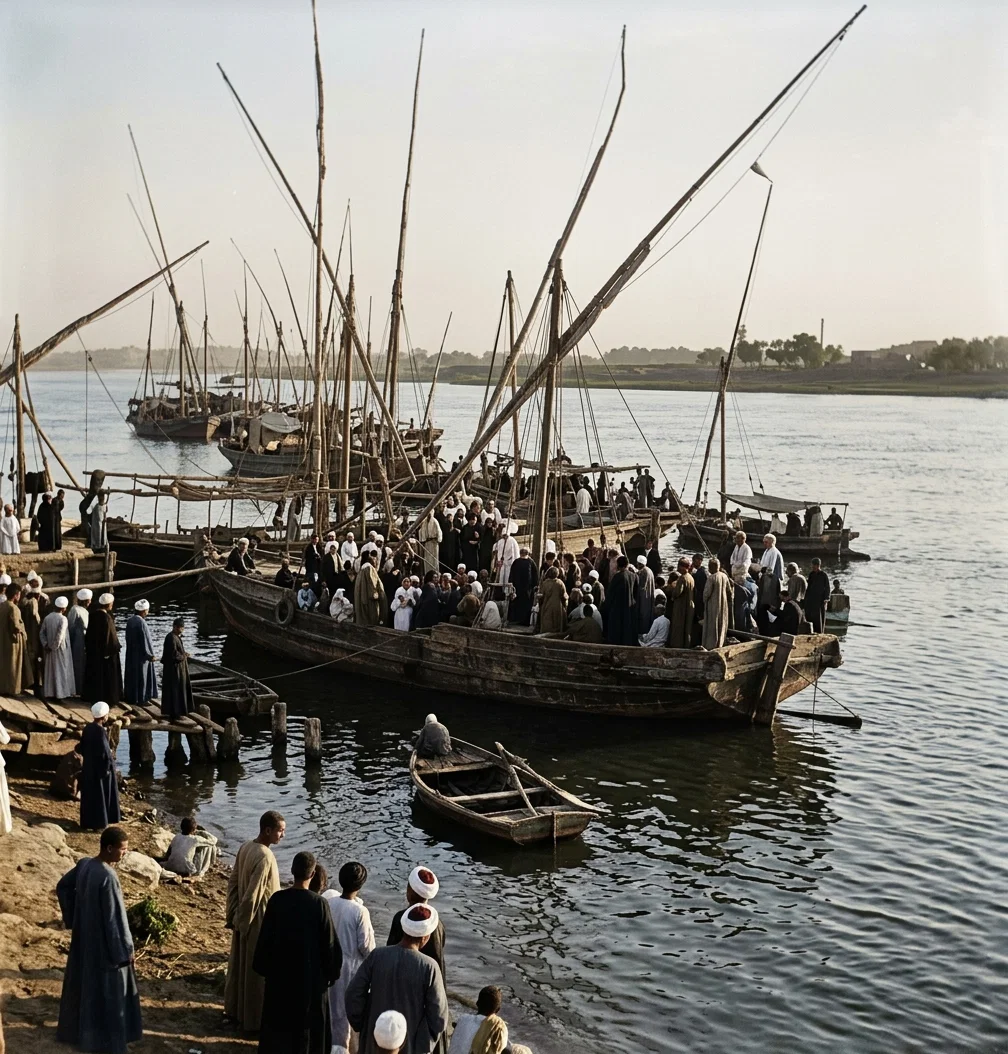
ASSEMBLED FOR BAPTISM
While in Cairo, we had meetings almost every night, speaking in English, which was translated into Armenian by one brother, and into Arabic by another. Twelve Armenian Sabbath keepers, and Elder Awada and his wife (Copts), who had been working for the American Presbyterian mission for eleven years, were present, and he translated into the Arabic. Sabbath, December 13, was an excellent day for us. During the preceding week, I had been holding meetings with the candidates, preparing them for baptism. Sabbath we filled a tram (as there were thirty of us), and went to the River Nile, where we had secured one of the small sailboats that ply to and fro on the river, to be used as dressing rooms in connection with the preparations preceding the service. It was a beautiful day, and I baptized twelve. One aged brother who had kept the Sabbath, and paid his tithe faithfully for two years, but was not able to leave off the disgusting tobacco habit, wept bitterly as he saw them, one by one, going down into the watery grave, while he himself was left behind. And, the solemn ceremony being over, he stepped up to me, and said that, by the help of the Lord, he would gain the victory over the filthy weed, and a few weeks later Brother Passebois baptized him also. We organized a church in Cairo, with Brother Passebois as elder.
While at Cairo, we went out one day to visit the pyramids, those mighty sepulchers of the ancient kings. I also paid a visit to the mosque Gami’a el-Azhar, which was converted into a university in A. D. 988. The sanctuary, with its nine aisles, now forms the upper hall of instruction, and has one hundred and forty marble columns, and covers an area of thirty-six thousand square yards. The subsidiary buildings are divided into separate chambers for the use of the natives from a particular country or province of Egypt. Most of the students are natives of Egypt. At the last census, the mosque was accommodating 6,923 students. Before the English occupied the country, there were sometimes as many as 7,700 students in attendance. The pupils sit crosslegged on the ground, in little groups around their teachers. A great part of their task is to learn the Koran by heart; and while thus engaged, they continually swing their bodies to and fro,—a most peculiar sight,—and as they do this, they repeat certain portions of the Koran. Most of these students go forth as fanatic missionaries to Africa and Asia.
As the home of Elder Awada was at Luxor, four hundred and eighteen miles south of Cairo, he was anxious that we should go there to see the country, and visit several interested persons. The railroad kindly granted us half-fare permits, a concession which we had not enjoyed since we left the United States. All the way, one could see the entire width of Egypt, composed of only the Nile Valley, from twelve to thirty-one miles wide, flanked on either side with high hills, beyond which stretches the sandy desert, and from which the fine sand continually drifts into the valley, even penetrating the closed apartments of the cars. All along the road we could see the people, busy irrigating the country, a basket filled with water being swung on a rope between two laborers. The density of the population of the Nile Valley is indeed wonderful. If one takes only the arable area into account, it has a population of seven hundred and fifty per square mile, a density unequaled by any other country.
Leaving Cairo at night, we reached Assiut very early in the morning. Thiscity, with a population of forty-two thousand, is the capital of Upper Egypt. It is also the chief station of the American Presbyterians, who have quite a school here.
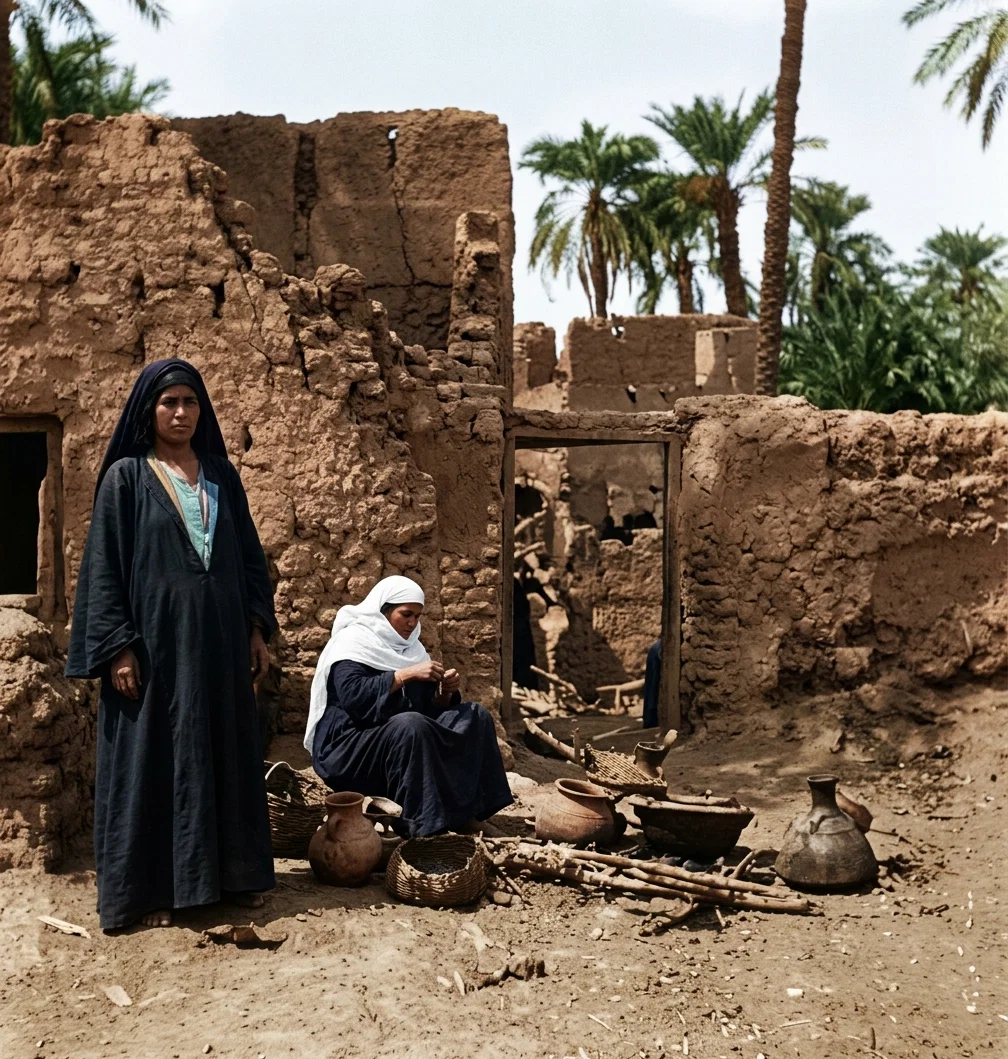
EGYPTIAN VILLAGE WOMEN
We next went to El ’Matia, a small village in which Elder Awada’s brother lived. At this place we saw something of Egyptian village life. One thing peculiar is the large pigeon houses in which huge flocks of pigeons are kept, simply for the sake of their droppings, which is the only manure used in the fields, as the dung of the cattle is dried and used as fuel. But inasmuch as the pigeons consume really more than they produce, they are a loss rather than a gain to their owners.
It being Sunday morning, a number of friends soon called to greet the strangers, and they began to inquire with reference to our belief. Here we went to a Coptic church, quite a large building, the only furniture being mats placed on the floor, on which we all had to squat down. As we were obliged to rise to greet every stranger as he entered, the process became somewhat like a gymnastic exercise. One other peculiarity I noticed was that there was not a female visible in the church. About a fourth of the place was fenced off for the women, from behind which they could peep out through small holes. We talked a while to those assembled, but their service was rather formal in its nature. They partook of the Lord’s supper. One gentleman came quite a ways to meet us, and we had a long and interesting conversation with him.
In order to catch the fast train in the evening, we put our things on a camel, some of the brethren also riding on the animal, while we preferred to return to Assiut on foot. Elder Awada had told us that there was a postmaster a hundred miles south, at Farshut, who was anxious to see us; but as our time was limited, we hardly saw our way clear to stop there. Being tired, as we had had but little sleep the night before, we reached Farshut before we were aware of it, and were awakened by hearing some one knocking at the car window. When we opened the window, a gentleman told us to hurry out, and stop there. But upon offering objections, we learned to our astonishment that our baggage had been taken from the train already, so we had to follow.
Farshut is a town of about fifteen thousand inhabitants, and the postmaster told us that there was not even one physician in the whole place. He took us to his house, and not until morning were we able to retire, he asked so many questions, and was so deeply interested. Before retiring, we sought the Lord together, and in his prayer he promised to give himself fully to the Lord’s service. Although we had supper and breakfast in the house, and were lodged there, and met the gentleman of the house, his children, and his servants, yet one person we did not see—his wife. Even in a Christian family like this, the women are secluded from the men. The only way to reach them is for the missionary’s wife to accompany him. The Orient surely presents a great field for the labors of the Bible woman.
Next day we proceeded to Luxor, so noted for the ancient temples lying on both sides of the Nile,—Luxor and Karnak being on the right side and Thebes on the left. When we reached Luxor, we found the town and the station with flags and banners flying, and decorated in the finest style. The khedive had paid a visit to Khartum in the Sudan, and was expected back the next day on a steamer stopping at Luxor. As we were anxious to see some of the ruins of these noted temples, especially of Thebes, we arranged to go across the Nile that night. As Elder Awada had been pastor of the church at Luxor for many years, the elder of the company at Thebes, across the Nile, came over in the evening to see us. Being well acquainted with the country, they secured a boat which took us across the river by moonlight.
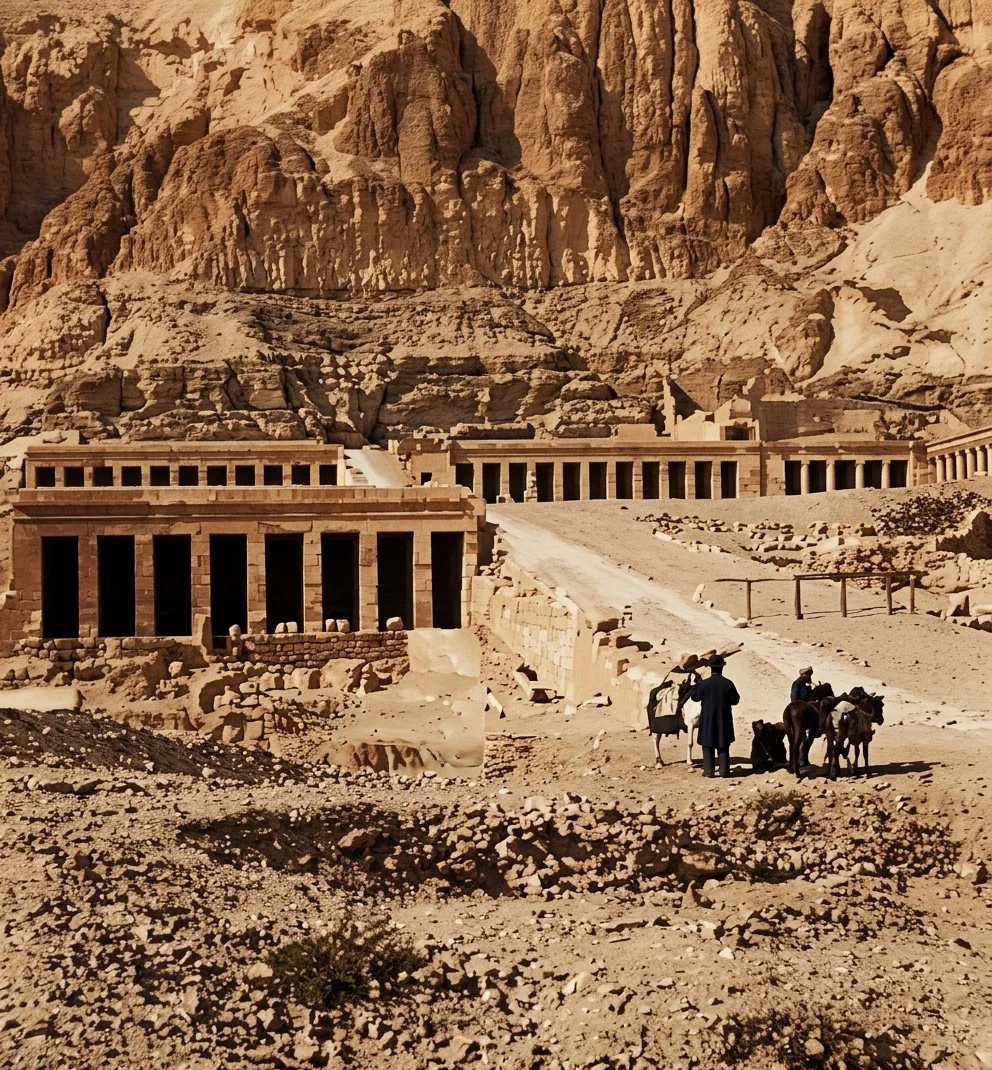
Thebes, the city of the dead, contains a number of temples, some of which date as far back as the time of Moses. They are most wonderful buildings, some of them being five hundred feet long and one hundred and fifty feet wide, all covered with hieroglyphics, and drawings picturing the life of the people of that time. One peculiar thing I noticed everywhere was that on nearly every pillar or column was a picture of the sun. In fact, all the pictures I could see testified to sun worship. The temple of Der el-Bahri, called Zoserzoru, or The Most Splendid of All, by the Egyptians, especially attracted my attention. From the picture, the reader may obtain some idea of the greatness of this temple, which is erected in the rocks, giving it a wonderful background. It occupies three terraces, one above the other. Some of the chambers have been wonderfully preserved. It is only a few years since the structure has been fully unearthed from the sands with which it was buried. Here I saw an altar dedicated to the sun, in an excellent state of preservation. Everywhere on the walls one may see pictures referring to sun worship. In the Ramesseum lie the remains of the colossus of Rameses II, the highest statue in Egypt, the total height of which was fifty-seven feet, with an aggregate weight of over two million pounds. We did not have sufficient time to visit the tombs of the kings and queens in the mountains near by. On our way back, we passed the two colossi of Memnon, each about sixty feet in height. They were formerly adorned with crowns. The size of these statues may be better conceived if we state that the middle finger on each one is about four and one-half feet long.
THE TEMPLE OF DER EL-BAHRI
We also visited Karnak, a little to the north of Luxor. Before one reaches these wonderful temples, he must pass a large avenue of sphinxes. The ruins of these splendid temples at Karnak are immense. Excavations are still being carried on, and new treasures are being constantly unearthed. Here I saw, engraved in stone, the history of the Bible. The triumphal monument of Sheshonk I, the Shishak of the Bible, commemorates the victory won by Shishak over Rehoboam, son of Solomon, king of Judah. “The large form of Ammon, wearing the double crown, appears to the left, grasping in his right hand the sword of victory, and in his left cords binding five rows of captives taken in Palestine.” The Bible passages referred to are1 Kings 14: 25, 26; 2 Chron. 12: 2, 4, 9. One may here find single halls of sufficient size to inclose some of our largest churches.
But we will not stop too long on these wonderful ruins of Thebes, with its hundred gates of old. Its splendor is gone. And we are glad that the temples of the idolatrous worship of the sun, as mighty as they were, are now but a heap of ruins. But brighter than all their former glory, is the Sun of Righteousness, who is again to enlighten darkened Egypt with the bright rays of the everlasting gospel.
As we had to leave that night for Cairo, we missed the arrival of the khedive, but we saw not only thousands assembled here from different portions of Egypt, but quite a number of Sudanese carrying on their wild dances.
Upon our return to Cairo, Elder Awada was ordained to the ministry. He is our first minister in the Arabic, and we hope the Lord may bless his labors to the salvation of many souls.
From Cairo we were accompanied by Brother Passebois to Alexandria, crossing the rich delta of the Nile. Alexandria is a beautiful city of about three hundred thousand inhabitants. It contains a large number of Italians. Its founder was Alexander the Great. Two faithful Armenian brethren have come from Constantinople to labor here. We had several Bible studies at their home, and celebrated the Lord’s supper.
The evening of the 24th I sailed from Alexandria on the Austrian Lloyd steamer “Bohemia.” But as the plague was still raging in Egypt, I had to undergo a careful examination at the hands of the physician before leaving. The following evening we came in sight of Crete, where Paul stopped on his journey to Rome, and the next day we saw the mountains of Greece and the Ionian Isles. There are millions in these countries without a laborer, and they need to be warned. As we entered the Adriatic, the weather became more stormy. And after three days and a half on the journey, the climate suddenly changed from the hot sun of Egypt to the icy air of the Alps. Arriving at Triest, we were all carefully examined by the doctor, and each was obliged to tell him where he was going. Twenty-four hours on the cars took me through the southern portion of Austria, where the German language is quite largely used. Whole provinces there, with a million or more of inhabitants, have not yet seen one of our ministers. Reaching Vienna, the police were still on the lookout for me, being notified by telegram that a man was coming from Egypt, and after they saw that I was well, they let me pass quietly by. I was glad indeed to reach home, after an absence of three and one-half months, having traveled thousands of miles by land and sea, in three different continents. Surely the Lord is good, and to be praised for his protecting care in granting us the privilege of carrying the gospel of the soon-coming Saviour, to the ends of the world.