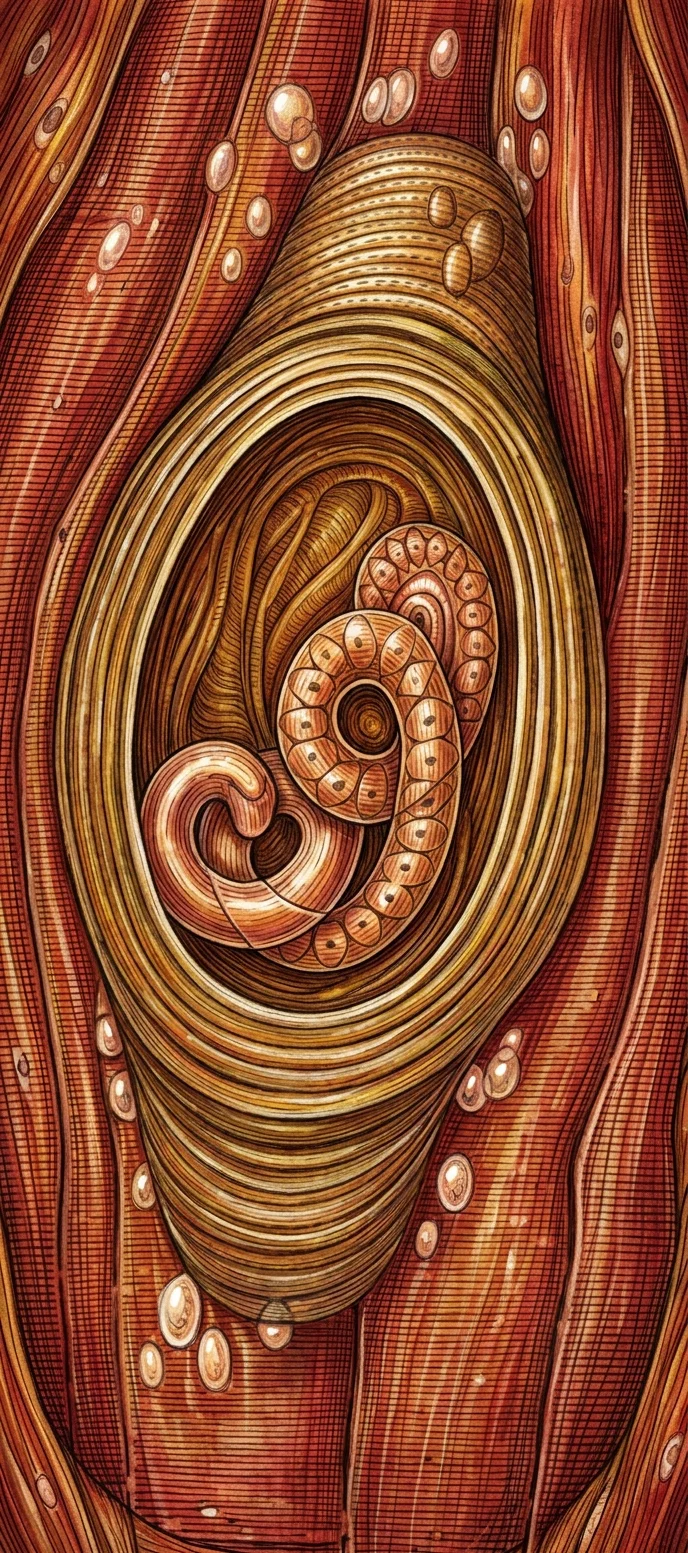
Now, my friend, assist your eyesight by a good microscope and you will be convinced that you have only just caught a glimpse of the enormous filthiness, the inherent badness, and intrinsic ugliness of this loathsome animal. Take a thin slice of the lean flesh, place it upon the stage of your microscope, adjust the eye-piece, and look. If you are fortunate, you will find displayed before your eyes hundreds of voracious little animals, each coiled up in its little cell, waiting for an opportunity to escape from its prison walls and begin its destined work of devastation. A gentleman of eminence in Louisville has made very extensive researches upon the subject, and asserts that in at least one hog out of every ten these creatures may be found.
A few weeks ago we obtained a small portion of the flesh of an individual that had died with trichinæ. Upon subjecting it to a careful microscopical examination with a good instrument, we discovered multitudes of the worms. Each individual presented the appearance represented in the accompanying accurate engraving, which we have published before, but reproduce for the sake of our new subscribers. The animal is here seen inclosed in a little cyst, or sack.
Being curious to know, approximately, how numerous were the worms in the specimen we were examining, we prepared a small portion about the size of a kernel of wheat in a suitable manner. By careful count, we found upwards of 500; and in a large portion of the specimen they lay so thickly together that it was impossible to isolate them. None but solitary individuals were included; and hence it is fairly presumed that the specimen really contained double the number actually counted. A little computation will show that the flesh of the individual furnishing the specimen must have contained from 250,000 to 500,000 trichinæ in every cubic inch of muscle.
HOW TRICHINÆ KILL.
When taken into the stomach, the trichina is invested by a capsule like the one seen in the engraving, a portion of which has been cut away to show the worm more clearly. This fibrous capsule is very soon dissolved away by the gastric juice, thus setting at liberty the partially matured worm, which grows very rapidly, attaining its full size in about two days, being then many times larger than when first taken into the stomach, when its length is only about one twenty-fifth of an inch. In about a week each worm gives birth to about 1000 young, according to Leuckart, which immediately begin to penetrate the mucous lining of the stomach and intestines. This gives rise to violent purging and vomiting, but to little effect for the relief of the patient, for the worms are already secure in the walls of the intestines. In a very short time they find their way into all the muscles of the body, when the most painful symptoms occur. The patient lingers along for a few days, perhaps weeks, in the most distressing suffering, finally dying from exhaustion, or from suffocation caused by the great number of parasites infesting the muscles of respiration and thus preventing their action.
In less than two weeks after eating an ounce of infected meat a person might have in his intestines hundreds of millions of these rapacious animals, whose ravages no remedy can stay. Imagine, reader, the agony which a person must suffer while this numberless horde of microscopic serpents are boring through the walls of his alimentary canal! The rapidity with which the body becomes filled with these loathsome creatures is most astonishing. Prof. Dalton found 208,000 to the cubic inch in the muscles of a boy who died on the twentieth day after being attacked with the disease. When a person has been once poisoned, he can never become free from the parasite. Death is his most probable end; but some survive after many months of suffering worse than death. In these cases the worm becomes inclosed in a calcareous sheath, which process takes place in from one to two years. Here they may live for an indefinite period, probably as long as the patient. Virchow mentions a case in which they were found alive in a cancer removed from a woman twenty-four years after they were received into her system.
While writing this article, we have before us a portion of muscle which we removed in an autopsical examination from the deltoid muscle of a woman who died in New York City a few days ago. Upon carefully inspecting it with the naked eye, numerous little white dots may be seen in the small fibers of the muscle. Upon examination with a microscope, these minute white bodies are found to be opaque, like a fine particle from a broken egg shell; but by adding dilute hydrochloric acid, the calcareous salts are dissolved and we are enabled to distinguish a veritable trichina, looking as well developed and vigorous as those found in the preceding specimen, already described, although they have doubtless existed for several years in their present state. Just how long we cannot state, having not yet been able to obtain the previous history of the case.
ITS PREVALENCE IN SWINE.
The trichina is found in cats, rats, mice, and various other animals, as well as in the hog, and it is probable that they are introduced into the latter by eating the dead bodies of the first-mentioned animals. It seems to be the general belief that the disease is of rare occurrence in hogs, and need excite no apprehension. Various facts disprove this supposition, however. It should be remembered that the flesh of an infected animal may be apparently healthy to the unassisted eye, for the trichinæ are microscopic objects, often being no more than one seventy-third of an inch in length, and one nine hundred and sixtieth of an inch in transverse diameter. Careful observations have been conducted by scientific men to ascertain the frequency of the disease by examination of the dead carcasses sent to market. A committee of the Chicago Academy of Sciences reported in the Medical News and Library for June, 1866, that in 1394 hogs examined in different packing houses and butcher shops of the city, they found an average of one in fifty affected with trichinæ. A gentleman of Louisville reported, as the result of extensive observations, that he found an average of one trichinous hog in every ten examined.
It was a current newspaper report that during the winter of 1873-4 between 10,000 and 15,000 hogs died of the disease in a single locality in Illinois. This report has since been disputed, it being alleged that the disease was hog cholera, instead of trichina poisoning, or trichinosis. This is merely crafty effort at deception on the part of the pork dealers; for we have good authority for believing that hog cholera and trichinosis are two names for a single disease. The first effects of trichinæ are very similar to the effects of cholera, and might easily be mistaken for it in man or beast, as both are affected in a similar manner.
FREQUENCY OF THE DISEASE IN MAN.
Until recently, there has been no conception of the frequency of this disease. It is now positively known that many cases of supposed typhoid fever are really the results of trichinæ poisoning. Prof. Janeway, Demonstrator of Anatomy at Bellevue Hospital, recently assured me that observations in the dissecting room had convinced him that the3disease was of great frequency, not being discovered until revealed by post-mortem examination, the patient being treated for some other supposed affection. He found three cases thus affected in the short space of one month; and it is probable that the majority go undetected.
Trichinosis may simulate numerous diseases. In the first stages it would readily be mistaken for diarrhea, dysentery, or peritonitis. The later stages as closely resemble rheumatism and typhoid fever. The patient often dies in coma, the cause of which would be likely to be attributed to almost any cause but the real one.
Many unmistakable cases of the disease have occurred within the last ten years since public attention has been called to it. I recently conversed with a physician who last winter attended eight cases of the disease in a single family in Malcolm, Iowa. Several members of the family died in a few weeks. The remainder of the family survived, but only to continue suffering. None of them have regained their health.
In Helstadt, Prussia, one hundred and three persons were poisoned by eating sausage at a public dinner. A large number of them died in a short time, twenty within a month.
In Germany, three hundred and sixty persons were attacked with the disease at one time. Large numbers of them perished miserably. Those who survived were doomed to carry about in their flesh, during the remainder of their miserable life, myriads of loathsome worms.—J. H. K., in The Health Reformer.