In Northwestern Rhodesia

8%

Review and Herald Publishing Association · Takoma Park Station, Washington, D. C. · Dec 31, 1914

FromReview and Herald, Vol. 91, No. 55.

Read the full edition

In Northwestern Rhodesia

W. B. WHITE
I RECENTLY had the privilege, in company with Elder H. J. Edmed and Dr. W. C. Dunscombe, of visiting our mission station in Northwestern Rhodesia, superintended by Elder W. H. Anderson. This station is located on a five-thousand-acre farm, eight miles from Monze Siding and about two hundred miles north of Victoria Falls, on the Zambesi River. The country about the mission farm is gently rolling, with good soil and plenty of wood and water, things greatly to be prized in a new and undeveloped country. As we looked over the mission farm, with its five thousand acres of splendid pasture land, its wonderful and never-failing spring, and the seventy-five acres of fertile black soil about it, with plenty of wood for future needs, we quickly came to the conclusion that as far as a farm is concerned, Brother Anderson made no mistake in selecting this land.
The farm cost the General Conference eighteen cents an acre, but not long ago Brother Anderson was offered $4,500 for the property, which indicates something of the rise in real estate in this region.
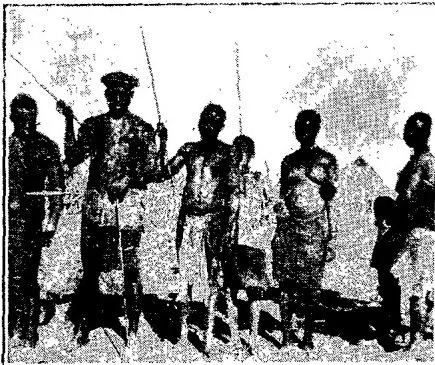
Savages of village near our Batonga Mission. These are as they appear in their kraals in their heathenism.
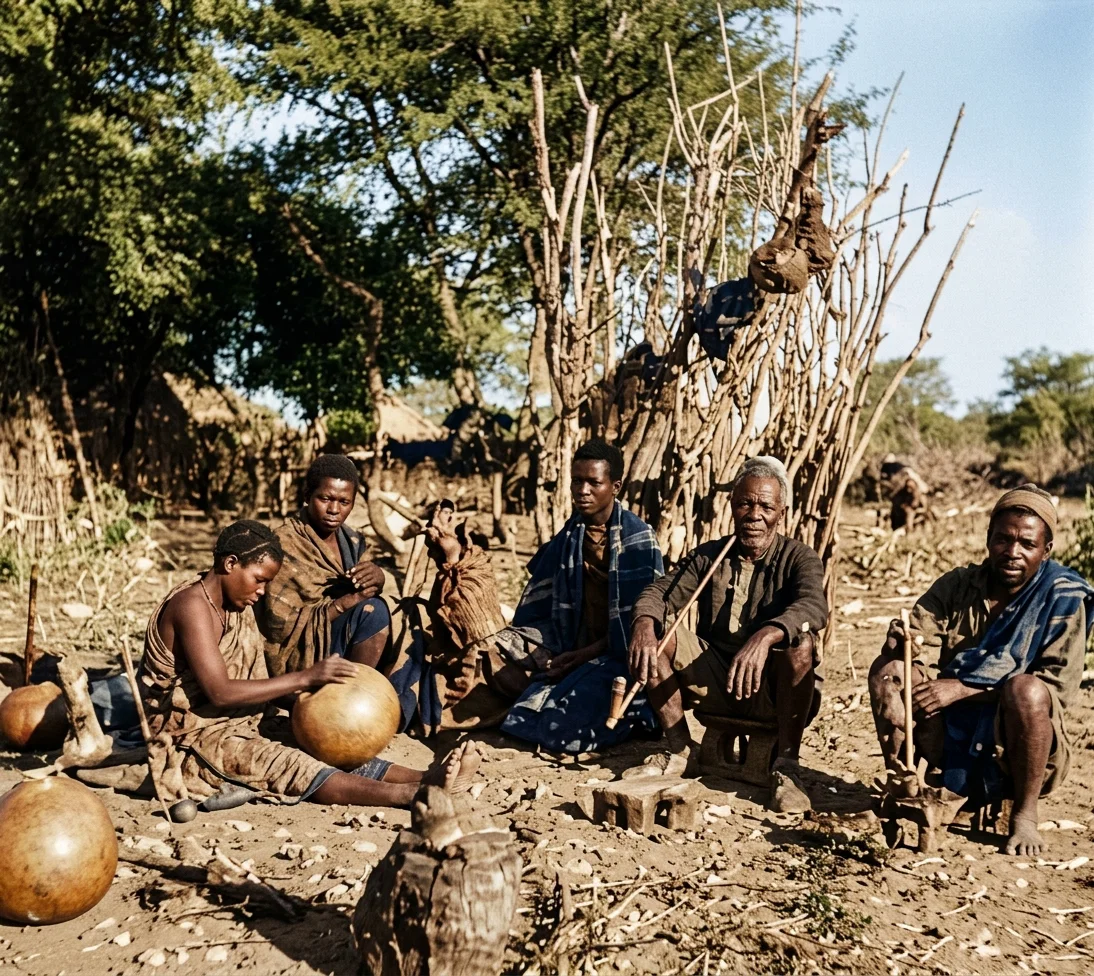
Natives at home. Notice old man with long pipe resting on a stool made from solid piece of wood. Also woman at left churning by rolling calabash across her lap.
We should not judge that the nativepopulation in the immediate vicinity of the mission was very dense, though there are a few native villages near by. These we visited, and found the people for the most part living in the dense darkness of heathenism, very near to nature. Advocates of the simple life would find it here to perfection. We wish the readers of the REVIEW could take a peep into one of these native villages, which is untouched by gospel and educational influences. It is a sight long to be remembered. We shall not attempt to describe it here, but only say that in the matter of living, there is not much distinction made between the native and his goats, hens, dogs, and pigs. All seem to have the inalienable right to occupy the same room, which right they exercise to the fullest extent. Dirt and filth are everywhere, the clothing worn never has seen a washtub, many of the children are stark naked, but little clothing is worn by the older ones, and their way of doing things is most primitive. What a contrast these heathen villages present to the villages of our Christian believers on the Malamulo farm in Nyasaland, where, under the Christian influence of our school and church and the persuasive and directing labor of Miss Edie, the natives keep themselves comparatively clean, yards are nicely swept, and lawns and flower beds grace the front yards. Surely this is a needy people, who never have had the privileges we have enjoyed, who never have had the light that has been shining upon us; but we are sure that many in the homeland are receiving such an infilling of the love of God that they will be willing to come to this dark land, to live, labor, and die if need be, that some of Africa’s sons and daughters may find a place in the kingdom of God.
In some respects this station has had quite a struggle to live and do the work for which it was established. It is well located, and the natives in Batongaland need what we have to give them; but so many of our white workers who have come to this place have suffered with malaria that it has seriously retarded the work of extension, even though open doors were on every side. Surely courage and faith have been in the hearts of Brother and Sister Anderson or they long ago would have become discouraged. The decisions of modern research on the question of malaria are practically unanimous that it is caused by the bite of the mosquito, and is carried in no other way. So it seemed to us that the best thing to do was to destroy at once the breeding places of this insect about the station, and especially near the houses of the missionaries. In the council held at this time, it was decided to clear away the tropical jungle about the great spring, which affords an excellent breeding place for the mosquito, and keep this ground under cultivation, and, as soon as possible, to tile and cover the open watercourses; and, further, that the grass land about the homes of the workers be broken up and cultivated for at least five hundred yards from the houses, and that all trees on this tract be cut down; also that the porches be screened, and a screen porch be placed in front of the schoolhouse where the night school is held. We presume this work is now in progress, and we trust that the results may be beneficial. The school is not large, numbering about twenty-two, but there seems to be a good interest, and we look for a larger attendance next year.
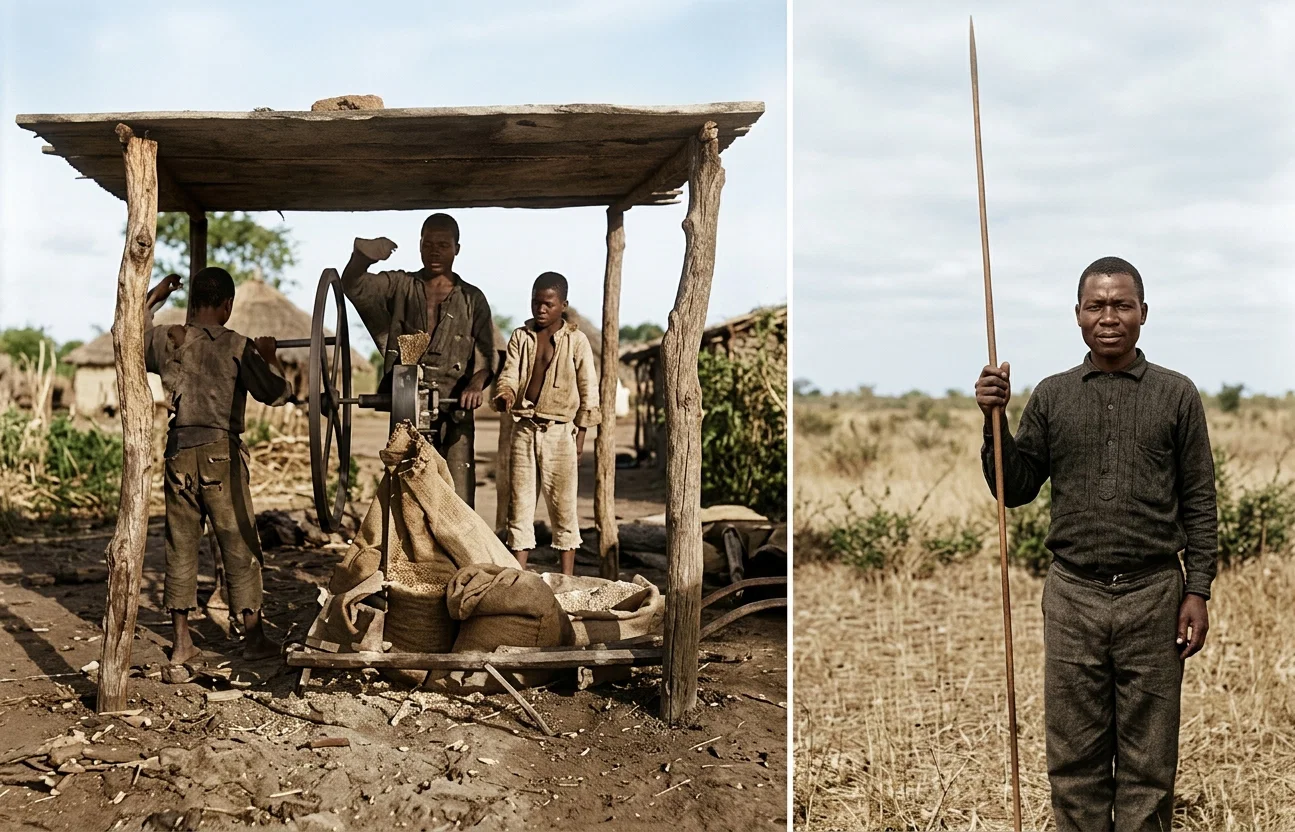
Batonga boys at work grinding corn. From this meal the staple article of food is made. Native teacher in charge of out-school where lions stampeded the cattle.
The mission has a herd of fine cattle, which is increasing each year and is not troubled much with stock diseases, though occasionally there is a loss. The night we reached the station, two lions broke into the cattle yard at one of the outstations about forty miles away, stampeded the cattle, causing them to break out and scatter. In the mêlée an ox and a cow were caught, killed, and partially eaten. A native, armed only with a spear, was in charge of the station; so the beasts had about their own way. So many wild animals prowl about at night that it seems almost impossible to raise fowls, as they are soon captured by these pests.
We spent a week at this station, and thoroughly enjoyed every moment. Several council meetings were held, Bible readings given, and the surrounding villages visited. On the Sabbath the schoolhouse was fairly well filled with people from the neighboring kraals, and a strange crowd it was that gathered that day. It certainly surpassed anything I had ever seen. An old chief of the neighborhood was present and occupied the front seat. I tried to tell the people of the better land than this, and that soon, if faithful, we shall go there; but I fear the sermon did not do much good, for after the meeting I learned that some weeks before this the native commissioner had visited this people in their villages and told them that before long they would have to move to a reservation which was being prepared for them, assuring them that it was a better land than the one they were living in. But the natives do not want to go; so when I mentioned the better land and told them that all the good people would soon be there, they came at once to the conclusion that I was working hand in hand with the government for their removal, and of course did not like the idea. After the meeting was over, the old chief said he did not want to go to the better land; the rest could go if they wished, but he wanted to stay where he was.
The bringing of this people out of their heathenism and superstition and into harmony with the divine will is certainly a great work, and can be accomplished only by the mighty power of God. Surely the workers who are called to labor in these frontier fields need the earnest prayers of the church in their behalf. That God is to work a great work in Africa we have not the least doubt, and we are glad we can have a part in it.