The Papacy in Prophecy

1%

Review and Herald Publishing Association · Takoma Park, Washington, D. C. · Sep 13, 1915

FromReview and Herald, Vol. 92, No. 45.

Read the full edition

The Papacy in Prophecy

The Little Horn of Daniel’s Second Vision a Symbol of Ecclesiastical Rome

By W. W. Prescott
In the book of Daniel there are three lines of symbolic prophecy which trace the history of the world from the time of Babylon to the setting up of the everlasting kingdom of God. In Nebuchadnezzar’s dream of the great image and the authoritative interpretation of it (Dan. 2: 31-45) we have a brief outline of the course of world empire, culminating in the establishment of the fifth kingdom—that kingdom which will stand forever. This is the basic prophecy which serves as the divine background for all other predictions.
In the vision recorded in the seventh chapter of Daniel the world’s history is again outlined, but for a different purpose. In the prophecy of the second chapter the aim is to show that the effort to establish a universal and permanent kingdom of this world will end in failure, and that the eternal purpose of God to restore all things in Christ and to reestablish a reign of righteousness in this world, long cursed with sin, will be realized. In the prophecy of the seventh chapter a revelation is made of the plan to establish upon this earth a kingdom of a different kind after the fall of Babylon, Medo-Persia, Greece, and Rome had demonstrated the failure of the long-continued effort to establish a world-wide rule under the inspiration and direction of the god of this world.

The Great Controversy

This view of these two prophecies will perhaps be more clearly understood by referring briefly to some scriptures which throw light on the great controversy for the possession of this world. Even the devil understood that the purpose of Christ’s work was to win back this world to its allegiance to the government of God, and he therefore sought to defeat this plan by a spurious offer to give to the Son of God dominion over all the kingdoms of the world (Luke 4: 5, 6), in return for his allegiance and his acknowledgment of the devil’s right to rule. In opposition to this purpose of the gospel of Christ is the avowed determination of Lucifer to establish his kingdom in the earth in open rebellion against God. This purpose is thus clearly revealed:—
“How art thou fallen from heaven, O Lucifer, son of the morning! how art thou cut down to the ground, which didst weaken the nations! For thou hast said in thine heart, I will ascend into heaven, I will exalt my throne above the stars of God: I will sit also upon the mount of the congregation, in the sides of the north: I will ascend above the heights of the clouds; I will be like the Most High.” Isa. 14: 12-14.
A reading of verses 4-23 of this chapter will show that Lucifer, who was originally the light bearer but became Satan, the adversary, by his rebellion, was the invisible king of Babylon; and the greatness of this ancient monarchy was but the outward expression of an effort on the part of the god of this world to establish his dominion upon this planet and defeat God’s plan to save the world. Although Satan gained his foothold here by deception and by Adam’s betrayal of trust, yet even the Son of God recognized him as the “prince of this world” (John 12: 31; 14: 30; 16: 11), and inspiration refers to him as the “god of this world” (2 Cor. 4: 4).

The End of World Monarchy

The supreme effort of “the prince of this world” to establish his rule in the earth was put forth in the days of the fourth kingdom—the iron monarchy of Rome. With the most extensive sway, with the most arbitrary and undisputed power, and with an idolatrous religion controlling every phase of human life and enforced by governmental power, Rome presented the most perfect picture of a government by the god of this world. By enforcing false worship, by demanding an outward expression of allegiance to the gods of Rome on the part of every inhabitant of the civilized world, and finally by the attempted slaughter of the infant Jesus at Bethlehem (Matt. 2: 16), the god of this world, through the agency of Rome, made a supreme effort to thwart the purpose of God concerning this world, and to retain indefinitely the dominion which he had secured by fraud. But the purpose of God stands sure, and his counsels cannot be overthrown. The weakness of Satan’s principles of government was never more clearly demonstrated than in the downfall of Rome, which came as the direct result of internal weakness due to the excessive indulgence of appetite and passion. The hardy barbarians of the North were shocked at the frivolities and the immoralities of Rome; and their overthrow of the fourth kingdom, and the establishment of ten kingdoms in its place, according to the prophecy (Dan. 7: 24), both put an end to all dreams of a world monarchy, and gave further opportunity to win the kingdoms of this world to be the kingdoms of our Lord and his Christ.
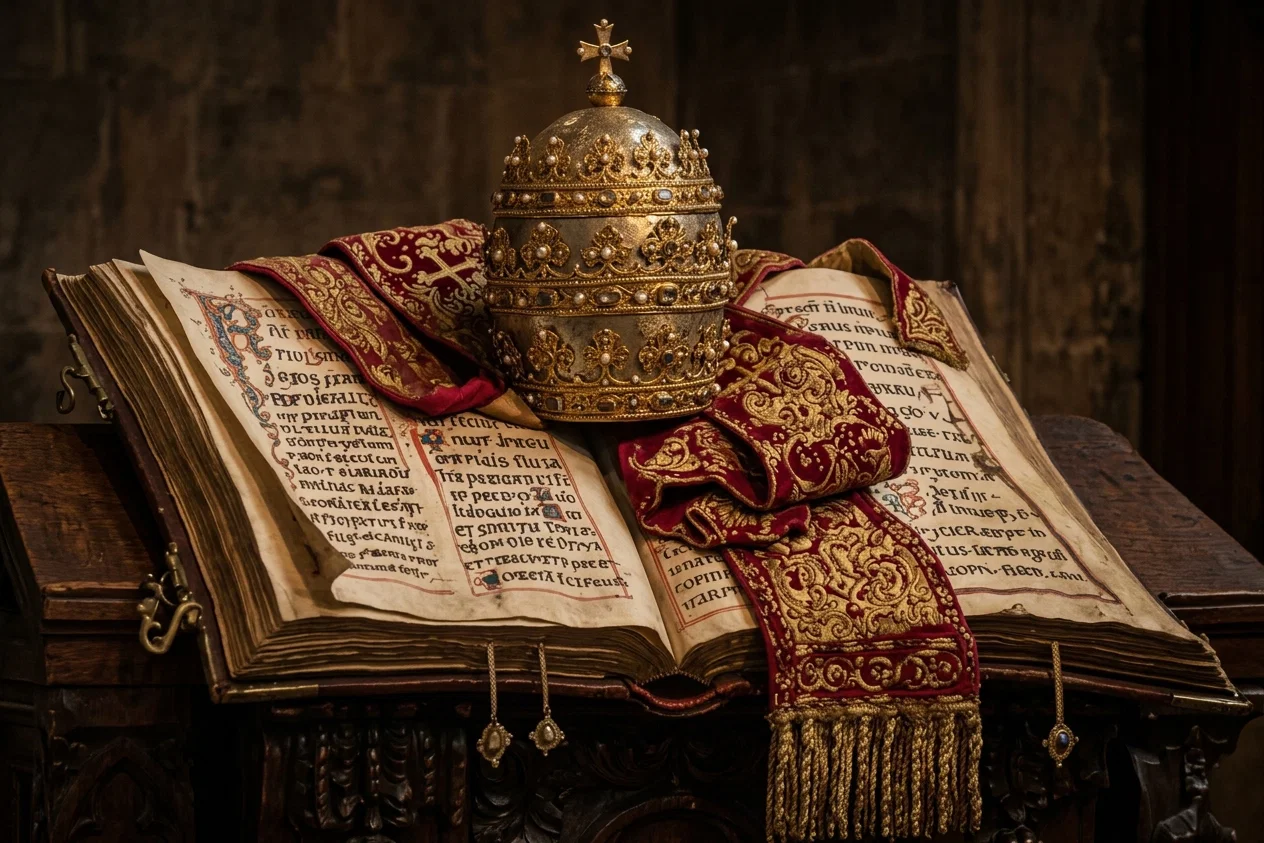
THE PAPAL INSIGNIA
THE PAPAL INSIGNIA

“The Mystery of Iniquity”

But although the original plan of the god of this world was thus brought to naught, yet he did not cease his efforts to bring the world under his rule. On the contrary, he evolved “the mystery of iniquity,” the counterfeit of “the mystery of godliness,” and having failed to establish himself as king of a world empire maintained by force of arms, he sought to establish an equally extensive spiritual rule, and by enthroning himself as the professed vicar of Christ, to secure to himself by his crowning deception that worship and allegiance which are due to God in Christ.
This is the philosophy of the Papacy, which, “next to Christianity, is the great fact of the modern world.” The prophecies of the seventh and eighth chapters of Daniel are intended to expose “the mystery of iniquity” and to put the church on its guard against this “all deceivableness of unrighteousness.” The Papacy is the little horn of Dan. 7: 8, 20, 24, 25.

Modern Babylon

A comparison of Daniel’s prophecy of the fourth beast with the ten horns and the little horn, with John’s prophecy of the beast from the sea (Rev. 13: 1-10) and his prophecy of the woman sitting upon the scarlet-colored beast (Revelation 17), will show clearly that the little horn of Daniel, the beast from the sea, and the woman upon the scarlet-colored beast of John, are symbols of the same power; and from Rev. 17: 5 we learn that this power, the Papacy, is modern Babylon. It is thus evident that in the Papacy, modern Babylon, we have the most long-continued, the most deceptive, and the most successful effort of the god of this world to establish his dominion in the earth. The invisible king of ancient Babylon is the invisible king of modern Babylon. The universal temporal sway of ancient Babylon is a type of the attempted universal sway of modern Babylon. In proof of this statement that the Papacy, “modern Babylon,” demands universal submission to its rule, we quote the last sentence of the famous bull Unam sanctam, published by Pope Boniface VIII in 1302:—
“Moreover, we declare, affirm, define, and pronounce it to be necessary to salvation for every human creature to be subject to the Roman Pontiff.”—“Vatican Decrees in Their Bearing on Civil Allegiance,” Archbishop of Westminster, London, Longmans, Green & Co., 1875, page 60.

The Religion of Babylon

The religion of ancient Babylon is the religion of modern Babylon with some variations, veneered with Christian names and phrases.
The following extract will fully justify this last statement:—
“On the overthrow of Babylon by the Persians, who nourished a traditional hatred for its idolatry, the Chaldean priesthood fled to Pergamos, in Asia Minor, and made it the headquarters of their religion. Hence Christ in his charge to the church in that city speaks of it as being ‘where Satan’s seat is.’ The last pontiff king of Pergamos was Attalus III, who at his death bequeathed his dominions and authority to the Roman people, 133 B. C., and from that time the two lines of Pontifex Maximus were merged in the Roman one. Therefore, when Julius Caesar was elected Pontifex Maximus, he assumed to himself the divinity claimed by the pontiff kings of Chaldea, and declared himself to be ‘Venus genetrix,’ or born of Venus, and from henceforth the emperors of Rome received divine honors. . . . But just as pagan Rome was the true offspring and successor of Babylon, so is papal Rome the true offspring and successor of pagan Rome. When paganism was nominally abolished in the Roman Empire, the head of the pagan hierarchy was also suppressed. Some of the Christian emperors did indeed accept the title Pontifex Maximus, while others, refusing it themselves, appointed a pagan priest, until the reign of Gratian, who, refusing to do either, abolished the office, 376 A. D. Two years afterwards, however, fearing that religion might become disorganized, he offered the title and office to Damasus, the Bishop of Rome. . . . This bishop, less scrupulous than the emperor, accepted the office, and from that time until now the title has been held by the popes of Rome, from whom, and through whom, the whole hierarchy of Western Christendom have received their ordination.”—“The False Christ,” J. G. G. [Garner], London, George Allen, 1900, pages 94-96.

The Prophecy of the Little Horn

With this general view of the aims and the work of the Papacy we proceed to a more particular examination of the prophecy of the eighth chapter of Daniel.
In the Bible study printed in another part of this Extra there is a verse-by-verse examination of the main features of this prophecy, and the conclusion is there drawn that the little horn represents Rome in its two phases, pagan and papal. As supplementary to this Bible study we present herewith some brief extracts showing the views of other writers upon this prophecy. Referring to the first two symbols, Dr. John Cumming in his “Prophetic Studies: Lectures on the Book of Daniel” (page 263), makes this clear application:—
“The ram’s head of gold was, as every historian will tell you, the diadem of the Persian king, this alone identifying that symbol with the personage to whom it refers; and ‘pushing westward,’ denotes that empire subduing Lydia and Babylon by Cyrus, and Egypt by Cambyses. The he goat is plainly explained in the chapter to be the Macedonian power; his ‘pushing’ (as is stated in verse 4) ‘westward, and northward, and southward; so that no beasts might stand before him,’ denotes his conquests, his advancing and irresistible might. The notable horn that starts up between the eyes of the goat might shortly be shown to be, what it may be indisputably proved, Alexander the Great, by whom the Persian ram was destroyed, and by whose destruction immense addition was made to his own empire.”

Dr. Pusey’s Exposition

To the same effect is the exposition of Dr. E. B. Pusey:—
“The two empires represented to Daniel are, that of Persia under the symbol of the ram, that of Greece, in the person of its first monarch, under that of the he goat. . . . No one has been found to doubt that by these (four horns of the goat) are intended Alexander’s four successors, the Diadochi, who collectively held whatever survived of his Asiatic conquests and his own dominions, subject to the rule of Greece.”—“Lectures on Daniel the Prophet,” E. B. Pusey, D. D., London, 1868, pages 88, 89.

Another Testimony

Another testimony to the correctness of this exposition is voiced in the following quotations:—
“Then the pushing of the ram westward, northward, and southward, exactly represents the successful wars of Cyrus himself, who carried his victorious arms, first, to the very bounds of Asia in the west; afterwards, to the north, against the Armenians, Cappadocians, and others; then, again, over Egypt in the south.
“‘The rough goat is the king,’ or kingdom, ‘of Grecia,’ or Macedonia; and the great horn between his eyes is the excelling power of the first king, Alexander the Great. Coming swiftly from West to East, he marched on Persepolis. . . .
“As the breaking of the great horn was one of the most remarkable incidents of prophetic action, so was its fulfillment one of the most impressive events of history. Alexander had broken the two horns of Persian strength when he burnt Persepolis, and when, in Media, he killed Darius II. This done, his own came to be broken. . . .
“His lineage became extinct; and neither kingdom nor succession remained to represent the fruit of his conquests in Asia under one crown, for they were divided towards the four winds of heaven; namely (1) Macedonia and Greece, westward, to Cassander; (2) Thrace, Bithynia, etc., northward, to Lysimachus; (3) Egypt, southward to Ptolemy; (4) Syria and the lands eastward, to Seleucus.”—“An Historical Exposition of Daniel,” W. H. Rule, D. D., London, 1869, pages 218-221.

Bishop Newton’s Interpretation

Of the significance of the various symbols in this prophecy, Bishop Thomas Newton writes thus:—
“The Hebrew word for ram, and the Hebrew word for Persia, both springing from the same root, and both implying something of strength, the one is not improperly made the type of the other. . . . It was usual for the king of Persia ‘to wear a ram’s head made of gold, and adorned with precious stones instead of a diadem;’ for so Ammianus Marcellinus describes. Bishop Chandler and others further observe that ‘rams’ heads with horns, one higher and the other lower, arestill to be seen on the pillars at Persepolis.”—“Dissertation on the Prophecies,” Thomas Newton, D. D., London, 1840, page 265.
“A goat is very properly made the type of the Grecian or Macedonian Empire, because the Macedonians at first, about two hundred years before Daniel, were denominated Ægeadae, or the goat’s people.”—Id., page 266.
The little horn is plainly some power different and distinct from the four former horns. Is not this therefore more applicable to the Romans, who were a new and different power, who rose from small beginnings to an exceeding great empire, who first subdued Macedon and Greece, the capital kingdom of the goat, and from thence spread and enlarged their conquests over the rest? Nor let it seem strange that the Romans, who were prefigured by a great “beast” in the former vision, should in this be represented only by the horn of a beast; for nothing is more usual than to describe the same person or thing under different images upon different occasions; and besides, in this vision the Roman Empire is not designed at large, but only the Roman Empire as a horn of the goat. When the Romans first got footing in Greece, then they became a horn of the goat. Out of this horn they came, and were at first a little horn, but in process of time overtopped the other horns.”—Id., page 279.

Rome’s Continued Rule

In considering the fitness of a single symbol to represent both pagan and papal Rome, we must remember that after pagan Rome fell, papal Rome took possession of the ancient capital of the fourth kingdom, and attempted to rule the world from the same center. A modern writer on the prophecies has called attention to the continuation of Roman rule in these words:—
“It is important that we should clearly grasp one great historical fact; i. e., the rule of Rome has never, since it first commenced, ceased to exist, save once, for a very brief period during the Gothic invasions. It has changed in character, as we have seen, but it has continued. Rome ruled the known world at the first advent of Christ, and still rules hundreds of millions of mankind, and will continue so to do right up till the second advent of Christ.”—“Romanism and the Reformation,” H. Grattan Guinness, London, 1891, page 24.

The Papacy Predicted

While some specifications of the eighth chapter of Daniel apply with greater force to the pagan phase of Rome and others to the papal phase, we shall in this article deal wholly with the papal phase, as described in Gabriel’s interpretation of the little horn, which follows:—
“And in the latter time of their kingdom, when the transgressors are come to the full, a king of fierce countenance, and understanding dark sentences, shall stand up. And his power shall be mighty, but not by his own power: and he shall destroy wonderfully, and shall prosper, and practise, and shall destroy the mighty and the holy people. And through his policy also he shall cause craft to prosper in his hand; and he shall magnify himself in his heart, and by peace shall destroy many; he shall also stand up against the Prince of princes; but he shall be broken without hand.” Dan. 8: 23-25.
In perfect harmony with the prediction here made concerning the Papacy, that “his power,” are the predictions made through the prophet John. Of the beast from the sea, which represents papal Rome, we read:—
“The dragon [Satan, Rev. 12: 9] gave him his power, and his seat, and great authority.” Rev. 13: 2.
So also it is written concerning the scarlet-colored beast upon which the woman sat:—
“And the ten horns which thou sawest are ten kings. . . . These have one mind, and shall give their power and strength unto the beast.” Rev. 17: 12, 13.
The Papacy never possessed great power of its own, but its success was due to its ability to use one king against another, as when the Pope stirred up the king of France to seize the throne of England, then occupied by King John, whose kingdom was under an interdict because he refused absolute submission to Innocent III.

Rome’s Persecution of Heretics

In this interpretation it is said of the Papacy that “he shall destroy wonderfully, . . . and shall destroy the mighty and the holy people.” The record of centuries of persecution carried on either directly or indirectly by papal Rome, is a sufficient testimony to the truthfulness of this prediction. Some quotations, both from Roman Catholic and from Protestant sources, fasten upon the Papacy the responsibility for these centuries of bloodshed:—
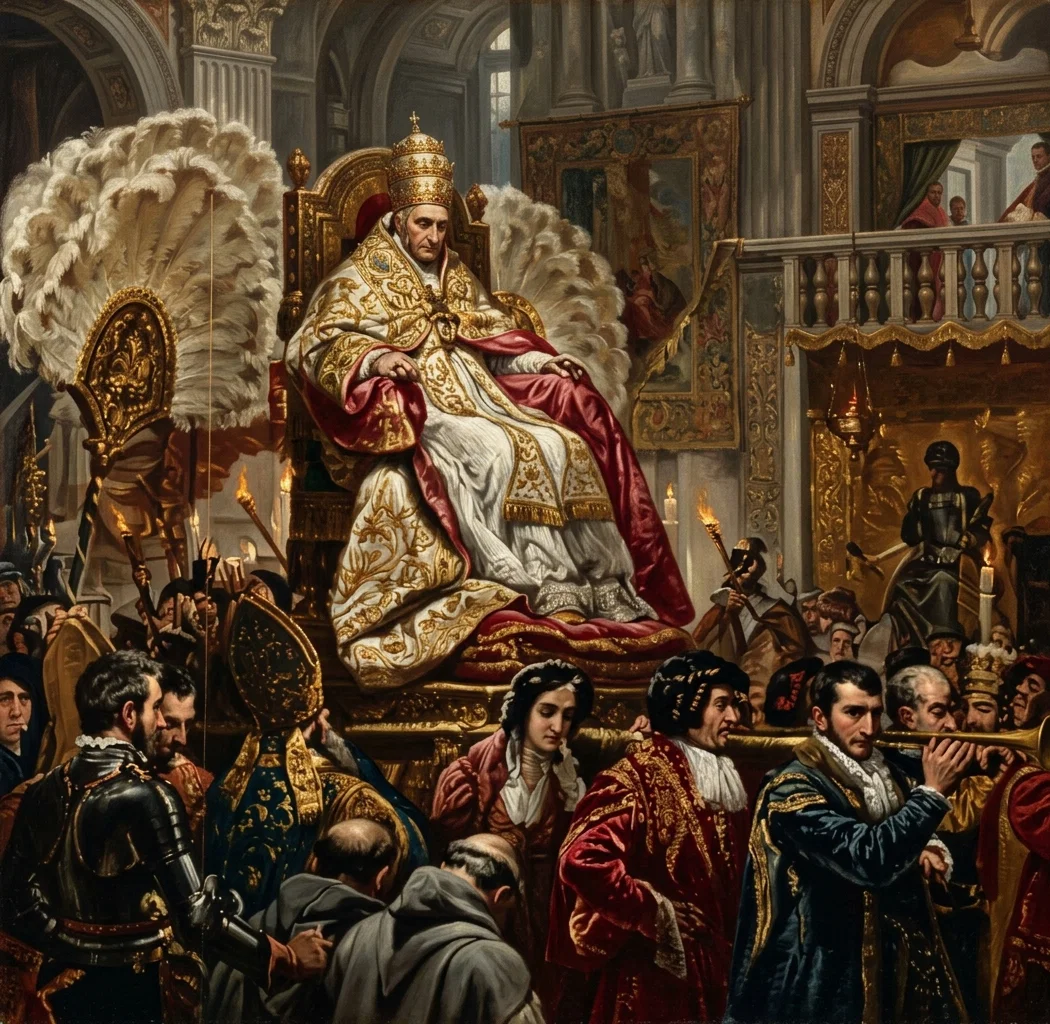
“HE THAT OPPOSETH AND EXALTETH HIMSELF”
“In the bull Ad exstirpanda (1252) Innocent IV says: ‘When those adjudged guilty of heresy have been given up to the civil power by the bishop or his representative, or the Inquisition, the podesta, or chief magistrate, of the city shall take them at once, and shall, within five days at the most, execute the laws made against them.’ . . . Nor could any doubt remain as to what civil regulations were meant, for the passages which ordered the burning of the impenitent heretics were inserted in the papal decretals from the imperial constitutions Commissis nobis and Inconsutibilem tunicam. The aforesaid bull Ad exstirpanda remained thenceforth a fundamental document of the Inquisition, renewed or reinforced by several popes, Alexander IV (1254-61), Clement IV (1265-68), Nicholas IV (1288-92), Boniface VIII (1294-1303), and others. The civil authorities, therefore, were enjoined by the popes, under pain of excommunication, to execute the legal sentences that condemned impenitent heretics to the stake.”—“The Catholic Encyclopedia,” Vol. VIII, page 84.
“When confronted by heresy she [the Roman Catholic Church] does not content herself with persuasion; arguments of an intellectual and moral order appear to her insufficient, and she has recourse to force, to corporal punishment, to torture. She creates tribunals like those of the Inquisition, she calls the laws of the state to her aid, if necessary she encourages a crusade, or a religious war, and all her ‘horror of blood’ practically culminates into urging the secular power to shed it, which proceeding is almost more odious—for it is less frank—than shedding it herself. Especially did she act thus in the sixteenth century with regard to Protestants. Not content to reform morally, to preach by example, to convert people by eloquent and holy missionaries, she lit in Italy, in the Low Countries, and above all in Spain the funeral piles of the Inquisition. In France under Francis I and Henry II, in England under Mary Tudor, she tortured the heretics, whilst both in France and Germany during the second half of the sixteenth and the first half of the seventeenth century if she did not actually begin, at any rate she encouraged and actively aided the religious wars.”—“The Catholic Church, the Renaissance and Protestantism,” Alfred Baudrillart (Roman Catholic), Rector of the Catholic Institute of Paris, London, Kegan Paul, Trench, Trübner & Co., Ltd., 1908, pages 182, 183.
“That the Church of Rome has shed more innocent blood than any other institution that has ever existed among mankind, will be questioned by no Protestant who has a competent knowledge of history. The memorials, indeed, of many of her persecutions are now so scanty that it is impossible to form a complete conception of the multitude of her victims, and it is quite certain that no powers of imagination can adequately realize their sufferings.”—“History of the Rise and Influence of the Spirit of Rationalism in Europe,” W. E. H. Lecky, Vol. II, page 32.

Rome’s Forgeries

It is further declared concerning the little horn, the Papacy, that “through his policy also he shall cause craft to prosper in his hand.” In these few words is set forth that which is characteristic of the Papacy which in the times of intellectual darkness enabled her to establish some of her fundamental claims.
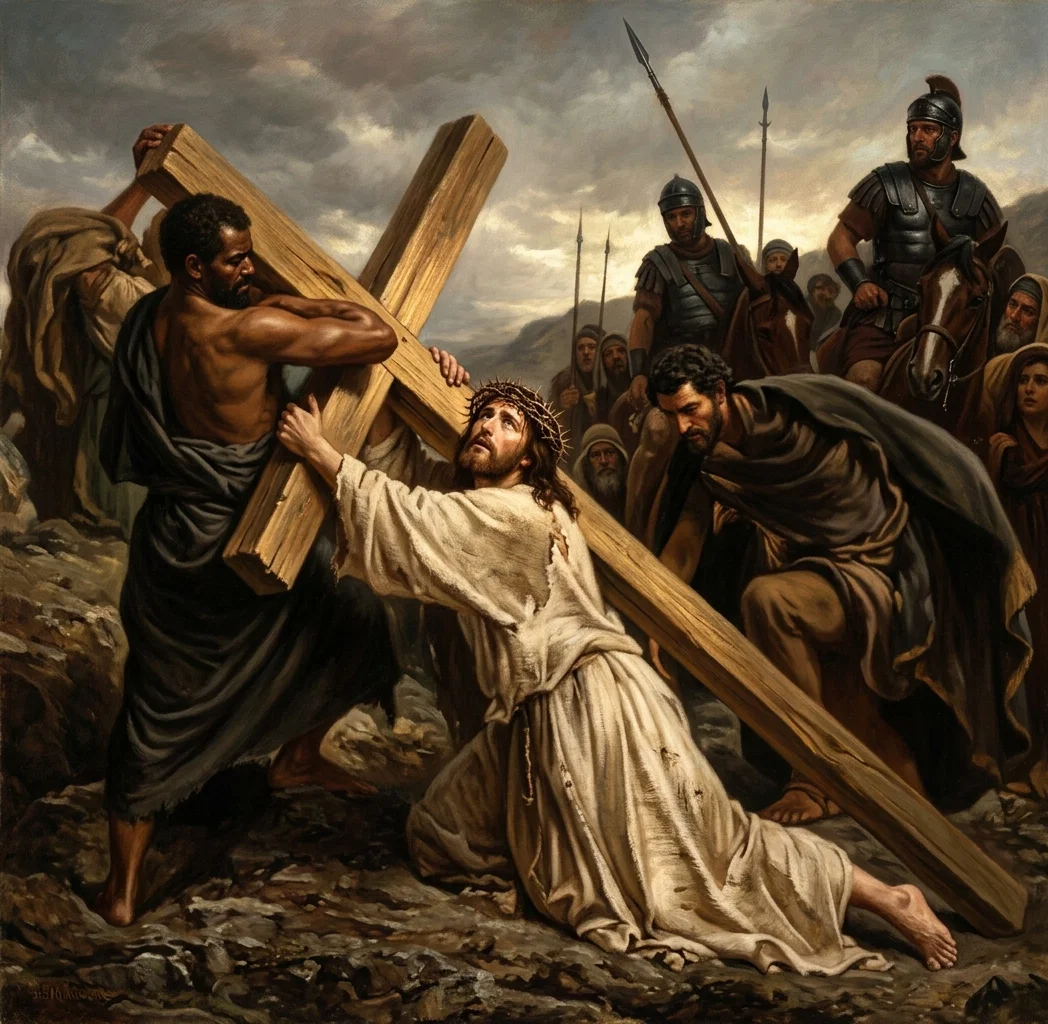
“HE HUMBLED HIMSELF . . . EVEN UNTO . . . THE DEATH OF THE CROSS”
to authority by suppressing testimony unfavorable to those claims, and by forging documents in her own favor. The following quotations refer to some of the various forgeries made in the interests of the Papacy:—
“This huge fabrication [the Isidorian decretals] arose about the middle of the ninth century in western Gaul. It consists of a large number (about one hundred) of pretended decrees of about thirty successive Popes in the first three centuries, together with certain other spurious documents of councils, and had for its object the protection of bishops against their metropolitans, and against the civil authorities, by magnifying the power of the Pope, and throwing it as an aegis around the persons of the bishops.”—“Leo XIII at the Bar of History,” Rev. R. H. McKim, D. D., 1897, page 83.
“Donation of Constantine (Lat. Donatio Constantini).—By this name is understood, since the end of the Middle Ages, a forged document of Emperor Constantine the Great, by which large privileges and rich possessions were conferred on the Pope and the Roman Church.”—“Catholic Encyclopedia,” Vol. V, page 118.
“The most potent instrument of the new papal system was Gratian’s Decretum, which issued about the middle of the twelfth century from the first school of law in Europe, the juristic teacher of the whole Western Christendom, Bologna. In this work the Isidorian forgeries were combined with those of the Gregorian writers, Deusdedit, Anselm, Gregory of Pavia, and with Gratian’s own additions. His work displaced all the older collections of canon law, and became the manual and repertory, not for canonists only, but for the scholastic theologians, who, for the most part, derived all their knowledge of fathers and councils from it. No book has ever come near it in its influence in the church, although there is scarcely another as shock-full of gross errors, both intentional and unintentional.”—“The Pope and the Council,” James (Döllinger, Roman Catholic), 1870, pages 142, 143.

Rome’s Self-Exaltation

Another specification concerning the little horn, the Papacy, is that “he shall magnify himself in his heart.” To the same effect, but with greater emphasis, the apostle Paul wrote concerning this same power:—
“That day shall not come, except there come a falling away first, and that man of sin be revealed, the son of perdition; who opposeth and exalteth himself above all that is called God, or that is worshiped; so that he as God sitteth in the temple of God, showing himself that he is God.” 2 Thess. 2: 3, 4.
Prominent among the marks of the Papacy is its spirit of self-exaltation. The Pope is exalted to be “as God” and to take the place of Christ as head of the church. The papal church is exalted to be above the Bible, with authority to change its teachings. The Roman Catholic priest is exalted to be “another Christ,” with such power that he is designated as “the creator of his Creator.”
It would require volumes in which to set forth fully all the evidences that the Papacy has magnified itself in its heart. Only the briefest statement of its claims can be presented here. The twenty-seven propositions designated as “The Dictates of Hildebrand” became a summary of papal claims in the eleventh century. We quote some of the more striking of these dictates as found in “Annals of Baronius,” Vol. XI, col. 506:—
“1. That the Roman Church was founded by our Lord himself.”},{
“2. That the Roman Pontiff alone is justly styled universal.”
“8. That he alone can use the imperial insignia.”},{
“9. That all princes should kiss his feet only.”},{
“12. That it is lawful for him to depose emperors.”},{
“19. That he can be judged by no one.”},{
“22. That the Roman Church never erred; nor will it, according to the Scriptures, ever err.”},{
“27. That he [the Pope] can absolve subjects from their allegiance to unrighteous rulers.”},{
Surely there is abundant evidence to justify the statement of the prophecy that the little horn “shall magnify himself in his heart.”

Vicar of Christ—Antichrist

The last specification concerning the little horn which can be fulfilled before the end of all things, when “he shall be broken without hand,” is thus expressed: “He shall also stand up against the Prince of princes.” It will be quite unnecessary for us to introduce any argument here to prove that the “Prince of princes” is Christ, and that the opposition of the little horn, the Papacy, to Christ is here foretold. We therefore proceed at once to give some proofs that the Papacy has done what is thus predicted concerning it.
The official title of the Pope of Rome is “vicar of Christ.” This title was formally established by the Council of Florence in 1439 in this definition:—
“We define that . . . the Roman Pontiff himself is the successor of the blessed Peter, prince of the apostles, and the true vicar of Christ, the head of the whole church, the father and doctor of all Christians.”—Labe and Cossart’s “History of the Councils,” Vol. XIII, Col. 1167.
The real significance of this expression, “vicar of Christ,” is well stated in the following quotation:—
“The apostle John, speaking of the great apostasy to arise in Christendom, calls it the‘Antichrist.’ And the Pope has taken to himself, as the name that best describes his office, the title ‘vicar of Christ.’ The first, ‘Antichrist,’ is a Greek word; the second, ‘vicar,’ is an English word; but the two are in reality one, for both words have the same meaning. Antichrist translated into English is vice Christ, or vicar of Christ; and vicar of Christ, rendered into Greek is Antichrist—Antichristos. If we can establish this—and the ordinary use of the word by those to whom the Greek was a vernacular is decisive on the point—we shall have no difficulty in showing that this is the meaning of the word ‘Antichrist,’—even a vice Christ. And if so, then every time the Pope claims to be the vicar of Christ, he pleads at the bar of the world that he is the ‘Antichrist.’”—“The Papacy Is the Antichrist,” Rev. J. A. Wylie, pages 1, 2.
When a Pope is crowned with the tiara, these words are spoken to him by the first cardinal deacon:—
“Receive the tiara, adorned with three crowns, and know that thou art the father of princes and kings, ruler of the world, vicar on earth of our Saviour Jesus Christ.”
The successive Popes for centuries have individually claimed to occupy the high position assigned to them by the Council of Florence. One utterance will serve as an example of all.
Pope Leo XIII, in his encyclical letter, Praeclara Gratulationis Publicae, June 20, 1894, made this blasphemous affirmation:—
“We hold upon this earth the place of God Almighty.”—“The Great Encyclical Letters of Leo XIII,” New York, Benziger Brothers, page 304.
Proof is sufficient that the Pope, as the head of the Papacy, has stood up against the Prince of princes by professing to take his place on earth, and while making this high profession he has shown himself to be the enemy of Christ by many utterances and actions absolutely contrary to the teaching and example of the lowly Nazarene, who “humbled himself, and became obedient unto death, even the death of the cross.”

Conclusion

In view of the argument, and the proofs presented in this article, we are now prepared to affirm concerning the prophecy in the eighth chapter of Daniel:—
1. That the ram having two horns represents Medo-Persia.
2. That the rough goat represents Grecia.
3. That the notable horn of the rough goat represents Alexander the Great.
4. That the four horns of the rough goat represent the four divisions of Alexander’s empire.
5. That the little horn represents Rome in both its pagan and papal phases.
6. That in the interpretation of the little horn, emphasis is placed upon Rome in its papal phase.
7. That the specifications concerning the little horn and his work have been completely fulfilled in the Papacy.
The study of this and the other prophecies of the book of Daniel furnishes sufficient ground for repudiating any claim of the Papacy to be a part of the Christian Church, and proves conclusively that it is the great apostasy concerning which so many warnings are given in the Scriptures. It is the duty of all Christians to separate from this anti-Christian organization, and to stand as witnesses for the truth of the gospel of Christ.