INFLUENCE OF DRESS

6%

Pacific Press Publishing Company · Oakland, California · Oct 14, 1897

FromSigns of the Times, Vol. 23, No. 40.

Read the full edition

INFLUENCE OF DRESS.

Our first parents in their holy, happy state, were clothed with shining innocence. They needed no other garment, until Satan beguiled them into yielding that to him. Then God himself made for them garments of skins and clothed them. The first idea of clothing, then, was to cover the nakedness of the body. Later, as the human family scattered over the earth and encountered varieties of climates and conditions, protection from the extremes of temperature modified the dress. Still the guiding idea was the need of the race.
By and by, as men still more lost sight of the real purpose of existence, an entirely new idea began to influence the human family in this particular—the idea of ornamentation. We believe it always has been true and always will be true that the dress is an index of the character of an individual or a nation. “It is astonishing how much people judge by dress. Of those, many go mainly by appearances in any case, and many more have in your own case only appearances to go by. The eyes and ears open the heart, and a hundred people will see for one who knows you,” says Lubbock.
It seems almost as if mankind sought to supply or perhaps cover up the lack of the true beauty which has been lost through sin by bedecking the body with ornaments of various sorts. It certainly is a fact that as sin developed and its evil effects began to be spread abroad, more and more adornment rather than protection became the central governing idea in dress. When men had so far strayed from the truth that we call them the “early savages,” we see them decking themselves with paints, feathers, bits of metal, colored stones, etc. So fixed was the idea of adorning the body that they sought to “improve” upon the construction of the human frame to make places for this senseless decoration regardless of the suffering and inconvenience necessary to produce the fashionable deformity and the hideousness of the result. (We certainly must call any modification of the original form, from whatever cause, deformity; and no deformity is truly beautiful or desirable except to a perverted taste.) Ears, nose, wrists, ankles, in fact, almost every part of the body has been utilized to display the wealth or vanity of the individual.
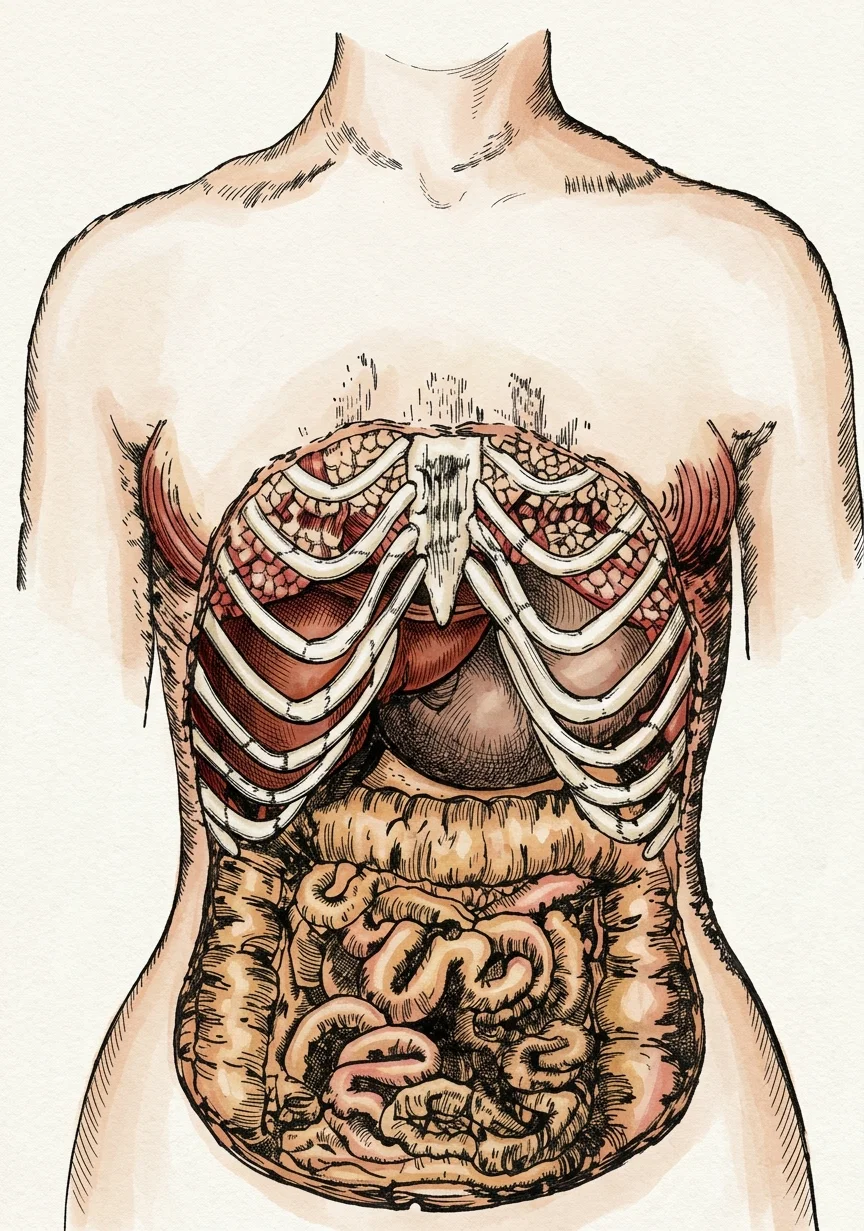
A natural waist, as God made it.
As a result of civilization, the first idea of protection once more began to take rank with ornamentation and display in developing the style of dress. But the practise of modifying the form of some portion of the body to suit the individual taste or the prevailing fashion still obtains among all classes of people, civilized and uncivilized, the idea among them all being to enhance the beauty and attractiveness of the person.
With what a superior, pitying air we regard those poor creatures who think to add to their beauty by inserting a fish-bone in the lip, and what a painful and inconvenient delusion is the idea of squeezing the feet into a shapeless mass, thus to impress the world with the distinction between such and common clay. But what shall we say of the extremely civilized custom of compressing the body into a shape resembling a wasp, but not at all adapted to the needs of the human animal.
We were impressed by the statement somewhere that the habit of deforming the body by tight lacing and the conventional mode of dress is responsible for as great loss of life and happiness as that other evil of this age—alcoholism. That is a broad statement, but is it not true? The first evil effects that portion of the human race to which God entrusted the responsibility of rearing helpless infants, of nurturing the race. In such a special way the tiny one is flesh of her flesh and bone of her bone. And while it is folded so close to her very life, through her alone its life and nature are shaped for good or ill, for strength or weakness. While some of the weeds and flowers have their roots far beyond her power, yet much is in her hands, morally, mentally, and physically. And for long years mother is the ideal toward which the daughters strive; and of the sons it is said, If a boy has a good mother he is worth knowing, no matter who may be his father.
This is woman’s special work which can not be passed on to another. We might write lengthily of the glories of this mysterious motherhood, but you will find that elsewhere—only a hint here. Your girls will be the women and mothers of the next generation; then rob them of nothing that shall help them on the way of attaining the perfection of their possibilities.
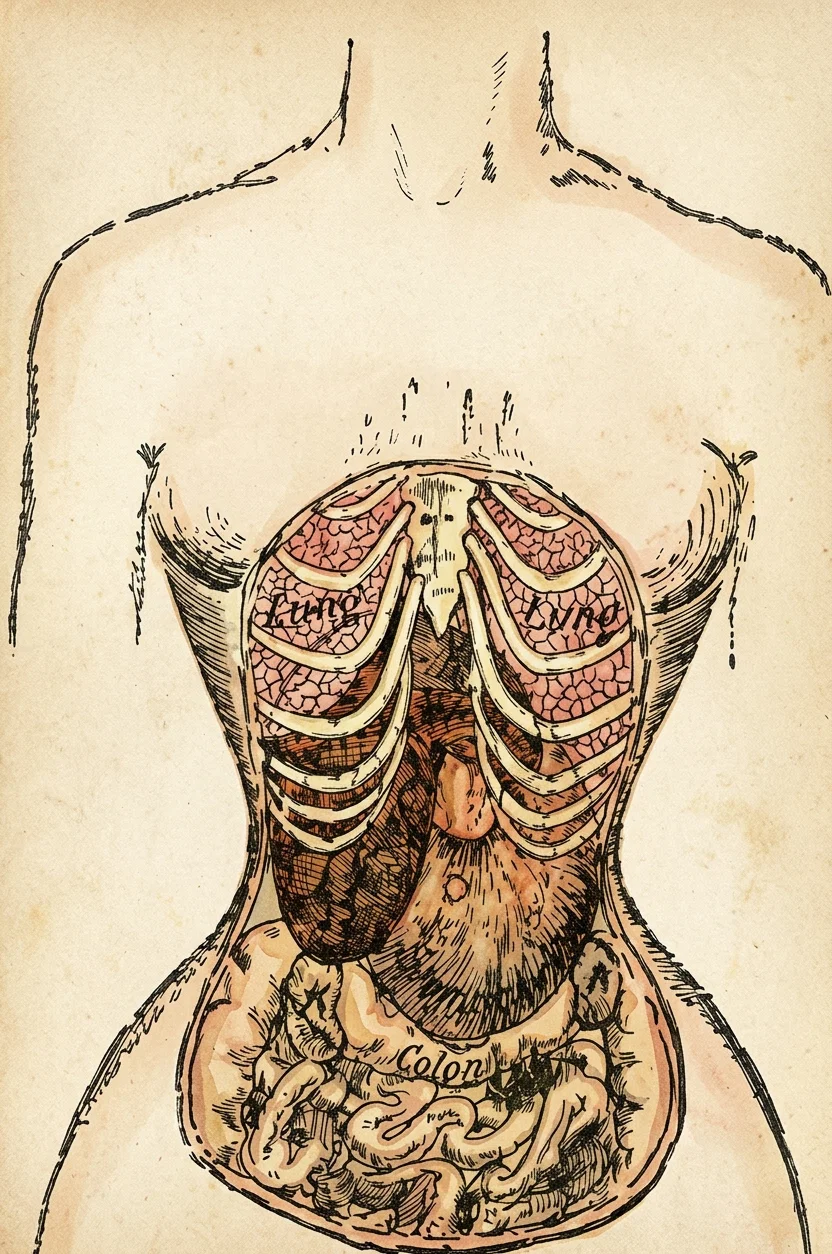
A human waist distorted by fashion.
We so often hear mothers speak of the difference between themselves and their daughters. “When I was a girl, I was worth two of my girls. They have no endurance nowadays.” And then with evident pride, they begin to name over the various uses and abuses to which they subjected their bodies. My good sisters, out of your own mouths you stand convicted. By these very abuses you wasted the substance which should have come as a heritage of strength to your frail, suffering daughters; and too often with this legacy, a dangerous ignorance of the laws of their being, is their portion. So they go forth to the battle not only with unknown foes of health and happiness within themselves, but with no knowledge of what is necessary to protect themselves from the known pitfalls prepared for their feet. Is itstrange that girls to-day are so often poor, puny, bundles of aching nerves?
Then again, see the little schoolgirl, just at that age when she is growing, developing into larger life; so laced that it makes one ache, and involuntarily you take a breath for her. In that inflexible case the organs strive and struggle and crowd one another in their efforts to keep pace with the demands the growing body makes upon them. Is it strange that the powers of endurance are far below par? And these are the mothers of the next generation. Her brothers during this formative period are running and jumping and howling like young savages, developing muscles and lungs and storing away nervous energy. (The foundation is better, tho the superstructure may contain much rotten timber.)
But this is not all. A large portion of the world’s work is called “woman’s work,” and the thing which, more than all else, hinders in its performance is slavery to fashion. “Satan has invented fashion to keep the minds of women from higher and better things. One of the weak spots in the armor of every woman is the desire to please. The desire to be beautiful is not in itself wrong—the wrong comes in a wrong standard and motives; but of this later. When once the first step is taken, Fashion lures on and yet on until every precious thing is laid upon her altar. And this is the atmosphere which surrounds the growing boys and girls. They are by precept possibly taught to regard life as the supreme thing, but by practise, an artificial standard is constantly kept before them. We need hardly be surprised that it is hard to break the power of the tyrant.
What shall be done about all this? Is it really something which must be recognized and met? If woman has a part to play in the drama, or, perhaps, tragedy, of the world, it is surely necessary that she have some sort of an equipment fitting for her part. Is it an easy part?—Nay, verily, it is taxing to both mind and muscle, for she has not been content with her Heaven-allotted work. She has stepped into the ranks with her brother, and in the race for fame and fortune, even for just standing room, she must strive shoulder to shoulder. She has yielded the right for consideration because she is a woman, and claims equal rights with her brothers. It is not hard to see that the race is unequal, for woman is the weaker vessel and the heavier laden. We can not better picture it than by noting the suggestion of an experiment on a North American Indian, proposed by a lady physician, which we fear would subject the one who put it into practise to prosecution by the Society for the Prevention of Cruelty to Animals.
Put him into the garb of a woman—feeble, delicate, gossamer woman (who by the way, has greater powers of endurance than any other animal on earth)—into tight corsets, which would jam his elastic ribs into his pendulous liver; his writhing stomach up against his wobbling heart and gasping lung, his whole nutritive apparatus upward, downward, sidewise, anywhere, so that nineteen inches of steel and whalebone would compass his twenty-five inch middle; add the dozen or more articles, with their aggregation of bands, strings, buttons, hooks, loops, clasps, and pins; place about him zone after zone of tight bandages, from which are suspended dozens and dozens of yards of gathered, puckered, plaited, and festooned material; tilt his body all out of plumb by fastening under his heels a wooden peg two inches high, and crush his toes into the space of a good-sized thimble. Weigh him down with a long, heavy, outside wrap, perch a bonnet upon his head and stretch a dotted veil over his eyes, put his hands into tight kid gloves, and into these a pocket-book and an umbrella; then send him out for business or for pleasure on a moderately wet morning or afternoon; let him keep his long, flopping skirts, his shoes and ankles, dry and clean, his feathers and bangs in curl, and his temper unruffled. Then ask him when he gets back to you—if he lives to do so —which he would rather be, a lovely civilized woman or a howling savage, and see what he will say.
And yet we send missionaries to such to civilize them.
IDA M. POCH.
Oakland, Cal.