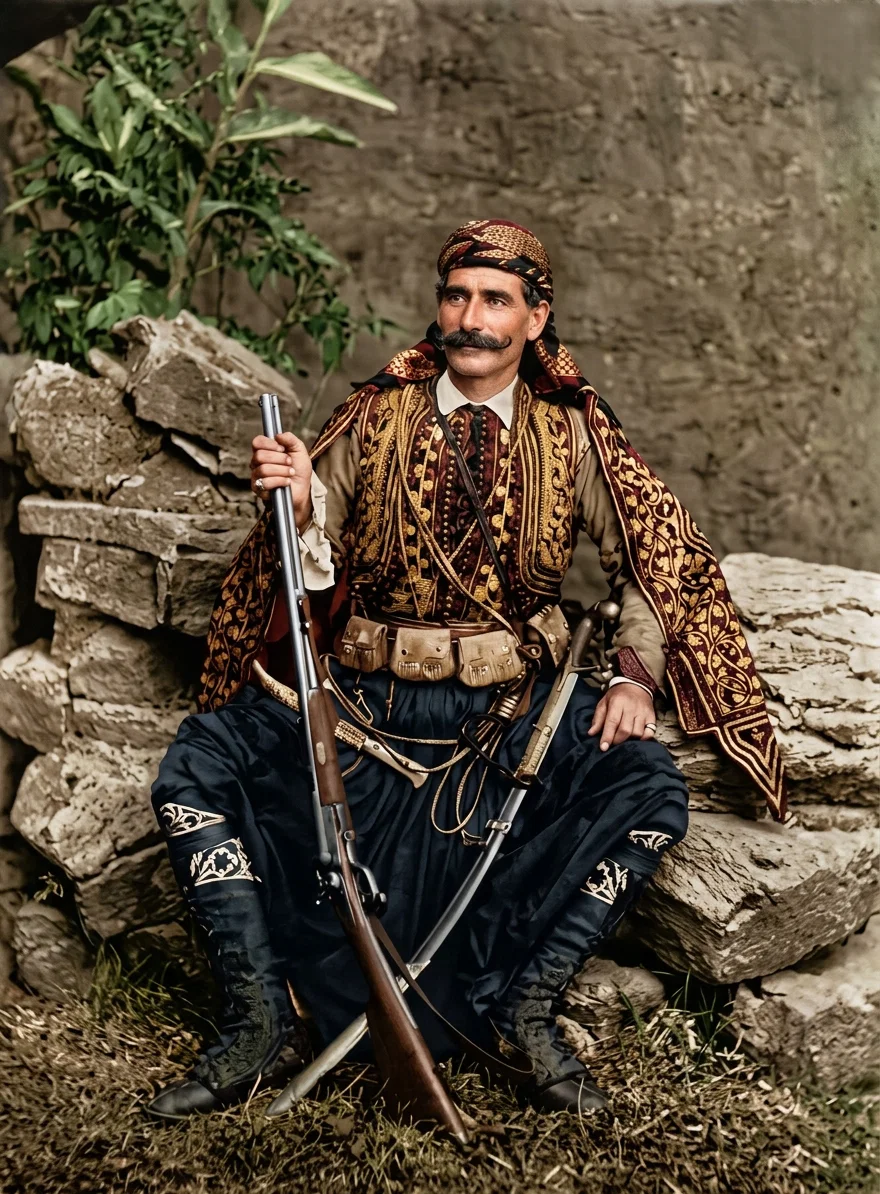
One of the most interesting features to the visitor in Turkey is the dress of the inhabitants. In striking contrast to the general sameness in apparel of Europeans is the almost endless variety in an oriental town. In the dress of woman as she appears on the streets, there is little of interest, but that of the men presents an entertaining display. Thus, the order is reversed, the man in Turkey occupying in this respect the same relative position as the woman in America.
Our illustration presents a dragoman (guide and interpreter) in full dress. He furnishes a splendid illustration of the tastes in dress which prevail in the east. The dragoman is usually well paid and hence can more fully than others gratify his desires in dress. This contributes to some extent to the fact that he is a man of authority among the common people. As a rule, the dragoman is intelligent and entertaining.
A TURKISH DRAGOMAN OR GUIDE.
The trousers of the dress shown in the illustration give a correct idea of those worn by the Turks in general. They were doubtless evolved from the long robes worn by men in patriarchal times. Instead of girding up his loins to facilitate marching as did the ancients, the Turk divides his skirt, tying it fast to the lower limbs, sometimes at the ankles only, sometimes from the ankles to the knees, as represented in the cut. It will be observed that the dragoman is quite as conspicuous for his weapons as for his gaudy apparel. Besides gun, sword, and dagger, he carries in his belt, pistol and revolver. The pouches suspended from his belt are for carrying ammunition. The wandering Arab, prowling about the deserts and making the country unsafe for the traveler and the caravan, is armed very much as this dragoman.
While the dress of the Turk has some sanitary points which our style lacks, it also has some most objectionable features. The heavy belt, loaded with arms and ammunition, is prejudicial to the vital organs on account of its great weight, its restriction, and the heat which it produces in summer. Also the turban, and still more the Turkish fes, often worn with the turban, as seen in our illustration, by causing undue heat and preventing the circulation of air, are the frequent cause of baldness; this fact, however, is of less importance than with the Franks, for the Turk never lifts his hat in salutation nor removes it in the home or in his place of business.
The style of dress of the Turk is closely related to his religion. Among the Mohammedans are many sects, most of which are indicated by some variation in dress. Thus, like the Pharisee, they bear outward signs of their religion. The greatest variation in this respect is seen in the turban, both in color and form. The softas (wise men) or religious teachers, who were the most active in killing Armenians in the massacres, are distinguished by their white turban; the dancing dervishes are distinguished by their tall, gray cylinder without rim at the top or bottom; and the Arab is marked by his black turban, with his heavy black horse-tail switch hanging down the back.
If the Mussulman adopts the infidel or European style of dress, he is regarded as untrue to the faith. Some divisions of the army which are dressed in the European style of uniform are looked upon with suspicion by the faithful, while the religious troops, so called because they wear the Mohammedan style of dress, are looked upon as the most reliable.
But these ideas of a particular style of dress as expressive of the faith are not all confined to the Mohammedan. The Armenian and Greek priests of the eastern churches, as well as the priests and various orders of monks of the Roman Catholic Church, are distinguished by their style of dress. How much better it is to manifest our faith in our lives and not simply our clothes! The east has ever been noted for its ceremonialism; but there is a vast difference between mere forms of dress and worship and vital godliness; and the marked difference on this point will constitute one of the signs of the times in the last days. While some will be prominent and zealous in form but lacking in power, another class will be simple in form but so great in power and true godliness that it will be said of them, “Here are they that keep the commandments of God and the faith of Jesus.”