The Sunday School

6%

Pacific Press Publishing Company · Oakland, California · Oct 14, 1897

FromSigns of the Times, Vol. 23, No. 40.

Read the full edition

The Sunday School

International Series.
LESSON V.—SUNDAY, OCTOBER 31, 1897.

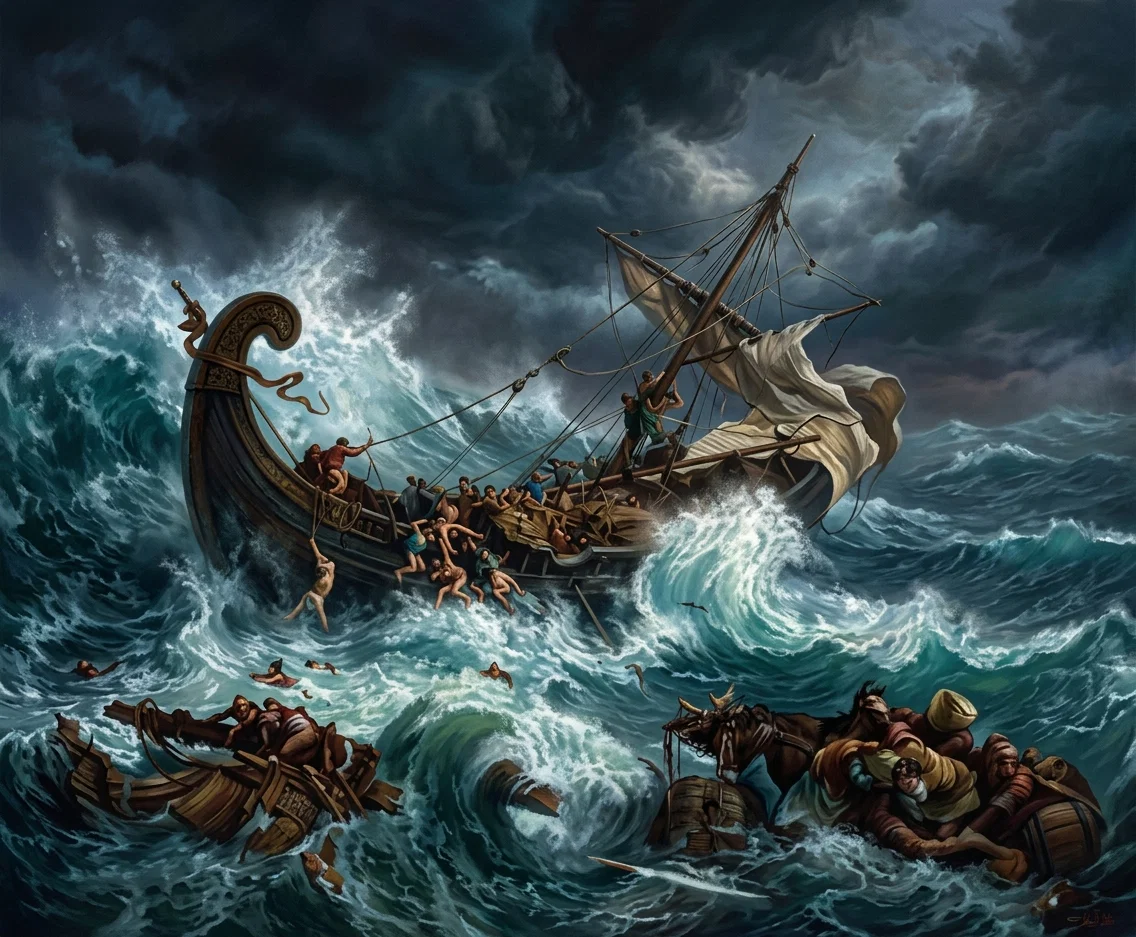
PAUL'S VOYAGE AND SHIPWRECK.

Note.—The present lesson section includes the whole of chapter 27. Interest will be added to the narrative by tracing the voyage on the map. According to Lewin the voyage began August 21, A.D. 60, and the wreck on the coast of Malta occurred about November 1. “The events described [in this lesson] were not only a part of God's providence guiding him to Rome, but they prepared the way for his better treatment at Rome and his release from prison.”—Peloubet.
Lesson Scripture, Acts 27:13-26.
13 “And when the south wind blew softly, supposing that they had obtained their purpose, they weighed anchor and sailed 14 along Crete, close in shore. But after no long time there beat down from it a tempestuous wind, which is called Euraquilo; 15 and when the ship was caught, and could not face the wind, 16 we gave way to it, and were driven. And running under the lee of a small island called Cauda, we were able, with difficulty, 17 to secure the boat; and when they had hoisted it up, they used helps, under-girding the ship; and, fearing lest they should be cast upon the Syrtis, they lowered the gear, and so were driven. 18 And as we labored exceedingly with the storm, the 19 next day they began to throw the freight overboard; and the third day they cast out with their own hands the tackling of 20 the ship. And when neither sun nor stars shone upon us for many days, and no small tempest lay on us, all hope that we 21 should be saved was now taken away. And when they had been long without food, then Paul stood forth in the midst of them, and said, Sirs, ye should have hearkened unto me, and not have set sail from Crete, and have gotten this injury and 22 loss. And now I exhort you to be of good cheer; for there 23 shall be no loss of life among you, but only of the ship. For there stood by me this night an angel of the God whose I am, 24 whom also I serve, saying, Fear not, Paul; thou must stand before Caesar; and, lo, God hath granted thee all them that sail 25 with thee. Wherefore, sirs, be of good cheer; for I believe God, that it shall be even so as it was told me. 26 Howbeit we must be cast upon a certain island.
PAUL’S VOYAGE AND SHIPWRECK.
Golden Text: “Be of good cheer; for I believe God, that it shall be even so as it hath been spoken unto me.” Acts 27:25

SUGGESTIVE QUESTIONS.

(1) What action of the wind did the sailors take as a favorable omen for sailing? Verse 13. Note 1. (2) Where did they sail? Same verse. (3) What change did they soon experience? Verse 14. (4) What was the result? Verse 15. (5) As they ran before the wind, what island did they reach? Verse 16. (6) What difficulty did they experience here? Same verse. Note 2. (7) What did they do to keep the vessel afloat? Verse 17. Note 3. (8) What serious danger threatened them at this time? Same verse. (9) As the tempest continued, what measures did they take for their own safety? Verse 18. (10) In what work did the apostles themselves engage on the third day of the storm? Verse 19. (11) What led them to conclude that they would not be saved? Verse 20. Note 4. (12) What did Paul tell the officers of the ship in regard to his former advice? Verse 21. Note 5. (13) Notwithstanding their present condition what cheering words did Paul speak to them? Verse 22. (14) What did his words show in regard to the fate of the vessel? Same verse. (15) How had Paul received this knowledge of what should happen to them? Verse 23. (16) How did Paul in this speech “show his colors”? Same verse. (17) What message did the angel have for Paul personally? Verse 24. Note 6. (18) What message did he bring in regard to the officers and crew? Same verse. (19) What reason did he give why they should be of good cheer? Verse 25. (20) What prophecy did he give of that which should happen to them? Verse 26.

NOTES.

1. When the south wind blew softly.—They were desirous of leaving the harbor in which they were now anchored, for it was not a good one to winter in, hoping for sufficient good weather to enable them to reach Phenice. The gentle south wind was taken to be indicative of favorable weather, and against the advice of Paul, they set sail, “thinking they had obtained their purpose” in waiting. The gentle south wind was no doubt the work of the “prince of the power of the air,” who designed to engulf the ship and thus cut short the work of Paul. It is in keeping with all his devices for entrapping and destroying souls. It is a gentle current that first urges the boat into the fearful rapids and falls of Niagara. It is a pleasant, tempting glass that draws the young into the rapids and over the brink of strong drink. It is the “little” sins that deaden the conscience and make it possible for the person to wantonly break the law of God and lose eternal life. “Be not deceived,” however pleasant the agent of deception. Know God's will and yield to it.
2. To secure the boat.—To bring the boat which was usually towed astern up out of the hold and upon deck, to be ready in case the vessel sank or had to be abandoned.
3. Undergirding the ship.—They passed chains or ropes under the vessel and over the deck, and then made them taut. This made the vessel better able to stand the strain of the tall mast with its great sail, and would also decrease her leaking. This expedient has been successfully resorted to by sailors since the day of Paul.
4. Neither sun nor stars . . . for many days.—In the days of Paul the compass was unknown, and sailors were guided by the stars and the sun. Not having seen either for many days they had no means of knowing where they were or even in which direction they were sailing. They might be driving directly upon a rocky coast.
5. Ye should have hearkened unto me.—Paul here refers to the advice which he had given them before leaving the harbor, not to find fault, but to impress upon his hearers the real value of that advice and the importance of heeding his encouragement, and the counsel which he was to give them later. That they did give heed to his words is seen by reference to verses 31 and 32.
6. Thou must stand before Caesar.—There is considerable similarity between this announcement of the angel and the words of the Lord as expressed in chapter 23, verse 11: “Be of good cheer, Paul; for as thou hast testified of me in Jerusalem, so must thou bear witness also at Rome.” The angel repeats the announcement that Paul may not forget God's unchanging purpose towards him in his work, notwithstanding the terrors of the gale, the dangers of the sea, or the apparent impossibility of being spared a watery grave.