Our East African Mission

4%

Review and Herald Publishing Association · Washington, D. C. · Sep 29, 1904

FromReview and Herald, Vol. 81, No. 39.

Read the full edition

Our East African Mission

L. R. CONRADI
As to the religious belief of the Wapares, we have found no idols whatever. They tell us that their ancestors had a god, but as a famine came and they implored his help in vain, they cast him off. While they thus lost their god, they still retained the belief in one great Creator, who is to them an “Unknown God.” They all seem desirous of hearing and being instructed. They have not the written law, and still we can see every evidence that in their hearts there is something left of the law once inscribed there. While there are not many civilized countries in the world, especially in the Orient, where one dares to turn his eyes away from his property even for a moment, yet here we could leave everything open in our tents, and no one would ever touch a thing.
Their present religious system centers in their witch doctors, who supply them with remedies against disease, charms against dangers, and protection against wild beasts, etc. I have several charms with me such as the natives wear on lead chains around their neck. Even the bodies of the children are covered with gashes and cuts, which the parents inflict for disobedience or other naughtiness on the part of the little ones. One of the most unsightly things that a visitor notices in this country is the manner in which the natives, especially the women, adorn their ears; as they bore large holes in them, and insert pieces of wood or paper or cloth, until the holes become so extended that the lobe of the ear reaches almost to the top of the shoulder. Nearly all shave their heads, but they leave a small spot of long hair on some part of the head, so that the appearance is very unique indeed, as one looks over a crowd of natives sitting or standing together. With the Suaheli women the case is just the opposite, for their hair is done up in the most fantastic manner, and they will sit for hours and hours trying to arrange their head-gear in the “latest fashion.”
One of the worst customs they have is their native dance—especially popular by moonlight—when you can hear the dancing-call beat on their small drum calling the people together. The dance lasts all night. While many youth are anxious to secure an education from our missionaries, yet the majority of these forsake the mission station as soon as they learn that they must give up these heathenish dances.
As far as the government is concerned, the natives are under local chiefs, and then the German government chooses a head chief, whose duty it is to gather in the poll-tax, amounting to thirty-five cents per hut, each quarter. If these natives do not earn that amount of money, then they must work on the roads, for their head chief must see that the poll-tax is discharged either in money or in work, building bridges, grading and keeping in repair the roads, etc., etc.
If we except the Leipsic Mission, eighteen miles to the north of us, there is no other European any nearer to us than Momba. This place is our future railroad terminus, and Wilhelmstal our post-office and trading city. Momba is over fifty miles from us, and Wilhelmstal is sixty-five.
ERECTING OUR MISSION HUTS
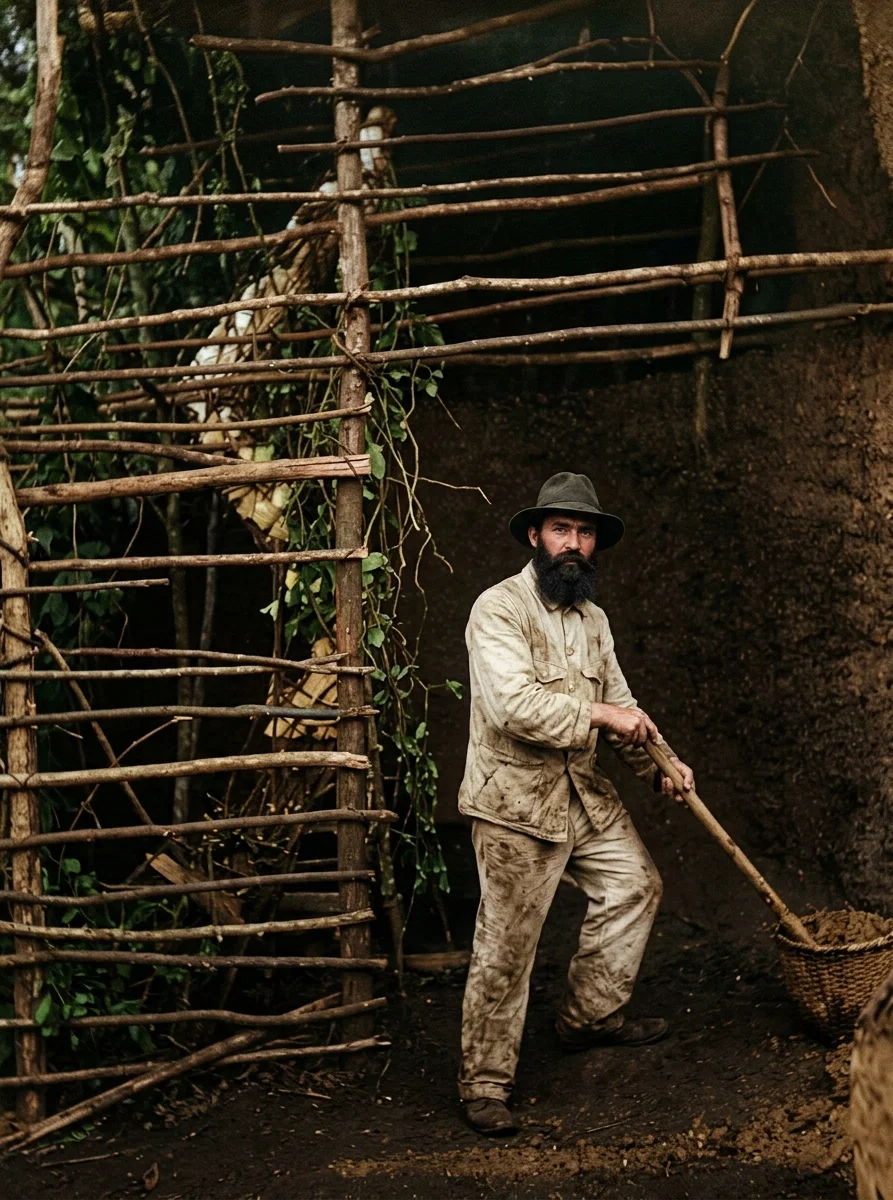
As our brethren arrived late, they could provide only temporary buildings for us, erecting these of light timber covered with banana leaves. One such hut served as kitchen and dining-room, a small adobe hut served as sleeping-room for two brethren, and we had two tents pitched and converted into sleeping apartments, and there was a small stable for the cattle.
After studying over the situation carefully, and visiting other missions, we came to the same conclusion our brethren have reached in Matabeleland—not to build up one large station, but to have a number of smaller stations. Thus far we have finished a good adobe stable, and one building intended for our blacksmith and carpenter shop. A temporary dwelling for the brethren is nearly finished. We expect to build a dwelling of four rooms surrounded with a veranda, from sun-dried bricks, upon a stone foundation. The roof of this house will be of banana leaves. Further up the hill we hope to erect a school and meeting-house. Our chief expense connected with the erection of our buildings is the transportation and preparation of the material, for the material itself costs nothing. The mission station is over eleven hundred meters above the level of the sea, we have no mosquitoes, and, therefore, no fever, so far as the station itself is concerned.
While with the brethren, we made a three days’ journey to the south of us, ascending as high as seven thousand feet above the sea, and from here we had a most beautiful view away into British East Africa, and over the Massai plains of German East Africa, to another mountain chain. After this trip, we thought that it would be best for us to plan to open up a school in Kihuiro itself. The chief treated us very kindly, promising us a nice building place in the valley, free of charge, and he not only promised help in erecting the building, but also said that the youth would come to school. While we expect to put up our school building at this place, yet we thought that during the time in which the erection of the structure was going on, we would have our brethren encamp further up the mountainside, to ascertain what would be the most healthful location for the dwelling-house, which the teacher would have. It is quite possible that half or three quarters of an hour up the hill, the fever would not be so bad, and walking to and from home would only be beneficial to the health of the teacher. I think that two thousand dollars will erect all the buildings we would need in German East Africa at present.
Before starting this East African Mission, we were very careful to prevent giving any occasion for complaint on the part of any other missionary societies that were operating in those fields. I visited the headquarters of the Moravian Mission in Herrnhut, and also called upon the officials of the Lutheran German Missions in Leipsic and Berlin. Besides that, we called on the government to ascertain what it had to say, and, indeed, it was the colonial government which actually pointed out to us the Pare Mountains as a good prospective mission field. But, lo, our workers had been there only a few months when some missionaries came down from the north, stating that they had come there to open up a mission, and that they were surprised to find us in that district. They claimed that, as they had a mission about fiftymiles north of us, in the North Pare Mountains, they were therefore entitled to occupy the whole range. Shortly afterward we received a letter from the mission superintendent in Kilimanjaro requesting us to move out. Our brethren kindly replied that this was impossible, that we had carefully considered the matter, and that when we arrived, there was no station in the district.
For this reason, I went up to that station and talked with the missionaries. The missionary himself was very kind to us, and said that he personally was satisfied, as their station was eighteen miles from ours, to divide the territory between us, but he did not know what their officials in Germany would say. While I was in Africa, a gentleman of the society called upon our office in Hamburg, and asked us to retire, but as their director had never been there to visit their station, and I have been there and have seen their own missionaries, and know the lay of the land, and as we have the government permission, and have bought our land, we feel that the protest of the society ought not to give us the least disturbance.
We all realize that pioneer work is the hardest kind of work, and as we are in a new country, and have not yet learned the language, and are without buildings, we know there will be difficulties and hardships. It is very hard to get one’s goods, where everything has to be transported on the heads of the natives for a hundred miles. Because of the building of the new railway, carriers were harder to get than usual, and we waited a whole month for our baggage and tools, etc., and of course were more exposed to the dampness than we would have been in the dry season; for we arrived in Africa during the rainy season.
When we started the mission, Brother Ehlers had an attack of fever lasting three weeks. Our company of seven reached their destination without sickness, and I left them all in good health. But Brother Ehlers, who accompanied me down to the coast, must have become infected from the mosquito bites at the same time that I did, as I learn from a letter just at hand that he took sick of the fever at the same time that I did. He had been ill for three weeks, and Brother Enns also had suffered several weeks, but they were better the last we heard from them. Upon leaving Dar-es-Salaam I had fever for three days on the boat, but checked it with quinine. We had a very pleasant sea voyage, and the fever did not return, and I thought that it had left me; but when I reached Rome, the fever reattacked me, and not until I was able to spend over a week at our sanitarium in Friedensau, under skilful treatment, with quinine as one of the remedies, did the malaria leave me.
While I was with our missionaries, we had no special trouble on account of the wild beasts, although there are enough prowling around in the desert below. Once some hyenas came, and took some carcasses; but since I came away, several leopards have visited our neighborhood, even entering our stable and tents.
Upon returning to the coast, I visited, with Brother Ehlers, the officials in Wilhelmstal. They received us very kindly, and not only were we given a written permission to have a school at Kihuiro, but they also promised us help in every right way. Our present mission property has been secured for forty-five dollars. It contains thirty acres, most all under cultivation in maize. Up the hillside, where we plan to have our buildings, there will yet need to be a little clearing done to put the place in proper condition.
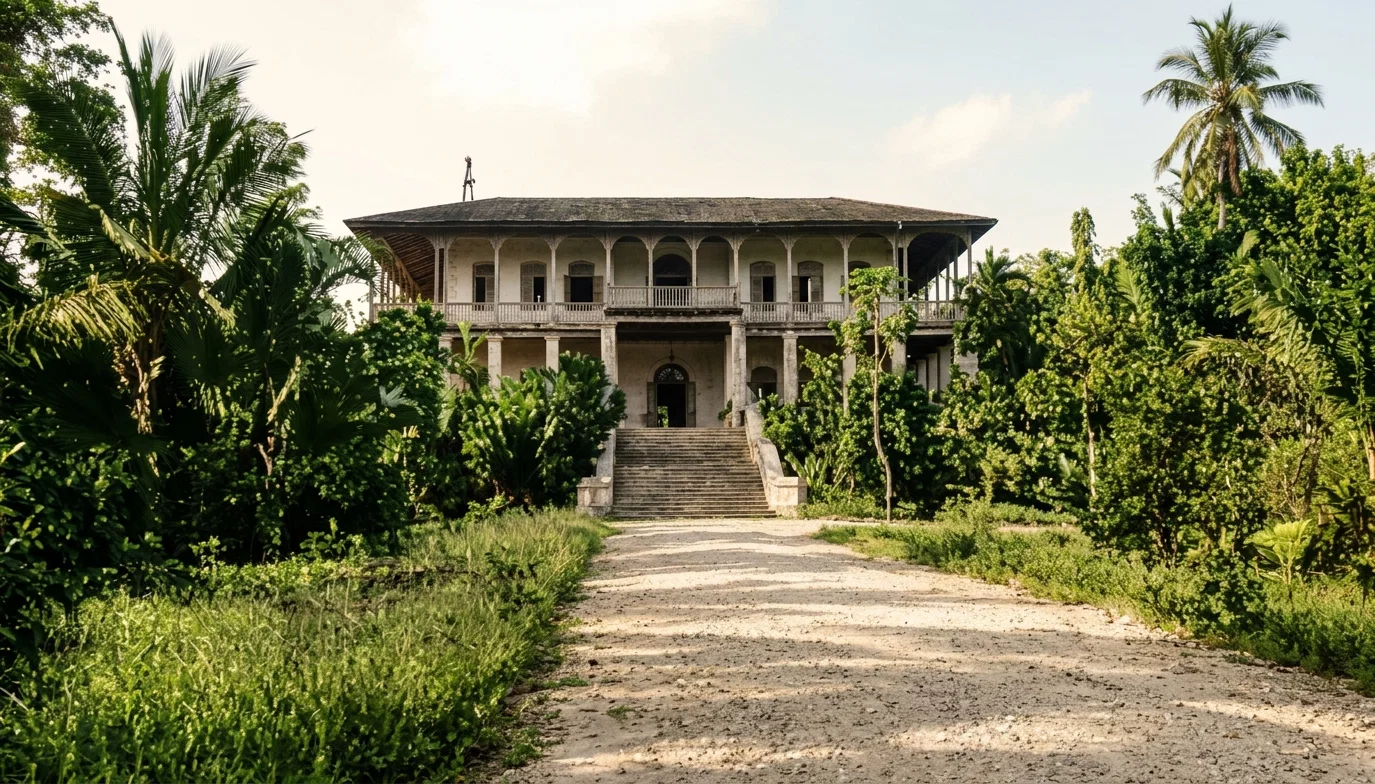
GOVERNOR'S RESIDENCE, DAR-ES-SALAAM
From Tanga, I went to Dar-es-Salaam, where is the beautiful palace of the governor. Here is one of the nicest harbors I ever saw. En route, I stopped at Zanzibar, a city of sixty thousand, in English territory; it would also offer us a good mission field.
The governor received me very kindly, and gave me an interview of over an hour, and he said he only wished we would extend our missionary operations. Through a letter he gave me, I was able to visit the government agricultural school. I found that the superintendent of the latter was an old friend of Elder Erzenberger, who had attended school with him in Switzerland, and that he was acquainted with our work. He had been a missionary in Abyssinia and in Egypt, and had married an Abyssinian woman, and he had spent quite a while in missionary work in German East Africa, and he was pensioned by his society, and afterward entered the government service. I had several very interesting visits with him. As he is a total abstinence man, he gave me some very nice fruit juices and fruits.
To my surprise, the adjutant of the governor called on me, and gave me a written invitation to dine with the governor at his residence. I hoped there would be only his family present; but, when I came, I found quite a number of higher officials had also been invited. His wife was formerly a resident of Washington, D. C., and was naturally very much interested in what I told her of the work we were doing in that city. She was acquainted with Takoma Park, and its surroundings.
As the governor knew of my temperance principles, he had kindly provided me with a glass of soda-water, and when the governor drank to my health, I was able to return the compliment with the soda-water he had given me. After the dinner, his wife took me aside, and she and some other ladies questioned me until eleven o’clock about our faith, and I felt very thankful that God had given me the privilege of witnessing for him in the palace of the governor. The officials also gave quite a little attention to the conversation. The opening for us is very favorable; indeed, I do not think any of our missions have opened any more favorably, but it depends upon the course which our missionaries themselves take, and the blessing of God, to give us the success we ought to have.
I felt indeed thankful to the Lord for the privilege of being personally acquainted with the work among the heathen. I shall be pleased when the missionary work extends to take in other places. While the malaria is not the most pleasant disease, yet the Lord is the great Healer. I am thankful that in a short time I was able to recover, and can now again be about my work. The missionary work among the heathen of Africa is deepening the interest our German brethren feel in scattering the truth throughout the whole world. I hope that our friends in America will also feel a genuine interest in this new enterprise, and follow it with their prayers, and with gifts, as God may lead them, that they, too, may have a part in the labors of our brethren at the front.