Our

3%

Pacific Press Publishing Company · MOUNTAIN VIEW, CALIFORNIA · Sep 4, 1907

FromSigns of the Times, Vol. 33, No. 36.

Read the full edition

Our

European Letter

(From Our Own Correspondent)

The Burial of Calvin's Church in Geneva.

SADNESS fills the hearts of Geneva patricians. Their beloved old national church has ceased to exist. On June 29 and 30, a popular vote of 7,653 against 6,823 cut off all State support from the churches in that canton. A bill to this effect had been adopted June 15 by the Legislature. A "referendum" was immediately called for, and the law was submitted to the people with the result just stated.
This was not accomplished without a desperate fight on the part of the State-church party. For a week or two before the vote, lectures were going on faithfully in the city and in the twenty villages which make up the canton. Large posters warned the people against the fatal law. Tracts and leaflets to the same effect were circulated everywhere. The defenders of "Calvin's inheritance" could not think that they could be defeated. On the other hand, the advocates of the law made a vigorous campaign in its favor, hardly daring to hope that success would be theirs.
The news that the bill had become a law, altho by the small majority of 830 votes, could scarcely be believed by either party. Consternation filled the hearts of the old Genevans; tears were shed in many a home. At first, some desire of renewing the battle and undoing its results was manifested. But this idea was soon given up, and made room for the wiser plan of accepting the new situation.

Geneva Then and Now.

More interesting, perhaps, than the fact itself, is the history of how it came about. Geneva is far from being what it was two and three hundred years ago. Then, the whole city, with scarcely an exception, was made up of staunch Protestants. A goodly number of them were exiles from France and Italy who had fled persecution, some of them leaving great wealth behind. For nearly two hundred years, Geneva was the leading asylum of that sad procession of victims who sought a refuge from the horrors of the Saint Bartholomew, the dragonades, and the revocation of the Edict of Nantes. Geneva was the nearest point of safety, and nobly did this little city, having then only 13,000 or 14,000 souls, do its part in receiving its persecuted brethren. Again, Geneva was the great educational center of the French and Dutch reformation. Hundreds and hundreds of preachers were sent out from here into neighboring countries.
All this helped in making Geneva a consistent, self-denying, austere, religious community.
But a change came. Persecution ceased. Prosperity, worldly fame, and worldly customs did their baneful work. In the eighteenth century, we find Genevan theologians gradually becoming unitarians, and in the beginning of the nineteenth, their religion had fallen to the low level of deism such as Rousseau taught.
Then came (1830-1850) the great revival under such men as Nalan, Merle d'Aubigne, Gaussen, and Bost, who were driven out of the national church, and whose faithful teaching and preaching rekindled the old candlestick of Gospel truth in Geneva. A new school of theology was founded, and from it hundreds of Bible preachers were again supplied for the needy fields in France and other lands. But this revival was not to last long, and the old apostasy, apparently checked, went on its way. Controversy with Rome was abandoned. Priests reentered Geneva, and swarms of Catholics from Savoy settled in the city and neighboring towns. At this writing the population of Geneva, city and canton, is 64,000 Protestants to 75,000 Catholics.

A Deadlock with Catholics.

Danger was approaching. Many Catholics were becoming citizens and thus acquiring a right to mold city affairs, including the affairs of the church. Things came to such a point that alarm took hold of the Genevans. Having given up the word of God for their weapon, they resorted to the arm of flesh. Under the guidance of a political leader, Carteret, a series of shrewd and violent measures were taken against the Catholic Church, by which it was hoped that its influence would be permanently killed. In 1870-72, a party refusing to accept the infallibility of the pope had seceded from that church in several cities, both in Switzerland and Germany. In 1873, the Genevan leaders took advantage of this, and passed a law recognizing this faction as the real Catholic Church. As a consequence, State support and several church buildings were withdrawn from the Roman Catholics and given over to the "Old Catholics." But these measures were only destined to be a ditch in which the Protestant church would find its grave.

Catholics and Socialists.

Prompted by a feeling of revenge and self-preservation, the Catholics went to work and organized into a solid political party, ready to take advantage of the occasion. This occasion was not long in coming. The Socialists had, in the meantime, become a party opposed to all religion, and especially to State religion. In 1880, a bill asking for the separation between the State and the churches was presented to the Legislature and was defeated. A similar bill came up again in 1897 and was also defeated. This year the union of Catholics, Socialists, and a growing class of Protestant dissenters carried the day. It is worthy of notice that this victory was gained notwithstanding the fact that the Protestants own 18,000 ballots while the Catholics have only 9,000.

Clear-sighted Pastors.

An interesting fact in this contest is the open stand taken in favor of the separation by eighteen pastors, to the present in the employ of the national church. These pastors made a clear and convincing statement in favor of the principles at stake. And it must be recognized that the law is animated throughout by a liberal spirit. It is not the work of the Catholic party, altho it would not have been carried thru successfully at the polls without its help. It is the work of Protestant deputies, and makes it easy for the churches to change their mode of support. Pastors are to receive pensions, and the church buildings are given to the parishes outright. St. Peter, the cathedral of Geneva, is to be exclusively and forever the property of Protestants. In fact, many Protestants in Geneva feared that had the separation been delayed, St. Peter might have passed over to the Catholic Church.

Bible Protestantism Dead Long Ago.

The lessons from this event are few, but obvious:
First, on the Catholic side: The separation of Church and State is forbidden by the Encyclical called the Syllabus; it was again condemned by Pope Pius X two years ago. How is it that Catholics were allowed to vote for it in Geneva? How can the same thing be bad in France and all right in Switzerland? Does God change? Does He suit His laws to circumstances? Or does not the pope care?
Secondly, on the Protestant side: Liberty of conscience, liberty of thought, the separation between the Church and the State, are Protestant principles because founded on the Bible. Of course, the Reformers had not seen that light in their day. But all Protestantssee it now as clear as daylight. Why then should they be so terribly afraid of carrying it out to its legitimate consequence—the separation of the Church from State control and State aid? Why should they cling to an alliance which is a stumbling-block to unbelievers and a constant temptation to persecute?
Why?—Because the Protestant church in Geneva, and elsewhere, has lost the source of its power—the Bible, the word of God—and is clinging to the arm of flesh. This fact is painfully evident from the arguments advanced in favor of maintaining the State church in Geneva:
1. "We shall lose the theological department at the national university, and thereby the high scientific standard of our pastors." The fact is that the teaching given at said department wholly overthrows the authority of the Bible!
2. "We may lose our cathedral, the sanctuary of our faith and liberties." The preaching now done at the cathedral ignores the fundamental truths of the Bible such as the divinity, vicarious death, resurrection, and second coming of Christ!
3. "We want to be a church of the multitude, including the whole nation, with State recognition." A clear rejection of the New Covenant church, which is made up only of professed believers and consistent Christian members. This rejection has made the Geneva National Church for the last thirty years a church in which different pastors preach from the same pulpit opposite views on the fundamental doctrine of the Bible.
4. "The two parties—orthodox and unitarian—in our church, which were living in peace, will split and new controversies will arise." Yes, would to God that the good fight for the faith once delivered to the saints, and which made Geneva the bulwark of Protestantism, might be resumed! But the Protestant church, being dead, can not claim this honor. Others will therefore have to be called to the blessed and painful privilege of following in the footsteps of the Master and the apostles and the martyrs. They will not fail to appear, and their work will be done and well done, tho without the university, the cathedral, the gold, or the police of the State, but only by the power of the word of God which liveth and abideth forever.
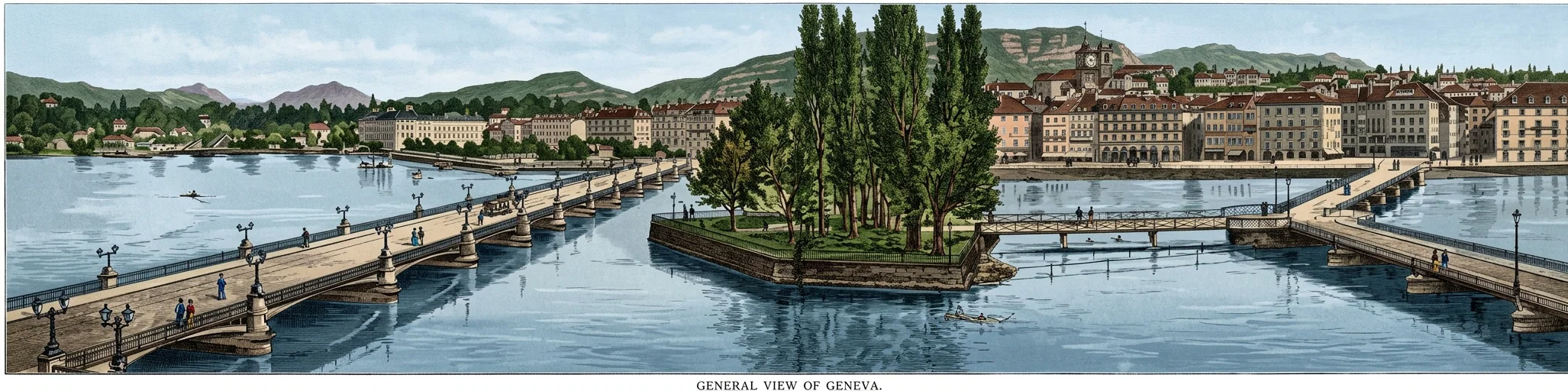
General View of Geneva.
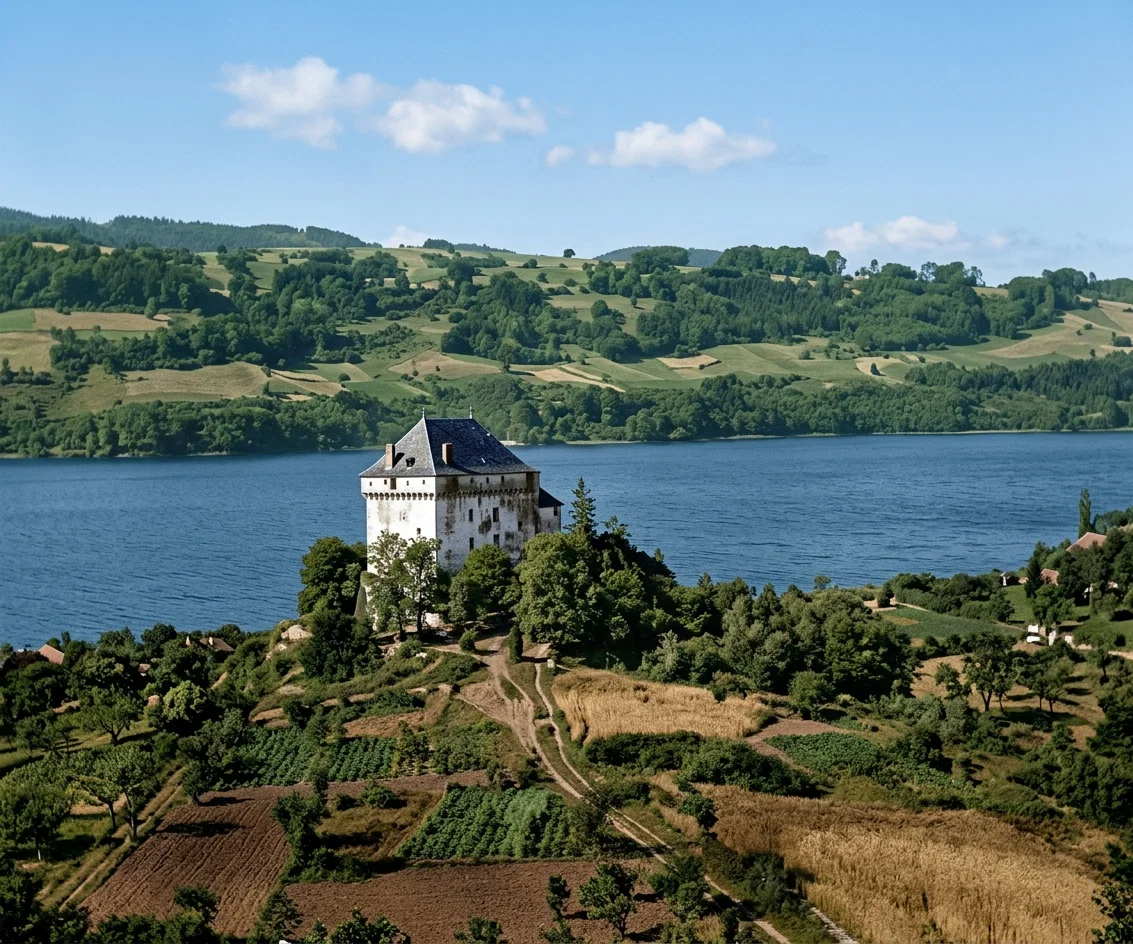
Chateau of Chatelard.
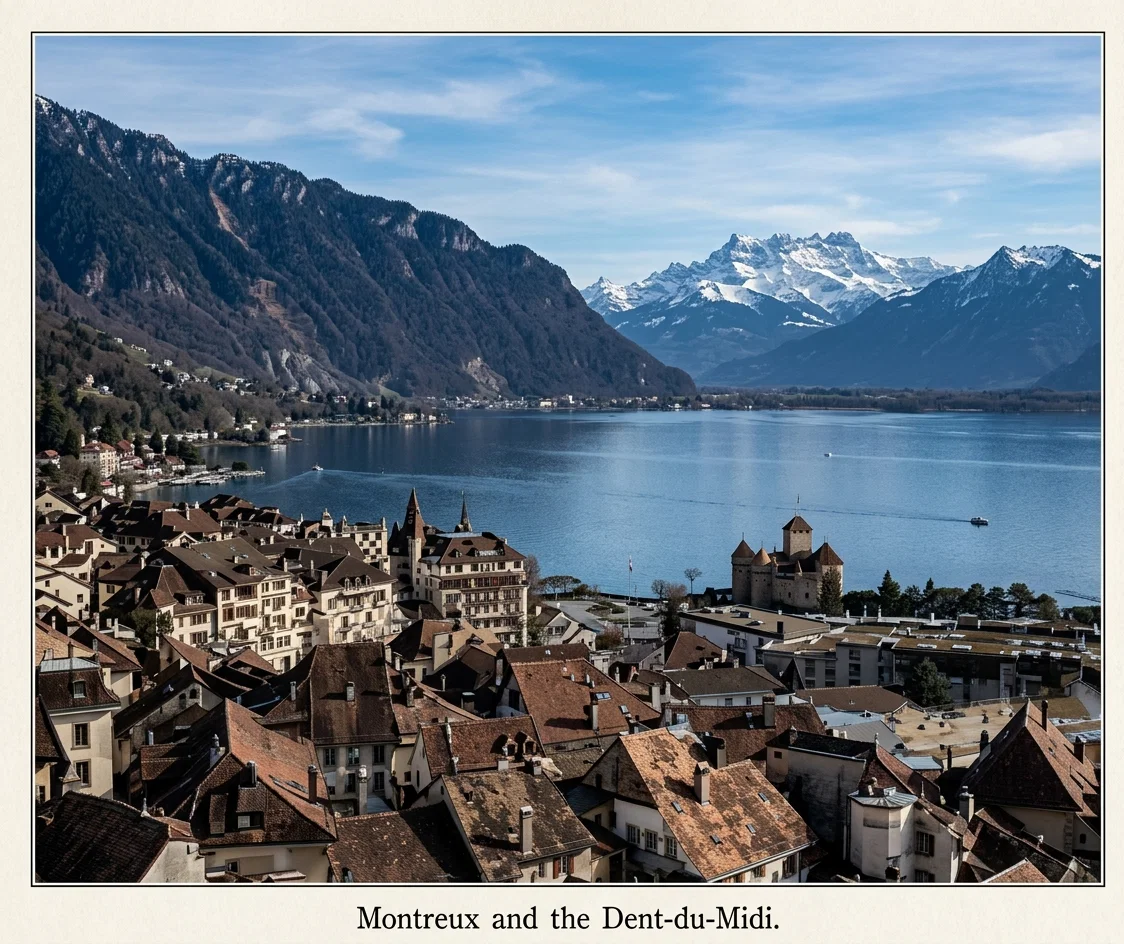
Montreux and the Dent-du-Midi.