The fame of that great nation from which the Copts mainly derive their origin, renders this people objects of much interest, especially to one who has had the privilege of examining the wonderful monuments of ancient Egypt.
The Copts at present, it is said, compose about one fourteenth of the population of Egypt; and about ten thousand of them are in Cairo. In some parts of Upper Egypt are villages inhabited exclusively by persons of this race, especially in the district called the Fayoom.
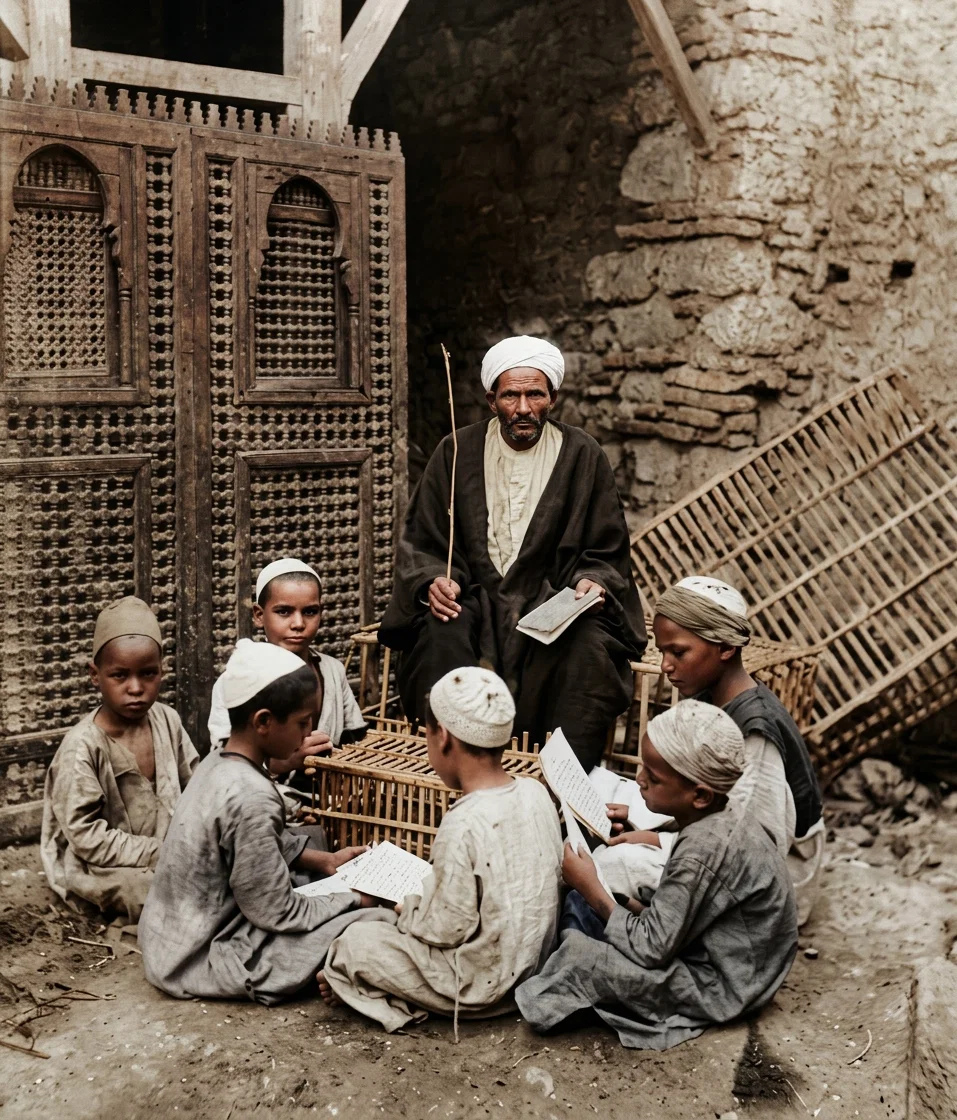
A NATIVE SCHOOL
The vast number of ruined convents and churches existing in different parts of Egypt shows that the Copts were greater in number a few centuries ago; but every year some embrace the faith of El-Islam, and become intermixed by marriage with Moslems. Thus the number of Christian Copts has been reduced to the present small population.
They have not altogether lost their ancient language, their liturgy and several of their religious books being written in it. But the Coptic has become a dead language, understood by very few persons, and the Arabic has been adopted in its stead; though at present there is a movement on foot for its revival, and it is now being taught in their schools. Many speak English, and thus the way is open to labor among them. Generally they love to study the Bible, but have many traditions. To them we are to look for workers to labor among the Islams.
Quite a number are interested in the truth, and some would keep the Sabbath, but, being employees of the government, it is a difficult thing for them to do so. Egypt has no industries whatever; and when young men come out of school, the only source of work is employment under the government. Even the commercial houses will not employ them, as the majority of these houses are European, and engage their workers from Europe.
With the exception of a small proportion who profess the Romish or the Greek faith, the Copts are Christians of the sect called the Jacobites, from Jacob Baradæus, a Syrian, who was a chief propagator of the Eutychian doctrines. The Coptic church recommends baptism of boys at the age of forty days and girls at the age of eighty days, if they are well and healthy, but earlier if they are ill and in apparent danger of death; for it is a prevailing belief among these people that if a child dies unbaptized, he will be blind in the next life, and the parents must do penance for the sin of which they are guilty in not having had the child baptized.
Most of the Copts circumcise their sons at the age of seven or eight years.
The Copts have numerous schools, and are generally better educated than the Mussulmans, occupying most of the government positions. But very few of their women are able to read or write.
In their prayers the Copts somewhat resemble the Moslems. I am informed that there are very few of them who do not comply with a precept of their church which enjoins them to pray seven times in the course of the day. The first prayer is said at daybreak, the second at the third hour, the third at the sixth hour, the fourth at the ninth hour, the fifth at the eleventh hour, the sixth at the twelfth hour,—sunset,—and the seventh at midnight. In the seven prayers of each day those persons who have learned to read repeat the whole book of Psalms. The illiterate repeat at each prayer hour the Lord’s prayer seven times, and, “O my Lord! have mercy!” forty-one times. Previous to prayer, persons of the better classes wash their hands and face, and some also wash their feet. They always face the east while praying. Their ordinary prayers, or at least the latter and shorter form, they often repeat while walking or riding or otherwise actively employed.
Confession is required of all members of the Coptic church, and is indispensable before receiving the sacrament of the Lord’s supper. The Copts observe long and arduous fasts. They also hold that pilgrimage to Jerusalem is incumbent on all who are able to perform it. The pilgrims compose a numerous caravan. They pass the passion week and Easter at Jerusalem, and on the third day after the passion week proceed to the Jordan, in which they bathe.
They almost universally abstain from the eating of swine’s flesh. Their ordinary domestic habits are Oriental, and very nearly the same as those of their Moslem fellow countrymen. They pass their hours of leisure chiefly in the same manner, enjoying their pipe and coffee. Their meals, and the manner of eating, also are similar, but they drink brandy at all hours of the day, and often to great excess. The women are not allowed to be seen in the street without a veil.
Recently we have had meetings in our mission home, which were well attended by Copts and Greeks. The services were conducted in English and Arabic, and much interest has been manifested. A few days ago I received a letter from a Copt who is a government employee, a railway station master. He has attended some of our meetings and studied present truth. He writes that he is anxious to be free from his employment, and go into a school where he and his wife may study the Word of God and prepare to work for him. We hope that his prayer may be answered, and that both he and his wife may become wise in the Word of God, and be able to teach it to their people. As yet we have no lady workers to labor among these native women groping in darkness; and a man, no matter how often he visits the home, may see the men, but is never allowed to talk to the women.
Several other Copts are much interested, especially two young men in the school of telegraphy. They have been coming to our house almost every night to study the Bible, and have told me that their one desire is to prepare themselves for the ministry, to be instruments in God’s hand to carry the everlasting gospel to those who are far from him. A Greek young man also is much in favor of the truth, and desires to keep the Sabbath; but being young,—only sixteen,—his parents have put him into employment. The Word of God is working upon his heart, and we believe that the time is not far distant when he will, by the help of God, keep the commandments of God and the faith of Jesus.
We are in great need of a school, that14we may train some of these young people for the work, and of a printing press, that we may print literature in the Arabic. We hope that the day is not far distant when these needs will be supplied.