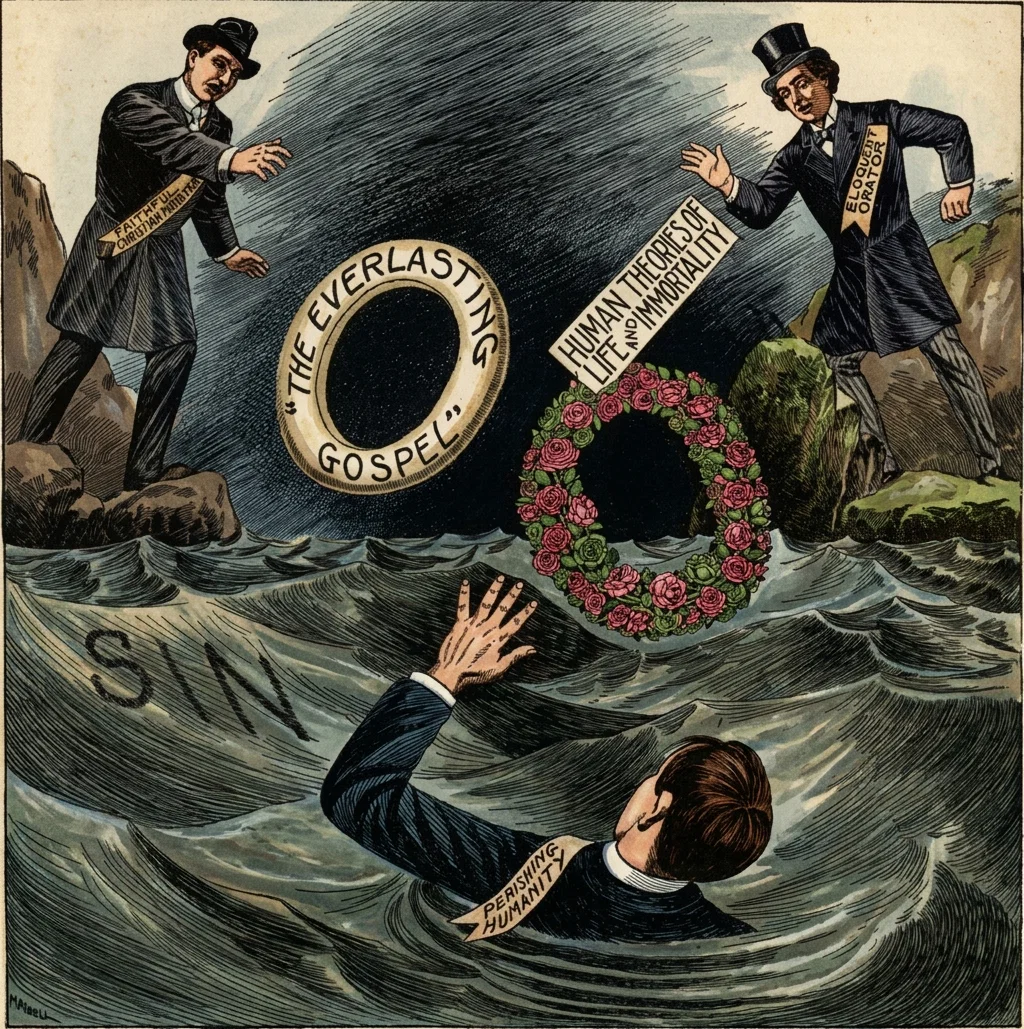
The apostle Paul, in speaking of the days in which we live, sets forth the following prediction concerning a large religious class. He does this not as suggestive or presumptive, nor is it a conclusion from certain premises; it is an inspired prediction concerning an apostasy to take place in the church. We read:
Humanity is perishing in the great sea of sin and vice and sorrow and wretchedness. Humanity is longing for salvation. What a mockery it is to cast to it the beautiful flowers of rhetoric which furnish nothing but human theories, new hypotheses of science, falsely so-called, and dreams of blue ribbon orators! What is needed, as has been recently expressed by Professor Nash, is "men of God who will preach the Gospel of Jesus Christ." There is in that Gospel the power to save. Would to God there were vastly more preaching it!
“This know also, that in the last days perilous times shall come. For men shall be lovers of their own selves, covetous, boasters, proud, blasphemers, disobedient to parents, unthankful, unholy, without natural affection, truce-breakers, false accusers, incontinent, fierce, despisers of those that are good, traitors, heady, high-minded, lovers of pleasures more than lovers of God; having a form of godliness, but denying the power thereof: from such turn away.” 2 Tim. 3:1–5.
Note that these eighteen different sins are among those who have “a form of godliness” but deny the power thereof. That is, they are professedly religious, but the power of godliness is not seen in either life or doctrine. In the same chapter the apostle declares that “evil men and impostors shall wax worse and worse, deceiving and being deceived.” He exhorts Timothy, and through him all the Christian ministers to come, to hold to what he denominates the Sacred Writings, the Holy Scriptures, “which are able to make thee wise unto salvation;” and then of these Scriptures he declares, “Every Scripture inspired of God is also profitable for teaching, for reproof, for correction, for instruction which is in righteousness: that the man of God may be complete, furnished completely unto every good work.”
Then follows the solemn charge which has been repeated thousands upon thousands of times in Christian churches to Christian ministers: “I charge thee therefore before God, and the Lord Jesus Christ, who shall judge the quick and the dead at His appearing and His kingdom: Preach the Word; be instant in season, out of season; reprove, rebuke, exhort with all long-suffering and doctrine.” The reason for this admonition is given in the following verse: “For the time will come when they will not endure the sound doctrine; but, having itching ears, will heap to themselves teachers after their own lusts; and will turn away their ears from the truth, and turn aside unto fables.”
These are solemn truths to him who believes in the inspiration of the Scripture. When “the light of the world” becomes dim, when “the salt of the earth” has lost its savor, then indeed are times perilous. The same degenerate condition of the latter-day church is predicted in many other scriptures. Our Lord tells us that “because iniquity shall be multiplied, the love of the many shall wax cold.” Matt. 24:12. Another apostle writes: “But there were false prophets also among the people, even as there shall be false teachers among you, who privily shall bring in damnable heresies, even denying the Lord that bought them, and bring upon themselves swift destruction. And many shall follow their pernicious ways; by reason of whom the way of truth shall be evil spoken of.” He tells us that these are “presumptuous,” “self-willed,” “wells without water,” “clouds that are carried with a tempest;” “they speak great swelling words of vanity,” and promise liberty, but bring bondage.
Many other passages might be given, but these must suffice. Are they met in these days? Do we see the awful drift there predicted?
“An Epoch in Theologic Thought”
Last week we quoted from an authority on the new departure in the Christian church, “The Independent” of June 24. We refer our readers to that again, on page 7 of that issue. We are there told that the process of criticism beginning with Genesis “had to go on from Genesis to Revelation with no fear of the curse at the end of the last chapter. It could not stop with Moses or Isaiah, it had to include Matthew, and John, and Paul. Every one of them had to be sifted. They had already ceased to be taken as unquestioned final authorities. . . . The miracles of Jesus had to be tested as well as those of Elijah. . . . We have just reached this condition, and there is repeated evidence that it MARKS AN EPOCH, A REVOLUTION IN THEOLOGIC THOUGHT. . . . But this DOUBT, even this QUESTIONING OR DENIAL, CHANGES THE OLD EVANGELISTIC THEOLOGY. It QUESTIONS OR DENIES the TRINITY, the RESURRECTION, the SACRIFICE OF THE CROSS, even ALL MIRACLES, and it DETERMINES ALL AUTHORITY OF INSPIRATION OR EVEN REVELATION and sends us back to HUMAN REASON, with such divine guidance as may be allowed. The authority of the Bible and the authority of the church both to be validated ONLY BY HUMAN REASON.”
That is what “The Independent” said several months ago. It has spoken again. It is probably in touch with more ministers in the United States than any other journal. It has kept in touch with the so-called progressive movement. It has predicted it, fostered it. In its issue of January 6, 1910, it reviews some of the “progress” that has been made. It declares: “We are sometimes surprised [a strange thing] at the rapidity of the theological movement in various denominations.” And then it cites the coming over to that view of “The Congregationalist,” the leading orthodox paper in that denomination. It says:
Wide-Spread Infection
“Doctor Gordon, of the Old South Church in Boston, wrote a book, the purpose of which was to show that belief in the Biblical miracles is not at present particularly useful and is not essential to Christian faith. We might have passed this by as exceptional, altho indicative, if The Congregationalist, the old defender of the faith of its churches, and now the organ of the Congregational publishing society, had not frankly come to support this new view. It somewhat surprised us. We recalled the times when that journal under its earlier names . . . had condemned the succeeding innovations down to the later days when future probation was the militant heresy.”11
“The Congregationalist wrote to a dozen leading professors in theological seminaries and to other teachers and pastors, asking what they thought of the doctrine of Dr. Goodwin’s [Gordon’s] book. While some strongly opposed, it proved that the weight of the majority approved the teachings that the present age is not helped in its faith by a belief in miracles, and that the Christian faith does not need them; that it needs Christ and His teaching, but does not need His miracles. Thereupon The Congregationalist recorded, assented and approved.”
“And this remarkable fact we record as a fresh stage, if not an epoch, in our ecclesiastical history. The same infection, defection, or prefection, whatever it may be called, is visible everywhere. Only this past week a leading Presbyterian pastor in Brooklyn has preached the same new doctrine. It comes naturally out of the new view of Scripture, and the passing away of the doctrine of plenary inspiration, so that in place of it we have a teaching which does not essentially distinguish the inspired authority of the writers of the Bible from that of other wise and good men, and which leaves us to accept our sacred writings for what we find them worth rather than for the special grace of those who wrote them. We can judge the sixty-six books of the Bible, and can accept or reject what we find in them according to the evidence for or against it.”
And this brings us to just what “The Independent” said last year—HUMAN REASON. All the theories that may be presented before us are subject to that one standard, and to the one hope—self salvation.
“Myths” and “Disordered Visions”
“The Independent” continues:
“All this is very radical. It transcends the old Unitarianism and Universalism. . . . It must be understood that with the miracles it denies so important a doctrine as the physical resurrection of Christ, and that it must equally allow belief that it was either a pure myth which very early arose, or that it grew out of more or less disordered visions, like those of the apostle Paul. There can be no sort of historic doubt that the earliest apostles and other disciples fully believed in the resurrection of Jesus, and they, or some of them, believed that they had seen Him. On this belief the church was founded, not on the teachings of the Sermon on the Mount. This is a tremendous fact, of which the new theologians must take account. It was because they believed in the actual and visible resurrection of Jesus Christ, that they had courage to preach immortality, and were willing to die in hope of eternal life. If they had not held this great miracle true they would have held their preaching vain.”
“This they all held, Peter and James and John, as well as Paul and Barnabas. And much more Paul, the scholar and theologian, added, which we have largely allowed to slip out of our faith—the doctrine of the atonement, the penal sacrifice for sin, and the second coming. But all these are matters either of history or philosophy, and so not matters of duty and personal religion.”
Apostles and Disciples Mistaken
And regarding these very things on which the church is founded, “The Independent” says:
“We are no better or worse for believing or not believing so long as we try honestly to follow the evidence.” “While it is very hard to believe that the early disciples, the associates of Jesus before His crucifixion, were mistaken when they testified that they had seen Him risen from the grave, or that the Christian church was founded on an historical mistake, yet we have no right to disfellowship those who doubt, but who yet accept Jesus as Master and Lord, and who follow and obey His teachings of duty to God and man. They are yet brethren, even if they follow not us; good and godly Christians, and are not to be repelled even notwithstanding 2 John 10.”
And here we are. This is in perfect harmony with a sermon preached in the Old South Meeting-house, Boston, by the Rev. C. W. Casson, reported in the Boston “Journal” of November 22: “I accept the Bible as you would a fish, picking out the bones before swallowing it, and I AGREE WITH IT when it agrees with ME.” And the “ME” has come to be the god to direct our faith and to save us from our sins. That perhaps is a statement which the modern theology would not approve; for some of the advanced ones do not believe that we are sinners after all, because the story of the fall is utterly rejected. We are only in a stage of development in which all are progressing. The calmly thinking, reasoning man will naturally inquire, If the stories that have come to us concerning Jesus Christ are not to be believed in respect to His birth, His miracles, His atoning sacrifice, His death upon the cross, why shall we believe Him concerning His teaching? Why should we accept the Sermon on the Mount as His teaching, and not what He says of His second coming?
Either the writers of the New Testament spoke the truth, or they were dishonest men. They not only say that they themselves saw Christ after He was risen from the dead; they not only say that Christ wrought the miracles recorded, and that they saw the miracles; they not only give in their own words what Christ taught; but they also declare that Christ Himself taught the very things which modern theology declares to be myths, falsehoods, vagaries of a disordered mind. Again and again Christ tells us that He is coming again, and that His coming will be a literal coming. The teachings of the later writers are but accounts of what our Lord Himself taught respecting this. If their teaching and conviction is to be laid at the doors of a disordered vision, why not that of the Master also? and then how can we depend upon any of His teaching?
“The church has fallen, the beautiful church, And her shame is her boast and pride.”
What Is Christianity?
This brings us again to the very question, “What Is Christianity?” No better, more comprehensive human definition than that given by the historian of the Reformation: “Christianity is a life sent down from God.” Jesus declares of Himself, the basis of Christianity, “I am the Way, the Truth, and the Life.” The way to life He makes through the atoning sacrifice and His death upon the cross. To reject the atonement, the way of the cross, is to reject Jesus Christ. Everywhere He confirms the Word; everywhere He honors it; sometimes upon one single word alone He builds mighty arguments. To reject that Word which came through Him—for He was but the Incarnate Word—is to reject Jesus Christ. To reject that life, based deep in essential righteousness, and which was manifest in the resurrection from the dead, is to reject Jesus Christ.
We may not accept His moral teaching and call ourselves Christians while rejecting the essential things that will make that moral teaching effective in our lives. We had the moral teaching before Jesus Christ came. He demonstrated the power, the life; and that only is Christianity which takes hold upon that power and that life. If we reject His miracles, we will also fail to grasp that greatest of all miracles—the changing of an unregenerate heart into the likeness of Jesus Christ. For He felt that it was essential that those miracles should be recorded in order that men might believe what is to every soul the greatest of all miracles, the transformation of his life. For we read, “Many other signs therefore did Jesus in the presence of the disciples, which are not written in this book: but THESE ARE WRITTEN, that YE MAY BELIEVE that Jesus is the Christ, the Son of God; and that BELIEVING YE MAY HAVE LIFE in His name.”
Standard Bearers Yet
Thank God, there are yet those in the great denominations, in the various Protestant bodies, who believe the Word; who believe it from Genesis to Revelation; who believe in the fall and the only redemption from that fall—Christ Jesus our Lord; who believe in the virgin birth; in the marvelous teaching; in the mighty miracles; in the resurrection from the dead,—a pledge to God’s church in all time of the glorious eternal victory of righteousness and life over sin and death. We plead with these to be faithful to God and faithful to that Word wherever it may lead. We plead with those who are holding out empty cups to the clouds without water, driven by the tempest of theologic doubt, to turn from these deceptive appearances to the great Fountain of life, opened for sin and uncleanness. Turn from the broken cisterns of men to the cool snow-waters of life’s Lebanon. Turn to Him who entreats us, “If any man thirst, let him come unto Me, and drink.” If a man drinks of these human theories, he will thirst again; but if a man drinks deep of the life of the Lord Jesus Christ, he will find refreshing at no other fountain.