THE RISEN CHRIST

8%

Pacific Press Publishing Company · Mountain View, California · Apr 18, 1906

FromSigns of the Times, Vol. 32, No. 16

Read the full edition

THE RISEN CHRIST.

Gloom as dark as night marked the declining day that Jesus was laid in the silent sepulcher.
“HE IS NOT HERE; HE IS RISEN.”
But the gloom could not quench the love-light that still glowed in the hearts of devoted disciples. Loving hands lift the dear form from the cruel cross and lay it upon the cool earth, upon which He had bowed in such fearful agony a few hours before. Loving hands straighten the bent limbs, which had ever moved in the pathways of love and duty. The nail-pierced hands, which ministered so many blessings of life, are composed by His side. The dear eyes, no longer lighted by infinite love, are gently closed. The hair is smoothed back from the noble brow. Loving hands of devoted disciples, some of them unknown till this darkest hour, wrap the body in linen and spices, and bury Him in the new rock-hewn tomb of one who loved Him even to the death.
DESPERATION of death in the heart of priest and rulers, they led the mad mob which cried for His crucifixion before the Roman governor. They had exulted in triumph when the time-serving Pilate had yielded to their clamor and He was led away to be crucified. But the awful, supernatural events of the hours upon the cross had taken away their lately-begotten confidence. What meant the darkened heavens? What meant the rent veil of the temple? What was the meaning of the mighty earthquake and the opened tombs and the terror of the people? It was plain to the Roman centurion—this was the Son of God. It was plain to the dying thief—this was the Saviour of men, the Coming King. The rulers of the nation, who above all others ought to have known, were blinded by sin, so they shut their eyes to God’s tokens, and persistently go on in their rebellion. They are determined that He shall not rise from the dead, and so the greatest power of earth, Rome, is enlisted to circumvent and bury forever Life. That the soldiers may be secured, they even desecrate the Sabbath to obtain the military guard. Pilate granted their request; “so they went, and made the sepulcher sure, sealing the stone, the guard being with them, in the end of the Sabbath.” Matt. 27:66; 28:1. Satan and his host seemed triumphant.
GLORIOUS was the mission God gave His mighty angel that First-day morning. His glory overpowered the Roman cordon of soldiers, and hearts which had quailed not in fiercest battle fell before this shining messenger from the courts of glory. The Roman seal melted in the presence of his splendor; the stone was rolled away; God’s voice called to the Royal Sleeper; and Jesus the Son of the Infinite came forth a conqueror. With Him sprang to life the persons whose graves were opened at His crucifixion.
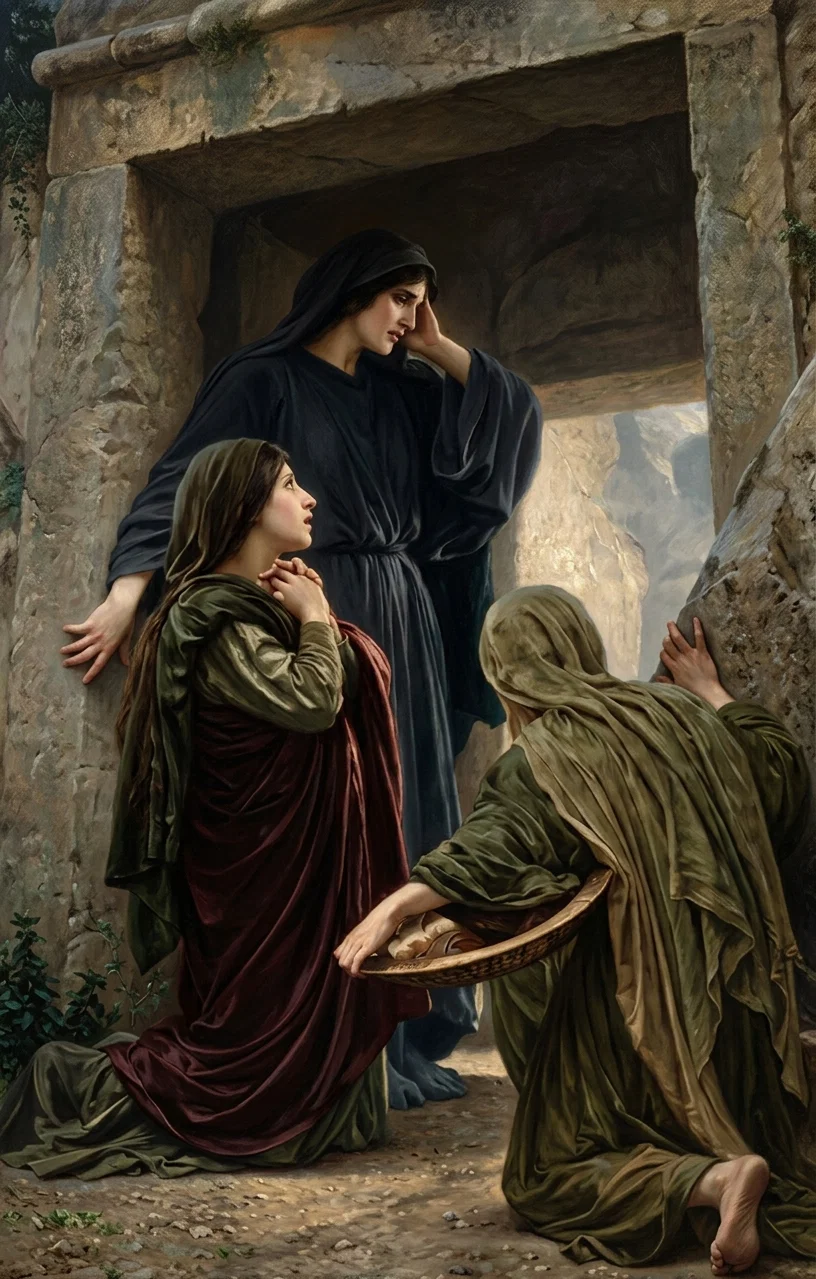
GLAD were the tidings God gave His angel to bear that morning to the almost disconsolate disciples. The women came first; they wished better to embalm the body for burial than they were enabled to do that afternoon before the Sabbath. They asked themselves the question, “Who shall roll us away the stone from the door of the tomb?” And looking up, they see that the great stone is rolled away. Then Mary Magdalene runs and tells Peter, “They have taken away the Lord out of the tomb, and we know not where they have laid Him.” The other women enter the tomb, and find two shining angels who ask the question, “Why seek ye the Living among the dead? Ye seek Jesus, the Nazarene, who hath been crucified; He is risen; He is not here; remember how He spake unto you when He was yet in Galilee, saying that the Son of Man must be delivered up into the hands of sinful men, and be crucified, and the third day rise again; behold, the place where they laid Him! But go, tell His disciples and Peter, He goeth before you into Galilee; there shall ye see Him as He said unto you.”
NOT gladder was the angels’ song at the birth of our Lord than was the message of the angels to the discouraged disciples,—“He is risen.” And this later message has also its important lessons for our admonition and instruction.
WHAT an echo of trouble-borrowing humanity is in the question: “Who shall roll us away the stone?” How many times God’s own children see the closed doors in imagination, and wonder who will open them as they go forward. Sometimes while they question they become discouraged, and they turn from the opportunity which calls them forward to greater light and blessing. Others, tho trusting, go forward, and find the great stone rolled away, the obstacle removed, the lions chained; yet when a new danger threatens, the same experience is often repeated. O, that we might learn that God lives; and that, if He calls, the raging sea or the swelling Jordan would open a path through the deep at His command.
THE living among the dead!” Nay, more; the Living One! Among the dead! What should life have to do with death? There is no fellowship between them. When Christ the Lord went down into the tomb, He went there a prisoner in our behalf, as He declared He would go; and when that time had expired, Righteousness Everlasting could not be held by great stones or iron bars, or even death itself, “because it was not possible that He should be holden of it.” Acts 2:24. Look into the dead sepulcher if we will, mark the place where the Lord lay, gather up the “holy shroud,” the napkin, and anything else; but He is not there, the tomb will know Him no more. The linen cloths, the spices, the napkin are no more than the dust on which He trod in His journey up the steeps of Calvary. Yet for centuries men plotted and planned and strove and starved and suffered and died to obtain the empty tomb. “Why seek ye the Living among the dead?”
GOD pitied the disciples in their blindness. He knew that they sought Jesus, that they longed for Him. He recognized that; but He told them and all others who might come after them that Jesus was not in the tomb. He died, but He is risen. He is the Living One, alive forevermore. His own voice comes back, “I am He that liveth, and was dead; and, behold, I am alive forevermore, amen; and have the keys of hell and of death.” Tell this to My disciples. Especially tell Peter, the discouraged one, disheartened by his own sins, that I live; that I remember him; that I love him; let him take courage and live.
CHRIST goes before you, beyond the city walls, beyond the environs of Jerusalem, beyond Judea, out into the Galilee of the nations. He ever goes before, leading onward in the great field of truth, in the great regions of lost and needy humanity. The Crusaders were not alone at fault in seeking Christ and power and holiness in the dead and empty forms of the past. Any Christian who seeks power by the empty shell of what once held life is repeating in his own experience the lesson taught by the discouraged disciples and the Crusaders. John Wesley or Paul Smith or Peter Cartwright may have had wonderful success in using certain methods, but the methods were incidental; the success was because of the divine life within the workers. He who uses the empty method, hoping by that to gain success, is seeking the Living One among the dead; and to them comes the voice of God’s messenger, “He is not here; He is risen; behold, He goeth before you.”
BRETHREN IN GOD, by whatever name you are called, Christ is risen! By the power of His righteousness He is risen and lives and reigns. By the power of righteousness and life He would come into our hearts, make us alive from the dead, take us from the dry, dead empty forms which sometime may have known His presence, and make us to sit in heavenly places with Him. Keep close to His word. He declares, “The words that I speak unto you, they are spirit, and they are life.” If He dwell in us, His life will take new form in method and plan and device far more fitting to our work and character, and filled with the constant daily experience of a risen Christ in us. “Christ is risen indeed!” “He goeth before you, . . . there shall ye see Him.”