THE above expression from the Scriptures has been twice placed in connection with a fire scene in previous numbers of this paper. There are those who have inquired as to its meaning or application. In reply to these and others, we would say that the text was so used as illustrative of the often close connection of these agencies of destruction, and to teach a lesson. The lesson is of vastly more importance than the mere aptness of the illustration.
THE passage is found in 1 Kings, chapter 19. The previous chapter reveals the utter discomfiture of the false prophets who were nourished by the corrupt queen Jezebel, and of the slaying of those prophets who had brought such a curse upon Israel. Then Elijah, the prophet of God, prays for rain upon the drouth-smitten land, and it comes in abundance. Ahab, the king, drives from Carmel to Jezreel in his chariot, but Elijah, the messenger of the Most High, the hardy mountain-dweller, runs ahead of the chariot for twenty-five miles, enters the city before the king, and lies down wearily by the city gate, discouraged at the spiritual apathy of Israel.
FROM his unrefreshing slumbers a messenger from the cruel Jezebel arouses him with this message: “So let the gods do to me, and more also, if I make not thy life as one of them [the false prophets] by to-morrow about this time.” Wearied, worn, and discouraged, fear took possession of the fearless prophet who had fearlessly faced the most dreaded dangers. He arose and fled for his life. Reaching the southern border of Judah, he leaves his servant, and presses on into the wilderness to die. At the end of a weary day's journey, he casts himself down under a scraggy broom tree of the desert, and moans in his utter discouragement: “It is enough now, O Jehovah, take away my life; for I am not better than my fathers,” and in sheer exhaustion he falls asleep.
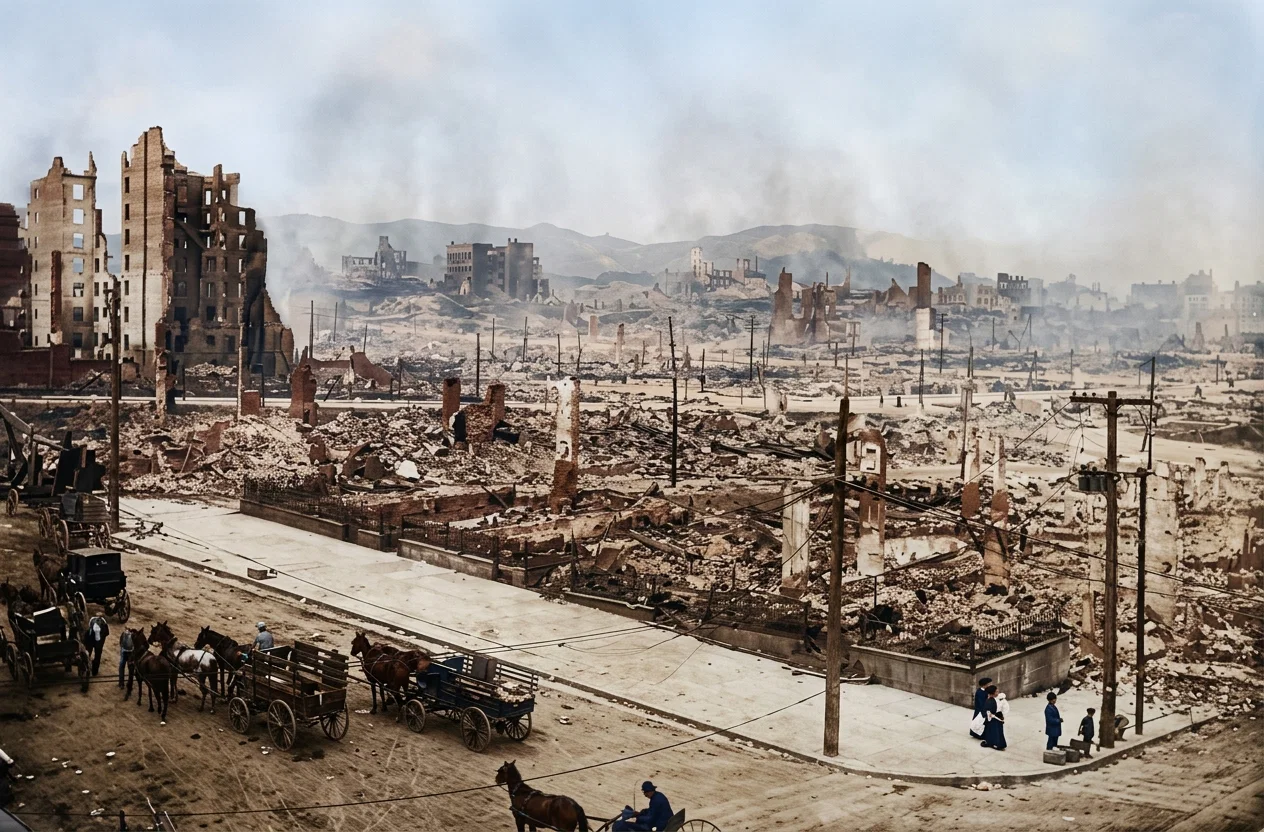
After the Fire in San Francisco. Looking northward toward the Fairmont Hotel. This was the appearance of square miles after the awful burning.
GOD pities him, sends His messenger, and twice in that night he is aroused to eat and drink of the food prepared by the angel; and in the strength of that food he presses on for forty days and nights unto Horeb the Mount of God. And the story continues:
“And he came thither unto a cave, and lodged there; and, behold, the word of Jehovah came to him, and He said unto him, What doest thou here, Elijah? And he said, I have been very jealous for Jehovah, the God of hosts; for the children of Israel have forsaken Thy covenant, thrown down Thine altars, and slain Thy prophets with the sword; and I, even I only, am left; and they seek my life, to take it away. And He said, Go forth, and stand upon the mount before Jehovah. And, behold, Jehovah passed by, and a great and strong wind rent the mountains, and brake in pieces the rocks before Jehovah; but Jehovah was not in the wind; and after the wind an earthquake; but Jehovah was not in the earthquake; and after the earthquake a fire; but Jehovah was not in the fire; and after the fire a still small voice. And it was so, when Elijah heard it, that he wrapped his face in his mantle, and went out, and stood in the entrance of the cave. And, behold, there came a voice unto him, and said, What doest thou here, Elijah? And he said, I have been very jealous for Jehovah, the God of hosts; for the children of Israel have forsaken Thy covenant, thrown down Thine altars, and slain Thy prophets with the sword; and I, even I only, am left, and they seek my life, to take it away. And Jehovah said unto him, Go, return on thy way.”4
THE text and context clearly indicate that Elijah expected his zeal to accomplish Israel's reformation. He had been very zealous, he had wrought mighty things; but now, discouraged, all his work seems a thing of naught, and he stands alone. Then God gave him the lesson. A mighty wind rends the mountains and breaks the rocks, a mighty trembling follows which shakes the very earth; and then a devouring fire sweeps over the ruins; yet God is not in wind or earthquake or fire. He uses them. Before they came “Jehovah passed by.” But the prophet seemed not to know it. He shrunk back into the mountain cave, afraid.
YET Jehovah uses even these great destructive agencies. They come in consequence of sin, as the results of perverted law. God permits them, that man may learn how evil sin is, how destructive is its power, what an enemy to mankind it is. God would have man learn his own helplessness and nothingness; how pitifully weak he is before these great perverted forces of nature. He has grown him great crops; the wind, the storm, the tempest, the tornado, destroys them. He erects noble buildings; the earthquake shakes the foundation and the buildings are broken, and the fire sweeps over and licks up what is left. All earthly hopes are wrecked and in ashes, and upon the dreary ruins sits helpless humanity, discouraged, despairing, disconsolate, desperate, or determined.
TO ALL in these great calamities, which come in consequence of sin, God speaks. Again and again in that awful morning at San Francisco, conscience called men to judgment, conscience condemned them for their deeds, conscience aroused within them impulses to do better, and nobly many acted on those impulses; not alone in San Francisco the great heart of humanity was touched. It is ever so. In the great forest fires of Wisconsin and Michigan a few years ago, wild and savage beasts herded with the most timid, peaceful, and harmless. In the waters of a lake could be found bear and deer and dog and wolf and sheep and man. The fear of a great power had suppressed for a time the savagery born of sin, and peace reigned. The tornado, the earthquake, the fire, frighten and subdue for the time the sin-born savage in man, and good impulses rise to the surface and bear sway till the fear is gone, the love of self asserts its rule, and the impulse issues in death. Men—even the unregenerate—sorrow as the impulses die and the spirit of fellowship vanishes. Even so are they sorrowing to-day in the city by the Golden Gate.
AT such times as these comes ever the voice of God to every soul the sanctuary of which is not barred and bolted against righteousness. By some almost forgotten sermon, by some word of Scripture learned when a boy, by every and any means which can be used, God speaks to the soul, and bids it, “Come unto Me.” He offers forgiveness and cleansing, fellowship and counsel, comfort and strength; healing for every hurt, balm for every bruise; riches of grace and glory which tornado nor earthquake nor fire can destroy, a character which is priceless beyond all rubies, eternally young and expansive in the everlasting, unshakable, sinless kingdom of God.
TO HIS servants Jehovah would teach this lesson: “It is not by might, nor by power, but by My Spirit, saith Jehovah of hosts.” It is not the big things in which we pride ourselves that accomplish God's work; it is the uplifting, penetrating power of a life hid with Christ in God. We may not reach Israel by thunder tones or mighty displays of eloquence or force; we may reach them by prayer through the power of the Spirit. We may feel we are all alone; but God still has His own faithful ones who have not, and will not, compromise faith or righteousness on the altars of lust or greed. The still, small voice of God is more than all the might of mere power. The weakness of God is stronger than men. O soul, hide in Him.