Current Arguments for the Return of the Temporal Power.
As one may readily imagine, the current arguments in favor of the return of the temporal power of the Papacy are those that emanate from Catholic sources; and therefore in the main they are but a repetition of the arguments that have long been in vogue in the Catholic Church. They were largely formulated by Thomas Aquinas whose theology is the basis of almost all Catholic teaching. The old saying which we repeat so often that “the church never changes” is a truth easily susceptible of verification here at Rome. In fact one who is now a teacher of truth, while a professor in the Catholic seminary, objected to some of the teachings of the church as being out of harmony with the spirit of the times. To which the head of the seminary responded that “the church is founded on God, and as God never changes, so the church never changes.” It is from all testimony clearly evident that their position remains always practically the same, and differs only in the statement of it.
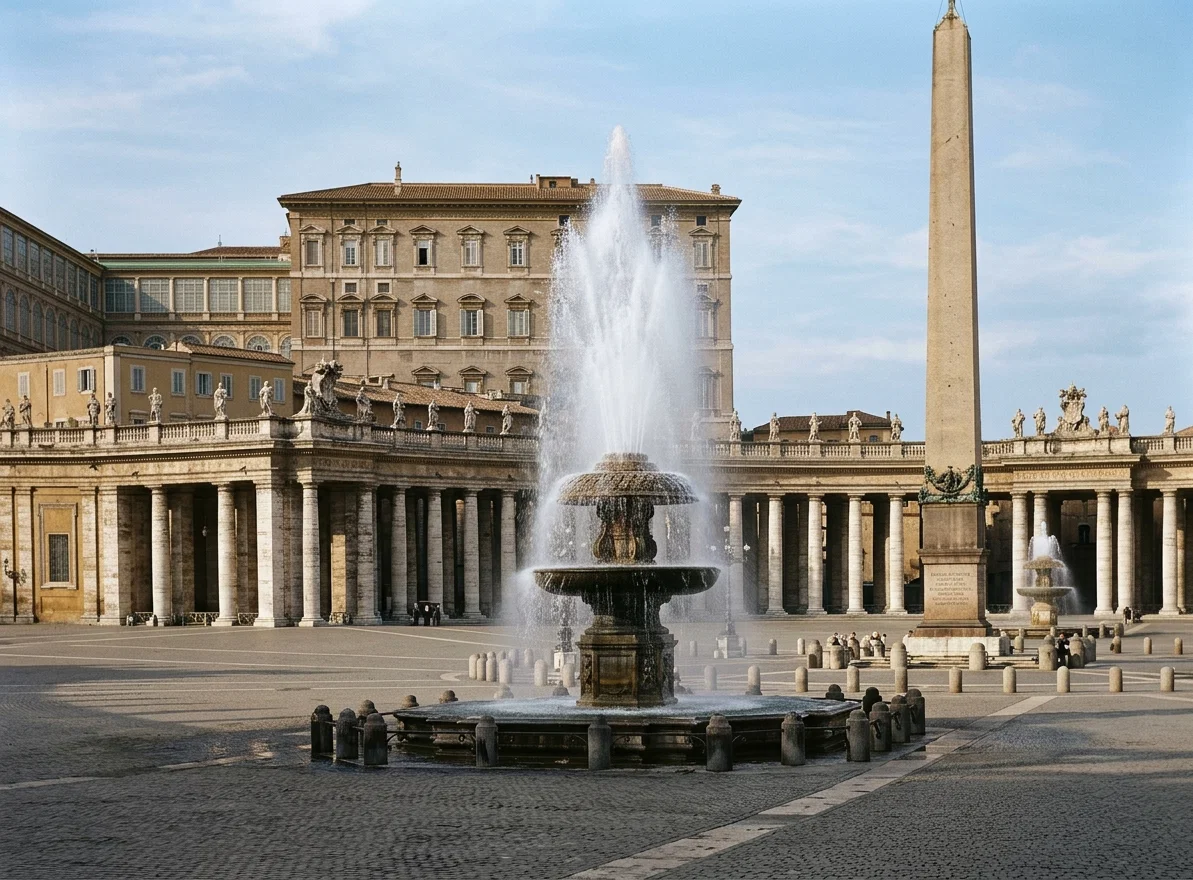
Plaza and Fountain in the Vatican.
The Main Arguments.
The main arguments employed by the church to sustain its claims to the temporal power may be reduced to a few statements:
1. The Catholic Church claims to have received from God the commission and the authority to teach men the right way to live. As they are invested with the authority to teach individuals, they claim that this authority extends itself over the state likewise, for a state is only a collection of individuals. Therefore to exert this authority it is necessary that the church should occupy a position which is independent of the state. If the church were subject to the state it could not exert its authority over the state; for the teacher must occupy a position superior to the one taught; or otherwise, there could be no discipline and consequently no progress. Then it would follow that one could not have a discipline without some punishment attached, and some authority to enforce such punishment when the case should demand it. Consequently, the church claims that it must occupy a position in society where it is subject to no government, and yet have secured to itself at the same time the power to make laws for the furtherance of its God-given work, and also the authority to see that its commands are obeyed. Therefore, Catholics claim that they are entitled to a government of their own where they can be independent to do the work assigned them according to the best interests of the church.
2. The church is a regularly constituted institution, established in the midst of society by God. As every society has the right to make laws for the furtherance and protection of its interests, the Catholics claim such a right for their church. Therefore, they also insist that by the nature of the case they are entitled to a position where they can protect their own interests, and where they can deal decisively with such as are trying to break down their institutions. Thus persecution is simply their attempt to stamp out the enemies of their society and those that are plotting against the best interests of their church.
3. The moral capability of the pope to rule. As the pope is the vicar of Christ on earth, and has been appointed by God to rule the church, why should not such a person be also a splendid ruler for the state? And after all the state that has a good moral basis is more sure to succeed than the one which is irreligious and corrupt. As the pope is morality personified, according to the Catholic conception, his rule would certainly be preferable to that of kings and emperors who often make no pretensions to religion.
Perhaps these statements may suffice to give the general underlying principles, which form the basis of the arguments for the return of the temporal power. These principles are manipulated and woven together according to the necessity of the case; but the Catholic position always remains the same. C. E. MILTON.
[The next article will consider some of the Arguments against the Restoration of the Temporal Power.]