The First President — Dissolving Parliament — A New Despotism Feared — China’s New Constitution — The Financial Crisis
By F. E. STAFFORD
Shanghai, China
Mr. Stafford has spent five years in China. At first he was connected with the large Chinese publishing house that has wielded such a powerful influence in bringing about the transformations that have made China so modern in many of her governing aims and designs. Later Mr. Stafford’s work has brought him in personal contact with the masses of her people, so that he writes from the standpoint of experience and his own observation. He has given us four articles, of which this is the first, in each of which he presents some features of the material and the moral conditions and problems of the great Oriental republic. Next week he will tell of the progress in education, the extension of railways and telegraphs, increase in army and navy, the development of her natural resources, and the suppression of the opium traffic. EDITOR.*
Since the election of Yuan Shi Kai as president of China, October 6, 1913, followed immediately by the formal recognition, by the world powers, of the new republic of the Pacific, much interest has been displayed by the different nations, and by individuals all over the world, in watching the course of events in the Orient, to see if the great step contemplated by the Chinese people could be actually carried forward to completion.
Now that a year has passed, it will be interesting to note some of the events that have occurred during that time. That a backward movement should be reported in many quarters is not surprising, when it is considered how far the pendulum was swung forward two years ago, at the time of the revolution.
A United Country
First of all, China stands to-day as one country, territorially intact, with the administrations of all the provinces loyal to the central government, and the majority of the people anxious to lay down their arms and follow the pursuits of peace. Dr. Wu Dingfang says: “The Chinese people are peace-loving by nature. Leave them to themselves, let them have peace, and they are quite willing to be ruled. They are easily governed, and under a good government will progress. But let peace come first.”
A Suitable Government
The question of a proper government to fit the needs of the Chinese peoples seems to be the key upon which the progress of the country depends. Since the abdication of the throne by the Manchu emperor, much experimenting has taken place and is still going on as to just what is the best form of government. When the president was inaugurated, October 10, 1913, he took solemn oath that he would “most sincerely obey the constitution, and faithfully discharge the duties of president,” thus committing the country to the form at least of a republican government.
At that time, however, there was no constitution to obey, and absolutely nothing to show what the duties of the president should rightly be. Public opinion in regard to these questions was not only divided, but of such a hazy nature as to be thoroughly unreliable; so it is not surprising at all that the president’s own ideas about his duties have come to be adopted. Just whether this is best for all concerned, it is impossible to say at this early period; but one thing is sure,—a republican government as ministered by the American people is not suitable for China to-day.
Is Yuan Shi Kai Despotic?
Much has been written of late in the papers describing the despotic character of Yuan Shi Kai, and it has been openly charged that he is trying to set up another monarchy in China. In view of these statements, some assertions made by the president in his inaugural address will be of interest.
He says: “My opinion is that the chief and first principle of government consists in the clear definition and promulgation of legal systems, and the establishment and maintenance of public order, that the people may be united in the path of progress. I have preferred the more conservative rather than the extreme radical course, in order that the fate of the people should not be put to any risk. I am one of the citizens of the country, and the single purpose of my heart is to effect the salvation of the nation and its people.
“Western scholars have said that the principal thing for a constitutional government is the law, and that of a republican government is morality. Therefore morality should be considered as the cause, and the law as the effect. A republican government is one that gathers the opinions of all its citizens to form a complete system of law for the strict observance of all, and liberty outside the law should be forsaken by all.”
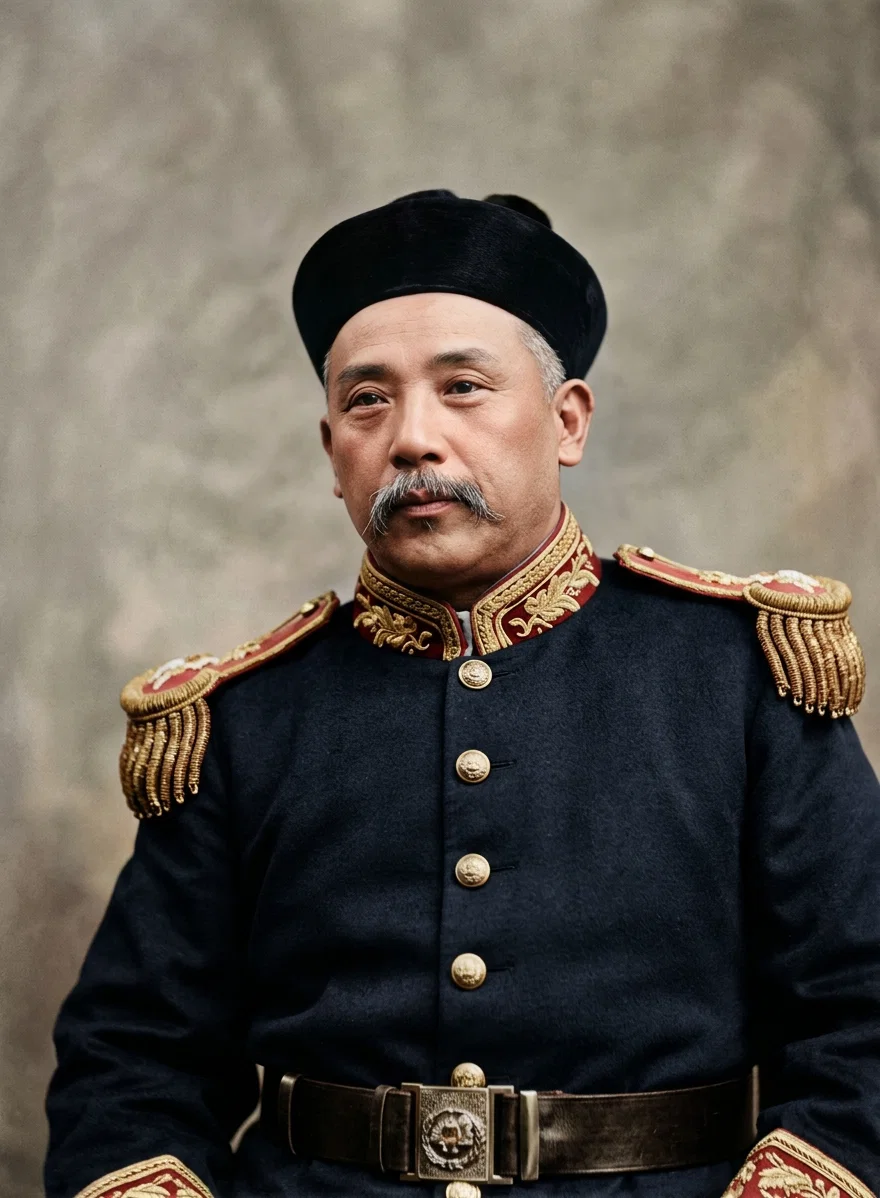
YUAN SHI KAI, PRESIDENT OF THE CHINESE REPUBLIC
“Should permanent peace and order be desired for the nation, it is imperative that every man be enabled to obtain a livelihood, which can only be done by paying special attention to agriculture, industry, and commerce. The climate and natural resources of our country are by no means inferior to those of other powers, but these have never been developed. Thus we are as a rich man who has buried his riches under the ground, and is complaining all the time of poverty. There are two reasons for this condition:
The education of the country is still in its infant stage, and no attention has been paid to physics, chemistry, steam, or electricity.
There is no large capital. If there be shortage of silver or gold, the means of exchange will be lacking. To introduce the civilization and capital of foreign countries is not only for the good of the country, but for the good of the world at large; and we should never have any prejudice against foreigners, causing trouble and breaking the laws of justice. I, the president, hereby declare that all the agreements, contracts, and treaties made between China and the governments of other nations during the time of the late Manchu government and the provisional government of the republic shall be respected.”
Fall of the Kuomingtang Party
Almost the first thing the president did was to issue an order dissolving the Kuomingtang party, stating as the reason that the members of this party were responsible for the rebellion last summer and were still plotting against the government. So their headquarters were to be closed permanently, and all Kuomingtang members of parliament were summarily dismissed.
When this was done, it was found that there were not enough members left in the parliament to make it a workable body; and as it had been more of a hindrance than a help from the start, the next logical step of the president was to dissolve parliament. This he did, promising to convoke the national assembly in due course, in accordance with the provisional constitution.
As time went on, however, it was plain that Yuan was in no hurry to do this; and when, a little later, he proceeded one step farther, and dissolved the provincial assemblies, it seemed as though the last vestige of government by the people had disappeared. Many of the heads of the government bureaus resigned. So for the time, the power of government was unquestionably in the hands of one man, and that man supposedly the president of the republic.
Building a New Government
The crisis had arrived. “What will he do now?” was asked by every one. Wise ones shook their heads, and the people watched with bated breath to see the die cast, to see if the pendulum would swing back to monarchism.
First the vice-president, Li Yuan-hung, was summoned to Pekin; and he turned over the command of the army at Hankow to another general, and proceeded to headquarters, to take his part in the drama. General Li has been strong for Yuan from the beginning, and the president was sure of one loyal supporter.
Yuan next began looking around for trusted supporters who would fill the portfolio of cabinet officers; and in a short time he surrounded his office with a coterie of followers, who at least would not hinder his plans, whether they had ability to carry out the duties of their various offices or not. Thus constituted, the new government unfurled its sails to the wind.
Early in December, 1913, the various provinces were asked to select delegates to meet with the cabinet officers in a central administrative conference, to which the general policy of the government would be submitted for discussion.
China’s Constitution
This convention assembled in due time; and after the consideration of various matters, a committee was appointed to draft a constitution. The draft was much discussed, and many changes were made, but it was finally passed, and became the provisional law of the land on May 1, 1914. It states in part as follows: “The republic of China is established by the Chinese people. . . . The sovereignty of the Chinese republic is vested in the whole body of the people. . . . The territory of782the republic consists of the twenty-two provinces, Inner and Outer Mongolia, and Kokonor. . . . The sovereignty of the republic is exercised by the national council, the president, the cabinet, and the judiciary. . . . The citizens of the republic are all equal, and there shall be no racial, class, or religious distinctions.”
There are sixteen articles regarding the president. They state that he is the head of the nation, and the controlling power of the administration. He represents the Chinese republic, is responsible for its citizens, and convokes the Lifayuan, or house of legislature. He declares the opening, suspension, and closing of its sessions; and he may, with the approval of the Tsangchengyuan, or administrative court, dissolve the Lifayuan. He appoints the secretary of state and the cabinet officers, and serves for a term of six years. He has sole power to appoint and to dismiss military officials, to declare war and to conclude peace, to control the army and the navy, to declare martial law, and to make treaties; but in the last case, he must have the approval of the Lifayuan if the articles change territories or increase the burdens of the people.
From these statements, it is perfectly apparent that the Chinese government is a government by the few for the many, and the principal power is in the hands of the executive of the land.
Financial Difficulties
One of the first questions Yuan Shi Kai faced was the very urgent one of the reorganizing of the finances of the nation. Persons unfamiliar with the facts, probably thought China had plenty of money to give her a good start, from the quintuple loan she secured last year; but upon close investigation, it appears that the largest part of this $125,000,000, as soon as it was turned over from the several governments to China, was immediately returned to them, either on back Boxer indemnity payments, or on short term loans, or in settlement of claims arising out of the revolution. Thus for running expenses and the enormous demands of reorganization work, China was nearly in the same position that she was in before. In fact, she was worse off in one respect, and that was that many of the provinces were not remitting any receipts to the central government, but were spending all they could collect locally, and securing private loans besides, which they tried to saddle onto the central government.
The minister of finance reported that besides the running expenses of the government, they would be compelled to meet, during 1914, payments of Boxer indemnities, interest on loans, etc., aggregating $205,850,000; so it would be necessary to take steps at once to put the finances of the country on some sound basis. He proposed the following measures of relief:
First, the conversion of short term loans into long term loans, and the repayment of loans bearing high interest with money borrowed at low interest.
Secondly, the issue of a six per cent domestic loan secured on the stamp tax.
Thirdly, the entire reorganization of the salt gabel.
Fourthly, internal revenue tax on tobacco and wines, mines, traffic, deeds, legal papers, etc.
Fifthly, income tax.
Sixthly, to petition the treaty powers to allow China to increase her customs tariff.
And last but not least, to reform the currency.
Some of these reforms are under way now, so that it is possible to see tangible results from them. As the quintuple loan was secured on the salt gabel, the reorganization of this source of revenue was put into the hands of a foreigner, Sir Richard Dane; and the latest reports are very encouraging in regard to the possibilities from this tax. It is coming in to the government now at the rate of $3,000,000 a month, thus making $36,000,000 for the first year; and as only $25,000,000 of it is actually pledged for interest and debts, it leaves a nice balance for China’s reorganization fund. This will probably be used in the reformation of the currency. The present plan, as outlined by the currency reform law published in January, is to adopt the yuan, or dollar, as the standard coin, and besides this, mint decimal coins as follows: fifty cents, twenty cents, ten cents, silver; five cents nickel; two cents and one cent, and five, two, and one li, copper.
The new currency will be introduced gradually, and all old coinages called in as fast as consistent, the existing dollars being regarded as equivalent to the new legal unit until a certain date when the new yuan is in general circulation.
Mr. F. A. Aglen, inspector-general of the maritime customs, reports that the total customs revenues for 1913 amounted to about $25,000,000 gold, showing a gain of $400,000 over 1912. The amount collected was more than enough to meet the payment of all loans secured upon them, as well as the entire Boxer indemnity charge for 1913.
Chinese National Loan
Just as we are mailing this article, the newspapers announce that the proposed domestic loan has been launched, and six per cent bonds for $25,000,000 have been issued by the government, secured on the surplus profits of the Pekin-Hankow Railway. This step is meeting with approval all over China, and the bonds bid fair to be all subscribed in a short time. $2,000,000 worth were bought in Shanghai alone, the first day they were put on the market.
This is a most encouraging omen for new China, as it shows the confidence of Chinese capital in the government; and it is only by this means that China can put her house in order, pay off her foreign loans, and become independent. This issue has been such a success that there is already talk of a second bond issue.
On the same date, September 5, the Financial Bureau issues a statement showing the amounts of each provincial revenue sent to the central government for the month of July, the grand total being $13,989,583. These figures speak louder than words, and to the friends and well-wishers of China, it is a source of great satisfaction to see the spirit of cooperation manifest. We trust it may continue to grow until the Chinese government is firmly established upon a solid foundation.