WIRELESS TELEGRAPHY

7%

WIRELESS TELEGRAPHY.

GALILEO, as early as 1632, discovered the principle of communication by electricity between widely-separated points. The action of the magnet upon a steel needle was the key to the discovery. In 1753 an Englishman suggested a method of conveying intelligence by electric currents through twenty-six wires, one for each letter of the alphabet. In 1837 Prof. S. F. B. Morse invented the telegraph instrument, and what is now known as the Morse alphabet. It was not until 1843, however, that he succeeded in obtaining from the government the aid necessary to enable him to construct and operate the first telegraph line in the world.
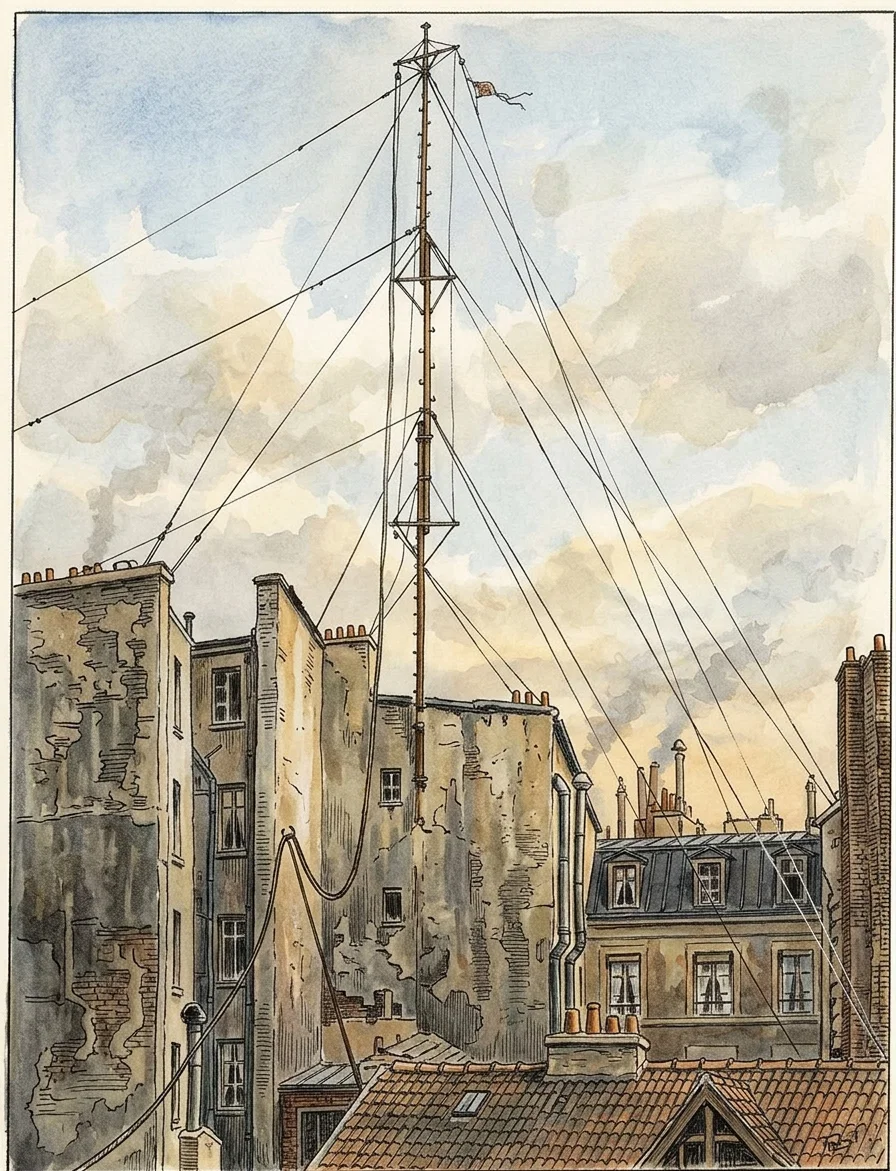
The Mast of a Wireless Telegraph Station Carrying the Wire Called the “Vertical Conductor,” from which the Messages Leap off into Space.
Since that time great advancement has been made in telegraphic communication, until the whole world is bound about or interwoven with a mesh of electric nerves. Let the finger of famine pinch Australia, and England knows it—feels it—without the lapse of time. Let the sword of the rioter fall in China, and the whole world is a-quiver with the sensation. It took the news of the battle of New Orleans three weeks to cover the distance between Louisiana and Maine. To-day we read of battles on the opposite side of the globe before the smell of the gunpowder has risen from the field, or the litters have dropped their bleeding burdens under the shelter of the hospital tent.
This is not all: where one message was formerly sent along one wire, now eight are being sent and received over the same wire at the same time. The carrying capacity of the electric wire is not limited to the transportation of dots and dashes, but has adapted itself to the faithful reproduction of the human voice, with its infinite variety of modulation; and, stranger than this, it is possible for the speaker and listener to see each other while they converse through hundreds of miles of wire stretched above the earth or under the sea. The hand-written telegram, produced at the rate of twenty-five or thirty words a minute, is being superseded by that produced upon the typewriter; that in turn gives place to a device which sends and receives over the wire, in printed form, two hundred words per minute. Scarcely has the latter been given a fair trial of its ability, before a device is patented and put in operation which will send matter over the wire at the rate of three thousand words per minute.
Now that the capacity of the copper wire has about been exhausted, the bold inventor discards it, and sends his messages quivering through the air. Perhaps the first step in wireless telegraphy was the invention of an apparatus by which messages could be sent and received from a moving railway train. The instrument would attract messages from the wires along the railroad or transmit messages to them; but the telegraph companies, fearing what this invention would enable one to do in the way of “wire tapping,” purchased the inventor’s patent rights for a large sum, and smothered the invention.
But the blocking of this step is a mere incident in the progress of long-distance communication. In 1842 Joseph Henry, of Washington, D. C., made the discovery that an electric spark in one room of his house could induce electrical activity in a wire circuit in another room without any connecting wires whatever. In 1888 the term “electric waves” was applied to this phenomenon by Hertz, a German inventor, who had spent much time in experiments along this line. Other scientists, foremost among whom is Dr. Bose, a Hindu, have been experimenting with this peculiar property of electricity; but Guglielmo Marconi, a young Italian of twenty-five years, has outstripped them all in turning the discovery to practical account.
The electric waves travel outward in widening circles from the instrument which produces them, as ripples on the water travel outward from the place where a stone strikes its surface. Young Marconi has invented a delicate instrument which picks up these waves and is agitated by them as the strings of a piano will pick up and reproduce a note struck on another instrument tuned to the same pitch. Thus the dots and dashes produced on the instrument which generates the waves are taken up and reproduced electrically in the delicate instrument constructed to receive them. As no wire connects the sender and receiver, this achievement is known as wireless telegraphy.
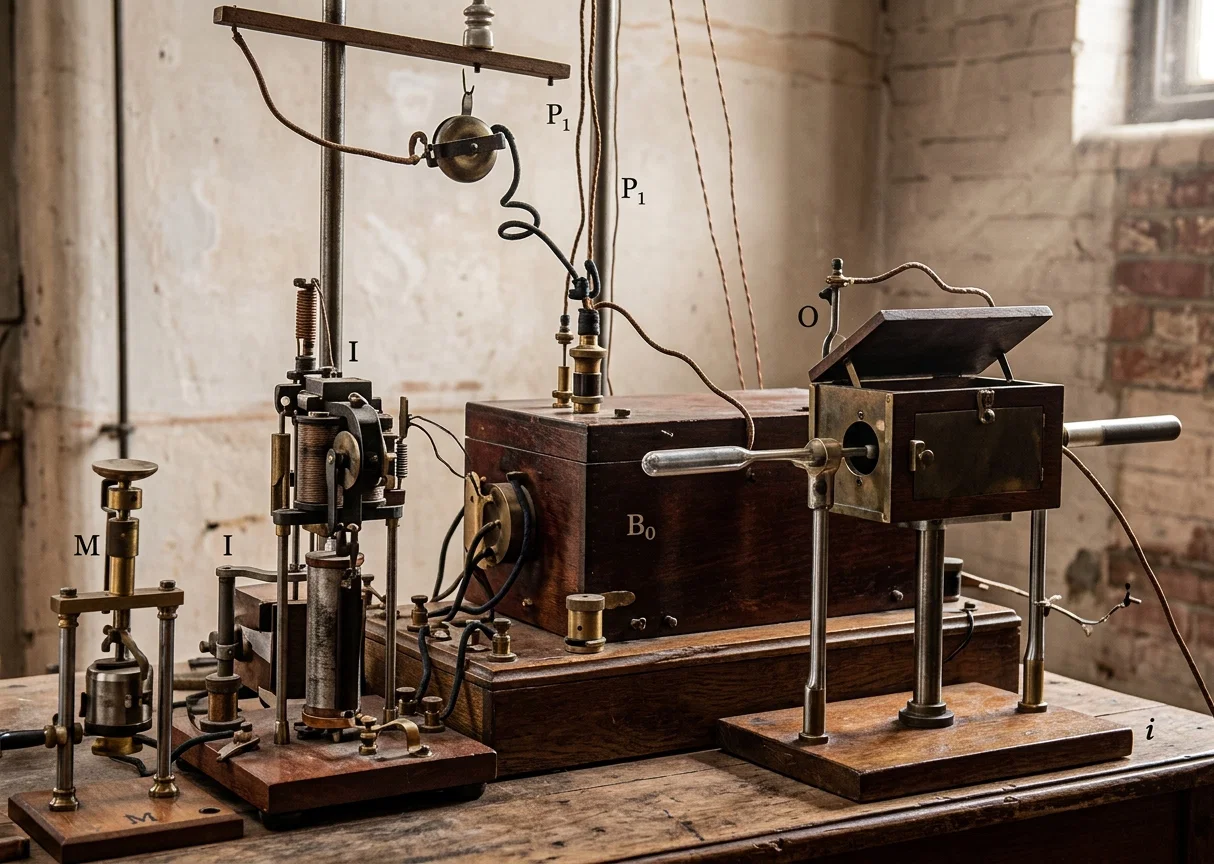
The Sending Instrument of a Wireless Telegraph Station. M is the Sending Key; I, the Motor Driving the Interrupter of the Coil, B₀; P₁, the Connection with the Mast; O, the Oscillator; and i, the Connection with the Earth.
Signor Marconi has had his system of wireless telegraphy in practical operation off the coast of England for several months, between the South Foreland lighthouse and the East Goodwin light-ship, a distance of twelve miles, while successful experiments were being conducted on land between stations eighteen miles apart. It is, however, within the past few weeks that the success has been attained which gives this system a real practical standing in the world. Marconi had been seeking for some time for permission to make the attempt to establish communication between the coasts of France and England, a distance of thirty-two miles across the English Channel. The permission was granted after much hesitancy, and stations were erected at Folkestone, England, and Boulogne, France. Messages were sent back and forth to the entire satisfaction of the experimenters, and apparently with as much ease as tho transmitted by wire under the channel instead of through the air above it.
The apparatus by which this wonderful achievement is accomplished is more simple in construction than would be expected of such a wonder-working instrument, and very little material is required for equipping a working station. Each station is provided with a sending instrument and a receiver, and from these a wire is carried to the top of a flag-staff, tower, tall building, or lighthouse. From this wire, or “vertical conductor,” the wave message leaps off into space, to be caught up by the receiver ten, twenty, or a hundred miles away.
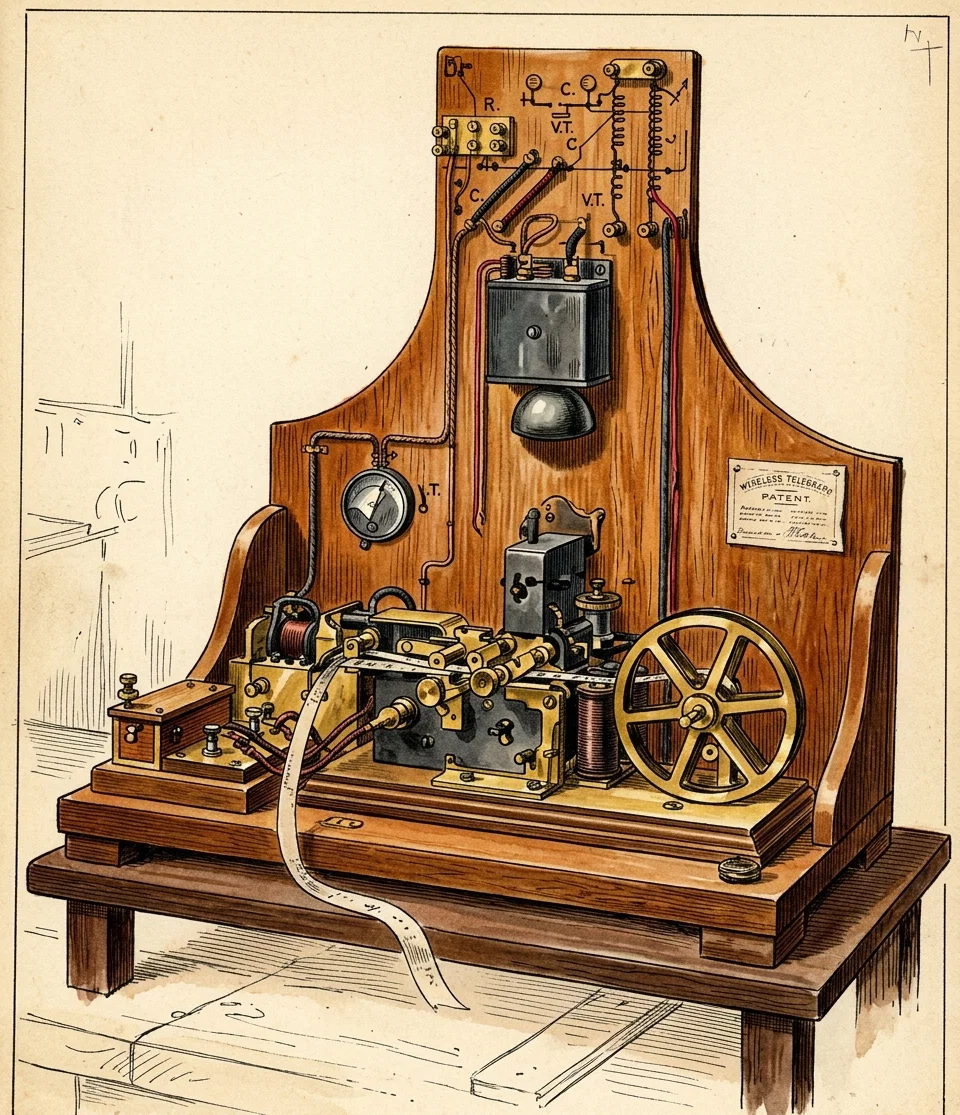
The Receiving Instrument of a Wireless Telegraph Station. The Dots and Dashes Are Registered on the Tape as Shown in the Cut.
From a tower eighty feet high messages are sent and received eighteen miles away. In the recent successful test of the system across the English Channel a “vertical conductor” 114 feet high was used. Tho the stations in this experiment were thirty-two miles apart, Marconi claims that with this height of conductor he can send messages forty miles.
It requires no stretch of the imagination to realize what the perfection of this system means. It is claimed that messages will soon be sent from continent to continent and from island to island by means of wireless telegraphy; that it will enable vessels at sea to detect the approach or proximity of other vessels in a fog, and thus avoid collisions, as well as to communicate with vessels in passing; and military men of the different nations are already preparing to utilize it in the operation of their armies. The old telegraph system, with its thousands of miles of wire stretched over the earth and its thousands of leagues of cable lying in the slime of the ocean bed, will then be a thing of the past, and the news of the world will be transmitted on electric waves and picked up on delicate electrical receivers in every part of the earth. C. M. SNOW.