The Millennium

11%

Pacific Seventh-day Adventist Publishing Association · Oakland, California · Oct 21, 1875

FromSigns of the Times, Vol. 1, No. 48.

Read the full edition

The Millennium.

THE Sacred Scriptures do not teach that at any period of time all men will be converted to God. There were but few righteous men from Adam to Moses. And their numbers in the Jewish age, compared with the multitudes of the unbelieving, were very small. Neither does God's plan in the Christian age embrace the conversion of all men. The gospel must be preached to all nations. Thus God visits "the Gentiles to take out of them a people for his name." Acts 15 : 14. Among the finally saved will not be found all of any one generation, or all of any one nation; but some out of every age, and every tongue will join in the song to the Lamb: "Thou wast slain, and hast redeemed us to God by thy blood, out of every kindred, and tongue, and people, and nation." Rev. 5 : 9.
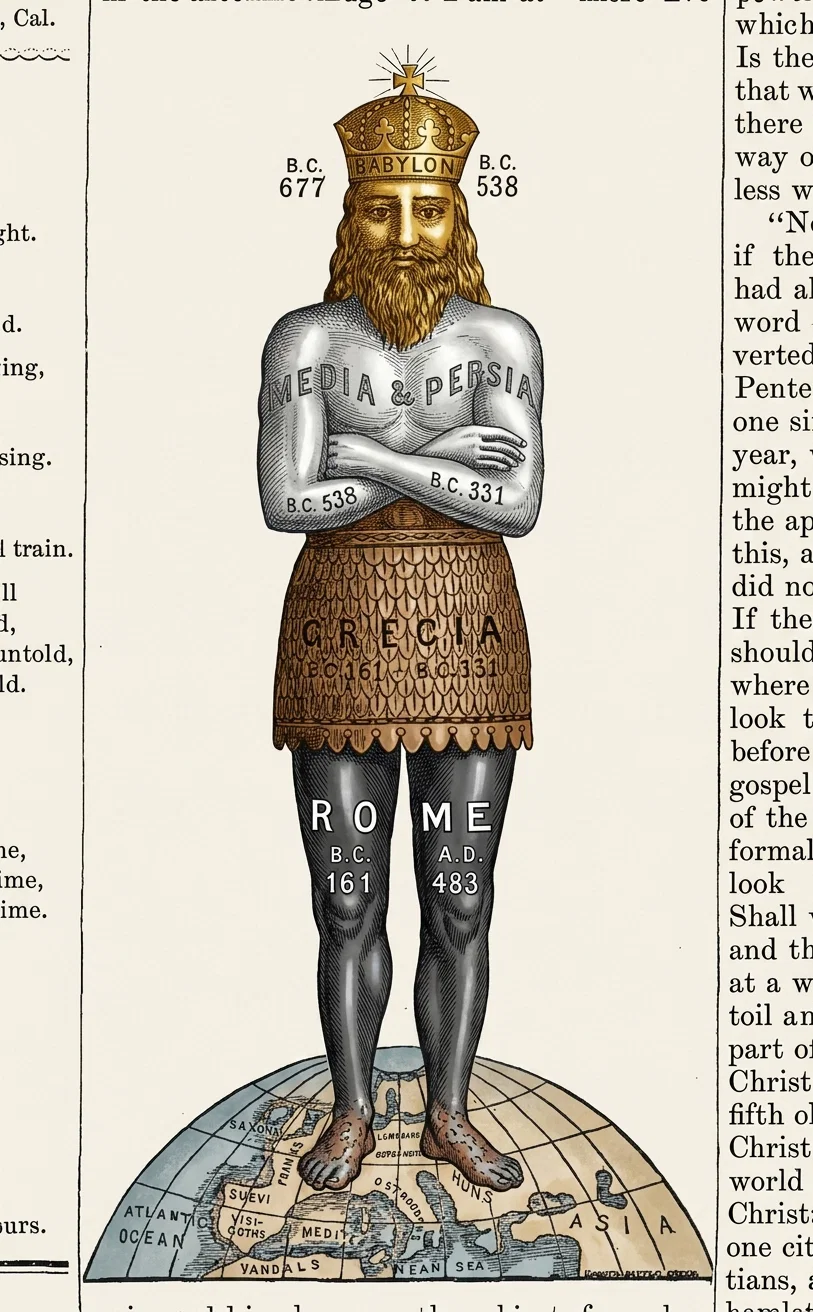
From the very nature of the case, the conversion of the world is an impossibility. God is the same during all time. He deals with men and nations impartially. The devil is the same, excepting that the experience of six thousand years has made him more artful in seducing men and women into sin. The fallen race is the same, only that each succeeding generation degenerates physically, mentally, and morally, till the world becomes fully ripe for her final doom. This is seen in the metallic image of Dan. 2. Here five universal kingdoms are the subject of prophecy. Four of these pertain to the mortal state, one to the immortal. The four earthly monarchies, Babylon, Persia, Grecia, and Rome, are severally represented by gold, silver, brass, and iron. We not only see in the symbol the depreciation of value from gold to silver, to brass, and to iron, but the last divided condition of earthly governments, just before the opening glories of the immortal kingdom, is represented by iron mixed with miry clay.
God's plan to convert sinners, and to save all who would obey him, and believe in Jesus, has been in operation about six thousand years. A crucified and risen Jesus has been preached with the Holy Spirit sent down from Heaven for more than eighteen centuries; yet the world has not been converted. And the prospect of its conversion to Bible holiness never looked darker than at the present time. In the forcible words of another we would inquire:—
"And what are the present prospects of a church that has set out in all confidence to convert the world? How may those now putting on the harness boast of greater expected success than is warranted by the experience of those who have put it off after having fought the good fight? The prophets could not convert the world; are we mightier than they? The apostles could not convert the world; are we stronger than they? The martyrs could not convert the world; can we do more than they? The church for eighteen hundred years could not convert the world; can we do it? They have preached the gospel of Christ; so can we. They have gone to earth's remotest bounds; so can we. They have saved 'some;' so can we. They have believed their report; so can we. They have finished their course with joy, and the ministry they have received to testify of the gospel of the grace of God; we can do the same. Can we reasonably hope to do more? 'It would take to all eternity to bring the millennium at the rate that modern revivals progress,' said the venerable Dr. Lyman Beecher, before a ministerial convention, held close by old Plymouth rock. And what hope is there that they will progress more rapidly? Is it in the word of God? Glad would we be to find it there. Sadly we read that 'evil men and seducers shall wax worse and worse, deceiving and being deceived.'
"Has God a mightier Saviour—a more powerful Spirit? Has he another gospel which will save the world? Where is it? Is there any way to the kingdom other than that which leads through much tribulation? Is there another way to the crown besides the way of crosses? Can we reign with Him unless we first suffer in his cause?
"No doubt the world might be converted if they desired to know the Lord. And so, had all who heard received with gladness the word of God, the world might have been converted within twenty years of the day of Pentecost. If each Christian had brought one single soul to God with each successive year, the calm splendors of the millennial era might have shone upon the declining years of the apostles of Jesus Christ. But instead of this, ages of darkness came on. The world did not repent, but the church apostatized. If the gospel were to convert the world, we should have seen tokens of it ere this. But where are such omens to be found? Shall we look to Judson, who labored ten long years before one sinner yielded to the claims of the gospel? Shall we look to the dense darkness of the heathen world? Shall we look at the formalism of the professed church? Shall we look at the wide extension of infidelity? Shall we look at the abounding of iniquity and the waxing cold of love? Shall we look at a world where eighteen hundred years of toil and tears have not brought one-twentieth part of mankind even to a profession of true Christianity; and where not more than one-fifth claim for themselves the dubious title of Christian nations? Shall we look over a world in which we cannot find one nation of Christians, nor one tribe of Christians, nor one city of Christians, nor one town of Christians, nor one village of Christians, nor one hamlet of Christians, save here and there where a questionable faith has led a few, with hypocrites even then in their midst, to withdraw themselves from the world, and cherish the untried virtues of secluded life? Surely, after eighteen hundred years of experiment with that system which was to convert the world, men might point to some country, to some province, to some nation, and say, Behold the commencement of a converted world.
"But will not the gospel then prove a failure? That depends upon what is to be expected of it. If the gospel was to effect the eternal salvation of all mankind, then failing to accomplish that work is a failure of the gospel. If it was to convert the world and then, if it is not done, it will prove a failure. But if the gospel was preached 'to take OUT OF THE Gentiles a people for His name,' then it is not a failure. If it was given that God might in infinite mercy and love 'save SOME,' then it is not a failure. If it was given that every repentant sinner might have eternal life, and that every good soldier might receive a crown of glory, then it is not a failure. If it was given that an innumerable company might be redeemed OUT OF every nation, and kindred, and tongue under heaven, then it is not a failure. If it was given that the vales and hills of Paradise restored might teem with a holy throng who shall be 'equal to the angels, and be the children of God, being the children of the resurrection,' then it is not a failure. If the elect might be brought into one great family of holy ones, then it is not a failure. And was not this its object, rather than the exaltation of a worldly church to the splendors of earthly prosperity, while beneath the theater of their easy triumph there slumber the ashes of prophets and the dust of the apostles? Are they to hold jubilee a thousand years, while the martyrs' unceasing cry, 'How long! O Lord,' goes up to God? Are they to have their songs of triumph, while the whole creation groaneth for deliverance, and while that longed-for day of the redemption of our body is postponed? Nay, verily, the hope of the one body is one hope. The hope of the church stops not at death, it sweeps beyond earth's scenes of tempest and of storm, and reposes in the calm beamings of that Sun of Righteousness which shall glow above the bosom of Paradise regained."