Railways

6%

Pacific Press Publishing Company · Mountain View, Cal. · Mar 20, 1907

FromSigns of the Times, Vol. 33, No. 12.

Read the full edition

Railways.

Peking to-day has two railroads which have succeeded in passing thru the walls, with stations located near the center of the city. Another railroad, called the Peking-Kagan line, has stations at each of the gates on the west side. This line passes north, and will connect with a southern branch of the Trans-Siberian road. It passes under the Great Wall and thru three tunnels, the longest of which will be a mile in length. When completed, this road, connecting as it will with the Peking-Hankow line, will form a very direct route from China to Russia, and will be the quickest mail route between Central China and Europe. It will also carry the tea from the great Russian warehouses at Hankow direct to Russia. This new line so far has been entirely under Chinese engineers, and only Chinese workmen are employed. Of the three roads entering Peking it is by far the best managed with reference to the conveniences offered to passengers. The other line is the one connecting Peking and Tien Tsin, trains running both ways forenoon and afternoon. This trip requires but three hours' time. Tien Tsin is the most northern commercial port of China. It is to be for North China what Shanghai and Hongkong are to Central and Southern China. This railroad has thus brought Peking in close touch with a seaport, making it convenient to ship modern conveyances of all kinds there, resulting in a great transformation in this ancient city.

General Improvements

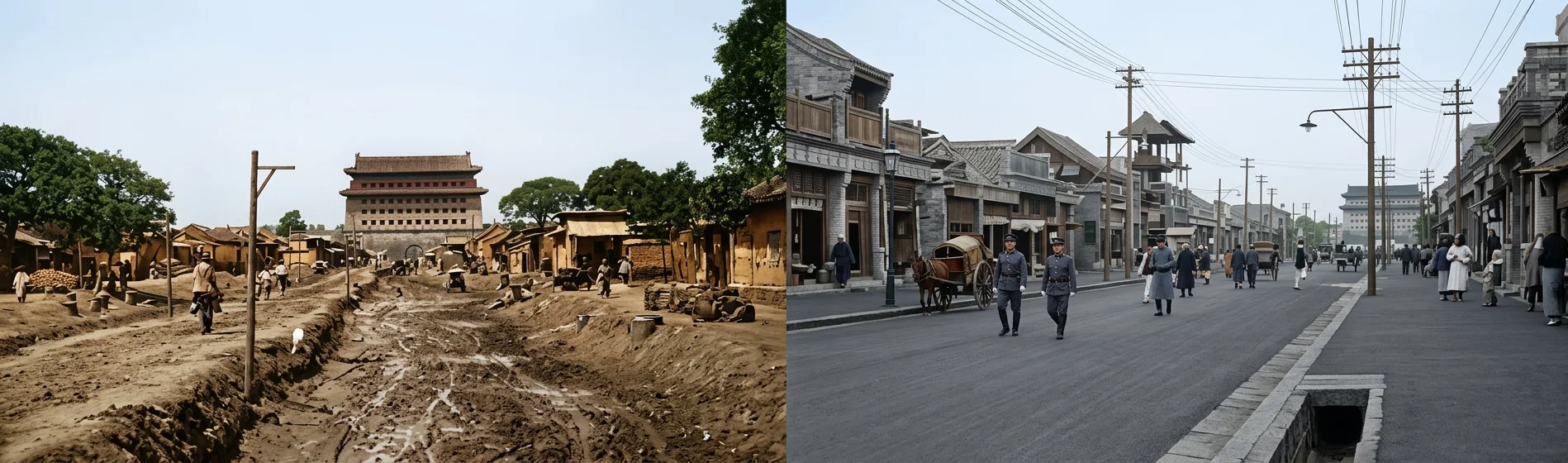
Macadamized roads, with sewers on either side, are everywhere supplanting the old mud road and trenches formerly used. Along either side of the main streets are street lamps, not over two rods apart; and corresponding to about every block, is a policeman stationed, dressed in foreign clothes and having no queue. Since this costume resembles that of the Japanese policeman, it is rather difficult to distinguish the two. On the streets are men employed, who are continually sweeping them, so they are kept like the boulevards in foreign cities. Also along each side of the street are telegraph and telephone poles. Almost all the important officials are already in communication by telephone. Carriage and bicycle shops are frequently seen, and these two conveyances are already much used. While Peking has opened no concessions for foreigners to conduct business, other than the land allotted to the legations and missionaries, nearly every foreign article is procurable, the Japanese especially having many stores and restaurants.

The Foreign Quarter.

The foreign ministers of the powers are all situated in one corner of the city, each having ample room and commodious buildings.
View of Street in Peking before Recent Improvements. View of the Same Street at the Present Time.
The American Legation is near the South Gate, Hon. W. W. Rockhill being the United States Ambassador to China. All of the countries have from one to two hundred soldiers in their legation for protection. The Germans have many more. Just across from the Foreign Ministers, the Catholics have a large, three-story hospital, and adjoining it an immense church. To the east of the Legations are thirty-two mo, or eight acres, occupied principally by buildings of the Methodist mission. There are eight large houses with all modern conveniences.
In connection with this mission are the following institutions: The Lockhart Medical College, the Peking University, the Woman's College, the Methodist Hospital, and the Woman's Hospital. All of these are buildings of modern convenience, being equipped with hot water and lighted with electricity or gas. It was surprising to find that in these buildings the most modern equipments were furnished, and nothing ordinarily used in securing comfort was omitted in their construction.

Idolatrous Temples.

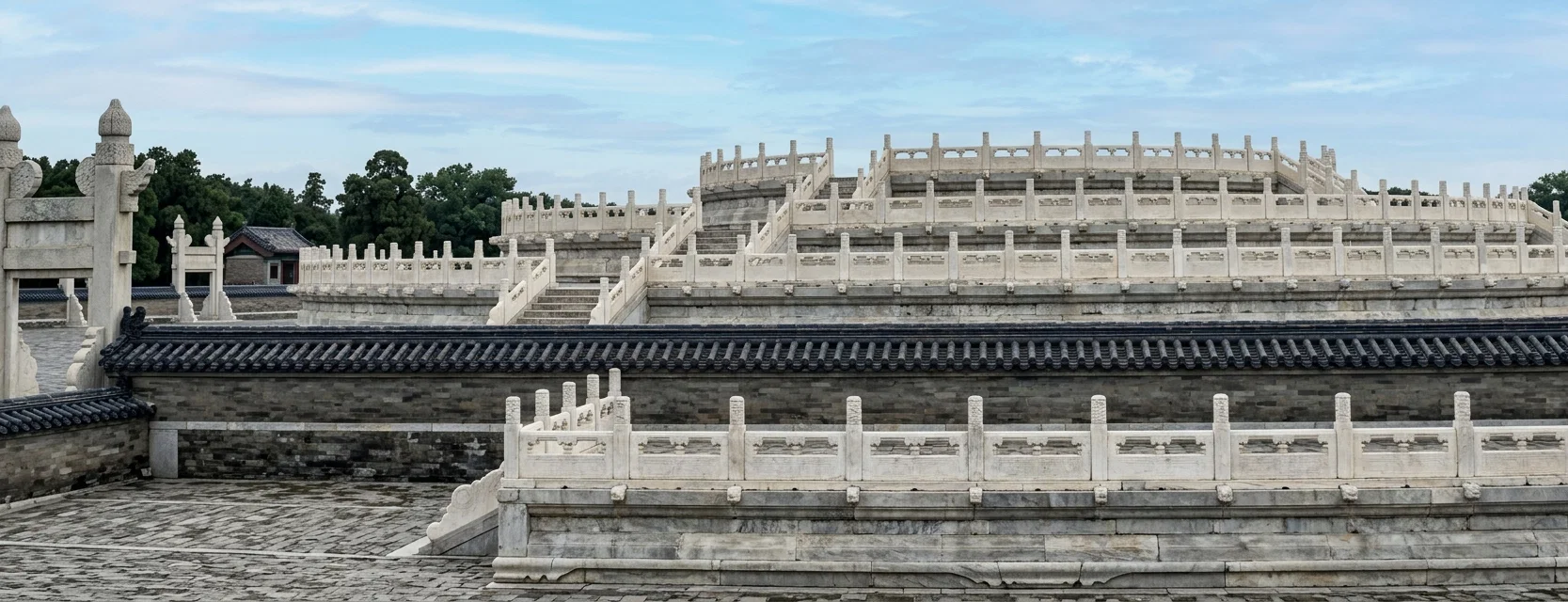
Peking, with these many modern improvements, has not cast off that which makes China a heathen nation, so that there is a great commingling of the ancient and the modern. Stepping off from the macadamized road one is soon surrounded with temples filled with idols that have been worshiped for several centuries. Four of these temples are of special interest, as they stand as models for the propagation of these debasing doctrines. One is called the "Temple of Heaven," the grounds on which it is built covering many acres. Here the emperor formerly went once a year to sacrifice to the gods. There are two large altars, one called the open altar, made entirely of white stone. It is circular in shape, being about twenty feet high and eighty feet in diameter at the top and two hundred feet at the bottom. On the inclined portion of this cone-shaped altar are four stone fences, one at the upper circumference, one at the lower, and two between. At each of the four cardinal points are steps ascending to the altar. Outside the outer wall is a furnace and several large iron kettles. Another, the "Closed Altar" (see page 3), is of about the same construction with the addition of a tall circular building set on the top of the altar. Also to one side is a long building where the animals were slaughtered. This temple is said to be the most elaborate and magnificent structure devoted to the unknown gods in Asia. Another temple is that known as Lamma Temple. Here there is building after building filled with costly idols dressed in the richest apparel. But towering above them all is the one containing the Buddha Idol. This Buddha is seventy-five feet tall, measuring from front to rear seven feet, and laterally ten feet. Before unlocking the door of each temple the priests ask for a tip. On thealtar before the gods, and especially before the great Buddha, were a few ten cent pieces, and the priest would ask the visitors to give a little money to buy some candles, incense, etc., for the idols, but they would use the money to buy rice for themselves.
Across from the Lamma Temple is the Hall of Confucius. In the courtyard in front of this great building are several tablets containing his essays. In the Confucian temples there are no idols, only tablets with monographs engraved thereon. To these the literary class bow down in reverence and respect. Across from the Confucian Hall are the Examination Halls. Surrounding a large enclosure is a long, narrow building with narrow benches, in which the candidates for the highest degrees are examined. And in these halls are about two hundred stone tablets upon both sides of which are carved the Chinese classics. This is called the "Stone Library." Many students come here to study the classics from these stone tablets. In the center of the courtyard which this "Stone Library" surrounds, is the throne of the Emperor Kang Hsu, who reigned in the present dynasty between the years 1692 and 1723, who is classed as one of the greatest of modern scholars of the Chinese language. The emperor compiled a dictionary containing forty thousand Chinese characters, which is to-day the standard dictionary of all China. It was after this throne that the present throne of the Emperor Kang Hsu was modeled. They also have several inscriptions written by this emperor, who was considered the finest pen-man China ever produced.

Changes Taking Place.

Much time might be spent in detailed study of the antiquity of Peking and points of interest there, but even the rulers are turning away to a great extent in their devotions. The population to a great extent are Manchus, who have come from the north and have many characteristics peculiar to themselves, and distinct from the Chinese. The women have large feet, and their hair is wound upon lattice work which almost gives it the appearance of a sail. The officials composing the emperor's cabinet are half of them Manchus and the other half Chinese. On nearly every street there are from two to ten memorial arches, one of which was erected in memory of an eminent foreigner who was murdered.
There are already many missions with their headquarters at this city, but they have not extended their work very extensively in this great metropolis. The people of this city are waiting for the proclamation of the great "Threefold Message," which God is sending forth by His servants at this time. A peculiar and interesting fact to note is that while foreign countries are establishing Christian missions, Japan has just lately made an effort to establish her Pagan religion in this metropolis, and is meeting with success. Her claim for the right to do so is based on the same ground as that of other nations. So that civilization does not mean, by any means, Christianization of this land. What China stands in need of is to see the manifestation of the outpouring of God's Holy Spirit. And this will only come to pass when there are those here who are willing to be led and guided by His Word.
The Open Altar of the Temple of Heaven.