Shiloh: the Man of Sorrows

3%

Pacific Press Publishing Association · Mountain View, California · Jul 26, 1910

FromSigns of the Times, Vol. 37, No. 29.

Read the full edition

Shiloh: the Man of Sorrows

Chapter XXI.—The Water Made Wine
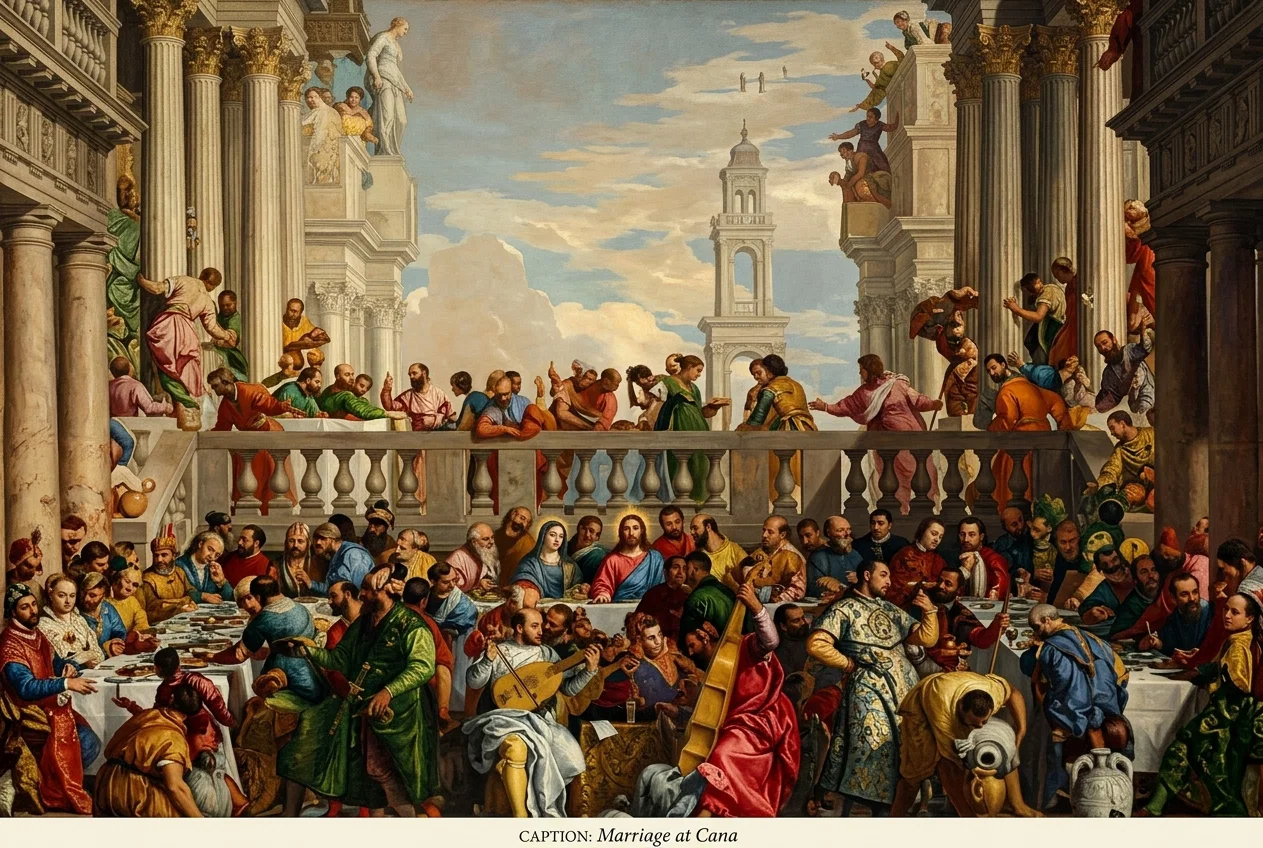
THE next morning, Chuza, the bridegroom, related a strange tale to a belated guest, whom all at once recognized as Jazer the scribe, of Jerusalem. The sallow countenance and the deep sunken eyes were always the same. But as he greeted his invalid sister, Huldah, gently and lovingly, the deep eyes grew soft and tender, and a light entered into them.
"Thou comest late, Jazer," began Chuza, greeting his guest.
"I have tarried, Chuza, that I might attend a council of the scribes and Pharisees at Jerusalem; for they be much perplexed concerning one Jesus of Nazareth, whom John the Baptizer preacheth to be the Messiah. But now we know," declared Jazer, elaborately waving his hands, "we do know that signs and miracles shall be performed by Shiloh when He cometh; and verily this Man hath done no miracle;" and with a self-satisfied nod, Jazer seated himself and waited complacently for Chuza to commend his superior wisdom. But he was surprised and chagrined to observe that his words were ignored, or at least passed over in silence, as Chuza seated himself by the side of his guest and replied:
"I have somewhat to say unto thee, Jazer; and when thou hast heard me, then thou shalt judge concerning the wisdom of my words.
"This Jesus of Nazareth hath been one of my guests—nay, thou needst not be affrighted," he continued, observing an expression of embarrassment and alarm in the small sunken eyes, "thou needst fear nothing. He hath departed; and tho His mother still remaineth, she heareth not our words. Yesterday when the table was spread, about the sixth hour, and my guests had seated themselves, it was discovered that the wine had failed—tho I knew it not. This had indeed happened through some strange and unaccountable mistake. But it was not made known unto me until many hours thereafter. I knew it not," again repeated the bridegroom, gazing fixedly at his guest, who exclaimed in astonishment:
"Thou knewest it not! How canst thou say that thou knewest not that thy guests had no wine? Hast thou no care for thy guests, Chuza? Then indeed hast thou been humbled in the eyes of these thy friends."
"Call me Caleb, the butler," commanded the bridegroom, addressing one of his servants.
"What wouldst thou? Behold, I am here."
"I would that thou shouldst relate before this man, Jazer, my guest, concerning the miracle of the wine; for verily I knew not of the failure, neither knew I of the supply, until many hours thereafter. But thou, O Caleb, thou sawest the miracle."
"Thou sawest no miracle!" exclaimed the scribe, scornfully regarding the butler; "thou speakest foolishly."
"Hear thou me, and then thou shalt judge, O Jazer. Yesterday, at the sixth hour, the wine failed. The guests were at table, and I went to draw, to supply their need. When I saw that there was none remaining, I was much perplexed. Mary of Nazareth, she of the hair of gold and the eyes of blue, stood near me, while I made this known unto the servants; and I saw that a look of astonishment and dismay overspread her face. But it was only for a moment. At once she turned and spake to a Man who stood near her. He turned as the woman spake unto Him, and His eyes looked full into mine own." Here Caleb paused for an instant, and slowly passed his hand over his brow, as if to gain a moment's time in which to frame his words more forcefully. Then he repeated:
"The eyes of the Man looked into mine own. I can not describe the Man—much less His wonderful eyes. Were I a Roman or a Greek, I should declare that the gods had come down to us in the likeness of flesh.
"Only for an instant His eyes rested upon mine, with a look of vast love in their clear depth. I wondered why He should so regard me, a stranger, and a servant. But in that instant my heart was melted within me, and I loved the Man—and verily I love Him still. Then I heard the voice of the woman as she spake unto Him. I have since understood that He was her Son, whom men call Jesus of Nazareth. And the woman—"
Marriage at Cana
Marriage at Cana
"I care not to hear this man further. He is thy servant. Bid him pass on, O Chuza. Behold, in these days every man's servant doth magnify himself; and verily this fellow hath a glib tongue," interrupted Jazer, while his small eyes blazed fiercely, and he would have turned hurriedly away, had not Chuza, the bridegroom, detained him almost forcibly.
"What aileth thee, O Jazer? Verily, I thought to do thee an honor, and now, behold, thou art wroth—and thou one of the scribes of the holy temple!"
At these words an expression of dogged helplessness came over the face of the scribe, like that of a caged animal, and he exclaimed morosely as he again seated himself:
"The Man! the Man! Jesus of Nazareth! Everywhere I find Him. The world is already going after Him. Even when a mere Lad, the lawyers in the temple preferred listening to His words rather than mine. But proceed with thy foolish tale, Caleb. Why should I interrupt thee further? What said the woman unto Him?"
"What said she? There was a look of tender love and perfect confidence upon her face as she said quietly, turning toward Him: 'Behold, the wine faileth. Verily, they have no wine.' And I heard the voice of the Man as He replied: 'Woman, what have I to do with thee? The hour in which I must receive the honor which thou desireth for Me, is not yet come.' These words spake He in a voice of tenderness, and He regarded the woman lovingly. Then turned she toward me, and said, 'Whatsoever He saith unto you, that do.'
"We stood near the door which led into the court. At the side of the door stood the accustomed large water-pots of stone. The Man led the way, beckoning me to follow Him; and I indicated to several of the servants to follow also, for from the appearance of the Man, I felt that there was some strange thing about to come to pass.
"At once He pointed to the water-pots, and I wondered greatly when He commanded:
" 'Fill ye the water-pots with water!'"
"Strange as was the command, to obey which necessitated considerable labor, we felt that the Man must be obeyed. In a few moments, the vessels were all filled to the brim, with the clear water of the fountain just outside the court. Then, O Chuza, my heart stood still, when the Man commanded—and verily His voice was like unto the voice of a god:
" 'Draw out now and bear to the governor of the feast.'"
"I saw the servants glance the one at the other, at these strange words, and hesitate; and one said unto his fellow: 'What! shall we obey the voice of a madman? Behold, why should we bring water unto the guests of my lord?' But another turned unto me, saying, 'The Man is a great prophet, and I wot not but He be the Messiah; for even thus saith the Baptizer!"
"Then," continued Caleb, the while Jazer sat in his seat uneasily, "then we each drew, every man for his vessel,—and behold! even as we drew, we saw that it was no longer water, but good wine, sweet and pure, which, when we had quickly tasted, we bare to the steward, who as yet knew not that the wine had failed. Then said the steward unto the bridegroom: 'Wherefore hast thou kept the good wine until now?'"
"But no man said aught of the miracle, until after the Man had departed; and when we would have found Him, behold, He had gone His way."
When the butler had finished his story, there was one face among the guests who had been listening to the conversation—one face—pale, careworn, pain-drawn, which grew radiant with hope, and bright with eager anticipation and desire. It was the face of the gentle invalid, Huldah, the sister of Jazer the scribe.
Let us mark her face well; for it will be some time before we meet her again.
But the countenance of the scribe was a study. Envy and hatred, bitter and deep, had written their ugly lines upon his face, as he rose and went out into the court.
"Thy miracle worker is a sorcerer!" he muttered.
(To be continued)