Untitled article

7%

Pacific Press Publishing Company · Oakland, California · May 11, 1891

FromSigns of the Times, Vol. 17, No. 19.

Read the full edition

FROM THE SEA.

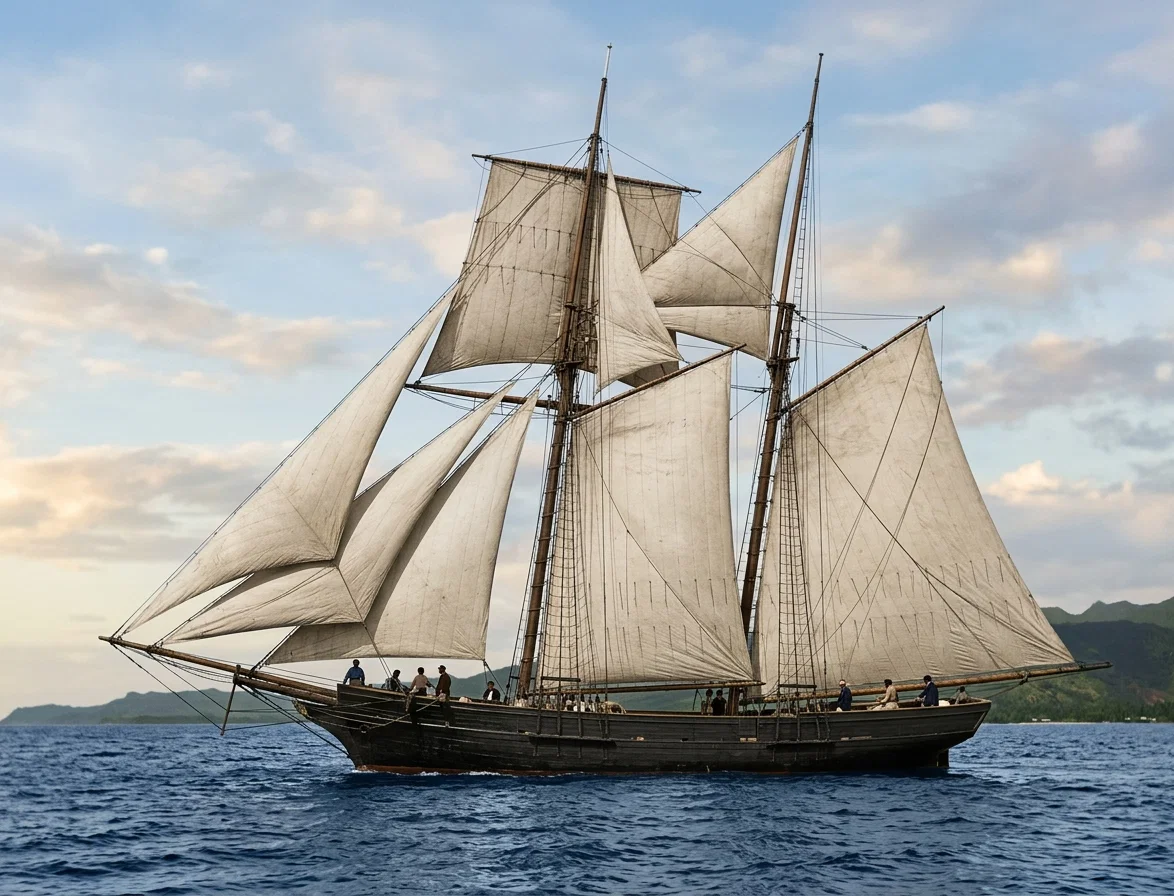
THE Pitcairn left Tahiti early in the afternoon of February 10. The next morning the missionaries put off in a small boat to Morea, a neighboring island. This island was the scene of John Williams' early labors, and the place where he learned the Tahitian language. The Tahitian is spoken in all the group, and in two other groups of islands, so that one who understands it can converse with the natives on over fifty islands.
Most of the few hours on shore were occupied in visiting the only missionary on the island; and before the boat left, a good supply of reading matter was given him. Late in the afternoon of the 11th our little vessel sailed away toward Raiatea, the most northerly of the Society group. We reached our destination, one hundred and thirty miles away, the following noon, amid thick and stormy weather; the vessel passed through an opening in the dangerous coral reef, however, without mishap, and we soon found ourselves in the broad lagoon.
These coral reefs seem to be a wise provision of the God of nature, by which most of these islands are furnished with copious natural harbors. There are many interesting historic places here, the scenes of the early labors of Williams, Platte, and their colleagues. Raiatea was also the great religious center in times of heathenism, and here are to be seen to this day the ruins of the old altars, called marai, where human sacrifices were offered. Piles of large, flat stones, some of them weighing nearly a ton, were used in forming the huge altars, and now the moss-covered ruins are strewn with fragments of half-decayed human bones. The marai are looked upon with much superstition, and it is little to be wondered at, for they are indeed canny-looking places, half concealed neath the thick shade of the cocoanut, orange, and bourao trees. What wonder that the native guide preferred to remain in the path rather than enter such a dismal-looking place! It was a whole day's journey to the marai and back, but the impressions it made on our minds will not soon be effaced. Oh, to what depths of degradation Satan leads those who close their eyes to light and truth and turn their feet aside from the path of God's commandments! The people of these islands have undoubtedly descended quite directly from very ancient stock; there are many striking indications of this,—their language, their physique, and many of their practices.
Perhaps one of the most peculiar of these practices is the religious custom of passing through fire. A huge excavation, twelve by fifteen feet, larger or smaller, is prepared, into which immense quantities of fuel are placed, and the whole covered with huge flat stones. After it is set on fire, it burns for about twenty-four hours, when the stones become heated to a white heat; then the one who has charge of the furnace takes a branch of the ti plant, and, with a muttered prayer to the god of the ti, sweeps the branch over the scintillating embers and rocks, walking composedly through the oven with his naked feet; then he is cautiously followed by a few of the most daring of the spectators, who pass through without a singe, while the heat rising from the rocks burns the leaves of the tall trees over their heads; these in turn are followed by the whole group of men, women, and children, who pass and repass through the burning mass unharmed.
This custom has probably been handed down from the same source as the ancient fire-worship among the Orientals and early Europeans. Virgil speaks of the same practice in connection with the worship of Apollo by the Etrurians on Mount Soracte. The custom has always been more or less closely allied with sun-worship, and is strongly denounced in the Scriptures. See Eze. 15: 21-23 and 2 Kings 17: 16-18. Though the custom is still continued, it is almost entirely bereft of its sacredness; yet it is to be feared that should the natives relapse into heathenism through political intrigue, this and many worse customs would be revived.
The government of Raiatea and the adjacent islands is in a divided state; the French control part and the natives part. Notwithstanding the unsettled state of affairs, the work prospered at Raiatea, a large amount of religious literature was sold and distributed, some Bible-readings held, and considerable personal work done in visiting and conversing with the people. There were among them three who have been readers of the Signs, and that so far opened the way for us that when we first arrived they received us like friends, and used us very hospitably during our whole stay, and when we sailed from there, March 4, we left them with several leading families honestly investigating the truth.
Early on the morning of the 5th we arrived at Huahine, and after an hour's row in the small boat we reached the shore. Here, as at some other islands, a report had been sent representing that we were either Jews or Mormons, and warning the people not to receive us. We went at once to headquarters, and, after some hesitancy and questioning on the part of the queen and her associates, we were received and cordially welcomed.
We found several very interesting families, whose eagerness to learn the truths of God's word reminds us of the prophecy of Isaiah, "And the isles shall wait for his law."
One of these families was especially interesting to us. We were received cordially, and as soon as they felt well enough acquainted, the man and his wife both began to ply us with questions about our religious belief. In every case we answered the questions, "not in words which man's wisdom teacheth," but by passages of Scripture. This not only satisfied them, but brought out more questions, and they became so interested that they bought a "Bible Reading" book, a "Daniel and the Revelation," a "Marvel of Nations," and a "Home Hand-Book." When we came away, we gave them some tracts on some of the very subjects which we had been talking about, and they received them gladly. They urged us to stay overnight with them, which we did, thus opening the way for further conversation on the subjects of such interest to us both. After evening worship we talked with them till ten o'clock, and they sat up two hours later conversing on what they had heard.
Our friends were great smokers, a very common habit in these islands, but in the morning the wife expressed her desire to give it up, and after morning worship, when we had prayed that strength might be given her to overcome the bad habit, our hostess took us by the hand and thanked us for the prayer, expressing her determination, by the grace of God, to forsake the evil, and before we departed her husband had decided to do the same.
We talked on several of the leading doctrines of the Bible, and it was gratifying to see the leaves of the old family Bible turned down as text by text was cited.
When we left to go on board the schooner, we were loaded with presents and curiosities, to remind us of the warm place we had in the hearts of those who were waiting for God's law on Huahine. A. J. READ.
Papeete Harbor, Schooner Pitcairn, March 11, 1891.