WOMAN'S LOT IN SIAM

6%

Pacific Press Publishing Company · Oakland, California · Jul 3, 1893

FromSigns of the Times, Vol. 19, No. 34.

Read the full edition

WOMAN'S LOT IN SIAM.

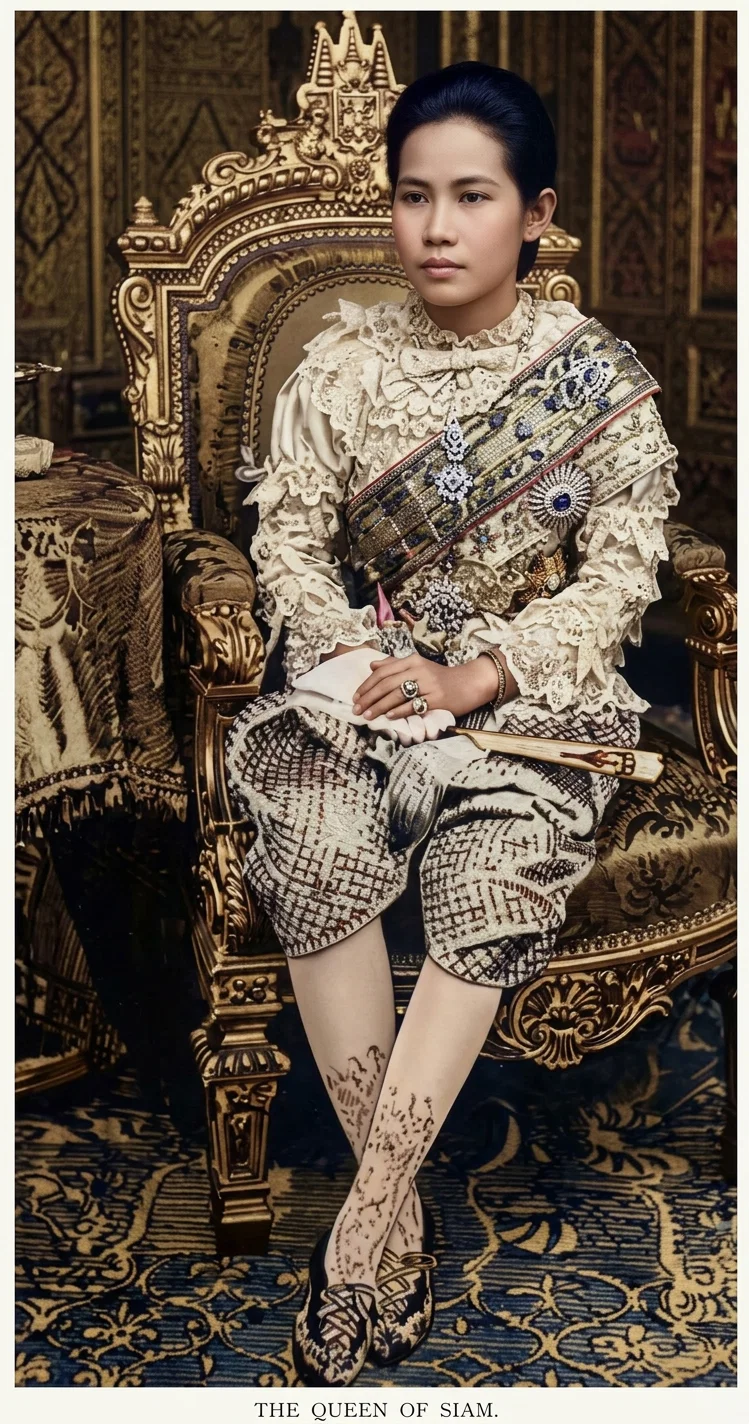
THE QUEEN OF SIAM.
THE QUEEN OF SIAM.
A PLEASANT song beginning with a high note and coming down to a plaintive, soothing falsetto, heard on every hand in Bangkok, is the lullaby of a Siamese mother over her little one asleep in its cradle. A Siamese cradle is called a play. It consists of a frame, from the four sides of which hangs a netting, woven like a fish net, the lower edges of which are fastened to a board which forms the bottom of the cradle. This is hung by a rope from the ceiling of the house, or from a frame made for the purpose, and thus it is easily swung to and fro. The little one in its mother's arms is a Siamese girl baby. If you follow her up through the various steps of life to motherhood or to great grandmotherhood, you will get briefly woman's life in this strange land.
SIAMESE WOMEN PLOWING RICE FIELDS.
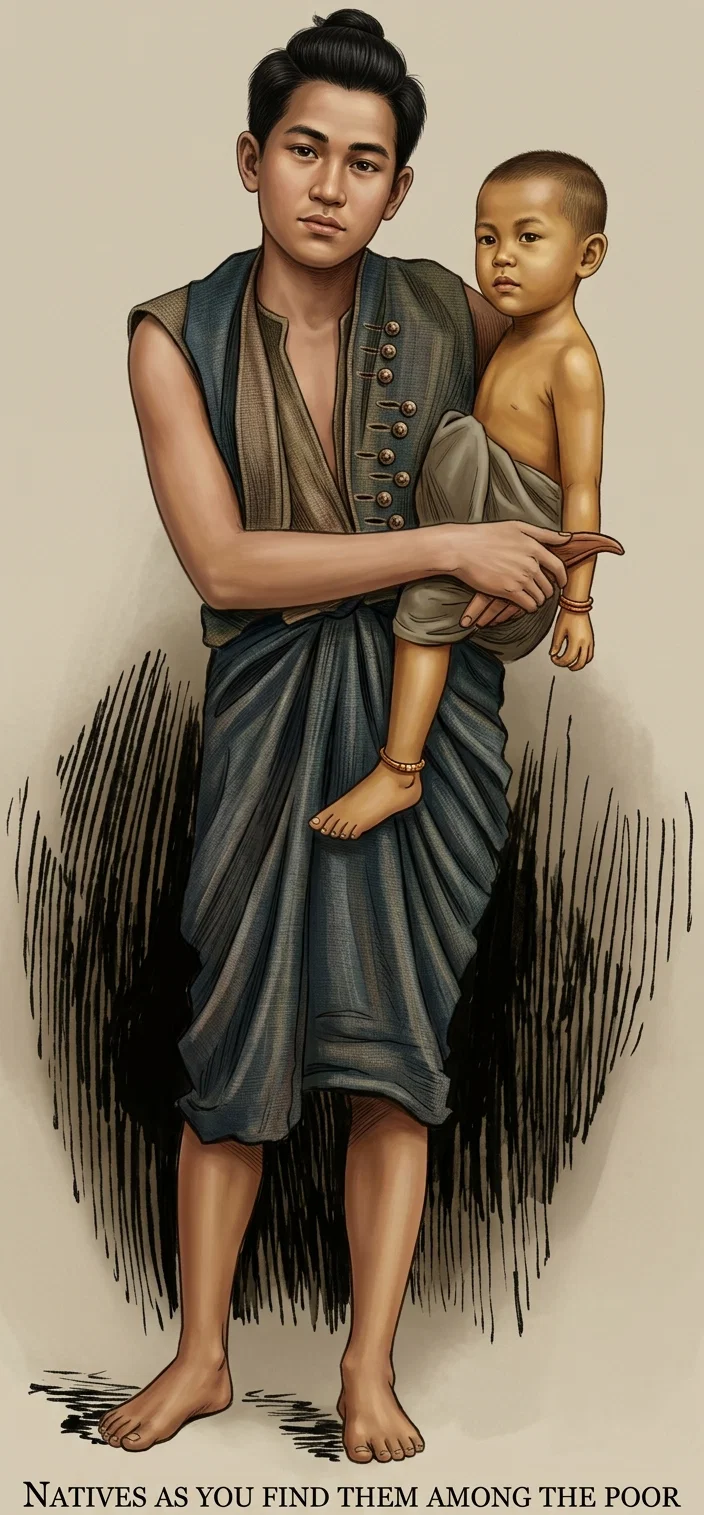
A Siamese girl baby is usually pretty enough for anybody. She has a much better and warmer place in the hearts of her parents than do little girls in China, for Siamese parents really love their children. A natural question is, "What is baby's name?" Translated into English a girl's name may be Bright, Change, Color, Pearl, etc. Siamese girls, as well as the boys, are not bothered with clothing until they reach 7 or 8 years of age, but they have anklets and bracelets and necklaces put upon them. These articles are made of brass, silver, or gold. The girl's hair is all shaved off her head, except, it may be, a tuft or two at the back and always a tuft on top, reaching to the forehead. This topknot is not cut off until the child is from 11 to 13 years of age. It is a superstitious belief of the Siamese that evil of some kind may befall the child if this is cut before the proper time.
When the time comes for the hair cutting, or kon chuk, a Siamese theater is hired and sometimes also a Chinese play, and they have a great time celebrating the important event. Buddhist priests say their prayers, guns are fired to frighten away the evil spirits, and a priest, or some other man appointed, shaves off this tuft with a razor. Then a white cotton cord is placed about the head to insure prosperity. Sometimes, while the child is still wearing the topknot, a circle of white beads or white flowers is placed about it, and it must be confessed it looks pretty and tidy.
These little girls begin while very young to use the betel. This is composed of an acrid leaf rolled up, with red lime spread on it, an astringent nut, sometimes also astringent bark, and some tobacco. When this is chewed it makes the saliva very red or reddish pink. Thus the girls' tongues and teeth and lips are discolored. Their excuse for chewing this wretched mess is that it keeps their mouths sweet. These young women assist in all the employments of Siamese life except a few of the trades, and even in many of these they are efficient helpers.
The next important step in the Siamese girl's life, after she parts with her topknot, is her marriage. This is brought about by means of various ceremonies. Frequently there is a go-between. It must be determined in what years the couple were born, for if she was born in the year of the timid rabbit, and he in the year of the dog, it would not do for them to join hands, for he might devour her. Should she have been born in the year of the tiger and he in the year of the chicken, who knows what might happen to the poor fellow? When their years are found not to be incompatible, it must be ascertained whether the girl is favorable to the project.
When there are sufficient means, feastings and other ceremonies are held. And, of course, the priests must be on hand to chant their prayers. The sum of money agreed upon is handed over by the young man. Some old persons give wise advise, and, the great event ended, they are husband and wife. According to Siamese notions, if she is faithful she becomes a real helpmate. If she belongs in ordinary walks, she is expected to help in all that is done. If he is a blacksmith, she may work the bellows, or even handle the sledge. If he is a brickmaker, she does her full share at that. If he is a worker in earthenware, she is as skillful as he. If he is a farmer, she plows, helps plant, reaps, helps thresh, and then helps take the grain to market. She can row a boat; she is also an excellent saleswoman. The markets are alive with the women at their stands, behind which they squat, for a Siamese seldom stands when he can sit down, and a good part of the time does not care to sit, if it is as convenient to lie down.
Thus one girl in married life does her full, in many cases more than her full share, in supporting the family.
Woman in Siam is favored above most of her oriental sisters. She is not condemned to wear the veil. She is not despised, nor is she treated as a mere animal. She is not condemned to wait while her husband and children eat the best of the meal, but she can sit with them. In the higher walks of life, the husband often eats alone. She goes to the holiday celebrations and sacred day doings with her husband. In the home she has more than a father's influence.
NATIVES AS YOU FIND THEM AMONG THE POOR.
Yet it must be said the Siamese woman has her troubles, which should enlist the sympathies and call forth the prayers of her Christian sisters in America. Her husband can cast her off when he chooses. He can leave her and enter the priesthood, and upon leaving the priesthood take her back again or take another, just as he pleases. He can take her children from her. He can chastise her and no one interferes. Often she is left at home, to do alone what is to be done in caring for the cattle, cutting the wood, and carrying the water, while her big, lazy husband is off at the gambling house, drinking stand, or chicken fight. But it is sad to say very many of the women are inveterate gamblers themselves. She takes the principal parts in the theaters, both in the singing and acting.
In the upper ranks the women dress nicely, have the luxuries of life, have almost nothing to do and are well treated, according to Siamese customs. Many of them have exquisite, rich complexions, and are very pretty. As the Siamese woman passes on to old age, she receives much consideration and respect, and is laid away at last with honors.
Woman is sharing in the progress which is being made in Siam. Many more women can read now than a few years ago. They are glad to get our books, and many of them buy them. Women will have more and more influence as to the education of the children, for it does seem sometimes that the mother cares more for this than the father does.
Siam has homes and affectionate wives and mothers. Siam has a term to express our word family; it is khrawp khrooa. Siam has a word for home; it is ban. The Siamese man who is industrious has a home to go to and an affectionate wife and glad children to meet him. What is needed in Siam to-day is more schools. Let the people be educated, for they are intelligent, able to learn readily, and accurate in their pronunciation of English. You never hear pigeon English spoken in Siam.
Americans first introduced schools. Americans first introduced steam rice mills and steam sawmills. An American established the first hospital. The first medical class was established by an American, and is now conducted by him. Americans have done more than any other nation to establish a friendly feeling and confidence with most of the foreign powers. Americans do not harass the Siamese or covet any of their territory. In the king's own words, 'They bring peace and good will.'—San Francisco Chronicle.