THE California Midwinter International Exposition will go down into history as an illustration of the most rapid development of a great enterprise that the world has ever seen. It was not until the last day of June, in 1893, that the proposition to hold an International Fair in San Francisco, in midwinter, was even so much as thought of. On the evening of that day several of the foreign commissioners to the Columbian Exposition were together in Chicago, when someone incidentally remarked that part of the foreign exhibits would probably go from Chicago to Chile before being returned home. The thought immediately came to the mind of Hon. M. H. De Young, the California member of the United States Columbian Commission, that if these exhibits were to be available for display elsewhere, why not secure them for California, and why not, at the same time, advertise California's climatic advantages by holding a great international exposition by the side of the Golden Gate, at the season when the greater part of the rest of the world sits huddled around its fires, or wrapped in a mantle of snow.
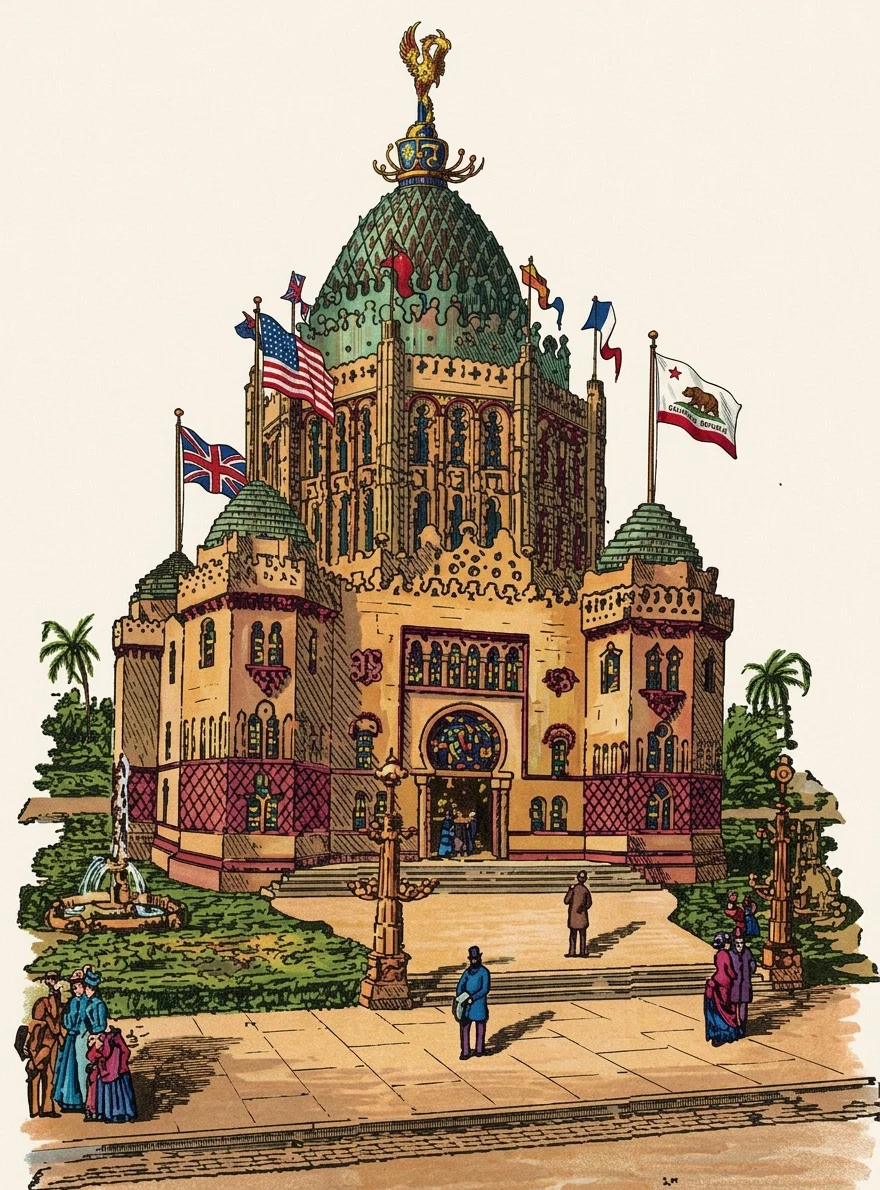
ADMINISTRATION BUILDING.
On the following day Mr. de Young communicated this thought to several other prominent Californians who happened to be in Chicago at the time, and through their combined efforts the Midwinter International Exposition began at once to assume shape. When the idea was first broached, it met with decided opposition in some quarters, and ridicule in others, while the good people of San Francisco themselves, though never underestimating their ability, were almost inclined to ridicule the project from the start.
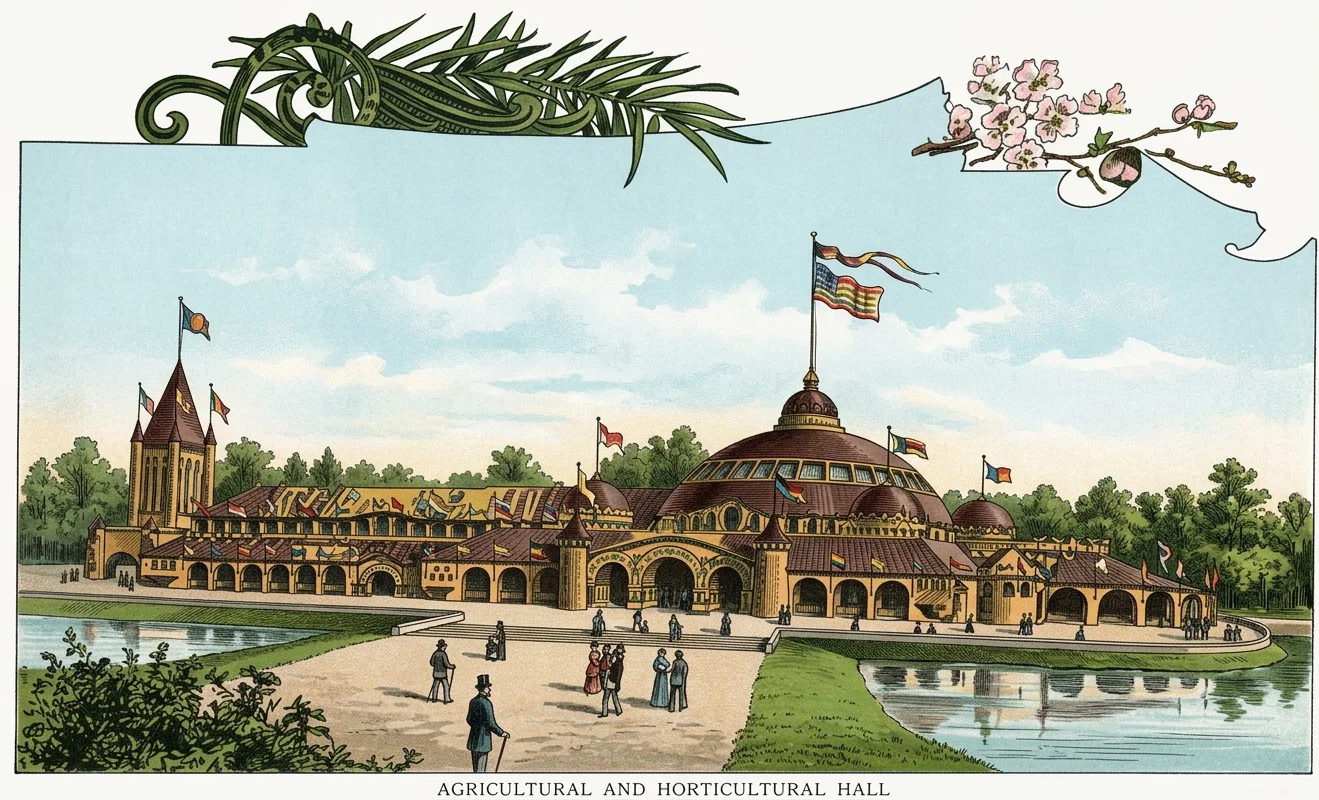
AGRICULTURAL AND HORTICULTURAL HALL.
A few, however, arose to the necessities of the case, and the result was the formulation of a plan for an Exposition which should include many of the choicest exhibits from Chicago, and as many new ones from abroad as might be obtainable, and a considerable list of local California exhibits and other practical features of Pacific Coast production—an Exposition, in fact, which should embody every element of interest and attractiveness, and which should draw to California thousands upon thousands of people who had for years been waiting for a better excuse to make a winter journey to the "land of sunshine, fruit, and flowers."
Ground was first broken for this Exposition on the 24th day of August, and within a fortnight after contracts had been let for the erection of five main buildings, to cost about four hundred thousand dollars, though where the money was to come from was yet uncertain. A popular subscription list had been started in San Francisco, and something like a quarter of a million of dollars was quickly raised; the rest came little by little, and when work on these five great buildings began, new subscriptions began to pour in, until now the four hundred thousand dollars has nearly been subscribed, and there is enough more money in sight from the sale of concessions and from the rental of space in the Exposition buildings to warrant the assertion that the California Midwinter Fair will be open on the first day of January, six months after its inception, and that when its gates swing ajar, it will not have a dollar of indebtedness, but that the receipts for admissions will not need to be diverted from the direct payment of the running expenses of the Fair during the six months of its duration.
The five buildings grew apace; a penalty of four hundred dollars a day was a part of the Exposition contract with the builders, if they failed to finish the buildings within ninety days from starting. The result was that no five such buildings have ever, in the history of the world, been pushed forward so rapidly as these, yet they have been constructed under the personal supervision of competent engineers, so that there can be no doubt of their stability and adaptability to the purpose for which they were planned.
We give in this issue cuts of two of these great buildings. Others will be given later. The first of these which we present is that of the Administration building, where the offices of the Exposition management will be located. It is by far the smallest of the five main buildings, being but 60 feet long by 40 feet wide. Its interior is especially adapted for the purpose for which it is designed, while architecturally it is highly ornamental. Our second cut is that of Agricultural and Horticultural Hall, 300 feet long by 125 feet wide, having a gallery 25 feet wide. The roof is partially covered with skylights. Manufactures and Liberal Arts, Mechanical Arts, and the Fine
Arts and Decorative Arts buildings will be briefly described in the future.
All these buildings have now progressed so far that the roofs are in place and the interiors perfectly protected from winter rains. The outside of the buildings is being covered with staff, and they present as solid an appearance as if made of granite or marble. These five main buildings are located around a grand central court, 900 feet in length and 500 feet in width, in the center of which a grand electric tower, 270 feet high, already begins to lift its head. In this court there will also be an allegorical fountain, emblematic of the history and achievements of the State of California, and also the magnificent electric fountains, which created such a sensation in Chicago, and which are to be transported to San Francisco at a great expense.
In addition to these main buildings and the features of the grand central court, concessions have been let for a great many other interesting exhibits and displays. The great cyclorama of the burning mountain will find a place in the Hawaiian concession. Heidelberg Castle will stand on an elevation, with the German village clustering around its base.
There will be an ostrich farm in full feather, an Arizona Indian village, a Spanish ranchero, an electric theater, a copy of the Ferris wheel 100 feet in diameter, a grand exhibit of sea lions from the Santa Barbara Channel, and an interesting exhibit of lions of another sort equal to the famous Hagenbeck Wild Animal exhibit in Chicago.
Besides all these, work on all of which is being pushed rapidly forward, there are also being constructed half a dozen special buildings, in which the exhibits from different counties of the State of California are to be combined, and in two of these buildings, the two great citrus belts of the different sections of the State, northern and southern, will be entered in friendly competition, so that visitors to the Fair will have a chance to see the greatest display of oranges that has ever been made.
These are but a few of the thousands of things that might be said in explanation of the development of this great Midwinter Exposition undertaking. It is said that it will open on the first day of January without fail, and everything is to be in readiness at that90time. The great advantage of such an Exposition, at such a time, is no longer a question in the minds of the people of California, and the dwellers in neighboring States are fast awakening to the opportunity offered in this connection to display their own products at great advantage. Nevada has already secured 2,000 feet of space, Oregon, Washington, Utah, and New Mexico are all falling in line, and other States west of the Rocky Mountains will also be represented there, to say nothing of the vast number of exhibits that have arranged to take up at San Francisco the work of advertising themselves which they began so successfully by the side of the inland sea at Chicago.