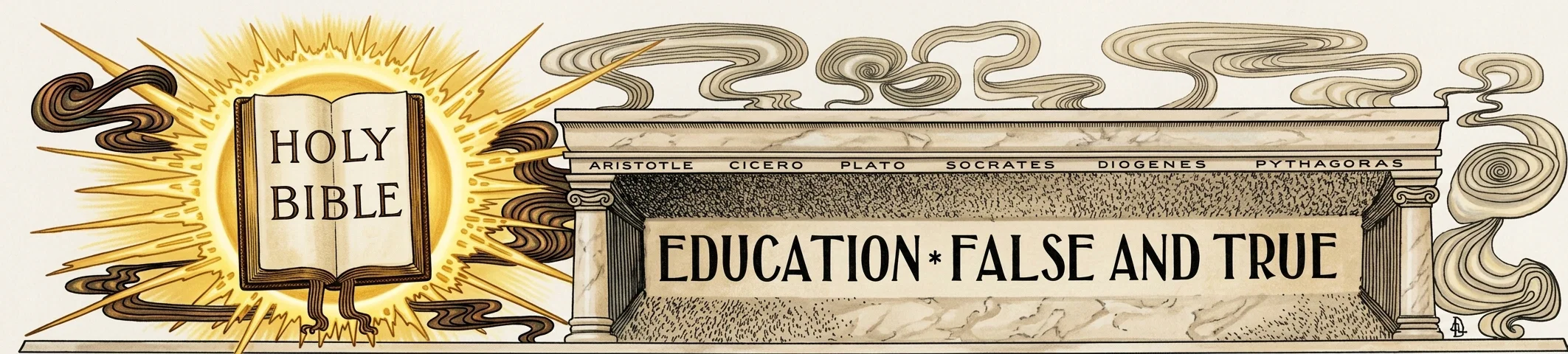
THE heavens had been opened and a flood of light far surpassing the brightness of the sun had shone upon the earth. As vegetation responds to the call of the sunlight, so the natural result would have been that all men should turn their faces Christ-ward, and the principles of education which had rendered His life a success would have become the all-pervading influence of the world. Would that it might have been thus! Imagine watching a cloudless sky on a June day. Depths of blue unfathomable—what could be more beautiful? And yet, as a shimmering cloud spreads over the azure surface and reflects the light in myriad tints and hues, even tho this is a portent of coming storm, does it not enhance the beauty of the scene?
It was thus that a cloud, thin, white and inoffensive to all appearances first caught the eyes of those who had been watching the leadings of Christ. So subtle is the growth of error that it often at first presents an appearance more attractive than unadulterated truth. Little by little subjection to man-made power took the place of the principles of faith and freedom. Little by little the pagan ideas which had been crushed to earth under the full blaze of a pure Christianity, again reared their heads, and the dragon's voice, smothered and smooth of tone, was once more heard throughout the world.
The deadliest error is that which so nearly resembles truth that the unsuspecting grasp it unwittingly. The principles of an education by faith in Christ were thus replaced, not by principles lacking faith, but by those forms which revealed another center than Christ for the faith. The papal system did not remove faith, but transferred it to deeds of men. And the true, pure miracles performed through faith in Christ were replaced by the supposed miraculous healing power of the bones of the prophet Samuel, or the skull of Saint Anne, or the ability of bits of Christ's cross to raise the dead. Physicians were not needed, for could not the napkin which covered the face of an entombed Saviour heal all bodily infirmities? Sciences were not needed. Had not the priests the right, and the only right, to interpret natural phenomena? Chemical experiments had the odor of the infernal regions, and were to be avoided as the fires of hell. Reading, writing, mathematics,—what use had the "common herd" of humanity with such things, since every man had access to some monk who could read and interpret to him all he needed to know? The Bible became an unknown book. Mass was said in an unknown tongue. Pictures of Christ and saints took the place of the real Son of God. It was the period in which the "two witnesses" prophesied in sackcloth. It came upon the world gradually, and men knew not that they were in the bonds of sin; they dreamed that they were free.
Had not Christ bidden His followers abstain from all fleshly lust, to crucify the flesh and die to the world? It was the perversion of such teaching that led to the establishment of monasteries. Thousands left the world and its allurements; the hot, sandy desert of northern Africa fairly swarmed with monks. The only faith of the world was in their hands. Not only did monarchs tremble when threatened by these creatures, but thrones tottered when the head of the hierarchy of which they formed an essential part uttered its voice.
It was a despicable era, a time which Draper describes as the "tyranny of theology over thought." That One who lighteth every man that cometh into the world was disregarded, and the "noonday of the Papacy was the world's moral midnight."
To show that freedom of thought was entirely out of the question, one needs but to recall the experience of Hypatia, which has been so vividly portrayed by Charles Kingsley. This woman was a highly-educated pagan, living in Alexandria in the fifth century. She represented a class of educators which was fast dying away. Though pagan, she taught in her school many things which far excelled the learning of the fanatics of the church. So far had Christianity and true education fallen that paganism was rather to be chosen than the apostasy. Realizing that there was a power in her work, the monks formed a mob, dragged Hypatia from her chariot, and tore her body in pieces. It was an age of persecution; for one original thought, if uttered, nay more, if but suspected, was sufficient cause for kindling the fires of the stake.
It is one of the most interesting of historical facts to note the rise of the Mohammedan power, on the very eve of this intense darkness; to watch its progress, first by the power of the sword; and when that failed, to see the leaders turn to scientific research and silently, but none the less surely, override the enemy before whom they had fallen when the weapon was the sword. To a people held in the iron grasp of the Papacy for hundreds of years, the intellectual growth of Spain during the twelfth and thirteenth centuries was little less than blasphemy. Yet so powerful is the influence of thought that gradually France, and then more distant nations, caught the spirit.
The narrowness of patristical education is seen when one reads in the writings of the fathers, which were then the only text-books in the hands of Europeans, that at the equator the water boiled; that sailing west, vessels could never return; that the earth was flat, and Europe was the center, not only of this world, but of the universe. It was when men began to oppose these well-established theories that De Gama made his voyage around the cape of Good Hope; that Magellan circumnavigated the globe. It was because men were breaking loose from a thousand such slavish ideas and were beginning to think, that Columbus was enabled to man his boats and sail for a north-west passage to the Indies.
The volumes of events which took place in this period are the results of a violent rending of the fetters woven by the papal church, and which had crushed out reason and hidden God from men for centuries.
It is true that there was a little knowledge hidden in the monasteries—and we are willing to give them due credit for the spark of life they kept alive—but so devoid were they of the life-giving element of true education that men were dying by thousands without knowledge, even within the shadow of the convent walls. The principles inculcated by Christ were wholly neutralized by pagan principles, which in education, as in religion, were at this time decked in Christian garb and presented under Christian names.
Looking more carefully into the higher forms of monastic education in those years when it became necessary for them to compete with the pagan schools, we find a seven years' course, in Latin, while, as Painter says, the mother tongue was almost wholly neglected. Logic, that subject which exalts man's reasoning powers to the debasing of faith, was one of the chief studies, especially in a theological course.
How quickly one feels that he is approaching modern collegiate instruction, and especially the curriculum of our theological seminaries. It is when peering into the annals of our ancient universities that the real secret of modern education is discovered. The Christian youth who flocked to the Mohammedan schools in Cordova or Salamanca, returned to France, England or Italy with the fires of education burning in their veins. Soon universities were established, the oldest being at Paris, Salerno, and Bologna. These were at first free corporations, but the Papacy, recognizing that the power they wielded was turning minds away from the church, in her death struggles grasped these institutions, wheeled them into line with her dogmas, again turning thousands of youth toward her walls. The universities of to-day, although they have passed through the period of Reformation of the sixteenth century, still cling to these medieval courses of study, and the subjects then taught. It is a combination consisting of an overwhelming amount of paganism, with enough Christian principle to flavor and deceive, and hence lacks the life of either taken alone. Here you have the foundation for the long classical and scientific courses, with the degrees and diplomas. Here you find the precedent for an education placing reason ahead of faith, and relegating God and the science of salvation to the background.
Is it not time that, as educators, we should arouse and let the light of truth illumine our minds, instead of holding to the forms which were rooted in the dark ages and fed from the sap of Greco-pagan philosophy? There is a deeper, truer channel in which the minds of youth should run, a spiritual life which is much needed, an education which will form a character which even the world admires but has not the power to produce.