The Peace Propaganda

2%

Pacific Press Publishing Association · Mountain View, California · Jul 4, 1911

FromSigns of the Times, Vol. 38, No. 26.

Read the full edition

The Peace Propaganda

Will It Be Peace or War?

In the preceding article of this series the magnitude and significance of the peace movement was briefly sketched. We also noted the fact that this movement is synchronous with a converse movement; namely, the most colossal preparation for war, on the part of the nations, known to history. Is a more glaring paradox conceivable? The question of vital moment is, Which will it be, peace or war? It is true that many of the apologists for militarism tell us these vast armaments are in themselves the only insurance against war. To insure peace, they say, the nations must be prepared to fight. Is this theory true? Will it work? We shall adduce a few authoritative opinions.
In an address delivered in June, 1909, the former British prime minister, Lord Rosebery, referring to the colossal armaments of the nations, said: "THESE ARE INTENDED TO BE USED; THEY DO NOT EXIST FOR ORNAMENT. They may be used at some moment where there is a sudden outbreak or a sudden attack of temper." He said further: "I do not know that in some ways I have ever seen a condition of things in Europe so remarkable, so peaceful, and in some respects SO OMINOUS as the condition which exists at this moment. . . . All forebodes peace; and yet at the same time, combined with total absence of all questions of friction, there never was in the history of the world SO THREATENING and SO OVERPOWERING a preparation for war. THAT IS A SIGN WHICH I REGARD AS MOST OMINOUS."

England's View of the Subject

The late English prime minister, Sir Henry Campbell-Bannerman, after an appreciative reference to the world-wide peace propaganda, said by way of contrast: "Is it not evident that a process of simultaneous and progressive arming defeats its own purpose? Scare answers to scare, force begets force, until at length it comes to be seen that we are racing one against another after a PHANTOM SECURITY which continually vanishes as we approach."
Colonel Richard Gaedke, the great German military critic, in an article contributed to "McClure's Magazine" for October, 1910, entitled "Peace and Disarmament," said: "It is only partly true that armaments are the insurance premiums of peace. With better right they might be called a CONSTANT MENACE TO PEACE. . . . I believe I have demonstrated that the last and greatest danger to peace is the excess of armaments, which keeps the thoughts of war awake in the hearts of the peoples, and puts upon their shoulders a financial burden that they can not much longer bear without danger. . . . Undoubtedly neither England nor Germany desires war. But — I must repeat it again — in the MUTUAL DISTRUST BETWEEN THE TWO NATIONS, IN THE COMPLETION OF ARMAMENTS which it provokes, and the aggravation which this economic burden imposes upon the people, LIES THE POSSIBILITY OF A SUDDEN FIERCE OUTBREAK."
In the San Francisco "Examiner," July 13, 1910, Rev. Dr. Parkhurst wrote, "With all the military preparations that are on hand ready for use, to prognosticate war is very much like attempting TO TOUCH A MATCH TO GUNPOWDER." In the editorial columns of "The Nation," May 27, 1909, appeared this significant declaration: "If something is not done to forestall this wicked craze [for bigger navies], AN EXPLOSION WILL FOLLOW THAT WILL SHAKE THE WORLD."
Sir Edward Grey, a member of the British ministry, recently said: "The great nations are raising enormous revenues, one half of which is spent in preparations to kill each other. It is a sad reflection on our civilization. SOONER OR LATER IT MUST SUBMERGE THAT CIVILIZATION."

Will They Fight?

"England and Germany: Will They Fight?" is the title of a remarkable discussion that appeared in the "World's Work," February, 1910. The writer, William Bayard Hale, had spent a year in Europe, "in confidential relations with governmental chiefs." The editor says that Mr. Hale was in a position to acquaint himself, "at first hand, with the views held in the highest quarters." Mr. Hale says:
They are talking, in Europe, of a war — a war in which two of the most powerful nations would face each other, with the largest armies and the biggest navies ever envisaged in battle; with weapons more destructive than any ever used before. It would be a war . . . colossal in the scale to which it would almost inevitably develop, stupendous in the possibilities of universal conflict which it would open. It does not require imagination to see the spread of this war till it should rage over all Europe, call Japan again to arms, make China a battle-field, and weaken or break the hold of home governments on widely scattered colonies; it rather requires ingenuity to find grounds for hoping that it would not extend its effects to both hemispheres and to all continents.

Who Will Provide This War?

To the question, Who are expected to provide this war? he answers, "England and Germany." He says this war talk had been going on for three years, that it refuses to die out, and that it deepens in seriousness and volume. The reader will remember the accounts of the "Englishman's Home" panic two years ago; how the hearts of all Englishmen "were moved, as the tree-tops of the forest are moved by the tempest." Mr. Hale says the public commotion has ceased, but in its place is a settled fear answering to the "ominous hush" of Europe which Lord Rosebery thinks more sinister than the bluster that preceded it. In Germany there has never been a panic; "only a slow gathering of belief THAT WAR IS INEVITABLE."
Mr. Hale tells us that neither the German government nor the British seeks war or desires it. On every score of common sense peace is desirable. In the face of every reason why peace should continue indefinitely, "what earthly ground is there for believing that Germany and England are about to fight?" Mr. Hale says: "The answer is this: THE MOST SERIOUS POSSIBLE GROUND FOR FEARING THAT GERMANY AND ENGLAND ARE ABOUT TO FIGHT IS, THE BELIEF OF THE PEOPLE OF GERMANY AND ENGLAND THAT THEY ARE ABOUT TO DO SO." He means by this that the talk of war, however causeless, tends to beget war. "Familiarize two nations with the daily thought of fighting, and it will be a miracle if they fail to fight."
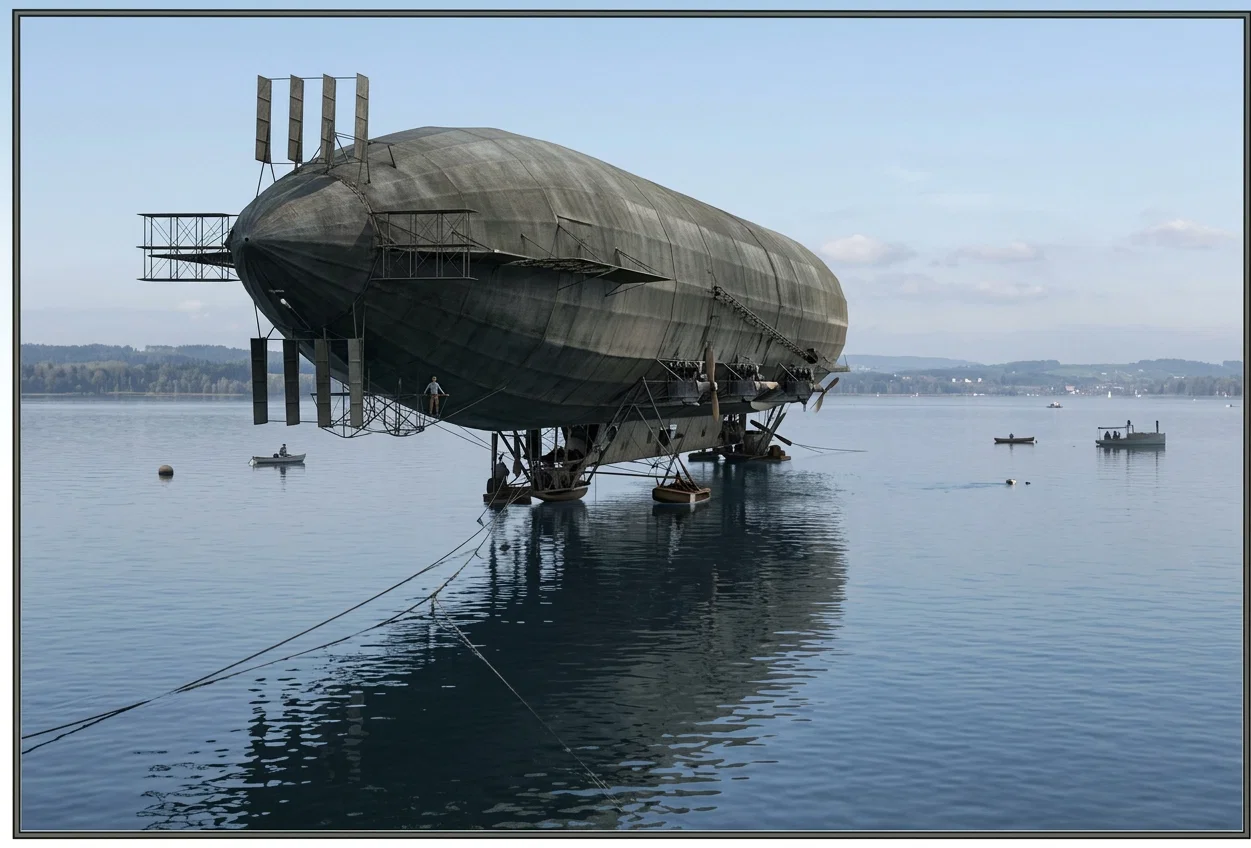
The British "Dreadnought of the air," the dirigible balloon Mayfly, was launched May 22 at Barrow-in-Furness. This gives the British navy the largest aerial war machine that has yet been built. In size it is said to surpass the largest Zeppelin air-ship, it being 510 feet long, and 48 feet in diameter, with a lifting capacity of 21 tons. There are two eight-cylinder 100-200 horse-power Wolseley gasoline motors, working three propellers, one large one in the stem of the rear gondola and two smaller ones at the sides of the forward gondola. The covering of the big gas bag is of "duralumin," a new metal which has been experimented with for several years and is said to be lighter than aluminum, stronger than steel, and not liable to rust. Count Zeppelin and others are learning by experience that the surface of the water furnishes the best place to launch these huge air crafts, and so the Messrs. Vickers launched this novel addition to the British navy in this way.

England's Naval Determinations

That England does, however, nurse a real, tangible grievance against Germany, is made certain by an article in "McClure's Magazine" (June, 1910), written by Dr. Theodor Schiemann, professor of history at the University of Berlin. He gives unimpeachable evidence that England regards Germany's rapidly growing navy as "a menace to the peace of Europe," and that she has expressed her determination to dictate to Germany, by a display of naval force, what the maximum size of the latter's navy should be. England is determined, if possible, to remain the undisputed mistress of the seas, and thus perpetuate her predominance in the commerce of the world. Professor Schiemann declares that Germany will under no circumstances brook dictation from any power as to the size of her navy or as to any other question that she regards as a matter of internal or domestic policy. He says further that Great Britain is the historic enemy of whatever European power happens for the time to be paramount on the continent. Germany is that power at present. Hence England's battle-cry is, says Professor Schiemann, Germaniam esse delendam—"Germany must be wiped out." Anent the wide-spread horrors that would result from a war between these two great peoples, he says:
A German-English war would be a calamity for the whole world, England included; for it may be regarded as a foregone conclusion that simultaneously with such an event every element in Asia and Africa that is hostile to the English would rise up as unbidden allies of Germany. The great connections of the world commerce would be rent asunder, incalculable values would be destroyed, and every nation in the world would share in these losses.
In the same issue of "McClure's Magazine" the president of the University of California, Dr. Benjamin Ide Wheeler, says: "Professor Schiemann is among present-day writers the most far-seeing, straight-seeing, and well-informed representative of German imperialism; that is, of the larger policies, both in the foreign and in the domestic affairs of the German Empire. . . . He is the trusted confidential friend of the German Emperor." Professor Schiemann's testimony is therefore absolutely dependable.

The Far Eastern Question

Intelligent observers as to current history admit, without exception, that the ambitions and aspirations of Japan and the unrest of China and India constitute a standing menace to the peace of the world. In a speech in the House of Representatives, last May, Congressman McLachlan of California said: "The new power [Japan] that has arisen out of two wars in the Orient stands militantly ready to defend the place she has secured. Her defeated opponent [Russia], neither forgetting nor forgiving, is preparing to take advantage of the first opportunity that arises to regain what she has lost. . . . They [rumors of war] come to us from every quarter, they come with increasing frequency, and we, no less than others, must take some note of them, and, if necessary, prepare for whatever they may portend. Even China, asleep for centuries, is aroused and preparing by her own military might to defend her territory against further aggressions. Nor are we outside of those rumors. On the contrary, we loom large in nearly all of them. . . . There never was a time when nations were so engrossed in keeping themselves in condition to maintain their rights BY FORCE."

"The Valor of Ignorance"

In the close of his address Mr. McLachlan refers to a recent book with the title "The Valor of Ignorance," by General Homer Lea. In this book the author gives reasons why he believes that war between the United States and Japan is an absolute certainty. "General Lea," said the congressman, "says that war for this country is inevitable, and he supports this opinion with a logical array of facts and arguments that certainly no one yet has controverted. . . . He touches upon the skill and the completeness with which the Pacific waters bordering our coast have been sounded, the coast itself mapped, and the topography of the interior studied. No observer on the Pacific Coast needs confirmation of his statements in these respects." General Lea's book has compelled publicists, not only of this country, but of the leading nations of Europe, to give serious thought to the phenomena that point infallibly to a conflict between our country and Japan. In a review of this book, the "London Times" declares it to be filled with indisputable FACTS.

Views of Japanese Officer

A Japanese officer of high rank recently said through the medium of the "Annual Register," of the English Navy League: "That State only is a genuine sea-power which does not need to let itself be disturbed by the laws of neutrality. Whether permitted or not permitted, JAPAN'S INSISTENT CRAVING is the mastery of the Pacific Ocean. . . . Japan is armed on every side with men who are stronger than armor-plate."
The German officer Colonel Gaedke has this to say on the foregoing citation:
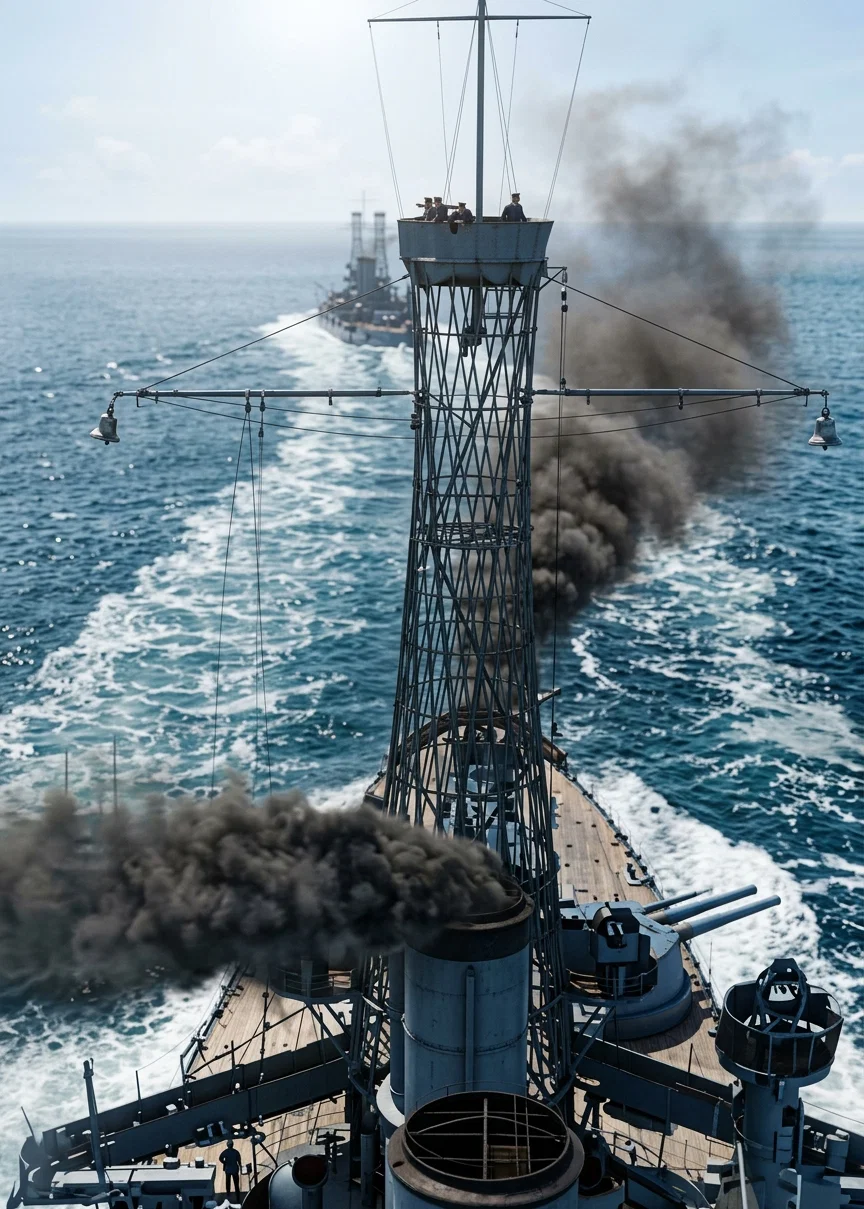
The above illustration is the main mast, or "fire-control" platform, of the most modern battle-ship. The observers on the platform at the top are about 100 feet above the water, and from this elevated position they are able to sight the enemy when his vessel would not be above the horizon of some one on the deck below. From this position also the "fire-control" officer is able to observe where the shells fired are striking; and by means of electric communication and speaking-tubes he directs the gunner so that he can alter his aim and hit the target.
It would hardly be possible for any one to speak with higher national self-importance. War begets chauvinism and armaments; armaments beget distrust; and distrust, in turn, augments armaments in the same ratio as these increase distrust. It is a vicious circle into which the whole civilized world of our day appears inextricably to have fallen.
In his remarkable book entitled "Asia and Europe," Meredith Townsend, an English historian, inquires most significantly: "Will the East ever conquer the West? Will the yellow whirlwind, rushing with irresistible force across the world, engulf Europe and its civilization until the people sink beneath the matchless strength and numbers of eight hundred million inhabitants of Asia?"
Commenting upon the foregoing, the London "Daily Mail" says, "SOME DAY IT WILL COME; and then, if Europe should drive it back, it in its turn would drive Europe out of Asia." From the same paper we quote: "What, asks Mr. Townsend, in closing a remarkable chapter, is to become of Asia? It is the most fascinating, the most hopeless of problems, and we feel with the author, as we close his book, that the only possible reply is: 'WHAT GOD WILLS, NOT WHAT EUROPE WILLS.'"
Not long before his death, Sir Henry Campbell-Bannerman declared, "On the one hand we find the reasoned opinion of Europe declaring itself more and more strongly for peace, and on the other hand, preparing for wars which in their extent and effectiveness suggest that a LUST FOR BLOOD is the actuating principle of modern society."

A Striking Prediction

These prodigious preparations for war, the marvelous awakening of the heathen nations after "the sleep of centuries," is an unmistakable response to the following inspired latter-day prophecy: "Prepare war, wake up the mighty men, let all the men of war draw near; let them come up: beat your plowshares into swords, and your pruning-hooks into spears: let the weak say, I am strong. Assemble yourselves, and come, all ye heathen. . . . LET THE HEATHEN BE WAKENED, AND COME UP TO THE VALLEY OF JEHOSHAPHAT: for there will I sit to judge all the heathen round about. Put ye in the sickle, for the harvest is ripe: come, get you down; for the press is full, the fats overflow; for their wickedness is great. Multitudes, multitudes in the valley of decision [thrashing]: for the day of the Lord is near in the valley of decision." Joel 3: 9-14.
In rapt vision Jeremiah looked down through the vista of the centuries to the time of the end, and prophetically exclaimed: "My anguish, my anguish! I am pained at my very heart. . . . I can not hold my peace; because thou hast heard, O my soul, THE SOUND OF THE TRUMPET, THE ALARM OF WAR. Destruction upon destruction is cried; for THE WHOLE LAND IS LAID WASTE." Jer. 4: 19, 20, A.R.V.
Again, the apostle John, in holy vision, declares: "And I saw three unclean spirits like frogs come out of the mouth of the dragon, and out of the mouth of the beast, and out of the mouth of the false prophet. For they are the spirits of devils, working miracles, which go forth unto THE KINGS OF THE EARTH AND OF THE WHOLE WORLD, TO GATHER THEM TO THE BATTLE OF THAT GREAT DAY OF GOD ALMIGHTY." That this divine forecast will have its fulfilment at the close of time, is made certain by the words that immediately follow. Christ declares: "Behold, I come as a thief. Blessed is he that watcheth, and keepeth his garments [spiritual garments], lest he walk naked [spiritually], and they see his shame." Rev. 16: 13-15.
We have cited the serious convictions (as to the prospect of a world-wide all-devastating war) of many of the most far-sighted, most acute, most veracious, and most influential leaders of human affairs in our day. Do you not see how wonderfully consonant with the predictions of Holy Writ are the sober, deliberate predictions of these great men?
God bless the noble men and women who are working for the bringing in of the endless era of peace; and may He graciously lead them to see that the only hope of ever realizing that glorious consummation, is "THAT BLESSED HOPE, AND THE GLORIOUS APPEARING OF THE GREAT GOD AND OUR SAVIOUR JESUS CHRIST." Titus 2: 13.