REVELATION XIII

4%

Pacific Press Publishing Company · Oakland, California · Oct 22, 1894

FromSigns of the Times, Vol. 20, No. 50.

Read the full edition

REVELATION XIII.

LAST week it was shown that the dragon of Revelation 12 represents the great enemy of our Lord Jesus Christ and the church of God, and that as such he is the instigator of all persecution against the people of God. The laws and decrees by which the persecution is rendered most effective, Satan utters through his chosen agents,—the governments or dynasties of earth that have yielded to his deceptions and power. These, from the time when the church of God went into captivity, to her final deliverance, are seven in number, represented by the seven heads of the dragon. The head is that part of the organism which plans and speaks for the mind behind it, and so these governments plan and speak for the Satanic spirit behind them.
In chapter 13 the chief instigator of all this persecution is left in the background, and the earthly agents, the ruling powers, appear under the symbol of a seven-headed, ten-horned beast, having the mouth of a lion, the feet of a bear, the body of a leopard, and receiving from the dragon, or Satan, "his power, and his seat [throne], and great authority."
The composition of this beast carries the student of prophecy back to Daniel 7. There four beasts are presented before the prophet, representing four kingdoms, the lion symbolizing Babylon; the bear, Medo-Persia; the leopard, Grecia, and the nondescript beast, possessing the characteristics of all three, representing Rome, the same as the seven-headed beast of Revelation 13. The fourth beast of Daniel 7 had ten horns, as also the beast of Rev. 3:1-10, symbolizing ten divisions of the Roman Empire. These divisions were brought about by the incursions of the northern barbarians between the years A.D. 351 and 476. They are named by good authority as follows: Ostrogoths, Visigoths, Allemani, Franks, Vandals, Suevi, Burgundians, Heruli, Anglo-Saxons, and Lombards.Among the ten horns another was seen to arise, before which three of these kingdoms fell. They were not united in lifting the little horn to supreme power. This little horn, having a man's eyes and a mouth speaking great things, as not less than ten clear and distinct specifications conclusively prove, refers to that great system of deception and lawlessness called the Papacy. Three of these ten kingdoms were Arian in their belief, while the bishop of Rome was a Trinitarian. The three opposing kingdoms fell before the Roman bishop, and the little horn of the Papacy became the dominating spiritual power of the divided Roman Empire in A.D. 538.
The little horn represents in some slightly different aspects what is represented by the beast of Revelation 13 under the dominance of the papal head. In fact, the Roman Empire, under the spiritual domination of the Papacy, is the special thing presented in Rev. 13: 1-10. The first four heads, through which the devil has uttered his persecuting laws,—Babylon, Medo-Persia, Grecia, and Pagan Rome,—are covered by the prophecies of Daniel and the twelfth chapter of Revelation. The worst work of Pagan Rome, under Satan, that which shows its character, was against the Prince of Glory himself.
The next great persecuting agent, the head in succession, is Papal Rome, the very masterpiece of Satanic deception, strength, and cunning, professedly Christian, but decidedly antichristian. The Roman Empire under this papal head, as before remarked, is the same as the Roman Empire under the little horn of Daniel 7. They both do the same work, and exist for the same time, as the following parallel will show:—
THE LITTLE HORN. THE BEAST.
Speaks "great words" against God. Dan. 7:8, 20, 25. Speaks "great things and blasphemies." Rev. 13:5.
"Shall wear out the saints of the Most High." Verse 25. "Given to him to make war with the saints, and to overcome them." Verse 7.
"Shall think to change the times and the law." Verse 25, R. V. "And they worshiped the beast." Verse 4.
"Shall be given into his hand until a time and times and half a time."—Id. "And power was given unto him to continue forty and two months." Verse 5.
The powers represented by both symbols do the same work, have the same character, occupy the same territory, and continue the same length of time. They are, therefore, identical. This time is from A.D. 538, when the bishop of Rome was made "head over all the churches," and "true and effective corrector of heretics," and ends in 1798, when the power of the Papacy as a persecutor was broken. The change which the Papacy has attempted to make in God's law was considered two weeks ago, and shown to be the substitution of the Sunday for the Sabbath of the Lord, the only authority for which is the tradition of the apostate church.
The first four verses of Revelation 13 present the entire career of the beast under the papal head, namely, its investment with authority and power, its seemingly complete destruction,—"wounded to death,"—and its restoration, and the subsequent homage rendered it by the world. Verses 5-10 refer to its career during the 1,260 years of its continuance as a persecutor, verse 8 looking forward to its restoration.

Its Different Phases.

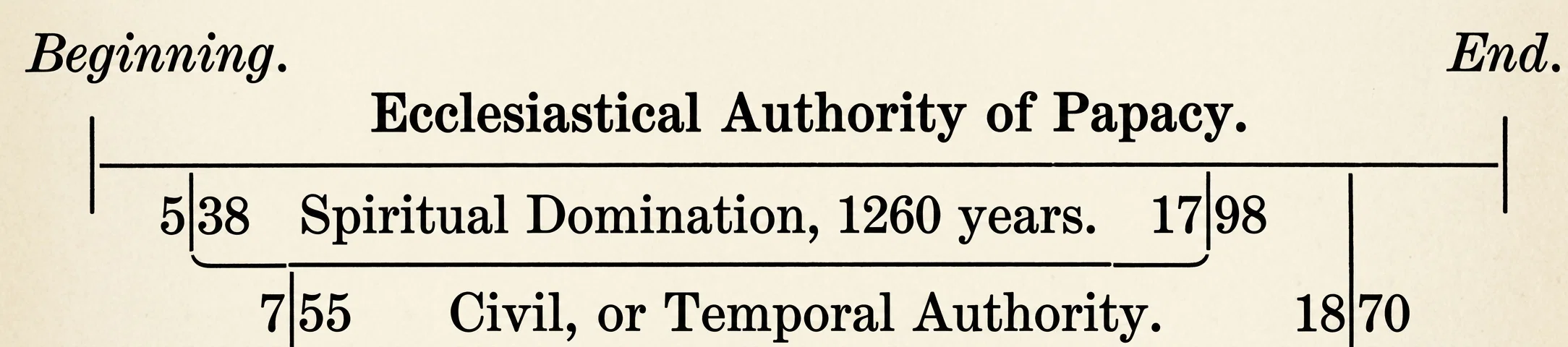
The authority of the Papacy, or the Roman Catholic Church, unconnected with earthly governments, is simply ecclesiastical, the same as that of any other church organization. Its authority which it possessed as a distinct little horn over the papal States, from A.D. 755 to 1870, is what we may call temporal power or authority, limited as regards territory. But the authority swayed by the Papacy from A.D. 538 to 1798 we shall call spiritual domination. It was given to Rome by the civil power, and taken from her by the same power, under God, of course. The Church of Rome was given authority to define what men should profess and practice, and power sufficient to enforce through her agents the temporal penalty which she adjudged due to those whom she was pleased to call heretics.
In order that the Papacy might thus punish what she deemed heresy, it was necessary that civil rulers should submit to her authority. This was done by the divisions of the Roman Empire generally. There were those who at times opposed her assumptions, but sooner or later the Papacy found means to bring them to the feet of the ruler of the Vatican. In other words, these governments generally acknowledged what the Papacy claimed, either because it was believed or for reasons of policy. And the Roman Church claimed the authority to define and punish heresy, with the blasphemous assumptions concomitant to such a claim. This led to the persecution of the church of God; and this it is which the prophecy presents before us.
The different phases of the Papacy may be better understood by the following diagram:—

What Makes a Persecuting Power?

A question of importance, not only as regards the Papacy, but of moment in this present time, is, What made the Papacy a persecutor? Briefly answered, it was religion by law, or power to enforce religious decrees and to punish heretics, or those who disobeyed these decrees. As it has been before more fully expressed:—
Two elements are always essential in order to have a persecuting power; and these two elements united always make a persecuting power. But if either of these is taken away, the power as a persecutor is destroyed. 1. The power must be religious or it will not persecute. The United States Government is perhaps the best example of this. The Federal Government has never persecuted; religion is in no way connected with it. 2. It must have power to enforce its religious dogmas,—to punish what it deems heresy,—or it cannot persecute. Methodists, Baptists, or any other church of this country, is a good example of this. They may issue decrees and pronounce penalties, but they cannot enforce them. This was the condition of the Papacy before 538 A.D. But when the bishops of the Roman Church became "head over all the churches" and "true and only corrector of heretics," the Papacy came into existence as the ruling, controlling power, in other words, the head of the beast. It was given existence or life as a head by the existing government, the powers that be, the government of the empire granting it the authority to define and correct heresy.
As an ecclesiastical system, it was not a head and could not persecute. As such it is not noted in the prophecy. It is placed there because it is a persecutor and destroyer of the people of God. It became a persecutor through the legal acknowledgment of its claims by earthly powers. Let these facts be borne in mind. This power to persecute did not exist by reason of Rome's civil power, for this was not possessed by the Papacy till 755. It did not exist by virtue of ecclesiastical authority, for this Rome had prior to 538, and still has. It existed by virtue of acknowledgment of the Roman bishop's position as "head over all the churches" by the governments of earth. This power that church possessed in a degree between 538 and 756, when she had no civil power. Again between 1798 and 1870 she did not possess this power, although neither the civil nor ecclesiastical element was wanting. It was created by an acknowledgment of her claims on the part of the governments of that empire. The Papacy, the beast under that head, in the light of the prophecy, must have such acknowledgment to exist again.
The taking away of the persecuting power of the Papacy is described by the prophet in these words: "He that leadeth into captivity shall go into captivity; he that killeth with the sword must be killed with the sword," and "I saw one of his heads as it were wounded to death."
These passages refer to the destruction of the Papacy not as an ecclesiastical or civil power but as a persecuting power. This is the only phase noted in this prophecy. The ecclesiastical power still remained, but not as a controlling element. As the head of the beast it was "wounded to death," and the beast as represented by the particular character of that head was no more. The beast still existed, but no longer as a papal beast, because the papal head controlling it was dead as a controlling element in the affairs of State. The wound was deadly.

Has the Deadly Wound Been Healed?

If so, the Papacy is now the corrector of heretics, not in claim merely, but in general recognition by the governments which are symbolized by the horns. But it is patent to everyone that this is not the case. The Papacy was wounded by the Reformation. The decree of toleration by Maria Theresa, empress of Austria, in 1756, the French Revolution, and other events, also sorely wounded it, and its death blow as a persecutor was given by Berthier in 1798. The persecution had really ended before this; the New World had opened its doors to the refugees from papal persecution, and swallowed up its flood of vindictiveness. But some waning prestige still remained. But in 1798 it received its death stroke, and was no longer feared or loved by the rulers of those lands over which it formerly reigned. The death stroke by the French greatly affected its temporal or civil power over the state of the church, but only for a time. Another pope was elected, and the temporal dominion was again restored, but his power in other realms was gone. One of the two essential elements which made it a persecutor was taken away, and it has not yet been restored.
At the time the deadly blow was struck another power, symbolized by another beast, was seen "coming up." This we will consider in our next.