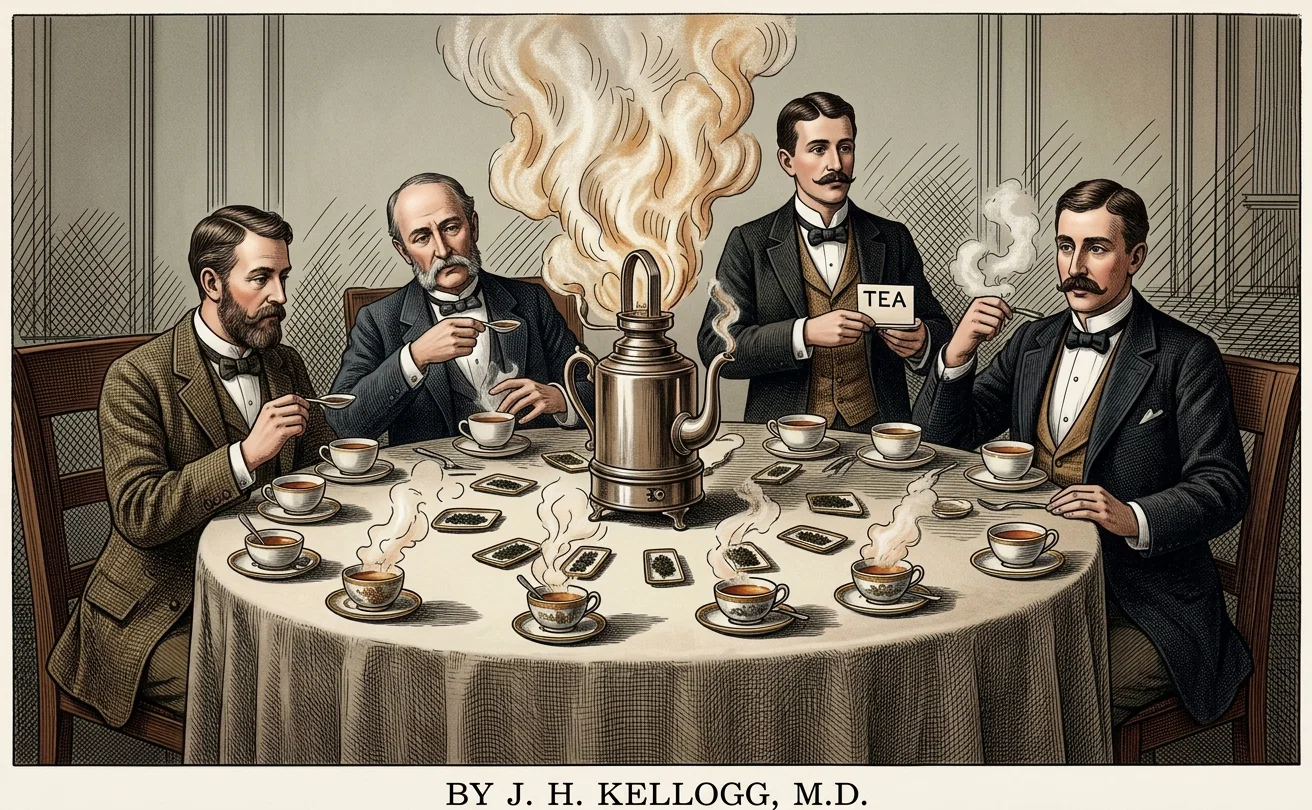
The picture shows a number of men sitting at a table engaged in the business of "tea-tasting." When a ship-load of tea comes into New York from China, samples of all the different lots of tea on board are placed in the hands of professional tea-tasters. It is the business of these men to examine all these samples by making a little tea from each lot and tasting it.
Possibly some tea-loving reader is inclined to envy the tea-taster, who has nothing to do all day but sip his dainty cups of tea. Wait a moment and learn more about these tea-tasters before you wish yourself one of them. Some years ago, Dr. Morton, an eminent New York physician, investigated the business of tea-tasting and its effects upon those engaged in it. After some months' study of the subject he made a report of the results before a body of learned physicians, from which we quote the following:—
"The pernicious effects of tea-tasting upon many of its followers are well recognized by all their number. It seems to be accepted among them, without discussion, that many break down and are obliged to give up the business, or else pursue it with much caution and at constant inconvenience to their health. And those of the public who are at all familiar with the facts, entertain the same view. Indeed, I may say that if I were now to express an opinion, based upon my present, it is true not yet sufficiently extensive information upon the subject, I should feel inclined to say that no one engages for several years in the profession of 'tea-tasting' without suffering both immediate and permanent harm to health.
"This feeling is well illustrated in the remark of a prominent wealthy tea merchant, who said, 'I would rather give a hundred thousand dollars than have my son become a tea-taster.'
"At first glance, to witness the operation of tasting, it would hardly seem possible that the very small amount of tea used at any one time could result in harm. This amount is only equal in weight to a five-cent piece, about fifteen grains. About two ounces of well-boiled water are turned onto this, and the infusion is allowed to 'draw,' perhaps fifteen minutes. Of this infusion the taster takes but a few spoonfuls into his mouth, and often spits it out again; he also at intervals inhales the steam. But the harm comes, of course, from the constant repetition of these acts.
"The cases which I propose to relate exhibit the extreme physiological action of an infusion of tea. They are cases of acknowledged excess; and in this lies their interest, for by familiarity with the symptoms of excess, we shall be able to thread our way back to those of moderation, and to point out, it may be, that what many perhaps consider moderation is, in reality, abuse, and that certain symptoms put down as 'nervousness,' 'nervous irritability,' and 'nervous exhaustion,' as well as the more clearly-defined ailments of dyspepsia, hypochondria and hyperemia, may sometimes be attributed to the misuse of a common domestic beverage. Indeed, I am forced to think that many people, unconsciously to themselves and to their physicians, suffer from a train of symptoms due to tea (or its congener, coffee). We often find people taking tea to relieve the very set of symptoms which the abuse, as will be shown later, produces; and it is often the fact that patients date their recovery from a dyspepsia or nerve exhaustion from the time when they gave up their tea."
Dr. Morton gives the following description of a tea-taster, which portrays in a most graphic manner the acute and chronic effects of poisoning with this drug:—
"The immediate effects upon him are as follows: In about ten minutes the face becomes flushed, the whole body feels warm or heated, and a sort of intellectual intoxication comes on, much the same in character, it would seem, as that which occurs in the rarefied air of a mountain. He feels elated, exhilarated, troubles and cares vanish, everything seems bright and cheerful, his body feels light and elastic, his mind clear, his ideas abundant, vivid, and flowing fluently into words.
"At the end of about an hour's tasting a slight reaction begins to set in; some headache comes on; the face feels wrinkled and shriveled, particularly about the eyes, which also get dark under the lids.
"At the end of two hours this reaction has become fully established, the flushed, warm feeling has passed off, the hands and feet are cold, a nervous tremor comes on, accompanied with great mental depression. And he is now so excitable that every noise startles him; he is in a state of complete unrest and mental exhaustion; he has no courage to do anything; he can neither walk nor sit down, owing to his mental condition, and he settles into a complete gloom. His body in the meanwhile does not feel weary. Copious and frequent urination is always present, as also certain dyspeptic symptoms, such as eructations of wind, sour taste, and others.
"The above-described immediate effects follow a single afternoon's tea-tasting. They may be summed up briefly as: Excited circulation, intellectual intoxication, with actual increased vigor of mind power, increased urination; then a period of collapse indicated by cold extremities, tremulousness, mental irritability and anxiety. It will be several days before this condition of affairs is amended. And at this time the temptation to take alcoholic stimulants is very strong."
Dr. Richardson, the eminent English physician and sanitarian, speaks upon this subject as follows:—
"The extremely injurious effects of tea are best seen in some of those who are charged with the commercial duty of 'tea-tasting.' A professed 'tea-taster' who was so seriously affected by the process that he thought it proper to consult me on the symptoms induced, defined the symptoms very clearly as follows: 'Deficiency of saliva, destruction of taste for food, biliousness, nausea, constipation, an extreme and undefinable nervousness, and nightmare whenever sleep is obtained.'
"The symptoms from which habitual tea-drinkers suffer are identical in character, but minor in degree."
The tea-taster's experience should be a warning to all tea-drinkers. The fact that the use of weak tea does not produce all the effects described does not prove it to be harmless, any more than the same argument proves wine, beer, and hard cider to be wholesome and innocent beverages.