THE INQUISITION AND ITS "HOLY OFFICES."
6%

Pacific Press Publishing Company · Oakland, California · Oct 1, 1896

FromSigns of the Times, Vol. 22, No. 39.

Read the full edition

THE INQUISITION AND ITS "HOLY OFFICES."

BY ARTHUR T. PIERSON, D.D.
Few people, even among intelligent Protestants, are familiar with the history of the Inquisition. When in Rome, few spots more repay investigation than the Palazzo del Santo Uffizio, near the Vatican, the building formerly used for the "Holy Office," as instituted by Paul III., in 1542. The tribunal was abolished by the Roman Assembly after the revolution of February, 1849, but restored in the June following by Pius IX. During the French occupation of Rome, the old Palazzo was turned into barracks, and the business of the Inquisition was transferred to the Vatican.
When Paul III., seeking to deal a death-blow at the Protestant Reformation, issued his bull in 1542, creating the tribunal of the "Holy Office [!]," he appointed six cardinals—Caraffa and Toledo being the chief inquisitors—who were clothed with power to appoint successors, and with authority to decide all cases as a court of final appeal. All parties, rich and poor, patrician or plebeian alike, were given over into their hands to imprison on suspicion, to punish on conviction, to torture by way of compelling confession. The only power not entrusted to them was the right of pardon—his "Holiness" reserving that prerogative to himself. And the Inquisition thus became, in a double sense, a court that showed no leniency, and its victims had indeed "judgment without mercy."
The rules of its action are a curious relic of papal equity: (1) In affairs of faith there must not be a moment's delay, but on the slightest suspicion proceedings must be taken. (2) No regard must be paid to any potentate or prelate, whatever his power or dignity. (3) On the contrary, the greatest severity must be shown toward those who seek to shelter themselves under the protection of a ruler; only where confession is made are leniency and fatherly compassion to be shown. (4) To heretics, and especially Calvinists, no toleration must be granted.
The cardinal chiefs of the Inquisition did full justice to their "Holy Office" as thus defined. And if Paul III. was a severe superintendent, his successor, Paul IV., out-Heroded Herod for the violence of his persecuting zeal. When he assumed the papal tiara he was already in his eightieth year, yet it was said of him proverbially that he knew not what it was to make a concession; and certainly in his conduct of the "Holy Office" he exhibited an unrelenting hatred of heretics, mixed with a severity which was absolutely merciless, and an intolerance that was absolutely unbending. He was the impersonation of Talus with his iron flail. His very eyes flashed fire, and his tall, erect, spare form seemed wrought of iron, with nerves of steel. To one end all his energies were devoted,—at any cost, to put down heretics and make the Roman Catholic See triumphant over all "reformers," a world-wide power with undisputed supremacy. In fact, so terribly hard was his iron rule that when, on August 18, 1559, he died, a riot arose, and "hell broke loose." The prison of the Inquisition was broken open and fired, the prisoners being released. The rioters went to the chamber of the Inquisition and slew the chief inquisitor, burned or spoiled all the archives, and were hardly restrained from burning also the convent of Sofia Minerva, where the old court of the Inquisition existed, and where Galileo underwent his famous ordeal of trial for astronomic heresies.
About the saddest things there is often a grim humor; and the "Holy Office" is not without its absurd and semi-ridiculous aspects, as when, for instance, in the name of religion, it calmly and systematically countenances the most atrociously irreligious and barbarous proceedings. For example, in the new Palazzo, near the Vatican, one may see the cells lined with reeds, in which a prisoner could not stand upright. A curious advertisement appeared in 1880, offering for sale the "halls of the tribunal, prisons, and dungeons of torture."
Dr. John Stoughton saw, while in Rome, that unique volume whose title is, "Sacro Arsenale, over operatica dell' officio della Santa Inquisition—con l'insertione d'alcune Regole fatta dal p. Inquisitore, Thomaso Menghini Domenicano, e di diverse annotazioni del Dottore gio Pasqualone. MDCCXVI." The sixth part, which treats of the detection of heresy, unblushingly describes methods of interrogation by torture. One would think even the "Holy Office" would hesitate to put such things in print and give such a formidable weapon to the "reformers" and other enemies of the "Holy Roman See," but the reader must be the judge of the depravity akin to madness that can unhesitatingly commend such atrocities.
Three of these modes of examination by the agonies of torture are specified: Tormento del fuoco, or torture by fire; tormento della stanghetta, or torture with the bolt or bar; and tormento della cannetta, or torture with the soldering pipe! Here, as Dr. Stoughton remarks, is a typical example of "framing iniquity by a law;" and in the pages of this extraordinary volume, with the coolness of the most audacious effrontery, rules are given for the infliction of the most exquisite pain.
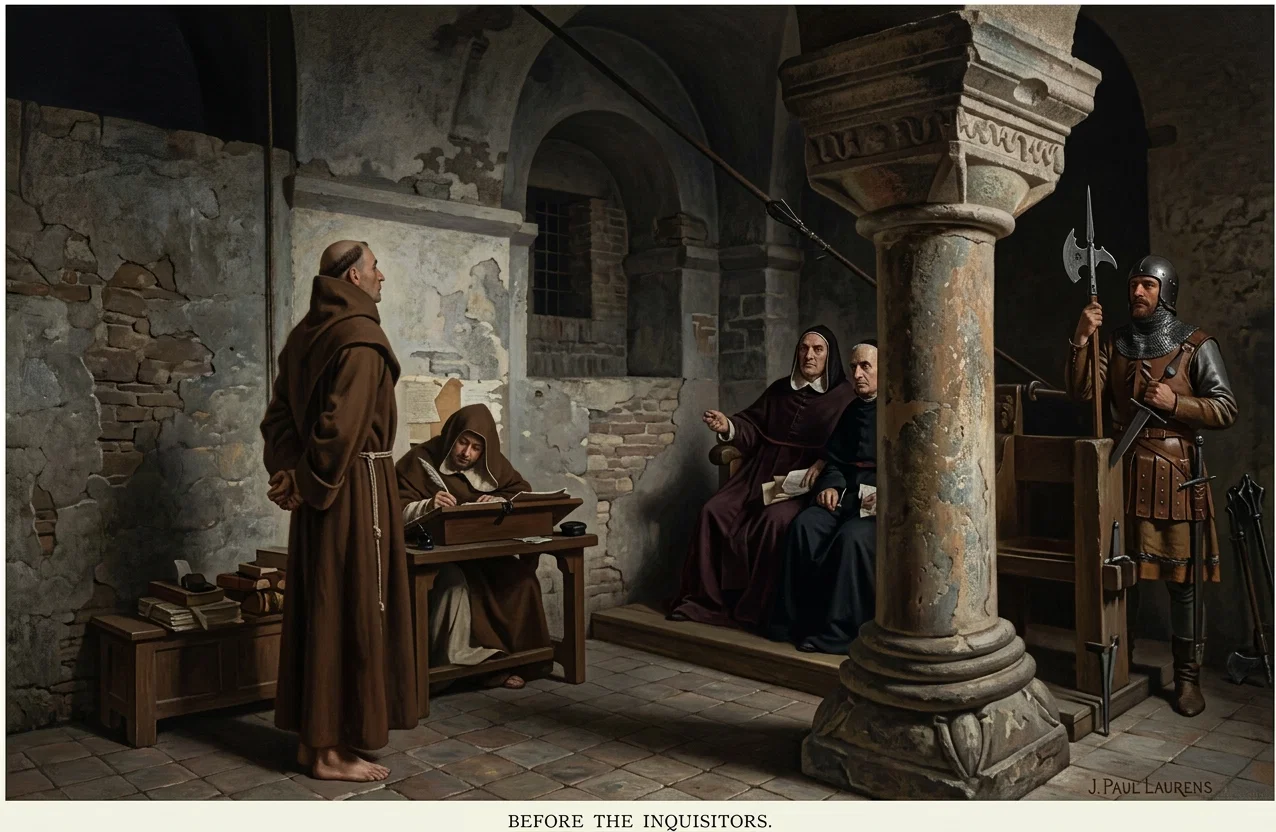
And yet, with the most pious conformity to a religious routine, all this holy vivisection was inflicted on the helpless human victims in the name of the church and the compassionate Christ! The inquisitors assembled in solemn fashion, invoking the name of Christ, and prayerfully proceeded to the duties of the Holy Office! Records were put before them of persons—suspectos heretica pravitatis, as the names of prisoners are entered on the calendars of Newgate, and they summoned before them the accused parties.
Severe questioning, accentuated with exhortation, threatening, persuasion, extorts confession; if not, then the gentle persuasions of flame and bolt and soldering pipe and other humane appliances are added to elicit the truth, until, to get rid of the intolerable torment, the victim acknowledges anything, however false—for no confession satisfies the Holy Office which does not confirm previous suspicion. It is a hall of judgment in which judgment is virtually pronounced in advance, and the examination must confirm the previous decision. Penalties of greater or less severity follow—a public whipping, confiscation of property, solitary penance, slavery in the galleys for any period, life incarceration; public abjuration is the least of penalties, the auto da fe is the greatest. And all this for what?—For holding that there is no future purgatory; that auricular confession is not necessary; that there is no sin in eating meat on proscribed days; that images and relics are not to be worshiped; that Christ is our sole advocate with God; that popes who do not live like Peter are not his true successors; that papal indulgences and anathemas are not of any value or weight, and priestly absolutions are not efficacious; that justification is by faith alone: and that the host is not the real body of Christ.
How one exults to trace the history of these victims of papal tyranny, who, like the three holy children, could not be intimidated even by torture—like Bartolomeo Bartoccio, who after two years in a cell, doomed to the fires, walked with a bold step up to the stake, and amid the flames shouted: "Vittoria! Vittoria!" It was said of Savonarola that as the bishop of Florence threw at him a burning brand, crying, "I cut you off from the church militant!" he triumphantly replied: "Aye; but you can not cut me off from the church triumphant!"
We have not in this brief paper traced the Inquisition either to its beginnings or into its ramifications. Suffice now to say, by way ofcompleteness to the outline of its history, that the first permanent court of inquisition was established in 1248 under Innocent IV., the chief direction being vested in the then recently established Dominican order. Previously it had been local; now the tribunal became general, and was introduced successively into Italy, and Spain, and Germany, and southern France. In France, the Inquisition came to an end under Philip the Fair, tho under Henry II., an unsuccessful attempt was made to revive it as an engine of extermination against the Huguenot heresy.
In Germany, it fell into disuse in the days of the Reformation. But in Spain and Portugal it has a history which has perhaps no parallel in the annals of the race. Early in the reign of Ferdinand and Isabella, Sixtus IV., in 1478, revived the organization after a long period, during which it had but a nominal existence, the crown, however, both controlling the acts and appointing the actors of the court.
In 1483, a little more than four hundred years ago, the Spanish Inquisition began its terrible career under Thomas de Torquemada. The number of victims, as given by Llorente, the popular historian of the Inquisition, is nothing short of appalling. During the sixteen years of Torquemada's tenure of office alone, there were nearly nine thousand persons who were burned! Under Diego Deza, the second head of the tribunal, in eight years, over sixteen hundred suffered at the stake. Some have doubted or denied the accuracy of these statements; but after making all possible deductions and reductions it is impossible calmly to contemplate the amount of cruelty undoubtedly practised. The rigor of the Spanish Inquisition abated in the later part of the last century, after a period of three hundred years, the full history of which can never be written.
The whole method of inquisitorial proceedings illustrates the irony of history. A party, on mere suspicion could be arrested and imprisoned at will, and kept in prison until it pleased his judges to submit him to examination. The proceedings were secret. He was confronted by no accusers, nor did he even know their names, and, in some cases, not even the grounds of suspicion! The evidence of an accomplice was inadmissible, and torture was always the last resort to extort confession of guilt. If, after the torture ceased, the victim disowned the confession made on the rack, he was put to torture again, till he once more "confessed the truth" as before. The fact that no such tribunal is in operation to-day proves, alas! nothing but that the Holy Roman Catholic Church has no longer the autocratic power which made such high-handed atrocities possible. When Father Hecker can boldly assert that "Heresy should be reckoned and punished in the thought," intolerance is not dead, and only the power is necessary to revive the Holy Office. Rome no more tolerates Protestant heresies to-day than at any other time since 1248. Let us not deceive ourselves, nor abate our solemn protest against the errors which ensnare human souls in the name of Christianity. "Separation" is the watchword of the day, not "Union," and charity itself demands this separation, that we "be not partakers of her plagues."—Condensed from Missionary Review of the World.
BEFORE THE INQUISITORS.