The Dragon

3%

Pacific Press Publishing Company · Oakland, California · Oct 15, 1896

FromSigns of the Times, Vol. 22, No. 41.

Read the full edition

The Dragon

THE CONTROVERSY OF THE AGES. NO. 2.

The Dragon.
IN our last we considered the first two verses of Revelation 12, in which is given the symbol of the woman representing the church at the time of, and previous to, the first advent of Christ. In this paper we will consider the second symbol of the chapter, the dragon, in his relation to the woman. Of that symbol the prophet says:—
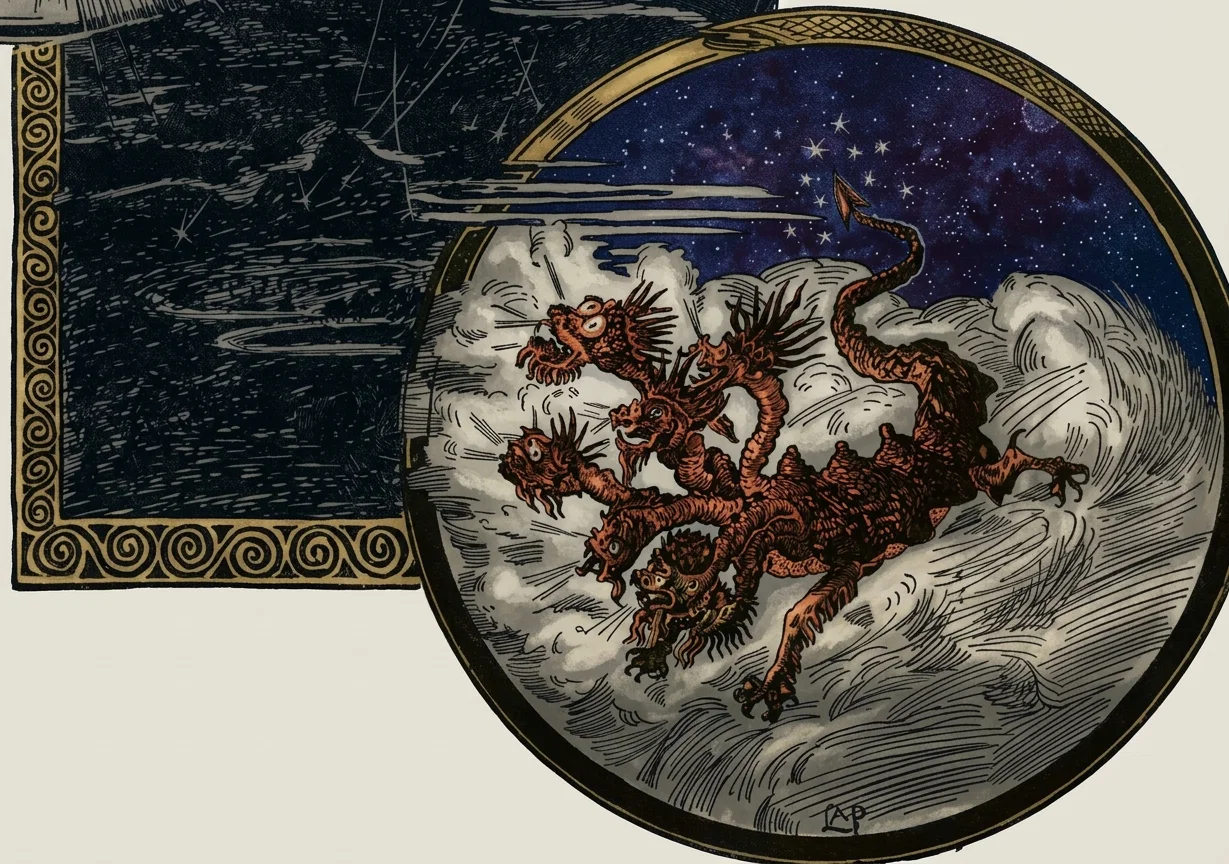
"And there was seen another sign in heaven; and behold, a great red dragon, having seven heads and ten horns, and upon his heads seven diadems. And his tail draweth the third part of the stars of heaven, and did cast them to the earth." Verses 3, 4, R. V.
Of the meaning of this symbol of the dragon we are not left in doubt; for the ninth verse expressly calls him "the old serpent, he that is called the Devil and Satan." It is the great adversary of God, hence of the church; the one who seduced our first parents in the Garden of Eden, the accuser of the angels and God's people, the destroyer and corrupter of all good. "Satan" means "adversary," and "Devil" means "accuser," "slanderer;" and the term "old serpent" carries us immediately back to the deceiver of mankind in the garden of God. The record goes back farther than this to his rebellion in the beginning, when he "drew after him the third part of heaven's sons."
Satan was not always the adversary and the accuser of God and his people. He was once an angel of light in heaven, bearing a name indicative of his nature. The prophet Isaiah, introducing him first as king of Babylon (Isa. 14:4), thus speaks of his fall:—
"How art thou fallen from heaven, O Lucifer ["Day-star," or "Light-bringer"], son of the morning! how art thou cut down to the ground, which didst weaken the nations!
For thou hast said in thine heart, I will ascend into heaven, I will exalt my throne above the stars of God; I will sit also upon the mount of the congregation, in the sides of the north; I will ascend above the heights of the clouds; I will be like the most High." Verses 12-14.
The king of Tyre is the figure by which another prophet introduces him, the earthly king being called the prince of Tyre (Eze. 28:2). Thus is his past glory, his sin, and his future doom described:—
"Thus saith the Lord God: Thou sealest up thesum ["measure," margin], full of wisdom, and perfect in beauty. Thou wast in Eden the garden of God; every precious stone was thy covering, the sardius, the topaz, and the diamond, the beryl, the onyx, and the jasper, the sapphire, the emerald, and the carbuncle, and gold; the workmanship of thy tabrets and of thy pipes was in thee; in the day that thou wast created they were prepared. Thou wast the anointed cherub that covereth; and I set thee, so that thou wast upon the holy mountain of God; thou hast walked up and down in the midst of the stones of fire. Thou wast perfect in thy ways from the day that thou wast created, till unrighteousness was found in thee. By the multitude of thy traffic they have filled the midst of thee with violence, and thou hast sinned; therefore have I cast thee as profane out of the mountain of God. . . . Thine heart was lifted up because of thy beauty, thou hast corrupted thy wisdom by reason of thy brightness. . . . Therefore have I brought forth a fire from the midst of thee, it hath devoured thee, and I have turned thee to ashes upon the earth in the sight of all them that behold thee. All they that know thee among the people shall be astonished at thee; thou art become a destruction, and thou shalt never be any more." Verses 12-19, R. V., margin.
These scriptures, with others which might be given, show the exalted position and nature of Lucifer before his fall. He was "full of wisdom and perfect in beauty," filling up the measure of created perfection, the highest of all created beings, even next to the Son of God, the One who created. But looking upon the beauty and wisdom and perfection which God had bestowed upon him, he ascribed it all to himself. His heart became lifted up. The free will and choice which God gave him—which Infinite Wisdom must give to every intelligent being in whom character is perfected—he turned to selfish ends instead of using to God's glory. He exalted himself above the other angels. "I," said he, "will ascend above the heights of the clouds," the hosts of angels that surround God's throne; "I will exalt my throne above the stars [the angels] of God;" "I will be like the Most High."

What His Exaltation Meant.

But all this meant the destruction of the Almighty and the ruin of the universe, which can only be maintained by the character of love. "God is love;" and his law is the law of love. He demands obedience, but it must be willing obedience, the obedience of love. The loyalty of love, of tested, willing obedience, will ever endure. Satan chose selfishness instead of unselfishness, hatred instead of love, sin instead of holiness, iniquity instead of righteousness. He thought it would exalt him, but it wrought his ruin, and the ruin of one-third the angelic host—"the stars of God"—whom Satan drew after him, or, as the Revised Version has it, "draweth the third part of the stars of heaven." It is a gradual fall; it did not take place all at once; the casting to the earth did not come in the beginning of his rebellion. "God is love," unchangeable love; and as this love has moved God to do all in his power to save man, we know that he did all he could to save Lucifer, the day-star, and all the others affected by him. But this Lucifer in his pride rejected, and in consequence fell, drawing a third of the angels with him.

Satan's Attitude toward God's People.

The dragon had seven heads and ten horns. This is not as Satan exists, but it represents him in his attitude toward the woman and his work respecting her. So Christ is represented by "a lamb having seven horns and seven eyes," having in himself the perfection of power and wisdom indicated by the number "seven." (Rev. 5:6.) The dragon is a persecutor of the woman. (Rev. 12:9.) But he is not permitted to do this as a spiritual being, a fallen angel; God does not suffer it. He must persecute the church, if at all, through other agencies, and those other agencies are represented by the heads through which Satan promulgated persecuting decrees. They must therefore refer to those governments which Satan has at different times perverted and ruled, in order that he might defeat God's plan. They are the great world empires which have persecuted and endeavored to blot out the church of God during past ages, from the beginning of the captivity of the daughter of Zion, and which will persecute and endeavor to destroy God's people till the coming of Christ the Deliverer. These heads are successive, not contemporaneous, as will appear in our study later. The horns are contemporaneous, that is, they represent earthly kingdoms existing at the same time.

The Dragon and the Woman.

"And the dragon stood before the woman which was about to be delivered, that when she was delivered, he might devour her child." Rev. 12:4.
The dragon, we have seen, represents Satan and his control over earthly powers. The woman represents the church of God. The child to be born is the Deliverer, Jesus Christ; for he was to rule all nations with a rod of iron, referring directly to the Father's promise to the Son predicted in Ps. 2:8, 9: "Ask of me and I shall give thee the heathen ["nations," R. V.] for thine inheritance, and the uttermost parts of the earth for thy possession. Thou shalt break them with a rod of iron; thou shalt dash them in pieces like a potter's vessel." This refers to the executive judgment against the wicked, when the priestly reign of Christ upon his Father's throne is finished, and the people of earth have forever rejected the salvation offered them in Christ. (Compare the following scriptures: Ps. 110:1; Heb. 8:1; Zech. 6:12, 13; 1 Cor. 15:24-28; Rev. 3:21.) Christ is now reigning on his Father's throne, and gathering out of all nations a people for his name, materials for his temple, subjects of his everlasting kingdom; when he comes again, after he has accomplished his priestly work, he will execute judgment upon the wicked, purify the earth cursed by sin, and begin his eternal reign with all his saints, upon his own throne and in his own dominion. Those who now let his grace reign in their hearts will then reign with him in glory.

Satan Waiting the Child.

When man first fell, he yielded himself to Satan. As Adam was given dominion over all the earth (Gen. 1:26, 27), under God, of course, when he yielded, he yielded all under him. Satan became ruler of the world by becoming ruler of man. Satan was lord and man was slave. God's design was and is that righteousness shall dwell in human flesh—righteousness incarnate. So it would have been had our first parents continued faithful. When man yielded to Satan, sin and Satan became manifest in the flesh, sin became incarnate, ruling the flesh. The kingdom could be won back only by man (to the number designed of God in the beginning) yielding to God and letting righteousness reign. This would be the driving out of Satan in the very citadel of his earthly kingdom. This work was undertaken by the Eternal Son of God,

Who Gave Himself,

an infinite sacrifice, to save the fallen. He laid aside his glorious and divine beauty, and took upon himself the flesh of fallen man. He did this in purpose in the beginning; he did it in fact when he was conceived and born of woman. And so God promised to sinful, sorrowful, repentant man a Saviour, a Deliverer, a Conqueror of Satan, speaking it even unto the old serpent, when it would seem that man's case was hopeless and Satan and sin forever triumphant: "I will put enmity between thee and the woman, and between thy seed and her seed, it shall bruise thy head, and thou shalt bruise his heel." (Gen. 3:15.) Satan might bruise and wound the people of God, and thus seem to triumph; but the Seed would bruise the head, would eternally destroy the serpent and the sin. (See Rom. 16:20.)

The Purpose of the Evil One.

Knowing that the Saviour of men, the Son of God, whom he had known and hated in heaven, would come in the likeness and weakness of sinful flesh, the devil, the old dragon, resolved to destroy the race, ay! the universe by destroying the One who had undertaken the vindication of God's character of love, and the salvation of sinners, those who could not save themselves, but were willing to be saved by love. As the human race were doomed to death by the first Adam, Satan determined that they would be finally destroyed by the destruction of their second Head, the Second Adam. Henceforth he would work to that end. He would deceive the world as to the character of God. He would frustrate and pervert every plan of God, and accuse God of its imperfections. He would bring calamity and death, and induce men to lay these to God's charge. He would induce all he could to sin, and thus so weaken them and blind them to righteousness that they would not accept the Christ when he should come. He would devise false gods and false religions of passion and lust as substitutes for the living and true God, and his religion of purity and life. But more than all would he wait before the woman that he might destroy the Holy Child.

Hopes and Promises.

Eve thought when Cain was born that she had gotten "the Man from the Lord," "the Man-Jehovah" (Gen. 4:1, Spurrell); but Satan overcame him, and the hope of the mother became the true child of the first murderer. It seemed that her hope revived when Seth was born (verse 25), but she was doomed to wait. Lamech seemed to have the same hope concerning Noah (Gen. 5:29), but disappointment, in a measure, came, and the curse rested still more heavily upon the earth.
After the flood, the first promise recorded, concerning the Seed's coming through any special family or line, was that given to Abraham. He should be the father to the promised Seed. Abraham had two sons—Ishmael and Isaac—Isaac was chosen. Isaac had two sons—Esau and Jacob—Jacob was chosen. Jacob had twelve sons; Judah was chosen. None of the others were rejected of God for salvation; nor was the salvation of those chosen assured; they were chosen as the earthly progenitors of the Messiah. Later on, of the families that sprang from Judah, Jesse was chosen. Of Jesse's sons, David was chosen, and of David's sons, Solomon.
We can imagine with what interest the arch-enemy read and heard these promises. How he plotted against those families and tribes. How he endeavored to deceive and lead them astray, and how finally by transgression greater than the heathen, the tribe of Judah was carried captive to Babylon. As long as the daughter of Jerusalem retained her kingdom and power she did not mourn. But when her walls were broken down, her beautiful temple burned, her cities deserted, and she herself carried captive, she hung her harp on the willow by the waters of Babylon and wept over the past, and travailed in birth for the Man child, the Saviour. Here the birth pangs began, as we saw last week, and as indicated by the prophet: "Now why dost thou cry out aloud? . . . for pangs have taken thee as a woman in travail. Be in pain, and labor to bring forth, O daughter of Zion, like a woman in travail; for now shalt thou go forth out of the city, and thou shalt dwell in the field, and thou shalt go even to Babylon." Micah 4:9, 10. See also chapter 5:2, 3; and the whole of Lamentations.
From this time forth the daughter of Zion—the church of God—was in travail. True she was delivered from Babylon, but she was still subject to the powers of earth. While many rejoiced at the building of the second temple, many also wept (Ezra 3:11-13; Hag. 2:3); for the glory had measurably departed till the temple should be glorified by the presence of the Desire of all Nations (Hag. 2:7), who should lead the elect of Israel to larger liberty and greater glory. Under the domination of the Babylonian, Medo-Persian, and Grecian empires the woman longed for her Child. A century and a half of the Pagan Roman passed away. Still the church travailed in pain and expectancy and the adversary waited. With what intense interest he must have noted the promises concerning John and Jesus. We can see his purpose of destruction in the full inn at Bethlehem, and the turning out of Mary, that if possible her child might be destroyed through exposure of the mother to the inclemency of night weather. Failing in this, he stirs up the minions of Rome through jealousy and envy. To Herod came the message from the wise men: "Where is he that is born King of the Jews? . . . we . . . are come to worship him." (Matt. 2:2.) "But," suggested Satan to Herod, "are not you the king of the Jews? Does not the kingdom belong to you and your successors?" Thus through pride, envy, and jealousy, the spirit which controlled him in heaven, Satan, the dragon, stirred up the minion of Rome against Christ, and the result was that Herod "sent forth, and slew all the children that were in Bethlehem, and in all the coasts thereof, from two years old and under" (verse 16), in order that he might destroy the Man child. But the angels of God frustrated his purpose, and his plans were defeated. The Child was preserved for his appointed work, grew to manhood, manifesting in his perfect life the perfect law of God (Luke 2:52), righteousness incarnate.
(To be continued.)