Note and Comment

6%

Pacific Press Publishing Association · Mountain View, California · Dec 5, 1911

FromSigns of the Times, Vol. 38, No. 48.

Read the full edition

Note and Comment

1. THE MASTER OF HIS EUNUCHS. The one occupying this position was very often one of the chief servants of the king, and the one who was most trusted for particular work which the king might designate. This officer was asked to choose of Israel's best — at least what Nebuchadnezzar would consider Israel's best. They must be of the seed royal and of the nobles of Judah, those who had received training and those who gave promise of future usefulness.
2. IN WHOM WAS NO BLEMISH. The object of the training was that they should stand in the king's palace, that they should be special servants of his, men gifted in learning and wisdom, those who would be able in the future to give counsel and stability to the kingdom. They must therefore be fine looking young men. They could not be cripples, or blind, or having physical defects; they must be "well favored," having not only a knowledge of the wisdom which they had been taught, but skill in using it — those who had gathered knowledge in their education, and who had studied science as a good groundwork for further education, and who in their very person would give promise of making just such men as the king chose them for. These he would give the best education that Babylonia afforded, the learning and the tongue of the Chaldeans.
3. THE KING APPOINTED. The king's students must have no impoverished diet. They must be well fed. Evidently he did not understand the true inwardness of the matter himself. It is not the sleek, fat, well-fed men who are always the best students, by any means. Some of the greatest thinkers that the world has known, some of the astutest men, some of the most diligent students, have been men whose diet was spare, who were very temperate and even abstemious in their lives. The king enjoyed his food, evidently. He thought the special students he was training should be fed the best the empire afforded.
4. GAVE NAMES. That is, the prince of the eunuchs in a shrewd way desired to wean them from their old associations, and so the very names that were given them were taken away and names substituted in their places. See the last article for the meaning of these names.
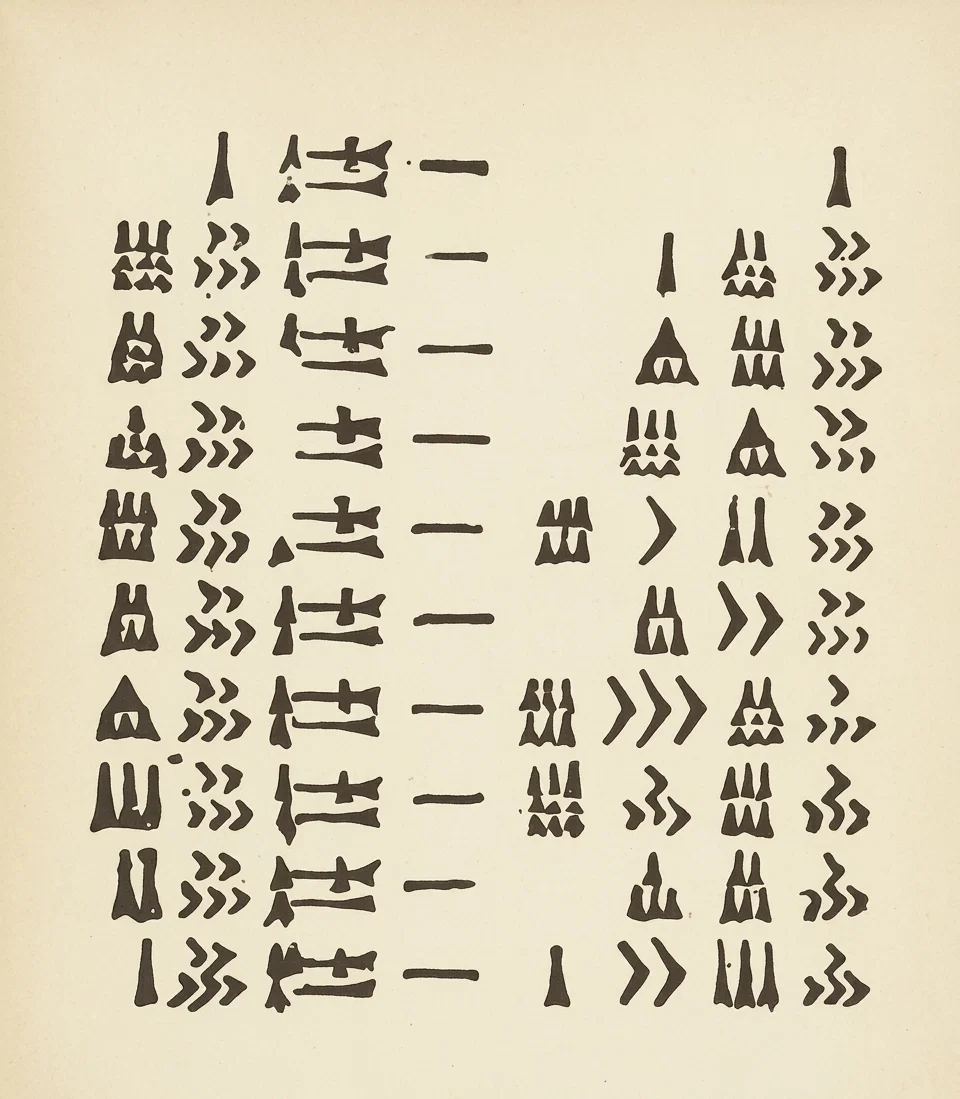
In arabic numerals the above may be expressed as follows: Soss Units Value 43 21 equals 51^2 45 4 ". 52^2 46 49 ". 53^2 48 36 ". 54^2 50 25 ". 55^2 52 15 ". 56^2 54 9 ". 57^2 56 4 ". 58^2 58 1 ". 59^2 60 0 ". 60^2. Extracts from a table of squares found at Senkereh, Chaldea. Berosus says that in computing time, the Chaldeans used an alternate sexagenimal and decimal notation, reckoning the years by the "soss" (60 years), the "ner" (600 years), and the "sar" (3,600 years). The calculations in every case, Rawlinson tells us, have been proved to be correct.
5. DANIEL PURPOSED IN HIS HEART. He made a strong resolve that he would not defile himself with the king's dainties. There were several reasons for this: First, they could not drink of the wine of the king, the wine of Babylon. Secondly, they could not be partakers of the unwholesome, rich viands of which royalty was partaker. They had been taught that service to God demanded strong, healthy bodies and clear minds; and the Holy Scriptures which they had learned from their infancy had taught them, as doubtless their own observation, that the dainties of the ruler were "deceitful meat," that "wine is a mocker," and that princes should "eat in due season, for strength, and not for drunkenness." See Prov. 23: 1-3; 20: 1; Eccl. 10: 17.
The school of the prophets, which at least in a perverted form they had doubtless attended, embraced the education of the whole man within its compass,—physical, mental, and moral. The very foundation of that education was the Word of God. Therein are found the best rules of sanitation and hygiene, the instruction as to the best dietary, that were taught in the ancient world; and those are the wonder and guide of enlightened sanitarians to-day. And that people—the Hebrews—who have but blindly, superstitiously, half-heartedly followed those instructions, are among the healthiest peoples of the world.
Babylon knew but little of this. Luxuriousness and lasciviousness reigned in their courts, fostered by luxury. These things were taught, or counseled, or permitted, in the Babylonian system of education. But the Judean princes, loyal to God, remembered the words of their wisest king: "Be not among wine-bibbers; among riotous eaters of flesh: for the drunkard and the glutton shall come to poverty [of both soul and body]; and drowsiness shall clothe a man with rags." "Look not thou upon the wine when it is red, when it giveth his color in the cup, when it moveth itself aright. At the last it biteth like a serpent, and stingeth like an adder." Prov. 23: 20, 21, 31, 32. Remembering this, they nobly refused to defile themselves with the king's meat, or with the wine which he drank.
Third, the eating and drinking of the Babylonians was more or less connected with their religion, the root of which was nature-worship, and the chief of which was sun-worship. Great feasts came weekly, monthly, yearly, in connection with this worship. Licentiousness in some form was a part of it, and this was fed and fostered by rich, unwholesome viands, exciting condiments and sauces, and the stimulating, intoxicating, maddening wine drunk on all such occasions. And the mad revels of students in our great institutions of learning to-day, connected more or less with fraternal secret societies, may be easily traced to the idolatrous feasts and revels of the various cults and guilds of ancient Babylon. But such feastings and revels were expressly forbidden by the law of Jehovah, in which the Judean youth had been educated. See Deut. 4: 19; 17: 3; Lev. 19: 26-29; Job 31: 26-28; Eze. 8: 7-16; and elsewhere. They saw their own nation reaping the fruit of their evil sowing in their own captivity and the enforced exile from beloved Zion, which lay in utter ruin. (See 1 Kings 16: 30-33; 2 Chron. 33: 1-6; Jer. 7: 17-20; 44: 16-22.) Even Israel's wisest king, who was famous throughout all nations for his knowledge, to whom all the world sought for wisdom, the scope of whose knowledge embraced botany, and zoology, and entomology, and rhetoric, and psychology, and art, and ethics, whose proverbs are even now in their comprehensive scope the wonder of the world—even he, through the seductive influences of wine and the idolatrous women of his court, fell. And the language, the memories, the associations of these Heaven-taught youth were stronger than all the glittering generalities, the seductive atmosphere, the full-some flatteries, the strong delusions, of the popular education of wealthy, world-renowned Babylon—a lesson which all Christian parents and youth should take to heart.
6. GOD MADE DANIEL TO FIND KINDNESS. God will always work with those who are true to Him. "The eyes of Jehovah run to and fro throughout the whole earth, to show Himself strong in the behalf of them whose heart is perfect toward Him." 2 Chron. 16: 9. Oftentimes to the tempted one there seems to be no way of deliverance, but the way of the tempter. We wonder how, if we don't yield, any good whatever can come to us. Satan makes the way of conscience and truth seem to be utterly closed, or enveloped in disaster, catastrophe, calamity, and defeat; and so the soul yields, and compromises, and passes on to destruction or defeat. But Daniel purposed, purposed for God, for truth, for righteousness, for strong, well-balanced manhood. And God worked with him. The hearts of kings are in His hand, and He moved the officer of the court to have compassion upon Daniel and his fellows, in order that Daniel's purpose might be carried out.
7. "WHY SHOULD HE SEE YOUR FACES WORSE LOOKING?" Ashpenaz had doubt of Daniel's proposition. He had not seen any of those things worked out in Babylon. He knew no abstemious, temperate youths in the great universities. They were like the universities of to-day, and perhaps worse—the sons of nobles and princes and kings then, the sons of wealthy men now—and they led the mass of the students. But here facing Ashpenaz were sons of princes who pleaded that they might not have to use the royal diet, might not eat of the king's dainties, might not drink of his wine. It was a marvelous thing to him, and he feared for its results. He thought that that diet would grow poor, weak, puny, feeble-minded, feeble-bodied young men.
8. PROVE THY SERVANTS. Daniel appreciated the position of Ashpenaz; he recognized that he held a critical place, and therefore he courteously laid before him a very simple proposition, so that Ashpenaz could say, Well, if I allow them the starvation diet for ten days, we can recover from all that before the king sees them. Daniel believed that God would work with him, and that God would manifest even in ten days that the diet that he asked for was best. And he asked for simply pulse, thought by some to be leguminous foods—lentils, beans, peas—by others to include herbs, as well as seeds of any kind. It was a granivorous diet that he asked, or what would be called a diet of grains. For drink he asked for no tea or coffee, or wine, or beer, or any of the imitations or temperance drinks that men put in the place of stimulants or intoxicants. All that he wanted was pure water. Then, he said, at the end of ten days look upon us, and look upon the others, and we are willing to abide by your judgment at the end of that time. "So deal with us." And Ashpenaz accepted the proposition.
9. AT THE END OF TEN DAYS. The time of the test came to an end. We may be sure that they were days of anxiety on the part of Ashpenaz. They doubtless were days of confidence on the part of the young men. Every day increased their confidence in the test that they had given. Every day they built into their bodies good, strong, clean material, and their countenances were fairer, and they were fatter in flesh, than all the youths that ate of the king's dainties. And so the officer, called in the Hebrew Hammelzar, took away the dainties and the wine, and gave them pulse. They had read in their own Scriptures concerning the wrong course: "Avoid it, pass not by it, turn from it, and pass away." Yet we can readily understand that their course cost them something. We can hear the protests and ridicule of the disloyal Judean youths among the captivity—there probably were such. We can hear the taunts of the Babylonians and captives from other nations; we can hear the reproach cast upon the simple diet of leguminous foods, as peas, beans, or lentils. We can see the curled lip and contemptuous glance; and we can note the repressed word on the part of the persecuted, can read their inward prayers, can almost join them in their prayer-meetings, when alone, as they poured out their souls to the living God, their personal Friend, as they stood for Him and His truth in Babylon. Like one of old, they were bearing the reproachesof Christ, counting them greater riches than the treasures of Babylon. They were building characters of eternal worth.
10. GOD GAVE THEM KNOWLEDGE. The three years' university course soon terminated. The Judean princes had studied the language and learning of the Chaldeans, the arts, the sciences, the knowledge—all of worth, and doubtless much which they had studied unwillingly, not of worth, among the renowned teachers of Babylon. But during all this time, and previously, they had had a higher Teacher than Babylon ever knew. Beyond the voice of heathen tradition they had heard the words of infinite truth. Above the workings of nature and nature-worship they saw the work of the great Jehovah. High sounding over the traditions of the priests, the commentaries of the lawyers, the guesses of the scientists, the vague generalities of the evolutionists, the droning of the temple choirs, they heard the voice of the infinite God. They had opened their heart and mind and soul and flesh to let God in, and He came. They were taught of Him in all the life-expanding, light-progressing power of infinite truth. How little in comparison with that were the hypotheses and suppositions and superstitions of men! With the whole being opened to God, who is seeking entrance to His temple—man's body—what wonder is it that God gave them knowledge and skill in all learning and wisdom!
11. AND THE KING COMMUNED WITH THEM. They passed examination, they finished brilliantly their course, so much so, and so marked was that finishing, that the king brought them in to commune with him. All that has come down to us of Nebuchadnezzar shows that he himself was a remarkable king; he was not willing to leave the momentous affairs of his kingdom in the hands of officials. Of the young men that were to stand before him, he must know himself that they possessed the qualifications; and so he brings before him Daniel, Hananiah, Mishael, and Azariah. And the record is that "in every matter of wisdom and understanding, concerning which the king inquired of them, he found them ten times better [not than all the students who had taken the course of study with them—inexperienced youth—but] than all the magicians and enchanters that were in all his realm." No wonder that he was impressed. Therefore they stood before the king as counselors. One reading the history of Daniel, and having in mind that wonderful 119th Psalm, must see Daniel's experience there written. Note especially verses 97-101: "O how love I Thy law! It is my meditation all the day. Thy commandments make me wiser than mine enemies; for they are ever with me. I have more understanding than all my teachers; for Thy testimonies are my meditation. I understand more than the aged, because I have kept Thy precepts. I have refrained my feet from every evil way, that I might observe Thy word." And because of such character, God could trust him. He opened to his mind new revelations of the far future, made him a prophet, a "see-er" of the time to come. Daniel could be trusted with the great prophetic gift to the glory of God, the warning of the world, to the good of his people. And the glorious lessons of infinite worth have come down to us. Will we heed them?