We recognize the purpose and good intentions of many who urge the passage of this bill — the improvement of moral conditions in the District of Columbia. With this purpose we are in hearty accord; but we wish to inquire if this is a proper means to be employed for the accomplishment of this purpose.
In its legitimate sphere — civil affairs — prohibitive legislation in civil government, we readily admit, may not only be beneficial but frequently absolutely essential; but again we raise a query, and ask, Does the proposed legislation come within this sphere?
There is a sphere to which human legislation is inapplicable — the sphere of religion. If the measure falls within this, its passage, we hold, would be out of place, and its results disastrous.
Text of the Bill
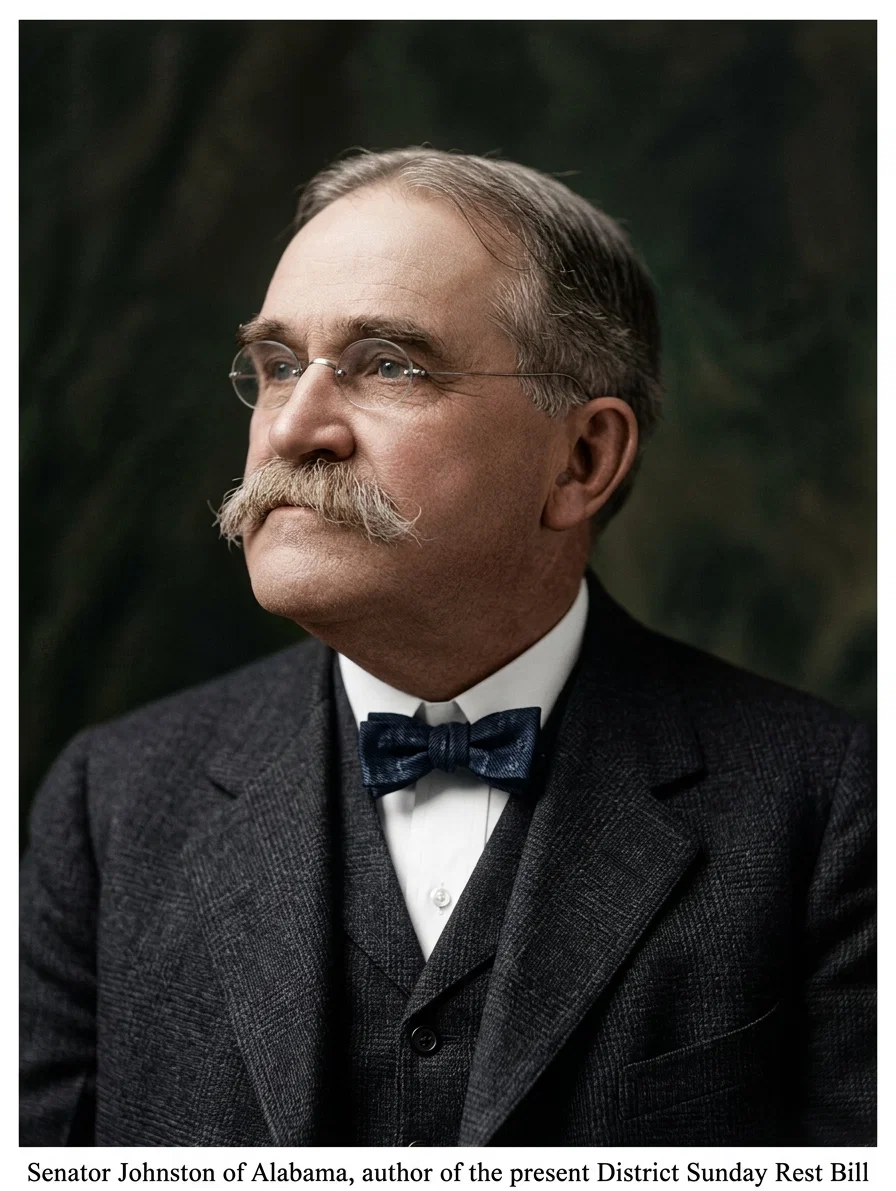
As stated in our former article, this bill was introduced in special session of the sixty-second Congress by Senator Johnston, of Alabama, April 6, of the present year. It is known as Senate bill No. 237; and according to precedent, it will be a live issue in the present session. See the center of this page for exact copy.
Our Ground of Protest
We do not oppose this measure, as has been supposed and alleged by some, simply because it selects the FIRST instead of the SEVENTH day of the week. While it must be apparent to every one at all familiar with the divine law that the bill does not name the day specified in that law, we would still be opposed to it if it did, believing that civil government has no right to attempt to enforce by law any religious institution or observance, even tho commanded by God, and exactly as God commanded it. We are opposed, upon principle, to all religious legislation on the part of civil government, and would not wish to see the religion which we ourselves believe and profess enforced by law upon others.
Neither is our opposition based, as some may suppose, upon the ground that we are looking simply to our own interests, pleading only for our own rights, or asking for special favors. This must be apparent from the fact that, as now worded, observers of another day than Sunday are exempt from the provisions of the proposed law. While we desire and appreciate protection from the Government in the exercise and enjoyment of our rights, we ask for no protection, liberties, or favors that are not, upon the same terms, freely accorded to all. Our plea is for the recognition and protection of the rights and liberties of all.
Our objections to this bill may be classified under a number of heads. In the first place, like all Sunday legislation,
It Is Religious
This is clearly indicated by its title; by its phraseology; by the exemption at the close of the first section; by the distinction it makes in days; by the character of its chief promoters; by the arguments adduced in its behalf; and by the nature of the Sabbath institution itself.
According to its title, the object of this proposed law is “the PROPER observance” of the day. God alone has a right to say what proper Sabbath observance is, as He has likewise to say which day shall be observed as the Sabbath.
The bill speaks of “Sabbath,” Sabbath “observance,” and “sacred concerts,” all of which are religious terms.
The exemption at the close of the first section exempts only upon religious grounds, and makes the observance of one day in each week, — if not Sunday, then some other day, — “AS A SABBATH,” compulsory upon all.
A bill for the proper observance of Sunday as a day of rest in the District of Columbia
1 Be it enacted by the Senate and House of Representatives of the United States of America in Congress assembled, 2 That it shall be unlawful for any person or corporation in the District of Columbia on the first day of the week, commonly called Sunday, to labor at any trade or calling, or to employ or cause to be employed his apprentice or servant in any labor or business, except in household work or other work of necessity or charity, and except also newspaper publishers and their employees, and except also public service corporations and their employees, in the necessary supplying of service to the people of the District: Provided, That persons who are members of a religious society
Folio 2
1 who observe as a Sabbath any other day in the week than Sunday shall not be liable to the penalties prescribed in this Act if they observe as a Sabbath one day in each seven, as herein provided.
2 Sec. 2. That it shall be unlawful for any person in said District on said day to engage in any circus, show, or theatrical performance: Provided, That the provisions of this Act shall not be construed so as to prohibit sacred concerts, nor the regular business of hotels and restaurants on said day; nor to the delivery of articles of food, including meats, at any time before ten o'clock in the morning of said day from June first to October first; nor to the sale of milk, fruit, confectionery, ice, soda and mineral waters, newspapers, periodicals, cigars, drugs, medicines, and surgical appliances; nor to the business of livery stables, or other public or the use of private conveyances; nor to the handling and operation of the United States mail.
3 Sec. 3. That any person or corporation who shall violate the provisions of this Act shall, on conviction thereof, be punished by a fine of not more than ten dollars, or by imprisonment in the jail of the District of Columbia for not more than ten days, or by both such fine and imprisonment in the discretion of the court.
4 Sec. 4. That all prosecutions for violations of this Act shall be in the police courts of the District of Columbia and in the name of the District.
In protecting the rights of man in his relation to man, the law should offer the same protection every day of the week. This bill singles out Sunday, and makes special regulations concerning this day alone. But it is impossible to distinguish Sunday from other days of the week except upon religious grounds. The whole history and interpretation of Sunday legislation proves this.
The chief promoters of this bill are the Interdenominational Committee on Sunday Observance in the District of Columbia, consisting largely of clergymen of the city of Washington, and certain church leaders and Sunday Rest Associations throughout the country.
These promoters have stated in print that they desired such a law upon the ground that they wished “efficient LORD’S DAY legislation for the District;” that “the FOURTH COMMANDMENT has been repealed” here; and because of “the SUPPORT” which such a law, they say, would “lend to the cause of our national CHRISTIANITY.” In the discussion of the bill in the Senate, January 27, 1910, during the sixty-first Congress, Senator Gallinger, the chairman of the Senate District Committee, objected to changing the expression “Sabbath” in the bill to “day of rest,” saying, “Had I been in charge of the bill I would not have accepted the amendment offered by the Senator from Utah, because I think the word ‘Sabbath’ ought to remain in the bill.” —Congressional Record, January 27, 1910, page 1078.
Senator Johnston of Alabama, author of the present District Sunday Rest Bill
The weekly Sabbath is a religious institution, ordained by God as such in the beginning. See Gen. 2:1-3; Ex. 20:8-11. Any law requiring the observance of such a Sabbath must therefore be religious.
These facts all show and prove conclusively the character of the bill. It is religious.
Unconstitutional
Being religious, its enactment into law by Congress would be unconstitutional, for the Constitution of the United States expressly forbids Congress’s making any law “respecting an establishment of religion, or prohibiting the free exercise thereof.” This reason alone ought to be sufficient forever to debar Congress from passing any such measure. To this clause in the Constitution, no doubt, is very largely due the fact that for one hundred years Congress has refused to enact a compulsory Sunday law.
Other reasons against the passage of this bill will be presented in our next article.
—**—
Peace and War.—The Marquis de Castellane, Paris correspondent of the Hearst papers, truly says that Carnegie’s Temple of Peace is a record of war, and that every stone is belligerent. “Four campaigns have been waged since its inception, and the European atmosphere is still red.” When it was decided to build it the Anglo-Boer war broke out; with the adoption of the plans came the Russo-Japanese war; the first stone was laid on the day Kaiser Wilhelm started out for Tangier and inaugurated the Morocco-European complications. Austria emphasized the completion of the first story of the temple by grabbing Bosnia and Herzegovina. The finishing of the second story found France and Germany in trouble. The painters and decorators and furnishers are yet to come, and there seems to be more prospect of war than ever before. China is rent with civil revolution, and Turkey and Italy are in actual war. While it is said that the best artists are to adorn the ceilings of the Temple of Peace with allegorical pictures showing the triumph of peace, the marquis says each one may mean a shower of shrapnel somewhere. And this is in harmony with Scripture. They shall cry “Peace, peace,” the prophetic Word declares, when there is no peace. And another prophecy, that of Joel 3, strongly avers that the great preparation which the world will make in the last days is for war, universal war. Peace temples and war preparations and actual combat are all fulfilling the divine Word.