Revolution in China

2%

Pacific Press Publishing Association · Mountain View, California · Dec 5, 1911

FromSigns of the Times, Vol. 38, No. 48.

Read the full edition

Revolution in China

(From Our Own Correspondent)
NOW that the smoke has cleared away from the first battle between the imperial and the revolutionary forces, after “taking stock” on both sides, it is found that the revolutionists not only have a well-organized army, but are also firmly entrenched in the most strategic center of the Celestial Empire. As the revolutionary movement has assumed such proportions that the world powers begin to take notice, and consider it necessary to agree upon a course of action to be followed for the protection of the lives and property of foreigners, possibly the readers of the SIGNS will appreciate a word from those who are actually on the field. While this news which is written to-day will be a month old when it reaches America, yet there are some features of the crisis which will not become generally understood from reading the newspaper reports; and then, again, the view-point of the missionary is quite different from that of the newspaper reporter.
As these reports are sent in from time to time, we shall endeavor to present the unexaggerated facts, and such actual results as have a relation to the spreading of the Gospel throughout this empire and preparing the way for the soon coming of our Lord and Saviour Jesus Christ.
To begin with, this movement is not of recent origin, but dates back at least twelve years, and possibly longer. During this time forces have been quietly working, the groundwork and foundation have been laid, the seed has been sown broadcast in the hearts of the people, and to-day we are seeing the harvest.
With few exceptions, every patriotic Chinese, no matter in what part of the globe he is situated, is favoring and assisting this movement, which means no less than the dethroning of the Manchurian Dynasty, which has been in power since 1644, and the setting up of a new empire under Chinese control; for the Manchus are not considered Chinese. They belong to the northern Tartar races, and ever since they came into power there has been universal dissatisfaction. They forced the Chinese to adopt their present head-dress, shaving the front of the head and wearing a cue, as a sign of submission to the Manchu government. Hence one of the first things the revolutionist does is to cut off his cue.
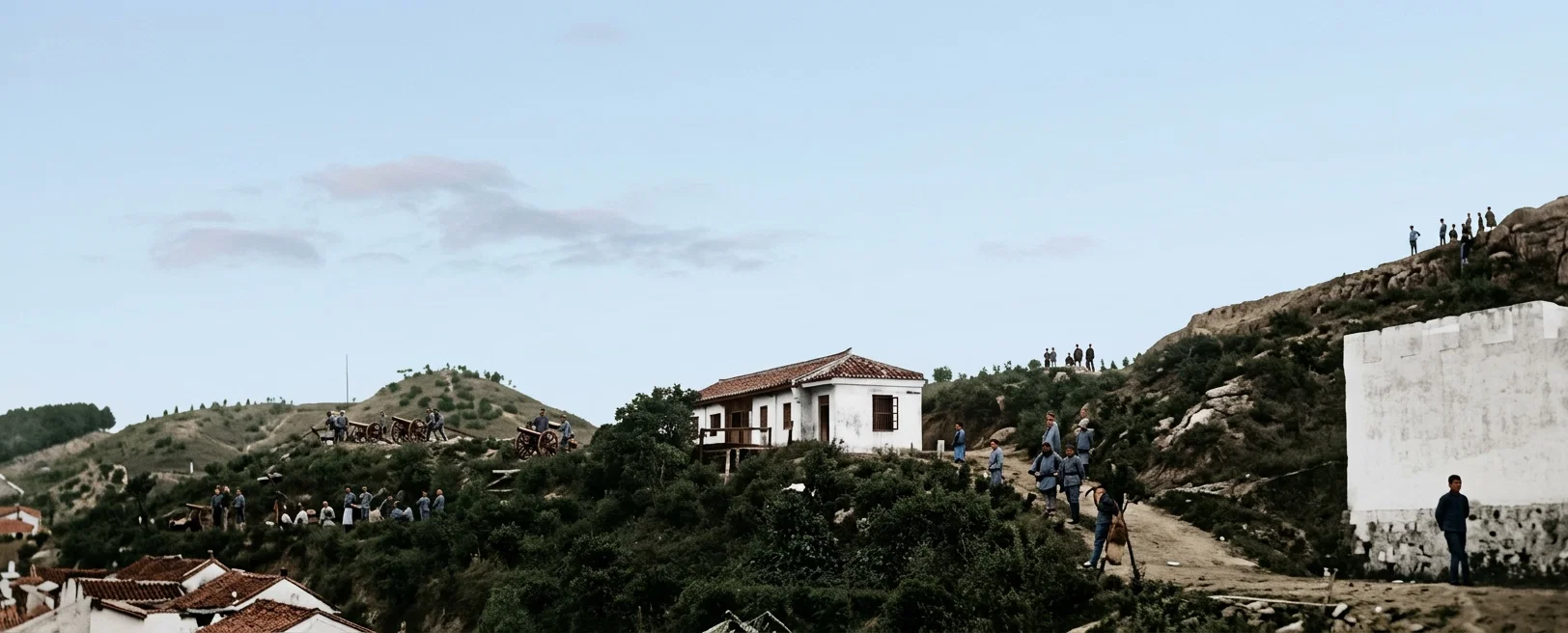
Revolutionists assembling their cannon on Serpent Hill, Wuchang (Photo by F. E. Stafford)
Active preparations for the present outbreak have been carried on for perhaps a year or more. Revolutionary leaders have gone from city to city, organizing their forces, soliciting subscriptions, and collecting arms and ammunitions. These preparations have been carried on not only in China, but in many other places where large numbers of Chinese are living. In Singapore and the Straits Settlements the revolutionists claim to have 20,000 supporters, with some troops and war-ships which are believed to be on their way to China now. The Chinese in Japan, Honolulu, and the United States are all subscribing liberally to aid the cause.

Contributing Agencies

This year the situation grew desperate, on account of the extensive floods throughout the Yang-tse Valley, leaving thousands of people homeless and the price of rice soaring too high for the common people to buy. The present regent and his cabinet have manifested very little sympathy for these sufferers, and have laid no great plan to relieve them. On the contrary, they have increased the taxes in some places, notably in Szechuen Province, where the people rose in revolt a month ago. A force of imperial troops was immediately despatched from the vicinity of Hankow to put down the revolt, and while these soldiers were absent the revolutionists decided to improve the opportunity to strike a decisive blow at Hankow. This city, with the city of Hanyang across the river Han, and the city of Wuchang across the Yang-tse River, is the commercial “hub” of China, and corresponds to Chicago in America.
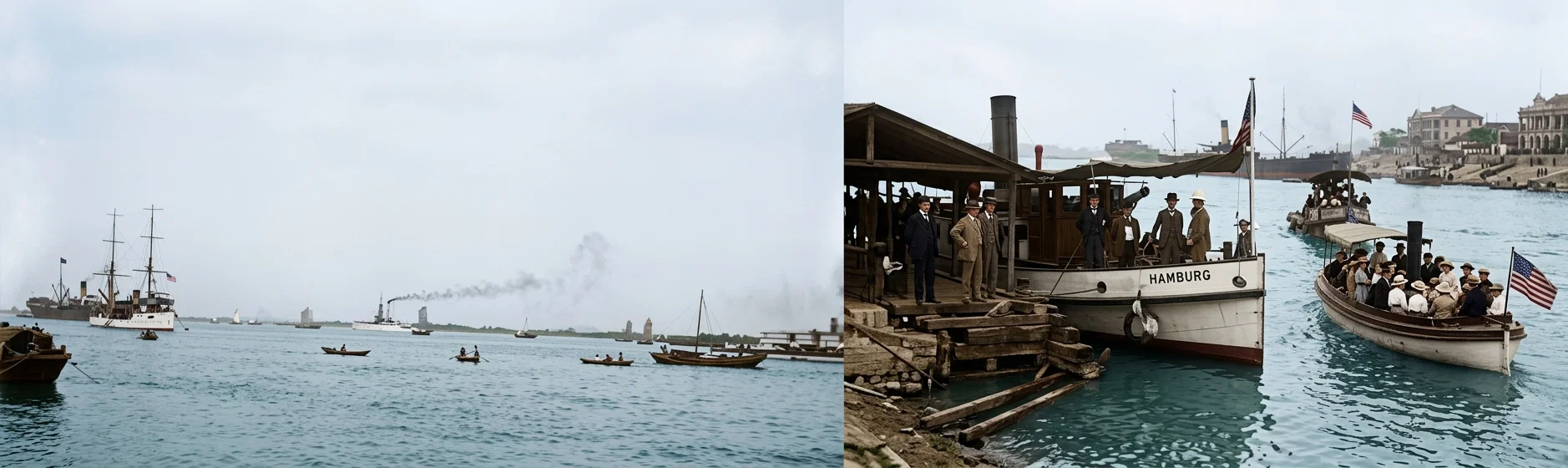
United States Steamer Helena in the center steaming into the Wuchang forts, requesting them not to fire while the missionaries are being moved to Hankow. American missionaries on the way from Wuchang to the foreign settlement in Hankow, escorted by Consul-General Green. (Photos by F. E. Stafford)
Connected by rail with Peking, the capital, in the north, and by the Han River to the south, and by the Yang-tse-Kiang to Shanghai and the Pacific Ocean on the east, this place controls practically all the shipping and commercial trade of the interior of China.
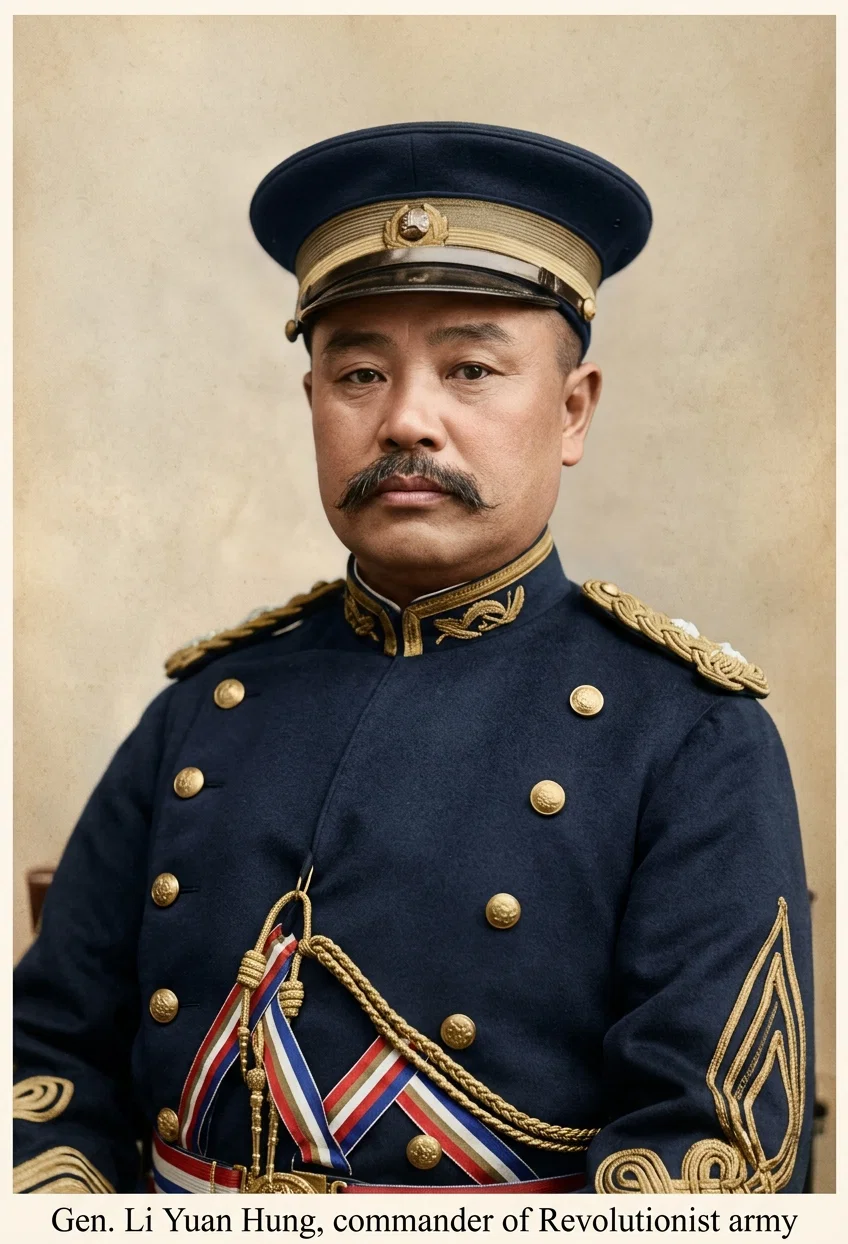
Gen. Li Yuan Hung, commander of Revolutionist army

A Set Time

The rebels adopted the Chinese character JI as their sign, and it has been found out later that the construction of this character includes the date which they had decided on for opening the struggle. The character means “a season,” or “a set time,” but when divided into parts it means as follows:
Thus on the twenty-third day of the eighth month (Chinese time), which corresponds to October 14, the revolutionists were to rise all over the empire.
The attack was precipitated, however, four days before this by the finding of a plant for the manufacture of dynamite, signal flags, and revolutionary badges, in a house in the Russian concession. About half past three, October 10, the people living near this house were alarmed by a sudden detonation from the rear, and they quickly collected to see what was wrong. They were surprised to find the occupants making every attempt to set their premises on fire by pouring kerosene on the floor of one of their lower rooms. Before they could set a light to the saturated wood, the neighbors interfered.
The occupants of the house then ran up-stairs, and made their escape by climbing over their veranda into the neighboring house, and disappeared.
The policeman on the beat had by this time made his appearance, and seeing that the case was serious, he at once reported it to the Russian police station,a foreign member of which went at once to the scene.
On examination it was found that one of the rooms in the upper story had been made into a laboratory for the manufacture of dynamite and nitroglycerin, a quantity of both in a raw state being left where it had been mixed. It seems that the amateur chemists had been busy mixing some of the latter when it had exploded and set fire to some articles near by. In the laboratory a large quantity of revolutionary apparatus was found. They had been busy in the making of badges for those who were to fight with them. They had made up bundles of the badges, each bundle containing a little triangular flag with Chinese characters signifying “Section No. 7”—or whatever the number might be. Signals of different sizes and colors and shapes were there, and a large number of books dealing with the movement.
One of the chief finds was a map of Wuchang, showing, apparently, the different positions to be taken up by the revolutionaries, and telling how the different sections of their company were to be divided, and the flags that were to be shown by each.
On further investigation, the viceroy, Jui Chung, ordered the gates of Wuchang closed, the city searched, and thirty-two suspects were arrested, and three of them who confessed to being revolutionists were beheaded on the spot.

Premature Action

Seeing that their plot was discovered, the rebels decided not to wait longer. Word was sent to the eighth division of troops in the city, who immediately mutinied and charged the viceroy Yamen. The viceroy, seeing the case was hopeless, escaped with his body-guards and boarded a war-ship. After his departure the revolutionists divided their forces and burned and destroyed all the Yamens and killed and arrested all the officials, and thus the city of Wuchang fell into their hands.
They lost no time in proclaiming a military government, and commenced at once to fortify the gates and walls, and assemble their cannons on Serpent Hill, which has a commanding view of the city and river. They elected officials and took over the control of the city, posting up proclamation in the name of the Huang Dynasty 4609, of the Tsong Hwa Kingdom, to the effect that they were fighting for a righteous cause, for the good of the Chinese people, against the Manchus—who are not Chinese, who do not belong to the sons of Han—for the purpose of establishing a stable and just government on the overthrow of the Manchu Dynasty. All classes were exhorted to unite, and treat each other justly.
After this Hanyang was taken, with the arsenal and iron works, without meeting much resistance, the imperial troops on guard simply laying down their arms. The revolutionists thus secured possession of the largest and best equipped arsenal in China, with 48 five-centimeter Krupp guns, 20,000 rifles, and 3,000,000 rounds of ammunition. They then occupied the city of Hankow, and put men in guard of all important positions, taking possession of the telegraph office, the railway station, the mint, and the government bank, with $2,000,000 taels silver. A government was established, a viceroy elected, and Li Yuan Hung chosen as general of the army. He seems to be very popular with the people, and is described as a hearty, rotund man, kindly in manner, an enthusiast, but not a blusterer. He was educated at the Imperial Mercantile Marine College at Tokyo, Japan, and has had many years' actual experience in army life. They claim to have recruited 20,000 men, most of them having served in the militia since the opening of the rebellion. Many reports have been spread that many of the imperial troops were joining the revolutionary forces. It is certain that some have.
Two prominent features stand out distinctly as marking this movement different from all previous uprisings in China. The first is the merciless slaughter of all Manchus. As soon as the revolutionists controlled the city of Wuchang, they started in systematically to kill every Manchu in the city. They organized a house-to-house canvass, and no mercy was shown. The streets of Wuchang were reported to be covered with dead bodies of Manchus. Sometimes it is hard to distinguish between a Chinese and a Manchu, so the rebels have devised a sure test. They make a suspect count up to sixty-six, and he is distinguished by his pronunciation of that number. If he is a Chinaman, he says “Lao sz Lao;” but if he is a Manchu, he says “Lieu sz Lieu,” and off goes his head.
Secondly (and this is regarded as most remarkable, considering the past history of all uprisings in China) is their care for foreigners' lives and their property, and the protection of Christian missions and their followers. As soon as organized, the government sent a deputation to confer with the consuls, and told them that the interest of all foreigners would be protected as long as they remained neutral and did not aid the imperials. This principle has been strictly adhered to, and all foreigners have been treated with the utmost courtesy. One missionary who had various interests to look after in Wuchang said that he went all over the city and was treated with kindness by all the soldiers, and the only password he used was the word “America.”
Four foreign women from a girls' school and hospital which were located near the thickest of the fighting, decided to make their way out and reach the foreign settlement of Hankow. They were escorted by a guard across Serpent Hill, where the batteries were located. All firing ceased as they crossed, and was not resumed until they were safely under cover. This seems to be so unusual an incident as to be worthy of notice.

The Imperial Government

Meanwhile the government has not been idle. On learning of the action of the viceroy Jui Chung, he was immediately rebuked for his leaving the city, and was cashiered. He is now in hiding. The imperial troops were on their way to their fall maneuvers near Peking, but were immediately recalled, and Gen. Yin Chang, president of the Board of War, made commander-in-chief, and as many troops as could be spared were despatched under him to meet the rebels and recapture Hankow.
Admiral Sah, commander of the navy, was ordered to take his fleet of war-ships to the scene of action at once. He arrived several days ago, and the first of the troops arrived from Peking over the Peking-Hankow railway. The revolutionists went out to meet them, and a battle took place, the imperial soldiers being covered by the war-ships on the river. After two days' fighting the result is just received here as these lines are written:
Battle ending in a victory for the revolutionists. The rebels are in possession of Yen Kilometer station, and the imperialists withdraw to Seven-Mile Creek.
Admiral Sah's gunboats have retired down the river. One of them is said to have gone over to the enemy, and the admiral is doubtful of the fidelity of the others.

A Desperate Struggle

Now the government realizes that it has a desperate struggle on hand, and has decided to play its best card even if that is a dangerous one. There is one man who they feel can be trusted to bring order out of chaos and win a victory for the throne. That man is Yuan Shi Kai, a man of commanding ability and notable military reputation of the past. But he unfortunately has been disgraced by the present emperor, and dismissed from the high office which he previously held under the government.
Now in this crisis, this man is recalled, and appointed viceroy of the Central China provinces, and supreme commander of all military and naval forces in the Yang-tse Valley.
He has accepted the position on the following condition: that he be permitted to take 10,000 soldiers of his own selection, and be provided with a war fund of 2,000,000 taels. The government agrees to these conditions, and he is preparing to take command at once.
Obviously the reason why the government appointed him to this place, was that he is a capable man, and they had no other man of his ability whom they could trust. Now that the whole responsibility of the imperial success or defeat rests on this man, the question is, Will he remain loyal? There are two causes for fears in this respect: first, he is not a Manchu; second, the ill-treatment which he has received from the present Manchu government. If he remains loyal, there likely will be a long and protracted struggle before this war is ended. But the rebels are inclined to prophesy otherwise. In fact the paper says to-day that he has been offered the place of first president of China if he will join the rebel forces; the present aim of part of them, at least, being to establish a republic in China.

Greater Freedom

It is impossible to predict at this writing what will be the result of this war, but we are inclined to take a hopeful view. It may be truthfully said that no matter which side wins, the conditions existing in the ancient flowery kingdom will be greatly changed as a result. If the revolutionists win, it of course will mean a radical change in everything; and on the other hand, if the imperial forces succeed in putting down the revolution this time, they will have learned a costly lesson, and must certainly alter their plans for the government of China, so as to institute a constitutional monarchy at once, and also give their consent and approval to the reform of the currency, the building of government railroad, free education, and all the customs and reforms of modern nations which the people of China now are ready to adopt.
Greater freedom will also be given to mission and missionary work. Therefore we feel that this great movement, no matter which way it turns, will open the way to spread the Gospel message quickly to every one of China's millions. In this respect it is undoubtedly preparing the way for the fulfilling of Christ's words, that the Gospel of the kingdom shall be preached “to every nation, and kindred, and tongue, and people.” It also shows that in the preparations for the great battle of Armageddon, China is to take her place with the other nations.
This time of trouble and unrest and an unexpected change of kingdom, we believe is a God-given opportunity to preach the truths of God's soon coming eternal kingdom to this people.
Here in Shanghai we are conducting a public effort with good attendance. This week we will preach on the second coming of Christ, the resurrection, and the judgment; and on our poster which we have circulated, announcing the meeting, we have put this title: “All Kingdoms Will Become One Kingdom.” Many read this, and are interested, and anxious to hear the truth on this subject.
Brethren, pray that the workers in China may improve this opportunity to spread the message of the kingdom.
F. E. STAFFORD.