The Invisible Empire

7%

Pacific Press Publishing Association · Mountain View, California · Sep 5, 1911

FromSigns of the Times, Vol. 38, No. 35.

Read the full edition

"The Invisible Empire"

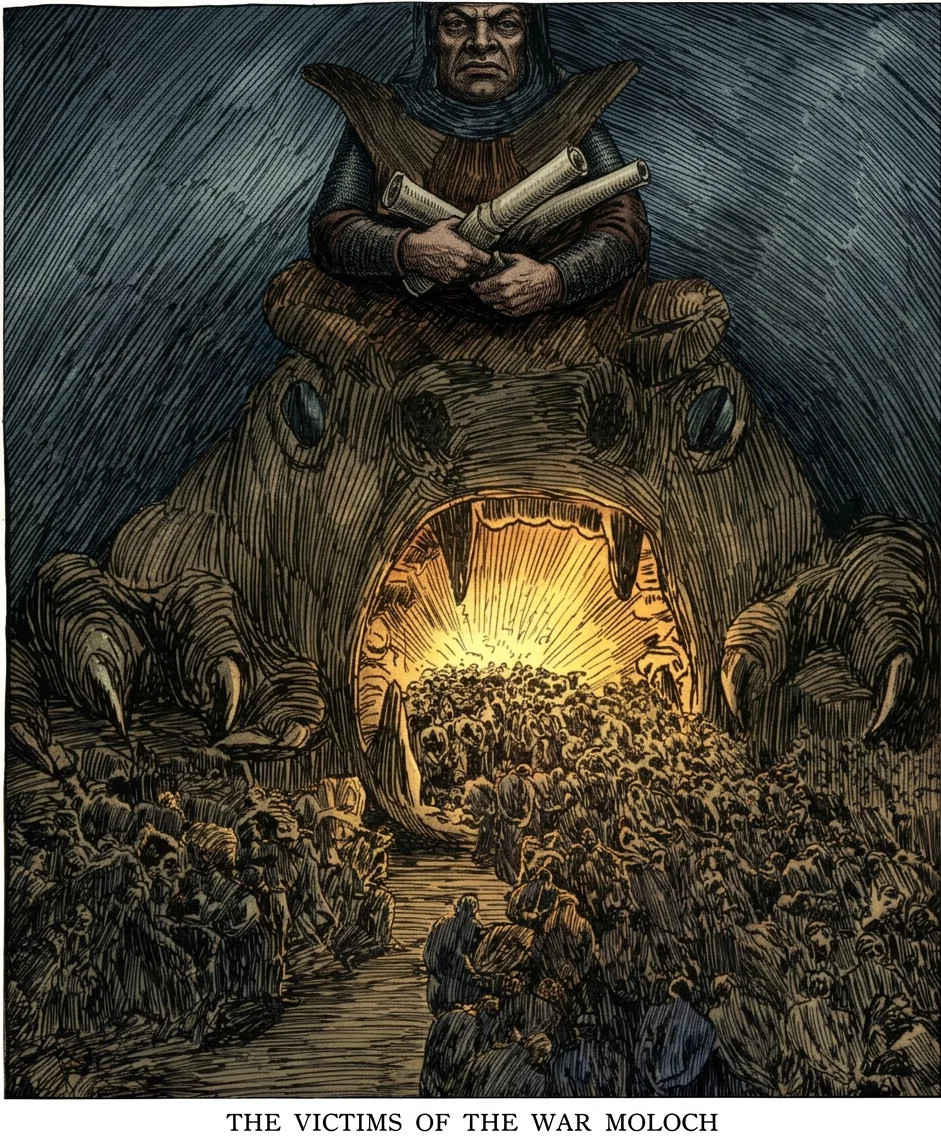
THE VICTIMS OF THE WAR MOLOCH
WHEN the late Mr. Ridpath was living, he used to speak of the great money power of the world as the "invisible empire." It is the embodiment of greed, and pays no attention to the distresses or woes of humanity. Its only thought is to hoard wealth greedily, even tho its servants be driven through rivers of blood, and the wailings of unsatisfied want and the agonies of despair receive not a single glance of sympathy.
The god of this "invisible empire" is commercialism. It must get and hold the world's markets for its commodities at no matter what cost. In order for the desires of the god of greed to be fully met, the keen eye of business must be kept ever on the alert in all parts of the world. It must allow no advantage to escape its attention.
This empire is of no particular nationality; the banner under which it marches is the sign of the almighty dollar. To open the avenues of trade in some particular locality, it may be necessary to incite nations to war, and millions of the common people must be slaughtered. But what does this "invisible empire" care? Beyond the slaughtering and the breaking up of homes and the losses of the mass of the people, there is seen great gain, and the sacrifice must be made.
By the "invisible empire" the nations are bound under the spell that they must be kept right up to date in all the paraphernalia and appliances for war. This takes not merely millions but billions of money. But the "invisible empire" can furnish this coin, and reap a harvest by furnishing it. True this war expense is supplied by a tax on the commerce of the big business concerns themselves that make up this "invisible empire;" but this tax is all added to the price that the common people have to pay for these commodities as they purchase them to satisfy the demands of every-day life.
The god of commerce, which is the god of this "invisible empire," is very closely related to the god of war. They work together in close and reciprocating sympathy. The inventive genius of man has brought about the necessity, from the standpoint of the "invisible empire," to have fleets of battle-ships that cost ten million or more each. These are displacing the battle-ships of half a decade ago, that cost only about four millions each; and now fleets of air-ships and "submarines" are being built with feverish haste to make all these great and costly ships entirely useless. But very little of the billions that are now called for to meet these vast war preparations would be demanded at all were it not for the call to protect the trade and the commerce of the "invisible empire."
When war is declared, the "big banks" must "finance" the undertaking; and this brings them great gain, while the people have to suffer. To be sure, individual instances may be pointed out where great principles of freedom are the underlying cause that leads men onto the battle-field. But even then, when men are dying for the sake of liberty, the "invisible empire" turns its ears from the sweet songs of freedom, and with eagle eye watches for opportunities to reap dividends from the great cause.
The "invisible empire" may find it to its advantage to throw a nation, or for that matter the world, into a financial panic that brings irretrievable ruin to thousands of families. Honest, industrious men in the middle and lower walks of society may be turned out of their homes, never to regain them again, through the panic. Suffering in the form of permanent loss of health, the loss of property by the aged, the orphan, and the widow, all follow in the wake of the financial panic. But the god of the "invisible empire" grimly sets his countenance and bids his votaries move on. Mercy, kindness, and love are not among the virtues that characterize this greedy god of Mammon.
The sentiments in the foregoing paragraphs may not be expressed in just the way you would express them. But do not find fault with the form of expression. Look at the facts. Every few centuries greed gathers into the hands of a small company of men a large part of the wealth of the populace. This wealth breeds luxurious vices that result in decay, and nation after nation has gone down as the result.
But heretofore this "invisible empire" has been largely confined to some leading nation of earth; and while it was producing in the vital organs of that nation the decay that meant ruin, there was room in some outlying, unoccupied territory for colonies to grow into nations, and these nations of sturdy frontiersmen would roll back upon the old crime-laden nation that was reeking in the vices of luxury, and overthrow her, and thus the race would get a new start. But the "invisible empire" would transfer its work to the new nation, and thus the ruin would be worked out again and again as one nation after another arose.
It was not till the impious Belshazzar, in the presence of "a thousand of his lords," gave himself up to the revelries of luxurious feasting and drunken carousals, that the hitherto mighty defenses of his empire crumbled, and the erstwhile insignificant and weak nation of the Medes and Persians assumed the mastery of the proud Babylon who for centuries had been the mistress of the world. It was not till the "invisible empire" had made Persia proverbial for her vices and luxuries that the little colonies of the Greeks were able to overthrow her. And in like manner Greece crumbled and was taken by Rome; and Rome in turn stood as the mistress of the world till her senators and leading men held all her wealth, and gave themselves up to the revelries of luxury, andwere in turn overthrown by the hardy colonies of so-called barbarians that had settled along her northern border.
But to-day the whole world is peopled, and the "invisible empire" that has come down through it all is reaching out for world dominion. The sentiments of greed seem to be stronger than any national ties, and the workings of the unseen hand of Mammon may be observed in every large city and in all the great capitals of the world. What sturdy people, uncontaminated by the luxuries and the vices of the age, is growing up to repeat the unvarying processes of the history of the past, and sweep away this "invisible empire," and begin a new and strong civilization? Manifestly there is none, for nowhere on the face of the earth is there any longer room for it. The next overthrow of this "invisible empire" must be from the skies above us, for it has at last succeeded in getting the whole of the earth under its feet.
This view should not be treated as a fanciful one; for aside from any line of reasoning, we have the unmistakable prophecies of the Scripture that tell in on uncertain way that the reign of greed is about to be brought to an everlasting end by the second coming of Christ. If ever there was a time when men should think clearly, soberly, calmly, and unselfishly in regard to the actual conditions as they exist all over the world, that time is now. T.