Justification by Faith

6%

Pacific Press Publishing Association · Mountain View, California · Aug 8, 1911

FromSigns of the Times, Vol. 38, No. 31.

Read the full edition

Justification by Faith

By Mrs. E. G. White
WHEN God pardons the sinner, remits the punishment he deserves, and treats him as tho he had not sinned, He receives him into divine favor, and justifies him through the merits of Christ's righteousness. The sinner can be justified only through faith in the atonement made through God's dear Son, who became a sacrifice for the sins of the guilty world. No one can be justified by any works of his own. He can be delivered from the guilt of sin, from the penalty of transgression, only by virtue of the suffering, death, and resurrection of Christ. Faith is the only condition upon which justification can be obtained, and faith includes not only belief but trust.
Many have a nominal faith in Christ, but they know nothing of that vital dependence upon Him which appropriates the merits of a crucified and risen Saviour. Of this nominal faith James says: "Thou believest that there is one God; thou doest well: the devils also believe, and tremble. But wilt thou know, O vain man, that faith without works is dead?"
Many concede that Jesus Christ is the Saviour of the world, but at the same time they hold themselves away from Him, and fail to repent of their sins, fail to accept of Jesus as their personal Saviour. Their faith is simply the assent of the mind and judgment to the truth; but the truth is not brought into the heart, that it might sanctify the soul and transform the character. "For whom He did foreknow, He also did predestinate to be conformed to the image of His Son, that He might be the first-born among many brethren. Moreover whom He did predestinate, them He also called: and whom He called, them He also justified: and whom He justified, them He also glorified." Calling is the drawing of the sinner to Christ, and it is a work wrought by the Holy Spirit upon the heart, convicting of sin, and inviting to repentance.

The First Steps in Salvation

Many are confused as to what constitute the first steps in the work of salvation. Repentance is thought to be a work the sinner must do for himself in order that he may come to Christ. They think that the sinner must procure for himself a fitness in order to obtain the blessing of God's grace.
But while it is true that repentance must precede forgiveness—for it is only the broken and contrite heart that is acceptable to God—yet the sinner can not bring himself to repentance, nor prepare himself to come to Christ. Except the sinner repents, he can not be forgiven; but the question to be decided is as to whether repentance is the work of the sinner or the gift of Christ.
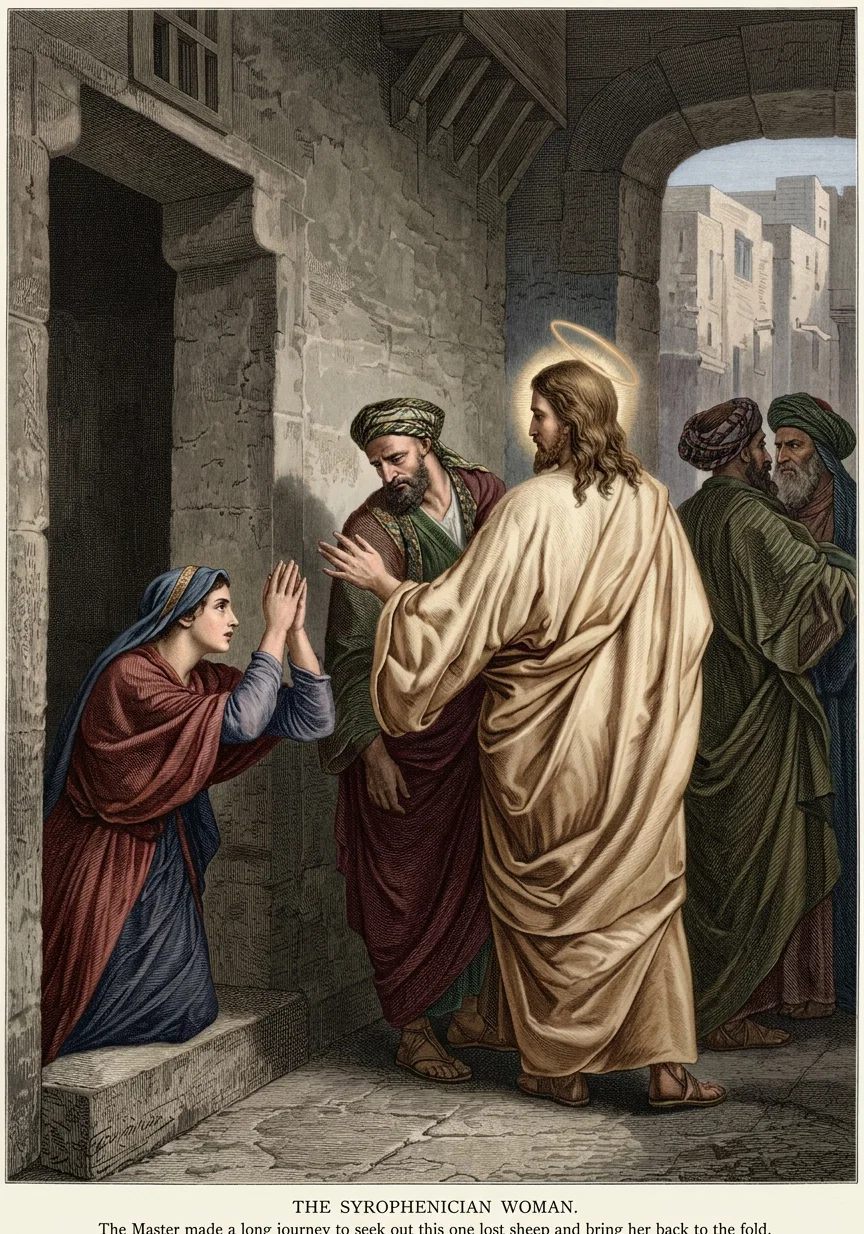
THE SYROPHENICIAN WOMAN. The Master made a long journey to seek out this one lost sheep and bring her back to the fold.
Must the sinner wait until he is filled with remorse for his sin before he can come to Christ? The very first step to Christ is taken through the drawing of the Spirit of God; as man responds to this drawing, he advances toward Christ in order that he may repent.

The Lost Must Be Sought After

The sinner is represented as a lost sheep, and a lost sheep never returns to the fold unless he is sought after and brought back to the fold by the shepherd. No man of himself can repent, and make himself worthy of the blessing of justification. The Lord Jesus is constantly seeking to impress the sinner's mind, and attract him to behold Himself, the Lamb of God, that takes away the sins of the world. We can not take a step toward spiritual life save as Jesus draws and strengthens the soul, and leads us to experience that repentance which needs not to be repented of.
When before the high priests and Sadducees, Peter clearly presented the fact that repentance is the gift of God. Speaking of Christ, he said, "Him hath God exalted with His right hand to be a Prince and a Saviour, for to give repentance to Israel, and forgiveness of sins." Repentance is no less the gift of God than are pardon and justification, and it can not be experienced except as it is given to the soul by Christ. If we are drawn to Christ, it is through His power and virtue. The grace of contrition comes through Him, and from Him comes justification.
Paul writes: "But the righteousness which is of faith speaketh on this wise, Say not in thine heart, Who shall ascend into heaven? (that is, to bring Christ down from above:) or, Who shall descend into the deep? (that is, to bring up Christ again from the dead.) But what saith it? The word is nigh thee, even in thy mouth, and in thy heart: that is, the word of faith, which we preach; that if thou shalt confess with thy mouth the Lord Jesus, and shalt believe in thine heart that God hath raised Him from the dead, thou shalt be saved. For with the heart man believeth unto righteousness; and with the mouth confession is made unto salvation." The faith that is unto salvation is not a casual faith; it is not the mere consent of the intellect: it is belief rooted in the heart, that embraces Christ as a personal Saviour, assured that He can save to the uttermost all that come to God by Him.

Believe That He Saves You

To believe that He will save others but will not save you is not genuine faith; but when the soul lays hold upon Christ as the only hope of salvation, then genuine faith is manifested. This faith leads its possessor to place all the affections of the soul upon Christ; his understanding is under the control of the Holy Spirit, and his character is molded after the divine likeness. His faith is not a dead faith, but a faith that works by love, and leads him to behold the beauty of Christ, and to become assimilated to the divine character. "For this commandment which I command thee this day, it is not hidden from thee, neither is it far off. . . . But the word is very nighunto thee, in thy mouth, and in thy heart, that thou mayest do it." "And the Lord thy God will circumcise thine heart, and the heart of thy seed, to love the Lord thy God with all thine heart, and with all thy soul, that thou mayest live."
It is God that circumcises the heart. The whole work is the Lord's from the beginning to the end. The perishing sinner may say: "I am a lost sinner; but Christ came to seek and to save that which was lost. He says, 'I came not to call the righteous, but sinners to repentance.' I am a sinner, and He died upon Calvary's cross to save me. I need not remain a moment longer unsaved. He died and rose again for my justification, and He will save me now. I accept the forgiveness He has promised."