Conditions in Turkey

7%

Pacific Press Publishing Association · Mountain View, California · Jun 6, 1911

FromSigns of the Times, Vol. 38, No. 22.

Read the full edition

Conditions in Turkey

From Our Own Correspondent
HERE is peace now on the Balkan Peninsula. When spring comes and the mountains become passable, the Bulgarian and Grecian bands of highwaymen leave their hidden corners and begin their so-called war for liberty and justice. But it is often only robbing and stealing and in general only fighting in the interest of the superiority of rude power.
The Turkish Parliament voted last year that these excesses should be stopped at all hazards. It was strictly forbidden to bear arms. This proved a good step in the direction of peace and order. New efforts were exercised with regard to the gendarmerie, the military outposts were strengthened, and as much as possible was done to protect the peaceful countrymen in the districts of Macedonia.
These Komitadjis, as the members of those bands were called, had always been a reason for trouble between Turkey and its neighbors. It is said that even the Bulgarian court played a suspicious part in the interest of these brigands.
But Turkey is feared now. None of the Balkan States would risk entering into trouble with Turkey. It is a factor with which all its neighbors have to count. Even Russia is stirred up, seeing how the naval forces of Turkey grow from month to month. It is true that the relations for instance between Bulgaria and Turkey are kept in order only with many difficulties. There was fear of a tariff war between them. But when the Servians as well as the Bulgarians, and the Greeks as well as the Montenegrins, know that there is no help at all from the European powers, they themselves will keep quiet.
In the European concert Turkey plays now also an instrument, but it is not yet clear which. Europe is divided into the triple alliance and the dreibund. Both hope to get the preponderance, when Turkey would enter into the one or the other. But the Turks are not in a hurry to make a decision. They think that they have the best profit by being friend with both constellations. They try with all their power to settle their inner difficulties, and have sent therefore their troops against Albanians and Druses, and now against the Arabs. In doing so they take away from Europe the right to mingle with their inner affairs. And it is true, the more the present government gains ground in the hearts of the people, and the more it fosters its position in the distant provinces, the more it is honored by the powers, which formerly had the idea that it was left to them forever to settle the affairs of Turkey.
We have to state a change in the sentiments of the Turks regarding Germany. Kaiser Wilhelm II had been friend with Abd-ul-Hamid; and when the Young Turks took possession of the government, they regarded Germany and its Emperor as an enemy of true liberty. But the Germans did not tire in stating again and again that they had been friends with the former Sultan only as a representative of Turkey.
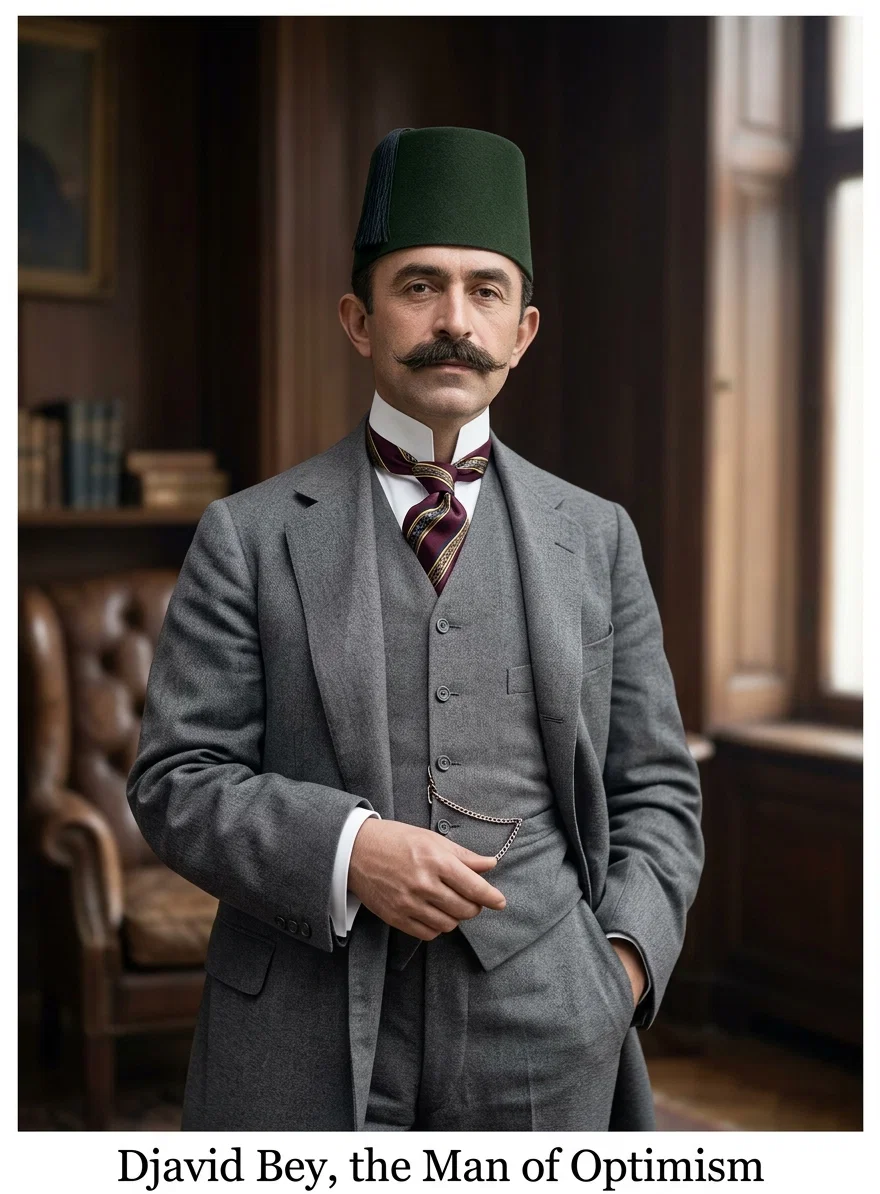
Djavid Bey, the Man of Optimism
And the last year gave one opportunity after the other, to show that this was true. When France wanted to grant a loan to the Turkish government under the condition of controlling the finances of Turkey — a condition which the Turks could not accept — the Germans were ready to give the money on better terms. Turkey was in need of war-ships, and Germany gave some ships, with which the Turks are satisfied. But a late and strong sign of Germany's friendship can be seen in these days, when the Bagdad Railway Company, a German corporation, agreed that the last part of this most important line — Bagdad-Persian Gulf — could be built by an Ottoman company.
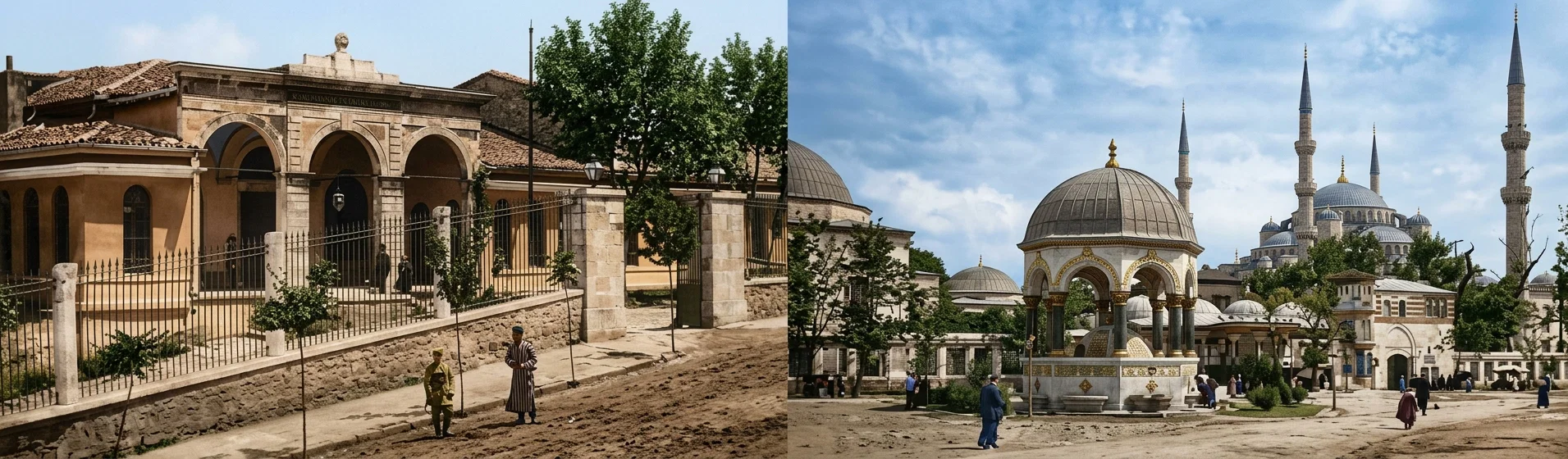
The Sublime Porte in Constantinople, which almost wholly burned down March 5, 1911 The Fountain which Kaiser Wilhelm erected in remembrance of his visit to Constantinople
This was done to avoid England's protest against the raising of the custom rate from eleven per cent to fifteen per cent, as England thought that the additional receipts would be used to build that German line from Adana to the Persian Gulf, and because England thinks to have a right to control those districts around that gulf. Furthermore the same company withdrew its rights to use the surplus of the customs, and will build the railway with other means, thus leaving a considerable surplus of income to the use of the Turkish government.
And they need it. Indeed, all the optimism of a man like Djavid Bey, the minister of finances, is necessary to believe that Turkey will not become in the very near future bankrupted. He had begun his introduction to the budget with the words that the deficit of the budget contains an educational element for the nation; but the chairman of the budget commission answered, when bringing it before the chamber, that with each deficit the nation loses a part of its independence. This is true, as it is the money of the foreigners with which the budget is balanced.
Again, more than one third of all payments of the present fiscal year are destined for the interests of navy and army, an amount of about 1,100,000,000 piasters. For public instruction the figures are about 100,000,000. Some 20,000,000 more than that will be paid for public works. It is true that the receipts every month are higher than were anticipated. But the big deficit of about 8,500,000 liras, or about $40,000,000, has to be paid in foreign money. And when we remember that nearly all the railways which run already, and all those which are to be started in the very near future — and these will furnish Turkey with a good railway system — are in the hands of foreign companies, then we see that Turkey's splendor and power are not founded on a basis which promises long continuousness. C. VOIGHT.
Constantinople, March 26, 1911.