THAT the Chinese have national characteristics needs no argument. What nation or people that ever held their own in the world has not had peculiar characteristics which belonged to them as families, communities, or nations? So with the Chinese we find peculiarities belonging to sections of the country, and we find other characteristics that seem to be national.
We will mention a few which seem to belong to the Chinese race, and which tend toward making them what they are. In mentioning these characteristics it is not by way of criticism; for we all have our peculiarities, which in time become characteristic of the individual, unless these peculiarities are overcome and put away.
Economy
As a race the Chinese lead the world in strict economy. No people are able to live better or do more hard work on so little food as the Chinese. Rice, beans, a few vegetables, and fish, make up the diet of millions of this people. They are fond of meat, and eat it freely when they are able to obtain it. One can not but be impressed, as he travels through China, with the extensive use of swine's flesh. This seems to be the meat liked best and eaten most; yet in nearly every native stall where meat is sold, will be found beef, mutton, donkey, and even dog's meat. All animals are considered suitable for food, even rats and mice. Not everybody would eat all of these meats, but many of the people are so poor they esteem some of these foods as luxuries. Dr. Smith says: "Doubtless it will appear to some of our readers that economy is carried too far, when we mention that it is the general practise to eat all of these animals as soon as they expire, no matter whether the cause of death be an accident, old age, or disease. This is done as a matter of course, and occasions no remark whatever, nor is the habit given up because the animal may chance to have died of some epidemic malady, such as the pleuropneumonia in cattle. . . . Dead dogs and cats are subject to the same processes of absorption as dead horses, mules, and donkeys. We have been personally cognizant of several cases in which villagers cooked and ate dogs which had been purposely poisoned by strychnin to get rid of them." The writer has seen cockroaches for sale as confectionery in parts of China.
In this plan of economy nothing is wasted. In the country the women and children wander in the fields day after day, hunting for a straw, a weed, or a passing leaf, which, when found, they carefully store away in a basket or a bag, for fuel with which to cook their food. All the bits of waste paper are carefully gathered to burn. There probably never was a whole people so trained in the most rigid school of the strictest economy as the Chinese.
Industry
One can not travel through China and see the toiling millions of men, women, and children, but he will confess he has seen nothing like it elsewhere in the world. From the first dawn of light till darkness covers the land, these people remind one of a hive of bees for activity.
The Chinese have divided themselves into four classes,—scholars, farmers, workmen, and merchants. To the Chinese the scholar leads all trades. The able student and scholar is the ideal man. From early childhood to old age, thousands of the Chinese work and toil to the limit of their strength to obtain their degrees. Among no other people is the task of obtaining a liberal education so difficult as among the Chinese.
In other countries the school years of the student are pleasant, full of happy experiences, and in after years the time spent in school is looked back on with pleasure. In China all is reversed. Few slaves ever toiled more unceasingly than the Chinese student. From the day he enters a fireless, dark, damp room to begin his lifelong struggle for an education, till his work is crowned with success by receiving his degree, or till death releases him from further hardships, the would-be Chinese scholar labors and toils beyond his strength. Often this labor lasts till old age. In Honan, Dr. Smith says, in the year 1889, "the governor of Honan reported thirteen candidates (who took the examinations for the highest degree) over eighty years of age, and one over ninety," who all "went through the whole nine days' ordeal, and wrote essays which were perfectly accurate in diction and showed no signs of failing years." But even this astonishing record was surpassed in the province of Nganhwei, where thirty-five of the competitors were over eighty years of age, and eighteen over ninety!
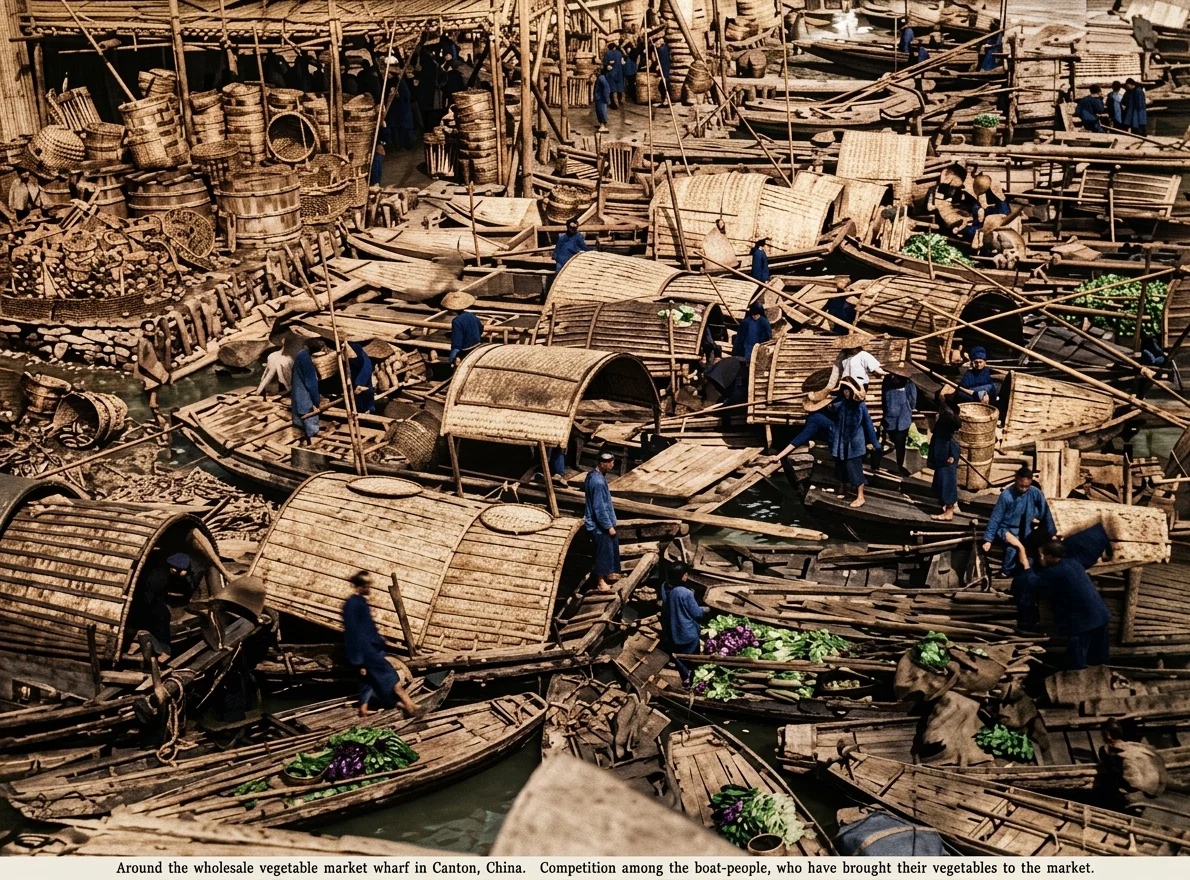
Around the wholesale vegetable market wharf in Canton, China. Competition among the boat-people, who have brought their vegetables to the market.
But in each of the other three classes of Chinese, —the farmer, the workman, and the merchant,—the same application, the same unremitting toil, is one of their chief characteristics. Even the horde of beggars in China possess the spirit of constant industry, fulfilling Wesley's description of a live church: "All at it, all the time."
Cheerfulness
Everywhere one travels in China the people seem contented and happy. They do not worry about to-morrow, and have more fully learned that lesson of contentment taught by the Great Teacher, than their Christian neighbors. The Chinese are fatalists. What is, must be, and they neither seem to worry because things are as they are, nor are they inclined to endeavor to make them different. They toil, they suffer, they patiently endure, without complaint. A kind look, a kind word, to a Chinese, will always bring a smile to the face; and no people could be so easily satisfied with the hardships the majority have to endure, as these people. In heat and cold, in the dulling rain, and in the scorching sun, these people toil on, day and night if need be, without a murmur. Again and again these toilers work for twenty-four consecutive hours, with only an hour or two for food and rest, yet never showing the least vexation at any extra hardship added to their toil.
In sickness, and even in death, this same cheerfulness seems to stay by this people. Many have seen some of these people on shipboard, gambling at the roulette wheel, or shaking dice, and losing heavily, and yet not a muscle would quiver, nor could one detect a shadow crossing the brow.
"We have known multitudes of cases where Chinese patients, suffering from every variety of disease, frequently in deep poverty, not always adequately nourished, at a distance from their homes, sometimes neglected or even abandoned by their relatives, and with no ray of hope for the future visible, yet maintained a cheerful equanimity of temper which was a constant, albeit an unintentional, rebuke to the nervous impatience which, under like circumstances, would be sure to characterize the Anglo-Saxon."—Chinese Characteristics.
Commercial Honesty
It would be impossible for any of us to believe that all the people of any nation would equally measure to the same high standard in any virtue. But as a race, a nation of people, those who know the Chinese best, maintain they stand high in commercial honesty. That this great people should know "a trick or two in trade," goes without saying; but that they have an unimpeachable reputation for commercial honesty, doing as they agree, and "delivering the goods," is recognized by most people who have done business with the Chinese. Some of the ablest bankers of the world belong to this people.
In China everybody seems to be involved in the game of "squeeze." There is a commission allowed to every Chinese servant for nearly every article he buys for his master. For groceries, vegetables, fuel, laundry, everything he buys for his employer, he expects a commission. In Canton a linen and silk merchant told the writer, when he had stepped into his store, that, having come without a Chinese, he would give him ten per cent more discount, and he assured him that had he been shown into his store by a Chinese he would have had to pay ten per cent more for his goods. From the viceroy down to the humblest servant who does business for another, the "squeeze" is known, and has proved unpreventable. Nor do the Chinese recognize it to be any reflection on their honor when it is known that they receive a commission. Notwithstanding the "squeeze," the Chinese still buy the same thing cheaper than the15foreigner could purchase it. While the servant always expects to have his commission in all the business he does for his employer, he is very jealous to allow no one else to get the better of his master. The servant class are not pilferers, and seldom do they steal from their employers outside of the "squeeze." Perhaps there are no people in the world whose servants are less addicted to pilfering than the Chinese. All in all, so far as honesty in deal is concerned, so far as commercial integrity is involved, measured by their own standards, and compared with the civilized nations of the world, the Chinese must take first rank.
Social Life
The Chinese are a very social people. Everywhere you see men, women, or children, there you will hear laughter and talking, and may know the people are full of pleasantry and gossip. But rarely does one see men chatting with women, or women engaged in conversation with men. The Chinese know but little of social life as enjoyed and appreciated by Christian people. The Christian home and fireside is the one place where all members of the family have their happiest moments. The Chinese social life has no family fireside. In most cases the husband and wife are not married because they love each other, for they are supposed to have never seen each other till after marriage. They have no knowledge of each other's temperament, taste, or refinement. They are married by their parents or relatives without personal choice or will.
The man is not supposed to talk to his wife before others, or to be seen with her. There must never be seen by others any manifestation of love on the part of the husband for the wife, for that would be a disgrace to the manhood of the man. They are not to eat together,—the men eating by themselves, the women by themselves. In the village streets the men cluster together, and the women do the same. Really, most Chinese know no family social life.
When the husband leaves home, sometimes to visit foreign lands, etiquette does not permit him to address a letter to his wife; he writes to his mother or son. To address a letter to his wife would be an act of indelicacy.
Conceit
The Chinese' self-consciousness and importance seldom fail him. He is satisfied with China, satisfied with his surroundings, and contented with his lot. He neither wants anything better, nor does he believe there could be any better country or better conditions than can be found in China. To his mind, a "foreigner" is uncivilized, brusque, disagreeable; his manners are offensive, and there is no comparison between them so far as culture and civilization are concerned. The Chinese live in the past. They worship antiquity, they reverence age, and are models of mankind in the way they respect their parents. Filial piety is a marked Chinese characteristic.
They want nothing like the foreigner, and they desire nothing from him save his money. A more happy, peaceful, contented, law-abiding, and knowledge-loving people have never existed as a nation. They have weaknesses—sad, painful weaknesses; but they also stand as a people with some of the most admirable virtues to be found among any people of any age.