THE year 1909 was doubtless one of the most unsettled years for India in recent times. The evidence of wide-spread disloyalty, the bomb outrages, and the germ of unrest that had evidently taken firm hold, culminating in the attempted assassination of the viceroy and the successful murder of a leading official in Western India,—all this and more boded ill for India during 1910.
However, as one looks back at the year just closed he can but be reminded of the first few verses of Revelation 7. Truly the seething, threatening winds have been held back for a little season, for which those of us who live and labor in India are truly grateful.
Legislative Councils and Wise Plans
In the political sphere the new representative legislative councils have done good work. There has been some little friction, but on the whole the results fully justify the bold move made toward giving India in a small measure representation with taxation.
In the viceroy's legislative council, the question of the heavy burden of military expenditure, amounting to about $2,500,000 annually, was brought prominently forward. It is a sad and significant sign of the times that poor India, suffering under the ravages of disease and hunger, with some part of her great country always beholding the gaunt specter of threatened famine, with her remarkably low wage scale and a universal rise in the cost of living,—with all this and more, is still compelled to contribute annually so large a sum to the growing burden of military expenditure.
Representative Indians made most eloquent appeals for increase in expenditure for the spread of primary education and for the inauguration of irrigation projects. There is a sufficient rainfall in India to preserve her from famine; but it comes largely in two or three months, and flows back into the sea. The government of India has completed great irrigation projects, has others in hand now, and is planning for still others to be opened in the near future.
The greatest political event of the year has been the departure of Lord Minto after five years of faithful service as viceroy of India, and the coming of his successor, Lord Hardinge of Penshurst. On November 29, with all the brilliance of Oriental State function, the outgoing viceroy transferred the reins of government to his successor.
Lord Minto served India well in a most troublous period. Calm and fearless, he pursued the even tenor of his way, bringing to fruition his plans for reform in India's political régime. With cool judgment and rare personal courage, and in direct opposition to the feelings of an influential portion of the Indian Civil Service, he was successful in inaugurating these reforms that have immeasurably strengthened the hands of the moderate Indians who are unselfishly working for India's political welfare, and at the same time effectively taking the wind from the sails of the extremists who were rapidly forcing India on the shoals of sedition and anarchy.
Lord Hardinge of Penshurst comes to India with hereditary connections with Indian history, an ancestor having served with honor and credit as viceroy early in the last century. He has already shown rare tact in his speeches and reception delegations. The first bow the new viceroy made to the Indian public, he consented to receive a delegation from the National Congress, a thing that has not been done since Lord Curzon unceremoniously turned them down several years ago. His diplomatic training will stand him in good stead in his attempt to keep peace among the warring elements that go to make up India.
As he himself, while ambassador at St. Petersburg, was largely instrumental in bringing about the Anglo-Russian agreement that changed the face of Asiatic politics in so far as India is concerned, he will be perhaps the best able to handle the threatening situation arising out of the disintegration of Persia and the prospects of extending the German Bagdad railway to the Persian Gulf.
A New Census
One of the interesting by-products of the new reform scheme that gives representation according to communities—the Hindu and Mohammedan communities being the largest—is the proper enumeration of the more than 60,000,000 outcastes of India. For centuries11the orthodox Hindus have declared these outcastes to be "untouchable," even their shadow defiling. They have not been counted as worthy to be included in the religious privileges of Brahmanism, which have belonged well-nigh exclusively to the higher castes. Still they have always been the hewers of wood and drawers of water for the great Hindu community. For want of a better method the government of India has always counted these people in the census report as Hindus; but now that the census returns are made the basis of communal representation, there has been an effort made by Mohammedans and others to have these 60,000,000 "untouchables" hitherto counted by Hindu leaders as unworthy to share in the proper ministrations of the Hindu religion, enumerated under a separate head in the coming census. As this would seriously cut down the Hindu representation, a great hue and cry has been made out of it.
A Royal Visitor
One of the pleasant events of the past two months has been the friendly visit of the crown prince of Germany. Only those living in English countries can realize the intensely strained relations existing between Germany and England. The future ruler of Germany has made himself extremely popular with the governing body of India, uniting heartily in hunting and sports — a feature of English life in the colonies that does much to keep the Englishman in good health — as well as taking a keen interest in everything pertaining to political and social India. There is no doubt that such visits have a tendency to bring the nations nearer together, thus holding the winds until the work of God is finished in the world.
The Coronation of George V in India
The most important event scheduled for 1911 is the coronation of George V as Emperor of India in Delhi, the old capital city of the Mogul dynasty. Ever since Queen Victoria was made Empress of India after the Indian Mutiny, it has been the custom to read the proclamation and parade the troops in every important part of India on the first day of January; but it could be only a sailor king, who had sailed to all parts of the dominions in his early days, who could conceive the idea of being crowned in India. Even in this event the supremacy of the religions of India above every other consideration is emphasized. It so happens that January 1, 1912, falls in the midst of the Muharram festival, one of the most important Mohammedan festivals of the year. For this reason it is found impossible to follow the precedent of the reading of the proclamation all these years. It is probable his majesty the King will be crowned early in December.
The Census
The census of India is taken every ten years. This year, on the tenth day of March, between the hours of nine p.m. and midnight, every man, woman, and child of India's 300,000,000 people will be counted, and all the important facts as to age, sex, religion, caste, literacy, etc., etc., will be written down, and that in only three hours. In one month all the returns will be in one central place, tabulated and ready for publication. This record is unequaled by any census in the world. Good organization, plenty of money, and an unlimited supply of cheap clerical help, exceed in rapidity the best enumerating machines yet invented. In less than one week the totals will all be in the head office.
Theosophy in India
The failure of theosophy in India is worth noting. Practically an offshoot of Hinduism, it came to India largely from the West, with its ethical standards purged from idolatry, and for a time it seemed that it would gather into its fold many of the best educated Indians. The reasoned eclecticism of theosophy, it was supposed, would appeal to the Hindu mind, and succeed where Christianity was failing. There is at present a reaction against it that well-nigh threatens its extinction, at least, its confinement to a limited area. The difficulty seems partly to have arisen through the contrast between its teachers' claim of sanction from the mystic world of Mahatmas, and the antithesis presented in their far from pure words and practises.
Krishna Worship in America
I was quite interested in reading in a native paper in the native library here a most earnest appeal from a teacher of the cult of Krishna for funds for the building of a heathen temple in the "dark city of Los Angeles, California." This temple is to be a replica of the Krishna temples of India, with its actual idol. The writer claimed numerous converts already, and predicted the rapid spread of Krishna worship in America. If the matter is of sufficient interest to SIGNS readers, I shall be glad to write an article on Krishna worship in India, which will state facts doubtless unmentioned by Krishna preachers in the West.
Second General Conference on Missions to Moslems
The first conference on missions to Moslems met in Cairo, in 1906, and has been followed by the second in Lucknow, India, January 23 to 28, 1911. It brought together almost 300 missionaries and other workers, representing fifty-four organizations and societies at work in the Moslem world. The Rev. S. W. Zwemer of Bahrein, Arabia, was selected chairman.
No student of missions can neglect the problem of giving the Gospel message to the more than 200,000,000 of the Mohammedan world.
India, with nearly one third the Mohammedan population of the world, presents just now the most favorable opening for Christian effort. The Mohammedan community of India is now raising money for the building of a large university to be run on modern lines, affiliated with the English university system. It is striving to encourage primary education, and giving increased attention to female education. The Moslem leaders are so busy with politics that it seems certain that modern progress will take firm hold of this great community. How Islam will meet this crisis in its history will be watched with the greatest interest.
The chairman's eloquent address closed with the following fine characterization of the various lands of the Moslem world:
As our eyes sweep the horizon of all these lands dominated or imperiled by this great rival faith, each seems to stand out as typical of one of the factors in the great problem. Morocco is typical of the degradation of Islam; Persia of its disintegration; Arabia of its stagnation; Egypt of its attempted reformation; China shows the neglect of Islam; Java the conversion of Islam; India the opportunity to reach Islam; equatorial Africa its peril. The supreme need of the Moslem world is Jesus Christ. He alone can give light to Morocco, unity to Persia, life to Arabia, re-birth to Egypt, reach the neglected in China, win Malaysia, meet the opportunity in India, and stop the aggressive peril in Africa.
GEORGE F. ENOCH.
Panwel, Bombay, India.
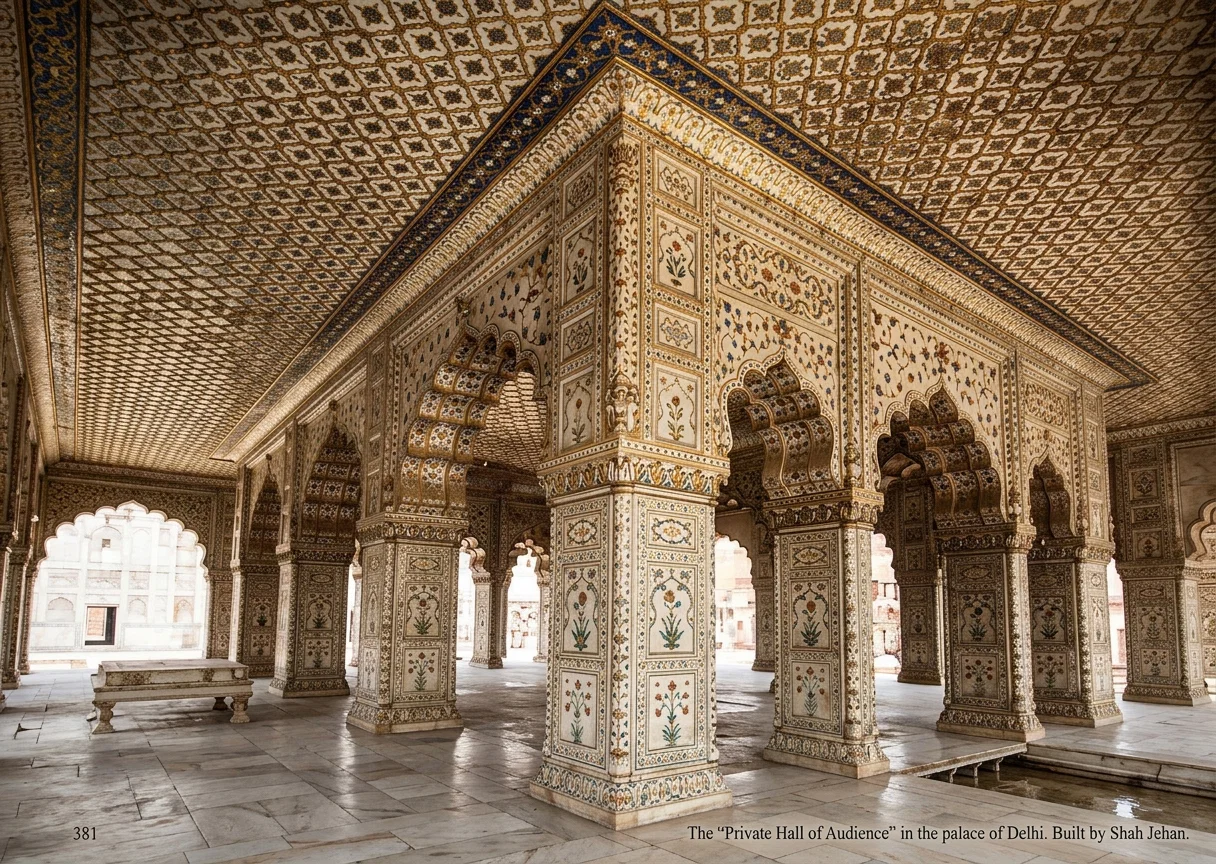
The "Private Hall of Audience" in the palace of Delhi. Built by Shah Jehan. Here none but ministers of State could come for audiences with the Shah. Here stood the famous Peacock Throne, unequaled in history, built of the purest marble, in the old days with ceiling of pure silver, and with the most marvelous inlaid mosaic of all manner of precious stones. Its ancient magnificence must have been beyond description. In this building is the famous inscription in Arabic:
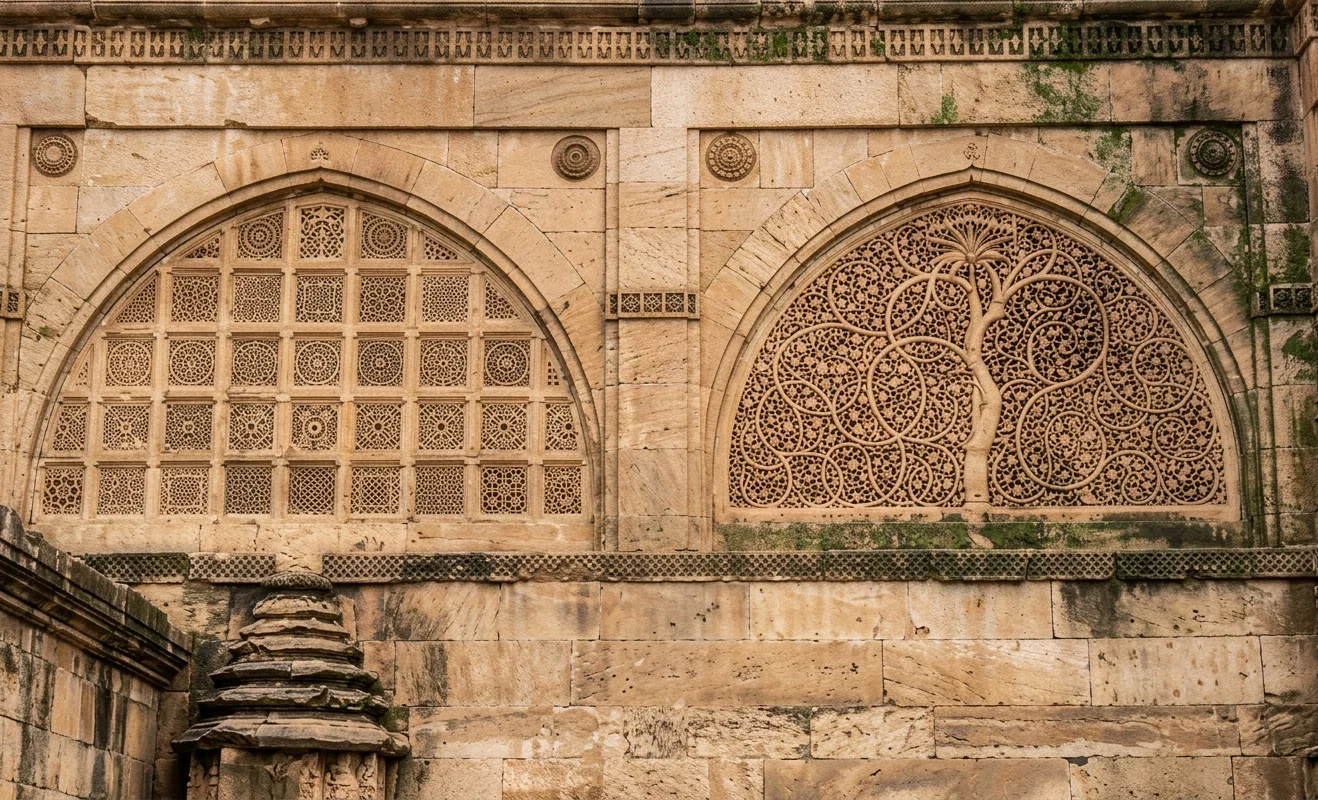
A fine example of Indian artistic skill and patience. Each of the windows in this Mohammedan place of prayer at Ahmadabad is carved from a single block of marble.