Shall I Not Drink It?

3%

Pacific Press Publishing Association · Mountain View, California · Oct 3, 1911

FromSigns of the Times, Vol. 38, No. 39.

Read the full edition

"Shall I Not Drink It?"

By Emma Hildreth Adams
IN the appalling accounts of the fierce fires which, but a few weeks ago, swept clean of shrub, tree, and flower wide acres of the noble forests of Southern California, readers of the daily papers were thrilled by the magnanimous efforts put forth by relief parties to convey water to fainting men engaged in fighting the furious, speeding, driven flames.
One can imagine the gratitude, the gladness, which filled the hearts of the singed, blistered, almost swooning heroes at sight of the hurrying relief men, at taste of the cool, refreshing liquid. One can imagine with what zeal they turned again to the mighty conflict, forgetting self, risking life, working from lofty principle.
But not always, in the fiery conflicts of life, are there held out to the wearied, threatened fighters cups brimming with cool, sparkling water, with restoring milk, with refreshing drink seasoned with fragrant juice of orange or lemon.
Not always are there pressed to heated lips cups quick to quench thirst, to alleviate pain, to quiet nerves, to impart strength, to renew courage.
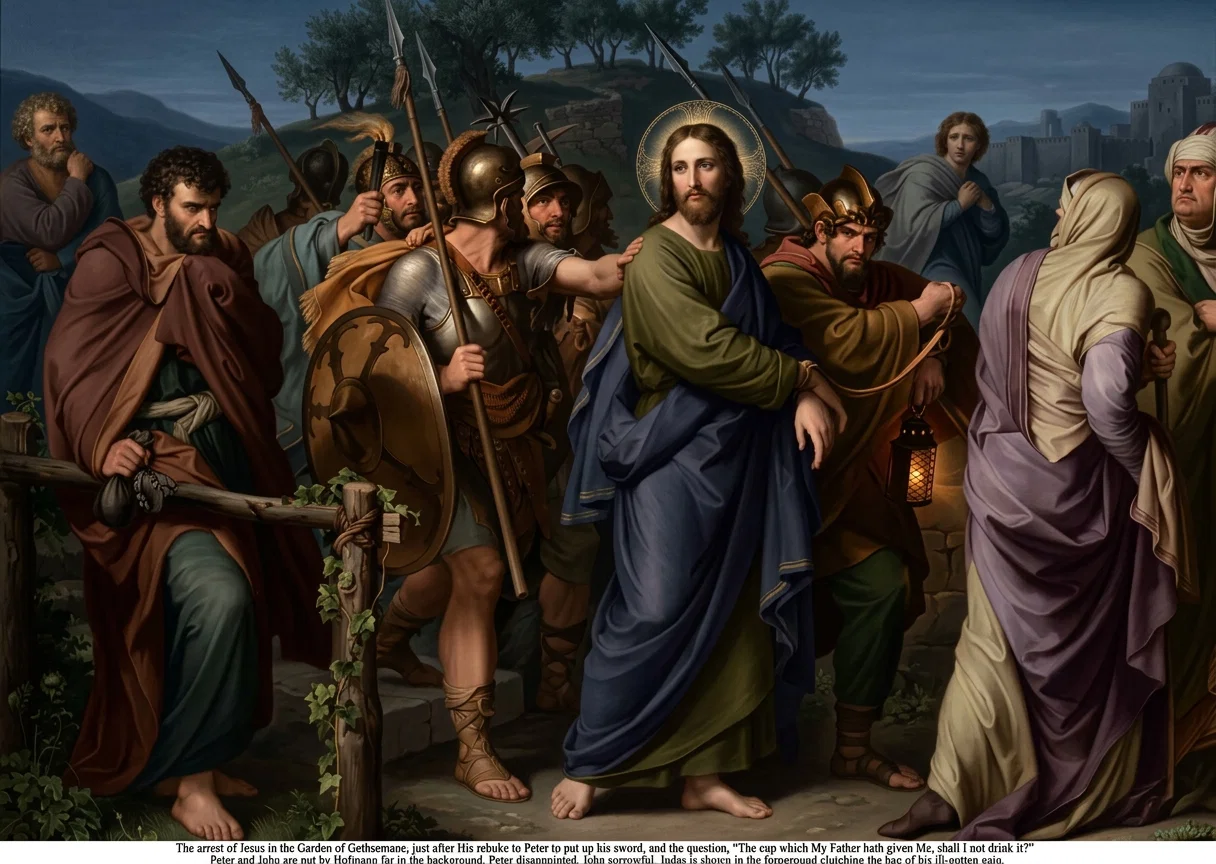
The arrest of Jesus in the Garden of Gethsemane, just after His rebuke to Peter to put up his sword, and the question, "The cup which My Father hath given Me, shall I not drink it?" Peter and John are put by Hofmann far in the background, Peter disappointed, John sorrowful. Judas is shown in the foreground clutching the bag of his ill-gotten gain.
Sometimes, oftentimes, in one's life experiences, when battling with strong, invisible conflagrations, when struggling to extinguish raging fires in heart, in soul, a cup is presented whose contents are distasteful, unwelcome, highly colored, and repulsive, but of which it is needful, it is urgent, it is salvation, that one drink.
Sorrow of heart, grief of mind, keen disappointment, serious want, sudden losses,—one or all of these may impart the dismal tint, the bitter taste, which so stir his aversion. Notwithstanding, the mixture may be designed for his greatest good, his highest welfare. It may be held forth as the one admissible test of obedience, of submissive will.

Should He Not Then Drink It?

In such case, the hand which extends the testing cup is a kind hand, a pitiful, merciful hand. He who holds it forth knows the remedial power of the liquid it contains; knows the radical fault it will correct, will extinguish; knows the serious blemishes of character it will amend, the discipline of soul and spirit it will achieve.

Should He Not Then Drink It?

The pathetic words which form the headline for these paragraphs were spoken by the Son of Man in Gethsemane, the night of His betrayal, when Simon Peter, in defense—as he thought—of his sorrowful Master, drew his sword and criminally smote the servant of the high priest.
Jesus said to him instantly: "Put up thy sword into the sheath: the cup which My Father hath given Me, shall I not drink it?"
For every member of Christ's body—the church—there lies in this touching, revealing, unveiling question, a profound lesson in the lofty calmness, in the nobly submissive spirit, manifested by the great Master, the mighty Creator of the earth, in that hour of trial unimaginable by those for whom He was about to give His life.
Christ's question to Peter leads us back a little to the scene in which figure the sons of Zebedee, their mother, and the ten other disciples. To the ambitious plea of the mother Christ gave answer—to her sons—in the pointed, startling question, "Are ye able to drink of the cup that I shall drink of, and to be baptized with the baptism that I am baptized with?" They, having at that hour no conception of the deep meaning, the vast inclusion, the far-reaching significance, of the act of baptism just beginning for their Lord, answered thoughtlessly, "We are able"!
The Man of Sorrows, knowing what completely testing cup awaited both Himself and them, replied, "Ye shall drink indeed of My cup, and be baptized with the baptism that I am baptized with: but to sit on My right hand, and on My left, is not Mine to give."
With hearts weighted with sympathy for Him who was beginning to drink an appalling cup for both the reader and the writer, let us, with careful, reverent tread, again enter the Garden of Gethsemane.

In the Garden

We find there, probably not far from the entrance, Christ and eleven of the disciples, all having come from the supper room in the city. Judas was busy elsewhere.
Selecting Peter and the two sons of Zebedee, perhaps because those three had profoundest need of witnessing the Gethsemane portion of the bitter cup He would finish drinking next day, Christ led them aside a few paces for companionship while He prayed.
Then He "began to be sorrowful and very heavy," saying to them, "My soul is exceeding sorrowful, even unto death: tarry ye here, and watch with Me."
Advancing a few steps, He "fell on His face, and prayed, saying, O My Father, if it be possible, let this cup pass from Me; nevertheless not as I will, but as Thou wilt."
Then—one of the most regrettable and sad things on the part of the disciples—returning to the three chosen ones, He found them asleep! And "He left them, and went away again, and prayed, . . . saying the same words."
Being very human, and not yet partakers of the Pentecostal baptism, they could not drink of Christ's painful yet willingly accepted cup. Later, in their noble self-abnegation, their heroic service to Him, their giving up of life for His sake, they drank of His cup.
A little later than to-day, after a few more years have sped, undoubtedly, should our lives be continued, there will come to both the reader and the writer of these paragraphs, opportunity to drink deeply of the cup of Christ's sorrow and suffering.
SHALL WE NOT DRINK IT?
—**—