THERE are many in the world who have supposed Darwin and Lamarck made decidedly solid and enduring contributions to science and truth, and two years ago the centenaries of their birth were celebrated by the English and French people. But another noted scientist, Elie de Cyon, declares that these celebrations were "but solemn funeral functions, in honor of dead theories;" and for those who understood, "these pompous discourses were merely the passing bell of the hypothesis of descendance." Professor de Cyon is of Russo-French origin, the Literary Digest tells us, for many years was a member of the Faculty of Sciences in the University of St. Petersburg. He has recently published a work called "God and Science," in which he declares that "the Creator reigns, and His Spirit governs." In a review of that book in the Record of Christian Work, it is said that M. de Cyon declares, "The atheistic, evolutionary speculation [of Darwin] found immense popular vogue among those who desired to see the Creator dethroned, who wished to be delivered from religion and the restraints imposed by the moral law on covetousness and human passion." He declares that Darwin's theories of "natural selection of the fittest, and hereditary transmission of characteristics acquired in the struggle for existence," "have been broken down by two evolutionists — H. Spencer and Weismann;" that "the theory that the marvelous operations involved in a transformation of species, are to be explained solely by the accidents of the struggle for existence, and for procreation, is the most supernatural conception that has been brought forward since the days of Empedocles."
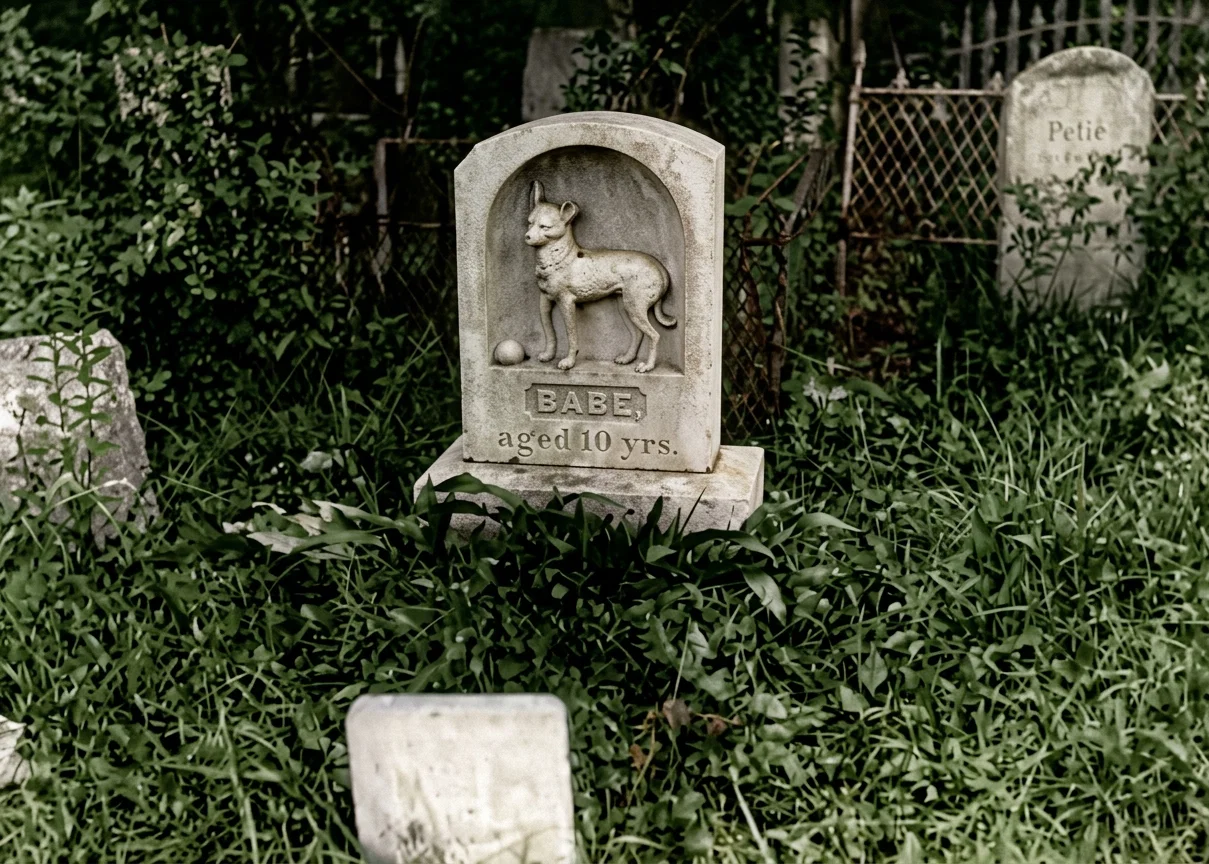
A monument erected to a pet dog in the canine cemetery in Hartsdale, New York. It bears the inscription, "Babe, aged 10 yrs." In the far right is a stone erected to "Petie." At present there are 451 tombs, some of the stones costing as high as $500. Prices of burial are from $15.00 to $25.00, boxes from $5.00 to $6.00. Dogs or humans — which?
When in 1866, he says, "I showed Claude Bernard for the first time the marvelous mechanism of the cardiac nerves, especially the depressor, the nerve which transmits to the brain all the emotions of the heart, and at the same time watches over its well-being by regulating its action, and by warning at the first suggestion of danger the vasomotor centers of the brain, the first words of Claude Bernard were, 'I should like to know how the Darwinists would undertake to explain such wonderful mechanisms with the aid of adaptation or selection.'" He declares that Darwin "too often confused analogy with identity to be a safe guide;" and at Professor de Cyon's hand Professor Haeckel fares worse than does Darwin. He says: "I have read the world-riddle of Haeckel, and have reddened with shame at the thought of the general education of our people! That such a book should be possible, that it should be written, printed, bought, read, admired, and taken seriously by the nation of Kant, Goethe, and Schopenhauer, is a sad fact indeed." He points out how Haeckel pictured three different things — the fetuses of a dog, a chicken, a mole — "with a single plate labeled in three different ways." Yet "for decades this mountebank has imposed on the international public as a king in the world of thought." "Lamarckism and Darwinism," he declares, "mark but passing phases in the history of science. They offer but fragments of truth. Presented as dogmatic theories, they are but an obstacle to progress."
Hertwig, we are told by him, "insists that animals differ among themselves as much in their germ cells as in their full-formed organisms. This renders improbable, if not impossible, a common origin of different animals from the same cell." "The theory of an apish ancestry for man" de Cyon declares pure assumption. He quotes Fraas, who devoted his long life to the study of fossil animals, as saying: "The idea that mankind has descended from any simian species whatsoever, is certainly most foolish, put forth by a man writing on the history of man. It should be handed down to posterity in a new edition of 'The Memorial of Human Follies.'" "No proof of this baroque theory can ever be given from discovered fossils." And Virchow says, "I have never found a single ape skull which approaches at all the human one," and "if we compare fossil men with men of to-day, we can boldly affirm that individuals of a low development are much more numerous, relatively, among present-day men than among fossils." In other words, the race is degenerate rather than the fruit, of an exquisite development, says the Record of Christian Work. And the Literary Digest says, "Where Darwinism sees but accident and matter, de Cyon is awestruck at the evidence of supernal wisdom." Thus much to our readers of what some scientists say. They need not be troubled about the old Book. Its record of creation still stands.