JAPAN

6%

Pacific Press Publishing Company · Oakland, California · Nov 26, 1896

FromSigns of the Times, Vol. 22, No. 47.

Read the full edition

JAPAN.

JAPAN consists of four large and many small islands on the eastern coast of Asia, with an area of 148,456 square miles (not including Formosa), and a population of over forty millions.
The national flag is a red ball on a white background. The red ball represents the sun rising out of the sea. Japan is "The Empire of the Rising Sun."
The reigning emperor is Mutsuhito, who was born in 1852, and succeeded to the throne on the death of his father, in 1867. The system of government was that of an absolute monarchy until the present emperor established a Parliament in 1890, thus sharing his authority with representatives chosen by the people.
Japan claims a written history of over twenty-five hundred years, and the present emperor is said to be a lineal descendant of the dynasty that was established six hundred and sixty years before Christ.
The women of Japan have more liberty than other Asiatic women, and their position under the rapid development of the country is growing constantly better.
The Japanese babies are not carried in their mothers' arms, as in the United States, but as soon as they are a few weeks old they are placed on the back of an elder child and thus carried from place to place. They are said seldom to cry. Mrs. Chaplin Ayrton has tried to explain the goodness of Japanese children on the theory that the furnitureless condition of Japanese houses leaves nothing for them to break, and they are not always being told not to touch this or that. The boys are fond of playing soldier, and the girls enjoy playing housekeeping and taking care of their dolls.
The adoption of children is quite general in Japan. No family name is ever allowed to run out. If a married man finds himself without children he looks about for a fine male child, and if he can give the promise of bettering its condition he has no trouble in adopting it and giving it his name. The same affection and the same care go out to adopted children, apparently, as to those of consanguinity. The emperor has an adopted brother. The artist may adopt his best pupil, to the end that his work and name may go down to posterity. To permit a family to become extinct would be a grave offense to the deceased ancestors, and it is not permitted in Japan.
In appearance the Japanese are short in stature, the men five feet and three to five inches, the women about five feet. The men will weigh from one hundred and fifteen to one hundred and thirty pounds, and the women from ninety to one hundred and ten pounds. The face is round, with full cheekbones and prominent brow. The eyes slope, but not with the degree of obliquity common to the Chinese.
During the last thirty years the Japanese have made remarkable progress in civilization, and their system of education, their literature, their manufactures, and their many railroads testify to their marvelous ability in appropriating that which is giving power and strength to other nations. But their civilization greatly needs the strength of Christianity. Nearly all the people are adherents of the Shinto and Buddhist faith. The Shintoists worship spirits. They have no images in their temples, only wooden boxes which the spirit is supposed to inhabit. Prayers are written on paper and hung up in the temple, hoping they may be answered. The spirits of dead relatives, ancestors, and emperors are worshiped. The Buddhists have many gods. The god of money is the favorite.
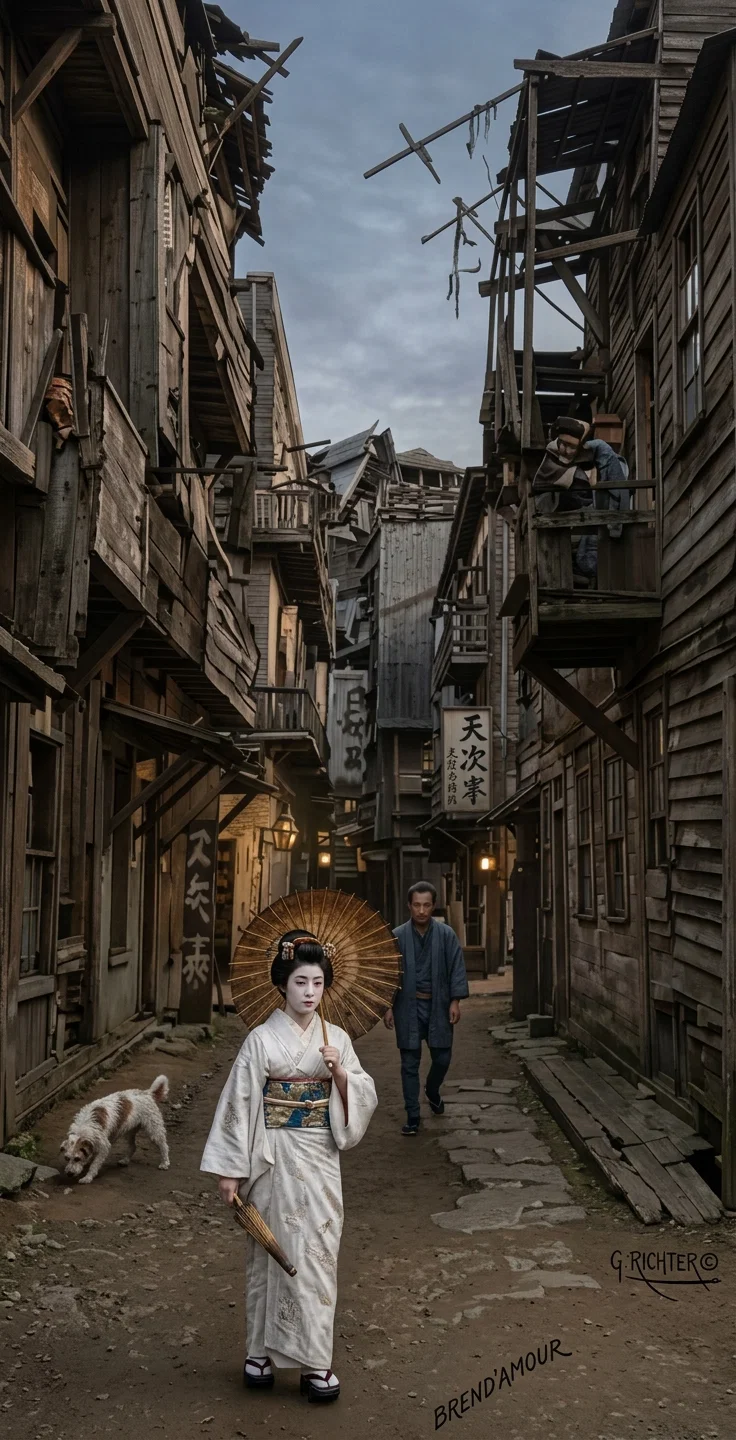
A STREET SCENE IN YOKOHAMA, JAPAN.
Christianity was first introduced in Japan in 1549 by the Roman Catholics, but in 1587 a decree banished the missionaries and ordered that all Christians be put to death.
In 1859 Protestant Christianity entered Japan in the person of missionaries from the United States. The work then commenced has grown until now there are in Japan 654 Protestant missionaries, 426 organized churches, with 38,710 adult members.
These Christian missionaries have had much to do in stimulating and developing New Japan, and the time can not be far distant when Christianity will be the controlling religion of Japan.
"Over twenty-five thousand public schools in all grades, from kindergarten to the Imperial University, having under it many colleges, are uprooting superstition and broadening the minds of the rising generation."
In Japan the Greek Church reports 22,576 adherents; the Roman Catholics, 50,302 adherents.
The Japan Mission of the Methodist Episcopal Church was commenced in 1872. It now reports 18 male and 44 female missionaries, 3,369 members, and 1,018 probationers, with 6,310 Sunday school scholars.—Gospel in All Lands.