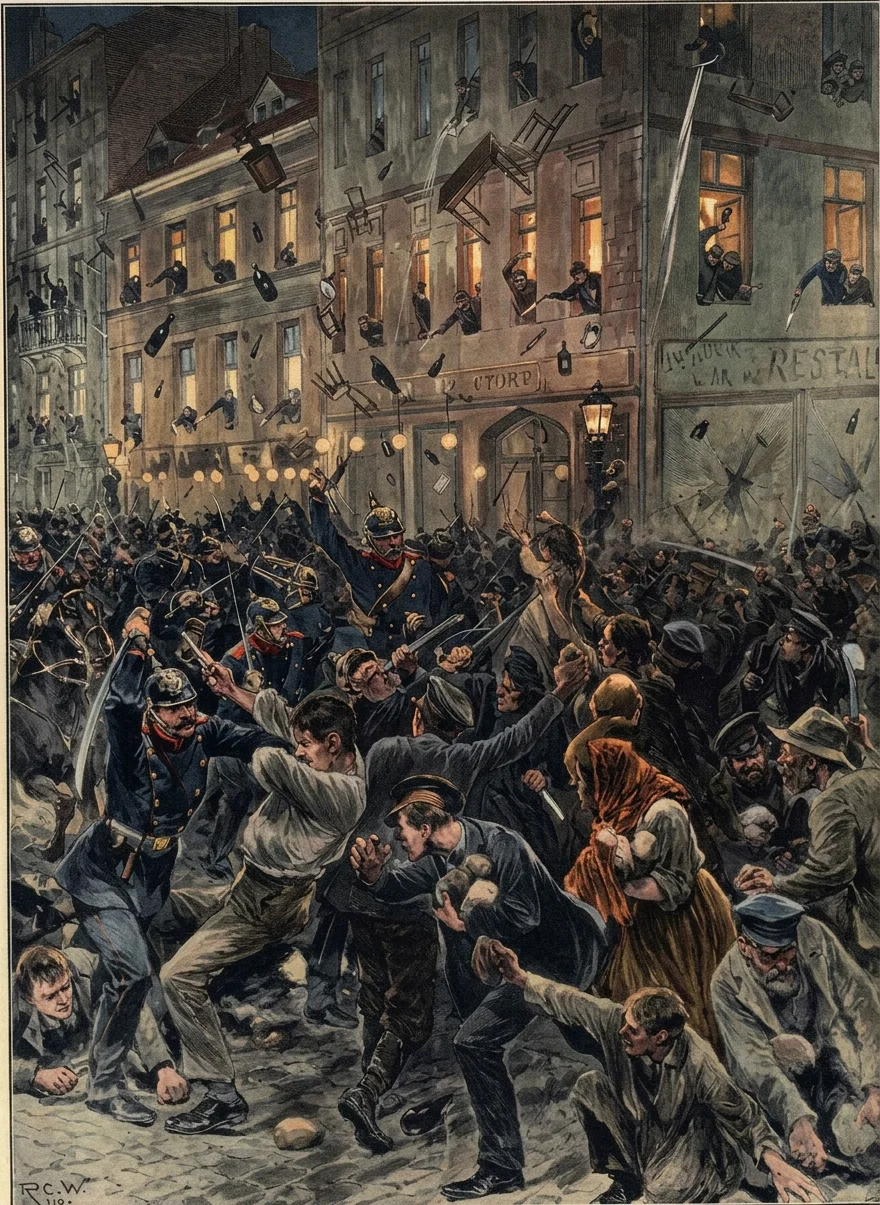
Photograph of a scene of rioting in Berlin, Germany, one of the strongest military countries in the world, and one of the best policed cities
IN the February (1911) "Everybody's Magazine" Mr. Frederick T. Martin, himself a millionaire, says in part: "The miserable excesses of society are an open book. I can not blind my eyes, nor deafen my ears, nor close my nostrils, and forget them. That decay has set in, I know; that it has struck deep, as yet I can not bring myself to believe." Mr. Martin goes on to state what he believes to have been the immediate CAUSE of the mad extravagance so glaringly prevalent in the society of the idle rich. "It was the magic of gold; it was the poison of idle wealth," he declares. "It was the curse of gold," he repeats, "no more, no less — the same poison that blighted the glory of Athens, that ruined the splendor of Rome, that brought upon Bourbon France the terror of the Revolution." He adds this significant declaration: "It is a melancholy fact that the impetus toward extravagance, excess, idleness, debauchery, and shamelessness comes to us from the underworld."
Less than a year ago an Italian scholar visited America. He gave to the public his impressions, and some of them are significant. For instance, he found that the wife of one of our millionaires wears a necklace that cost more than $600,000. Immediately following the birth of a son to this woman, a retinue of servants was formed for the sole benefit of the infant. Among those who made up this corps of retainers were four nurses and four high-priced physicians. The infant reposed in a ten thousand dollar cradle.
Embellishing a Five Million Dollar Palace
A money-king of the Middle West, wishing to make New York City his home, recently purchased for $2,000,000 the palatial residence of a deceased friend. The original cost of the palace was almost $5,000,000. The new owner expended $85,000 in embellishing the walls and ceiling of his bedroom, with carvings, enamels, and gold. Over the windows were suspended ten pairs of curtains that cost $2,000 a pair. The wardrobe in this famous room represents an outlay of $150,000; the dressing-table, $65,000; the wash-stand, $38,000; and the bed hangings cost fifty dollars a yard. The chimneypiece and the overhanging mantel and the four doors consumed a mere $18,000.
Somewhat more than a year ago one of the popular magazines published an article on "Luxurious Newport," describing conditions not only disgraceful, but even alarming. It is well known that for years the ultrarich and wantonly extravagant people of the North Atlantic cities have made Newport their summer rendezvous. Hence Newport is to-day the center of social conditions which in many of their aspects remind us of the wild and senseless prodigality that marked the decadent days of ancient Babylon, Greece, and Rome. The treasures of money that are wickedly wasted in spectacular display, in riotous luxury, and in more or less refined debauchery, stagger one's credulity.
Forty Thousand a Year for Clothes
We are reliably told that the typical woman of the Newport "smart set" spends $40,000 a year on her clothes, and that a "leading dressmaker" declares that $60,000 is not too high an estimate." Her dinner gowns represent $5,000; her shoes and stockings, $1,300; her hats and veils, $1,200; her handkerchiefs, $100 each; and so on. From $1,000 to $1,500 is frequently lavished on a single entertainment. One family owns fifteen automobiles, and spends $50,000 yearly on yachting. The average yearly expenditure of this "set" is $300,000 a family. Many a family, of course, spends far more.
The man "who can contrive some novel, stunning, and morally questionable means of enabling one rival, in this fierce competition, to outshine another, is richly rewarded." Invent something new in the way of food, costume, furniture, or equipage, which will stir these jaded prodigals with a new sensation, and you can sell it at your own price. "And so," writes the editor of the San Jose "Mercury," "the carnival of extravagance, pride, luxury, self-indulgence, and sensuality goes on, ever rising higher, wilder, and more furious."
We all know, too, that these regrettable conditions are not peculiar to Newport. They are most deeply rooted there, but they have spread over all Europe and America, wherever the idle rich have multiplied.
Not long ago a Southern millionaire bought an imported motor-car. The original cost was $12,000. He looked it over in scorn, and called in decorators. The car was completely refitted. It was equipped with a diminutive drawing-room, a sleeping-room, with hot and cold water fixtures, and space was found for even a small bath tub. A kitchen fully equipped with cooking utensils was added. And when the various mechanics completed their work, the car had been transmuted into a sumptuously furnished home on wheels. The first cost of $12,000 had been brought up to $30,000, and the owner was temporarily satisfied.
In the closing hour of an elaborate function in New York City, the guests leaned back languidly to listen to the singers. The cigarettes were11passed around. Up to that moment there had been nothing exceptional about the banquet; and as the host was famous for the startling novelty of his dinners, many of the guests were disappointed. Soon their disappointment gave way to admiration. "Each cigaret was rolled, not in white paper, but in a one hundred dollar bill, and the initials of the host were engraved upon each in gold letters. This strange conceit was applauded until the voices of the singers struggled amid the uproar."
A young millionaire of the Middle West owns a unique hat; it is made of greenbacks. Its cost was exceptional, as twenty thousand dollars in bills were used in making it. It looks precisely like the white hats worn by gentlemen. The owner, we are told, lacks imagination, and for that reason more involved methods of "burning" his money did not occur to him. Another young Croesus gave a banquet in honor of his small black and tan dog. The festivities were extremely gay. Of the invited friends, the men came in evening clothes, and the women bedecked in swishing silks and flashing jewels. In the midst of the gay festivities the host formally decorated his dog with a fifteen thousand dollar diamond collar. It was made up of seven hundred small brilliants. "The guests shouted their approval, and the dinner was regarded as a huge success."
As in the Latter Days of Rome
In the February (1911) "Scribner's Magazine," Prof. J. L. Laughlin tells his readers that during the past year diamonds to the value of $48,000,000 were imported into the United States. He says, "What is going on amongst us is not new; it is an outcome of rapidly growing wealth, like that in later Rome." He reminds his readers that the danger is not confined to those who have abounding wealth to spend. The passion for social position is almost universal; and the example of the rich who have low ideals is avidly followed by those who have meager incomes.
A London despatch to the American press, of date April 15, 1911, contained this significant bit of information: "Wearing precious heirlooms, diamonds and pearls, set in the buckles of their shoes, is the latest craze among smart, up-to-date women. Harem and the fashionable narrow-line skirts show so much of the feet that buckles are in great and increasing demand at present, and the woman who can afford real gems in her buckles is not content with imitation. She either has her buckles set with diamonds which she buys for the purpose at a cost of $250 to $1,500 a pair, or else she has her ancestral diamonds or pearls turned into shoe ornaments. 'There is a steady demand for real gem-incrusted buckles just now,' the manager of a large London firm of jewelers said, 'and I think the fashion will grow as the coronation draws nearer.'"
Half Million for Cigarets for New York Women Alone
The New York "World" informs its readers that in 1909 New York women burned up half a million dollars in the form of cigarettes. That is a pretty snug sum for the women of one city to send up in smoke in a single year. These figures are furnished by dealers, who cater particularly to women. One of them seeks no other trade. The "World" states that the reason for the astonishing increase of the smoking vice among women is simply this: "They took it up because it looks 'smart,' in much the same way that a small boy takes his first smoke. In much the same way it has grown on them, until now they are wrecking their nerves with nicotin, to say nothing of squandering great sums of money." Smoking is no longer a fad with many of these women; they must have their after-meal "pull" just as much as they must have their meals.
Thousands of women in the metropolis smoke fifteen to twenty cigarettes a day. We are told that in one of the fashionable shops which caters exclusively to feminine trade, the young woman who conducts the place sells to many a woman as many as ten thousand a year. The "World" correspondent gives the following estimate of what one fashionable woman will spend for smoking in a year: 10,000 cigarettes, with initial or monogram, at three dollars a hundred, $300; in-laid tabouret, $500; cigaret ring, $100; cigaret holder, $50; cigaret cases, $300; total, $1,250.
Thomas E. Watson, the noted writer on political and social questions, says that ten years ago the American people consumed three billion cigarettes a year, but that in 1909 they consumed eight billions. He says further, "In the rush for money, IN THE RUSH FOR PLEASURE, in the licentious indulgence of the lusts of the flesh, the whole nation seems to be plunging hellward."
Fifty Thousand to Save a Dog
The San Francisco "Chronicle," September 30, 1907, said editorially: "A widow, two maids, and a veterinary surgeon recently flew in a special train from Los Angeles to New York in the hope of prolonging for a short time the life of a dog which had already passed the allotted age of the cur tribe and was suffering from acute pneumonia. On arrival at New York the dog died, and is to have a monument." This trip involved an expenditure of $50,000.
How do the idle rich live? Principally, of course, by what is called rent and interest; that is, by the fruits of the labor and the abstinence of others, for which they return no equivalent. In the words of Professor Laughlin: "Wealthy women of to-day have come to regard work as demeaning. They would be mortified to be caught doing ordinary work in their households, which their mothers before them very likely did as a matter of course. Idleness has come to be a mark of social eminence. Whether a woman is properly to be included or not in 'good' society is almost decided by the fact that she takes her breakfast and spends her mornings in bed."
Is there not something radically wrong with society when 75,000 children in New York City alone go hungry to school every morning, notwithstanding the fact that there are 1,500 millionaires in that city? There are 10,000,000 people in the United States to-day who are not adequately fed and sheltered; that is, who are in poverty. "By poverty," says Jack London, "is meant that condition in life in which, through lack of food and adequate shelter, the mere standard of working efficiency can not be maintained."
Nations Overthrown by Luxuriant Vices
The overwhelming testimony of history is to the effect that every nation that has died, has died of the vices which are bred of wealth and luxury. In short, it was the reign of sin that killed them. That is the one lesson of history which needs heeding to-day. It was the wild extravagance, unbridled luxury, and arrogance of the rich of old Babylon and Rome that stirred the poor to frenzy and drove them to plunder the rich. Thomas Watson is convinced that "if something is not done to check the rising tide of discontent in this country, there will be the bloodiest struggle between the rich and the poor that ever drenched a continent with human blood." But in opulent old England and in pleasure-loving France the outlook is equally ominous.
Altho Mr. Watson had no thought of Holy Writ when he uttered the foregoing dark words, yet there is abundant Scripture warrant for his prediction. In the last chapter of his epistle, the prophet James declares: "Come now, ye rich, weep and howl for your miseries that are coming upon you. . . . Ye have laid up your treasure in the LAST DAYS. . . . Ye have LIVED DELICATELY on the earth, and TAKEN YOUR PLEASURE."
Again, the inspired Paul predicts: "But know this, that IN THE LAST DAYS grievous times shall come. For men shall be LOVERS OF SELF, lovers of money, . . . without self-control, . . . LOVERS OF PLEASURE rather than lovers of God." 2 Tim. 3: 1-4.
"Behold, this was the iniquity of thy sister Sodom; pride, FULNESS OF BREAD, and PROSPEROUS EASE was in her and in her daughters; NEITHER DID SHE STRENGTHEN THE HAND OF THE POOR AND NEEDY. And they were haughty, and committed abomination before Me: therefore I took them away as I saw good." Eze. 16: 49, 50. Sodom was in the days of Lot. Now note the prophecy of our Lord respecting our day: "Likewise even as it came to pass in the days of Lot; they ate, they drank, they bought, they sold; . . . but in the day that Lot went out from Sodom it rained fire and brimstone from heaven, and destroyed them all: after the same manner shall it be in the day that the Son of Man is revealed." Luke 17: 28-30. Is not the evidence conclusive that society is to-day repeating the sins of ancient Sodom? Will the harvest be different?