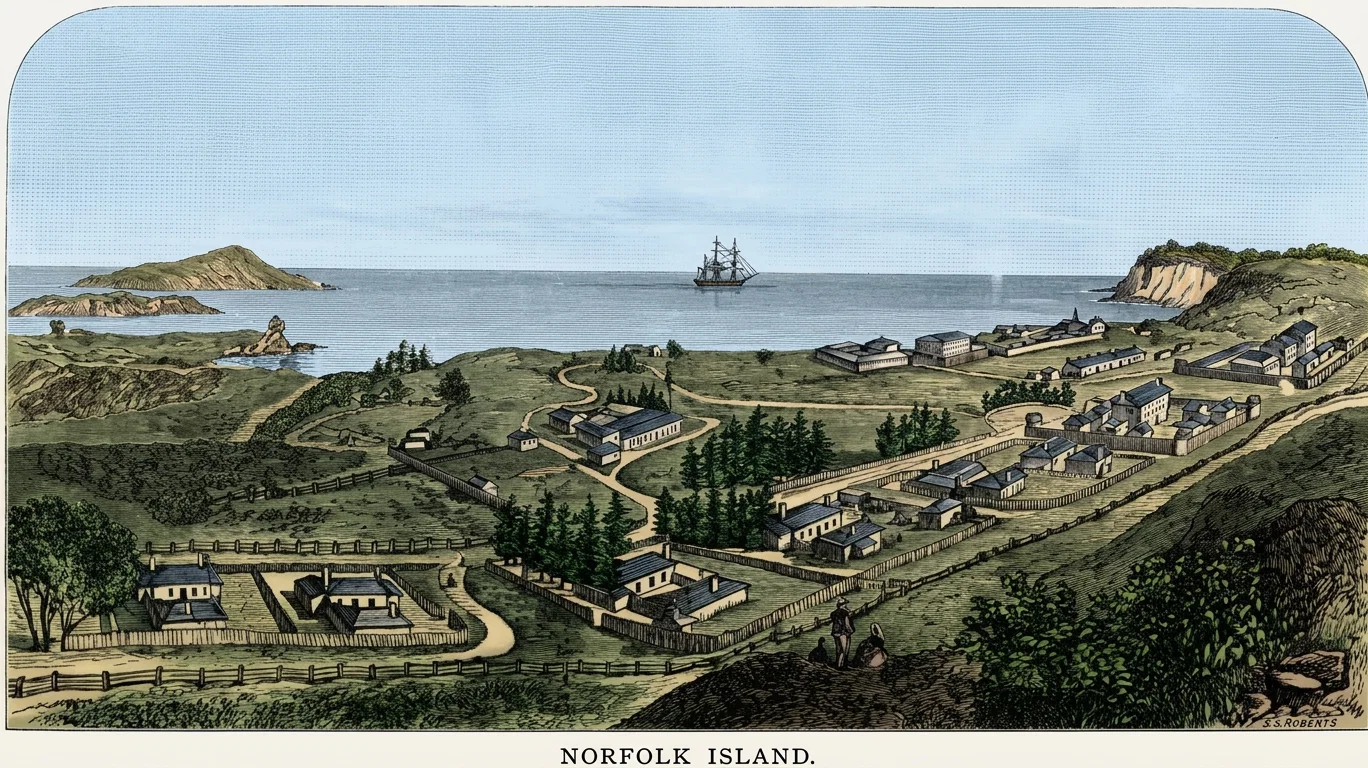
NORFOLK ISLAND

4%

Pacific Press Publishing Company · Oakland, California · Nov 28, 1892

FromSigns of the Times, Vol. 19, No. 4.

Read the full edition

NORFOLK ISLAND.

SOCIAL EXPERIMENT.

WE have already told the readers of the SIGNS about the first social experiment on Norfolk Island, how a community of convicts were conveyed there by the English Government, including all classes of criminals from petty sneak thieves to the most hardened robbers and murderers, where, instead of reforming under the banishment from the outer world, they only became worse desperadoes than before, the most wicked criminals making villains of the others, till the island paradise, overspread with all the beauties of nature and art, became a den of vice and crime, where bloodshed and suicide were the common occurrence and increasing in frequency, thus proving the first experiment a miserable failure.
The descendants from the mutineers of the Bounty were the subjects of the second social experiment. The progeny of rebellious sailors and half savage Tahitians would hardly seem like good material for making a good community, but the grace of God had interfered, and, through the instrumentality of John Adams, who instructed them, the race had become changed from a riotous, self-destroying people to a gentle, industrious community.
Good John Adams died in 1829, and his death was a terrible loss and grief to the Pitcairn islanders, but they continued to train their children, bestowing care upon the little ones, as he had taught them. As the population increased, the resources of the island became too small for its inhabitants, and they were persuaded by the British Government to remove to Tahiti. They were not happy there, however, and soon went back again. In 1856 they were removed to Norfolk Island, and there they remain still, with the exception of a few who became so homesick that they made their way back once more to Pitcairn Island, and formed the community which now dwells there.
Of course there was much of inherent indolence and depravity which had to be fought in their descendants for generations, and even to the present day. It was a community like this, with all the inherited tendencies of a past generation, well reformed individually, and controlled by their simple, paternal form of government, that was conveyed to Norfolk Island in 1856 to take charge of the land just vacated and furnish the material for a second social experiment.
The venture was unique, one hundred and ninety-four paupers, having no useful trades, possessed of no household furniture, with minds scarcely more far-reaching than the breadth of the little island they had left, taken by the great, and to them awe-inspiring government, and put upon an island which, though really only about twenty miles in circumference, seemed to them a vast expanse of territory, well-nigh inexplorable. Here they were made independently rich, being presented with a bewildering extent of land, twenty-five acres each, and a large stone house to each family,—a wonderful exchange for their little thatched huts and small garden plots on Pitcairn.
Besides this, they were made possessors of public works which had cost thousands of dollars. There was a well-built pier and breakwater, affording a comparatively safe landing for boats; there were miles and miles of well-surveyed roads, built across the island in all directions, winding around hills, crossing well-bridged rivulets, and extending over level tracts of land. The gigantic Norfolk pines (Araucaria excelsa), which stood in rows on either side of the roads and covered the high hills, were grand indeed, some measuring over thirty feet in circumference and towering to a height of over one hundred and fifty feet. Here was a huge corn mill, run by wind power, and, in the deep valley, a sawmill, run by water power. Here for the first time they saw herds of cattle and flocks of sheep. Wherever they looked, on the hills or in the valleys, on the well-built town or on the fertile country tracts, there was untold wealth, and all was theirs. It seemed like a fairy tale or a dream, their transition was so sudden from poverty to wealth.
NORFOLK ISLAND.
NORFOLK ISLAND.
But it must be remembered that the people so suddenly transported, while a virtuous community, not only had no useful trades, but they had not experienced hardships, in their almost tropical home, sufficient to develop in them the habits of industry necessary for a prosperous residence on such a well-organized island. A few tradesmen were left for a short time to instruct them in the use of the mills, but, as readily could be seen, this was insufficient to establish permanent industry, so necessary for the systematic maintenance and prosperity of the island.
The immediate government of the island was vested in a magistrate and two councillors, chosen from among their own number, and under the general control of the governor of New South Wales.
Naturally enough, the people, thus left to themselves, with no outside example or influence in the sterner duties of life, and being from the first puerile, soon allowed their fine island home to deteriorate till it became irrecoverable. Increased possessions developed traits of character which had before lain dormant; some of the more energetic became ambitious, while many others became indolent. Avarice, which before their increased wealth was almost unknown, now spread like a blight. Some, moved either by cupidity or debt, sold their twenty-five acres allotment of land, reducing themselves and families to pauperism, while others bought it for a fraction of its value.
A public fund for the support of the clergyman and doctor was created by disposing of a number of the sheep and cattle and the sale of one thousand acres of land for the establishment of the Melanesian Mission.
These functionaries, supported by a public fund, have not always benefited the people as they should, although some of the men filling these positions have made themselves noble exceptions to the rule.
As the population increased, the distinction between the rich and the poor became more marked, and vice and crime became more prominent. The laws were made more stringent, but as no distinction was made between crime and sin, the executive, perhaps encouraged by the clergy, often spent all its time and effort in trying to define and punish the latter, which belongs only to God (Deut. 32:35), while the former, the restraint of which devolves upon the government, was usually passed lightly by, partly because crime was considered of less moment than sin, and partly because the governors and governed were all relatives, ofttimes requiring a man to pronounce judgment against his father or mother, or perhaps his grandparents, brothers, cousins, uncles, or aunts, which he would seldom do unless he had some grudge or ill feeling against them, when an excellent opportunity was offered to retaliate. A chapter at once sad and amusing might be written on this phase of the experiment alone. Thus the solemn vows of executive and legislative offices came to be lightly esteemed.
The community, which at the present writing numbers about five hundred people, has but few traits which mark it as related to the smaller but more virtuous community on Pitcairn Island.
They are decidedly a pleasure-loving people. Picnics, attended by a greater or less number of men, women, and children, are held for almost every occasion, birthdays, weddings, and other anniversaries, holidays, etc. They occur almost every week, and in some seasons nearly every day. Sometimes a trip will be made to Philip Island or Napean Island, two small isles near by, where the day is spent in fishing, hunting wild rabbits, paroquets, and sea birds' eggs. The latter are found in abundance at the right season, and are considered a fine article of food, being the principal diet upon which some families subsist for about two months in the year. Riding parties are common, some of the young people being expert horseback riders. Dancing is also a favorite pastime, the ballroom attracting both old and young alike.
At Christmas time one whole week is given over to games and making merry. The principal industries are whaling and sheep raising. The old mills, which might have been made a means of establishing permanent industries, have long since gone into disuse and decay.
Agriculture is the only other resource, but as there is connection with the outer world only by a slow sailing vessel, and that onlyonce in three months, even this resource does not avail. The young people are taught no useful trades, and receive, as a rule, only the most meager education.
The religious belief of the islanders seems to be undergoing a metamorphosis. Many of the adherents of the Church of England are becoming more and more dissatisfied as the so-called High Church forms and ceremonies of recent adoption are introduced.
Within the past six years, through the labors of a Mr. Phelps, a lay member of the Methodist Church, who came on a whaling vessel, about twenty professed conversion and formed themselves into a Methodist Church, and afterwards professed holiness. At the present time this church numbers many more. As the result of our visit, quite a number became interested in the views of Seventh-day Adventists, and, though it was not deemed wise to make any public effort there, yet there were twenty-one who have purposed to stand for the truth, and a number of others expressed themselves in harmony with our views.
On the part of many of the islanders, as well as most of the Europeans dwelling among them, there seems to be a general feeling of discouragement and despondency; their formal worship does not give them peace; their crops and the few industries of the island do not remunerate them sufficiently to supply their needs, and many of them are in debt.
Their children have not the industrial and school advantages they should have, and, upon the whole, the island and the people are deteriorating. They consequently feel that, while the social experiment has not proved a failure, yet some other impetus is necessary to make it a success.