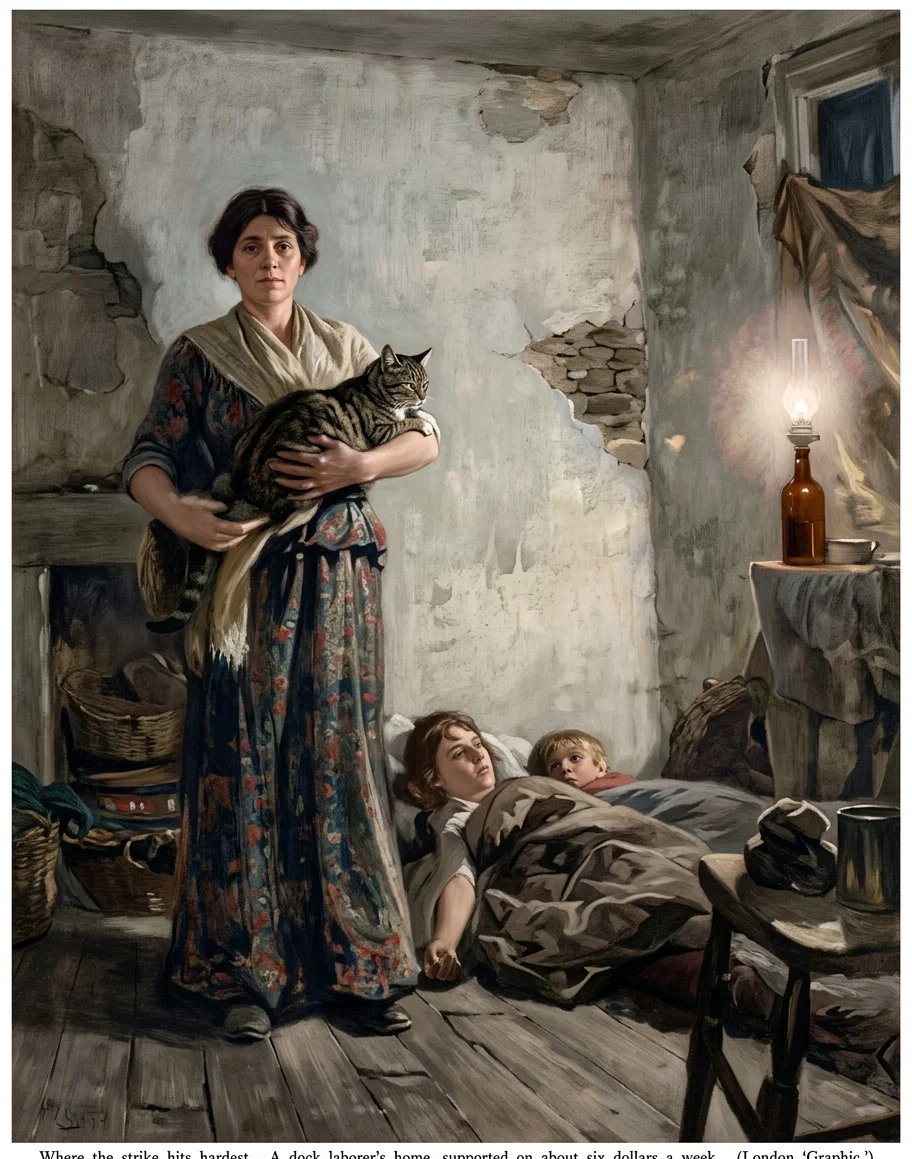
HE situation in which England has found herself the last week or ten days is one to cause even the most easy-going and thoughtless of persons to pause and think. England is usually quiet. Life for the aristocracy and for the comfortably-paid middle classes runs along with the smoothness of well-oiled machinery. The British laboring man, as we sometimes hear it said, knows his place, and keeps it. He may not have much more than a pound ($5.00) a week with which to pay a heavy house rent, and buy clothes and food, in a market with steadily rising prices, for a family of five or six; yet hitherto he has as a rule done his part patiently and with little grumbling. But the situation is changing, and in the last few days developments have been made with lightning rapidity. The laboring man is awakening to his needs, and to the fact that he possesses in organization the power to better his condition.
Meanwhile at all the great railway centers traffic is largely at a standstill, while Liverpool is undergoing a reign of terror, in which not merely the strikers proper, but all the baser elements, are in a state of ferment, and deeds of shameless violence are daily perpetrated, while the police in many cases must look helplessly on.
Almost a Civil War
A situation of such gravity has never before confronted the country. It is hardly less than civil war. All last night troops were pouring into Waterloo station. That great railway terminus was like an armed camp. Everywhere was clatter, bustle, shouting, and marching. Twenty train-loads of troops arrived, and to-day they are being quartered in various parts of the city,— 4,000 in Victoria Park, 1,000 in Hackney Marshes, 600 at the Tower, 600 at the general post-office, 3,000 in Hyde Park, 4,000 in Battersea Park, and others elsewhere. A party of artillery has been assigned to Willesden Junction, in the northwest of Great London, in order to guard the railway tunnels.
The strike mania — for that seems to be the best word for it — began a little over a week ago in London. The dockers, lightermen, and stevedores “walked out,” and they were soon followed by the carmen (draymen). The result was as if the port of London were undergoing a blockade. The vessels with provisions still sailed up the Thames, but there was no one to unload them. And not even the stores in the warehouses were available, for there were no carmen to distribute them. A few attempts were made to break the blockade; but they were mostly unsuccessful, for the strikers were grimly determined, and they held the field.
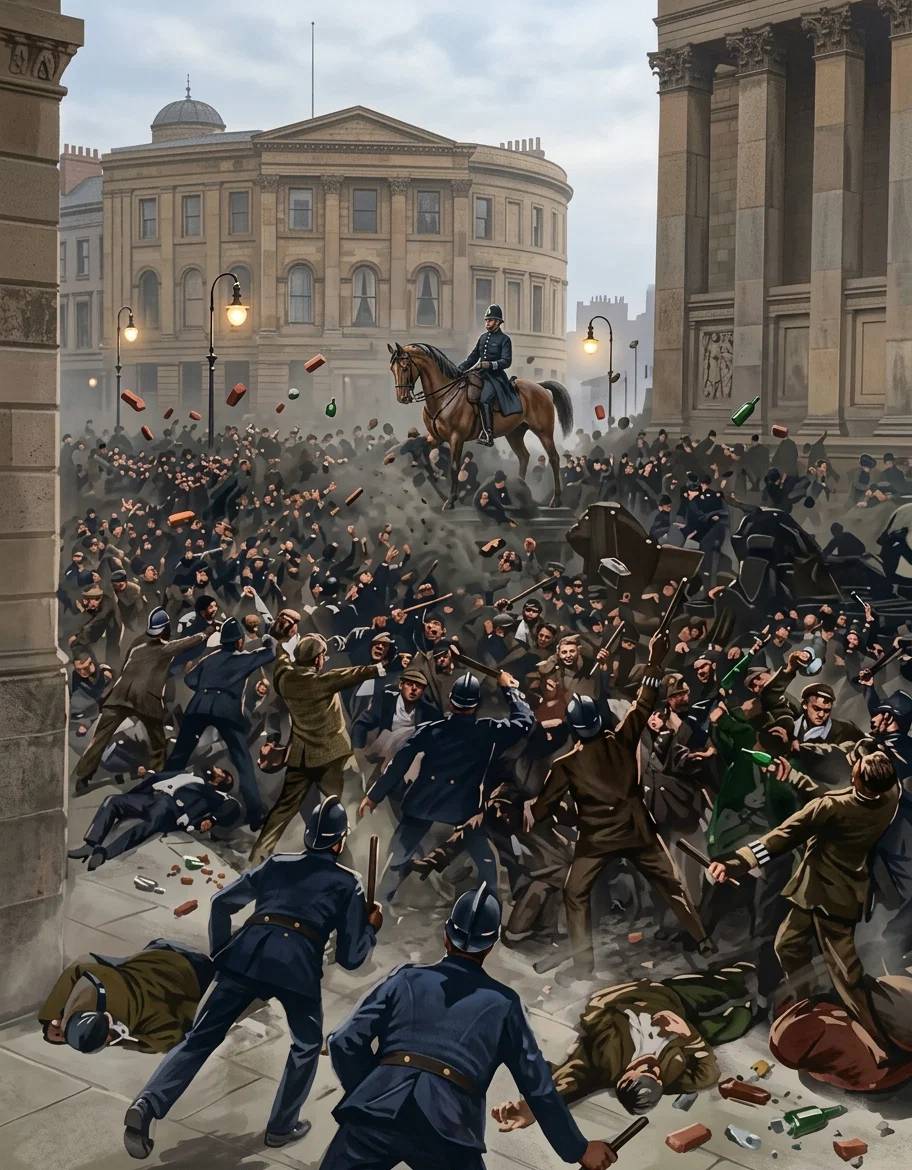
The beginning of street battles in Liverpool, police and mob in conflict, the police armed with truncheons and the latter with bricks, bottles, stones, etc. The scene is in front of St. George's Hall, the center of the city. (From London "Illustrated News.")
The resulting situation was a most impressive testimony to the power of labor. “Day after day,” writes a reporter, “I went down to the docks and gazed at their desolation. Where, as a rule, there is a world of noisy activity, there was now silence and appalling stillness. From East India Dock to London Bridge there was a vast crowd of craft; but they had been deserted by their crews, and there was no movement on their docks. The quay-sides were abandoned, the wharves were closed. There was no sound of rattling chains. Not a crane was working. No vans came rumbling out of the dock gates piled high with casks and cases. The gates were shut and guarded by strong bodies of police.”
Scenes of Violence
There were some scenes of violence, especially at the beginning, when attempts were made by means of “blacklegs” to get vans through the pickets. A score or more of vans were attacked by the strikers, the drivers handled very roughly, and the goods strewn about the streets.
A brewer’s dray carrying a thirty-six gallon cask of beer was captured by a gang of strikers, who burst in the bung, and emptied the contents into pails and jugs. They drank deeply, the women as well as the men, and then, joining hands, formed a circle around the beer cask with riotous mirth.
Fortunately this strike of the lightermen and carmen, which brought London face to face with famine, did not last many days. The employers gave the men what they asked, and the latter went back to work at the end of the week.
Other Strikes
But meanwhile numerous other strikes had started, as it were by infection. Factory hands of various classes, including men, women, and girls, found their situation intolerable, and joined the strikers. Everywhere was agitation and unrest. The air seemed full of the strike fury, and everything uncertain.
Thus it went on till the most serious development of all came early this week, with the four great railway unions announcing a general railway strike to take place within twenty-four hours unless their demands were met. The government called a meeting of the men and the employers, and the strike leaders delayed for a day, calling out the men to give opportunity to come together. The representatives of the government offered to appoint a royal commission to inquire into the grievances of the men. They tried every means in their power to avoid a general strike; but all attempts proved abortive, and very early this morning some 2,000 telegrams were sent out to branches of the unions all over the country, calling upon the men to10"strike at once."
The response has been general. Not only the union men, but also the non-union employees, are "coming out," and traffic in the midlands and in the North is largely paralyzed. Thus early this morning Bradford reported 1,500 men out, Doncaster 1,000, Leeds 5,000, York 2,500, Leicester 800, Hartlepool 2,000, while at Manchester and Crewe practically all the men are on strike, and traffic is at a standstill. The eagerness of the men is illustrated by the action at Leeds, where the 5,000 men ceased work even before they received the signal.
At the present writing the movement is gaining ground, and no one can tell where it will end. The grievances of the men date back to the big strike of 1907, which was more properly a threatened strike, and was settled, at the instance of the government, by the appointment of conciliation boards and other concessions. The men assert that these conciliation boards have proved unworkable, and that the employers have not lived up to the spirit or the letter of the agreements then made. The employers on their part seem inclined to fight rather than yield, and they have with them for the most part the sympathy of the middle and upper classes.
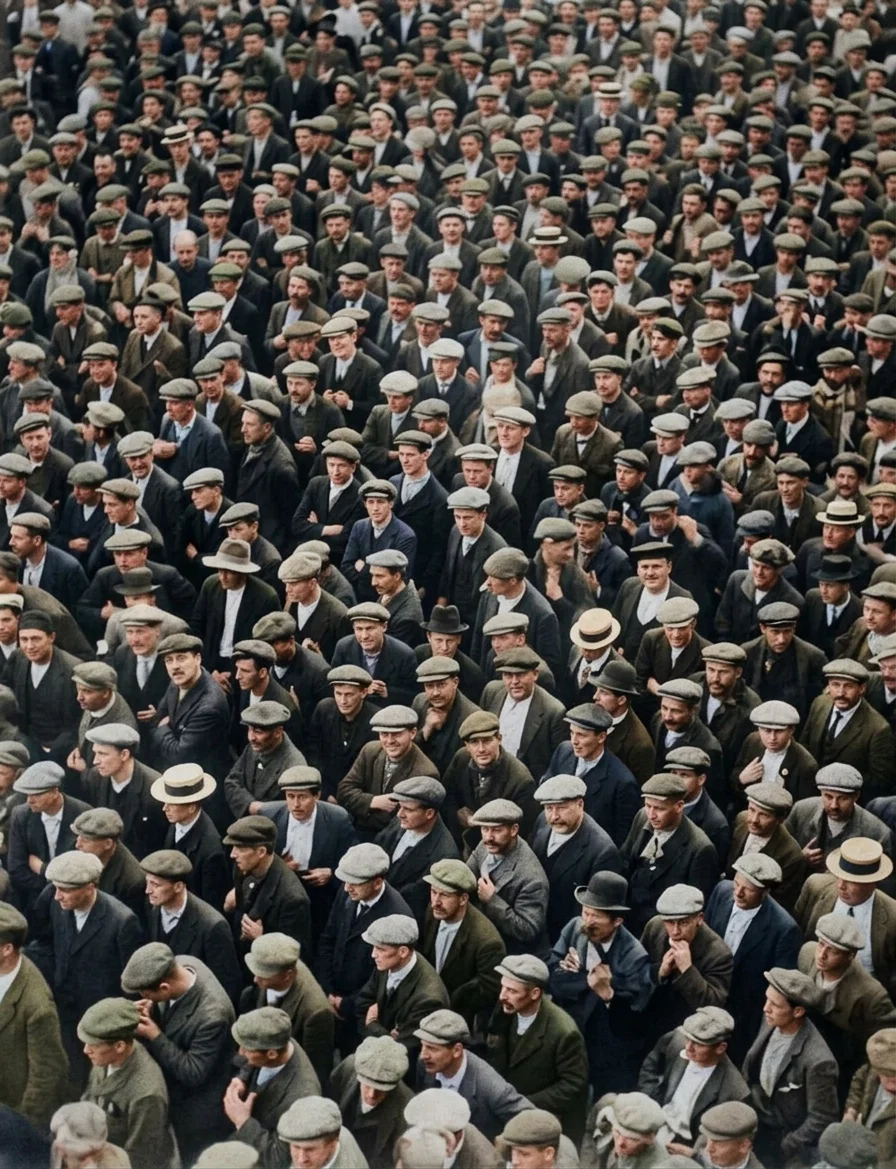
A section of mass-meeting at West India docks. Note the workmen's caps, called "the new caps of liberty." (From London "Graphic.")
Causes of Trouble
Thus the "Times" declares editorially that "there is absolutely no evidence that any grievance exists of such a kind that a few days' or a few weeks' delay in dealing with it can be of any consequence," and goes on to say that "the strike leaders, if they insist upon refusing a truce pending investigation, are divested of every particle of moral right, and must incur the reprobation and hostility of the entire community as the deliberate and wanton wreckers of the well-being and security of the whole nation."
But the "Times" puts it severely. There is in fact a good deal of public sympathy with the strikers. When poverty pleads its hunger and rags, it takes a hard heart to be utterly unmoved. When that long train of many thousands of strikers marched through the streets of London at the end of last week, many of the women carrying babes in their arms, there were many moist eyes in the crowds that watched them, and many silver pieces found their way into the hats passed around.
But London is tasting merely the first-fruits of the struggle. Only at Liverpool has the demon in men really been aroused, and it has been seen what hunger and fierce resentment can make even of an English working man.
Conditions in Liverpool
Liverpool, in spite of its hundreds of special policemen, and its thousands of soldiers, is still suffering from the violence of mobs. The situation grows more serious day by day. "I have been in the midst of scenes to-night," writes a correspondent of one of the leading dailies, "which I could not have dreamed possible in England of the 20th century. The anarchy began before darkness fell. The military and police were guarding the center of the city in full numbers, so that the terrible district stretching from Scotland Road to Everton Valley, with all its hornet nests around, was watched only by policemen scattered in twos and threes. Out of the courts and alleys and narrow side streets there came swarms of men, women, and children, until Vauxhall Road, Scotland Road, Stanley Road, and Kirkdale were densely thronged. They had come out for trouble, and, scoffing at the isolated policemen, dared them to come up the side streets to have their brains bashed out. The policemen held to their posts with real heroism. 'At any moment,' they said to me, 'we may be surrounded and killed. We have sent for re-enforcements, but they are a long time coming.' They were three hours before appearing, and during that time an infernal pandemonium reigned, and devilish work was done."
Going on to describe the attacks made upon the few straggling tram-cars which the company was trying to run, the same writer continues:
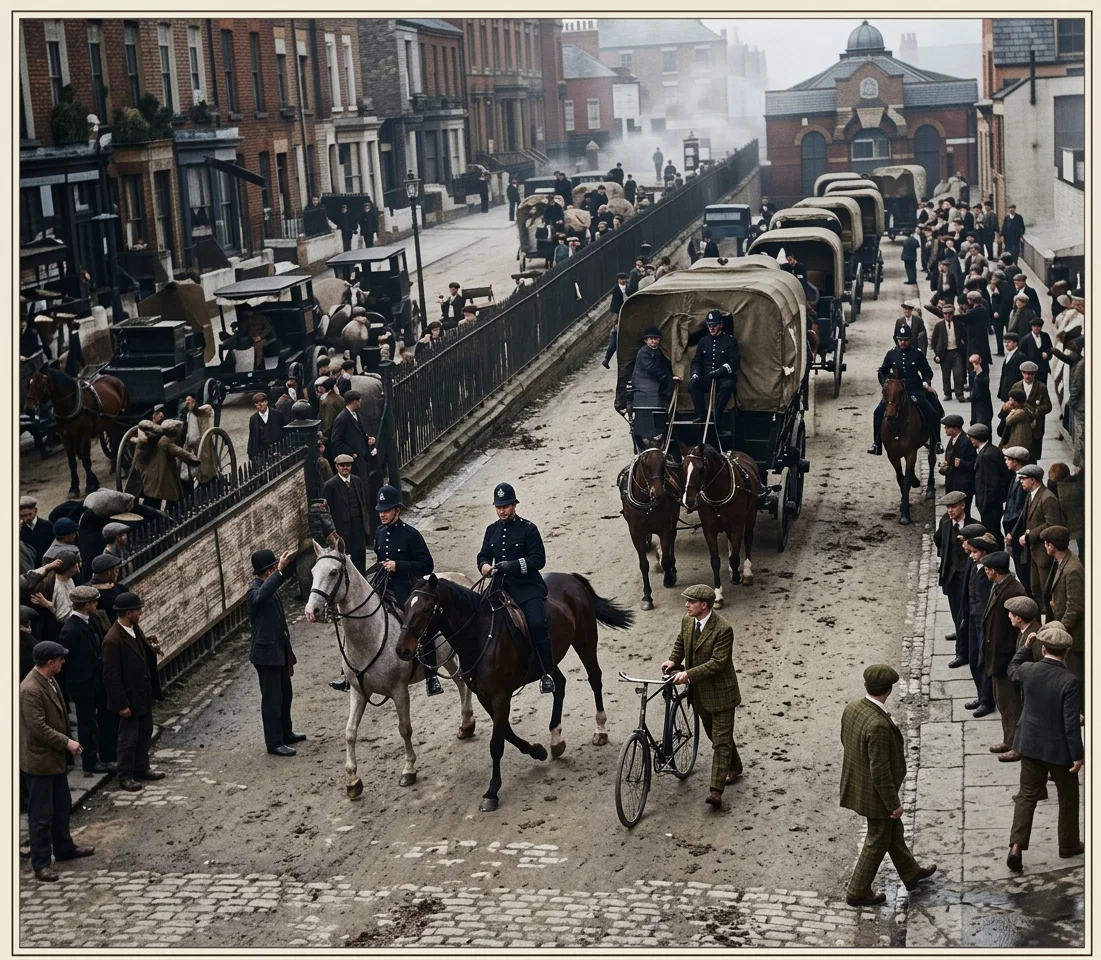
Provision wagons under police escort, a policeman on each van, and mounted police at the side. (From "Black and White.")
As the cars came along, they were assailed by stones and pieces of lead. These were thrown for the most part by boys from twelve to sixteen years of age, egged on and applauded by the men and women. Even little children of six or seven years scampered at the side of the cars and threw stones at them. It was a horrible thing to see the bricks flying and to hear the noise of smashing glass and the shrieks of the terror-stricken passengers, who cowered down below the level of the windows. I myself counted eighteen cars in which the windows were smashed, and then lost count.
As one car came along at full speed with a man by the side of the driver endeavoring to beat assailants off by a strap with a heavy buckle, a hail of stones smashed all the windows on one side. Inside the car were two women shielding a little girl with their own bodies, while another woman with a baby in her arms was at the end of the car terrified to the point of madness. The woman with the baby came out onto the step with the idea of jumping off as the car sped on at a great pace. Deliberately a young rough hurled a piece of brick. As the woman clung to the rail, the brick hit her full in the face, and with a shriek she let her baby fall into the road.
The car traveled on until the woman's shrieks and the stampede of ruffians to its sides made the driver stop. Some women in the crowd, more human than the other wretches, who were yelling with laughter, picked up the child and gave it to the mother, who went away unchecked.
Do not such things remind us, at least in some measure, of the French Revolution? And this in England of the 20th century! It is Liverpool to-day, but it may be London to-morrow. To be sure, the outbreak may be quieted down this time, and very likely will before this article appears in the "Signs of the Times;" but the significance of the whole movement will remain. There is altogether11
Too Much Self-Complacency
in the world to-day. Because we are ourselves well paid and comfortable, we give little thought to the starving multitudes. But it is a sad fact that inequality between the classes is, when all things are taken into consideration, almost as great to-day as it was in the eighteenth century; and it is much the more galling now than then, because the poor man of to-day is EDUCATED for a higher lot. His wants are increased out of all proportion to his power to satisfy them.
A Sad Mistake
The comfortable notion held by many, that in this favored century everybody is well fed and clothed, is a sad mistake. A few years ago extensive investigations were made in London, not by would-be strikers or labor agitators, but by sober, intelligent men, not given to exaggerate things. These men came to the conclusion that in London alone, one third of the population, or more than two millions of men, women, and children, were day after day living on the borders of actual starvation. Not only would a few days of non-employment bring them to actual want, but even with steady work they could not decently feed and clothe their families. And yet London is the wealthiest city in the world! Can we wonder at strikes under these conditions?
America Too
It is true that the American working man is better paid; but America, too, is becoming a land of contrasts, and it is by no means wanting in poor people. The social situation is not one to be proud of. Thinking men and women can not honestly join in the "peace and safety" cry. They get no comfort from the cheap optimism which glories in the scientific achievements of the age and the material prosperity which so many enjoy, and allows itself to forget the oppressed and downtrodden masses.
Perhaps the saddest feature of the situation is the thoughtless indifference to the lot of their poorer brothers and sisters on the part of so many professing Christians, who think nothing of wasting millions on their lap-dogs and other follies and frivolities, while in some near-by tenement children, clinging to the skirts of a poor, wan mother, cry in vain for bread. There is One who sees all this, and the reckoning day will come. "I was hungry, and ye did not give Me to eat; I was . . . naked, and ye clothed Me not." "Depart from Me, ye cursed." Do not these stern words apply to the fashion-mad and pleasure-loving Christians of to-day? Let us take heed that they shall not be true of us.
Even while this article has been in hand, the situation has grown decidedly worse. From all over the country word comes of railway men "coming out," in some cases dropping their tools, and leaving trains a long way from their destination. The railway companies remain firm in their decision not to yield to the demands of the men, tho they are willing to give evidence before a royal commission. The government, on its part, is distributing its troops, and all the great railway termini are guarded by large military contingents, Easton station alone having 850 soldiers, each man served with twenty rounds of ball-cartridge.
The news from the country grows worse hourly. Scotland is cut off; Wales, below Swansea, is likewise stopped; and the Bristol Channel ports are down. The strike extends from the extreme south of England to Scotland; and the leaders assert—tho this is probably an exaggeration—that at the present moment no less than 200,000 men have left work.
Negotiations are going on between the government and the railway companies, but the outlook is not promising. The situation in London has been rendered far more embarrassing and critical by a large portion of the employees on the underground railways "coming out."
M. ELLSWORTH OLSEN.
August 18, 1911.
Where the strike hits hardest. A dock laborer's home, supported on about six dollars a week. (London "Graphic.")