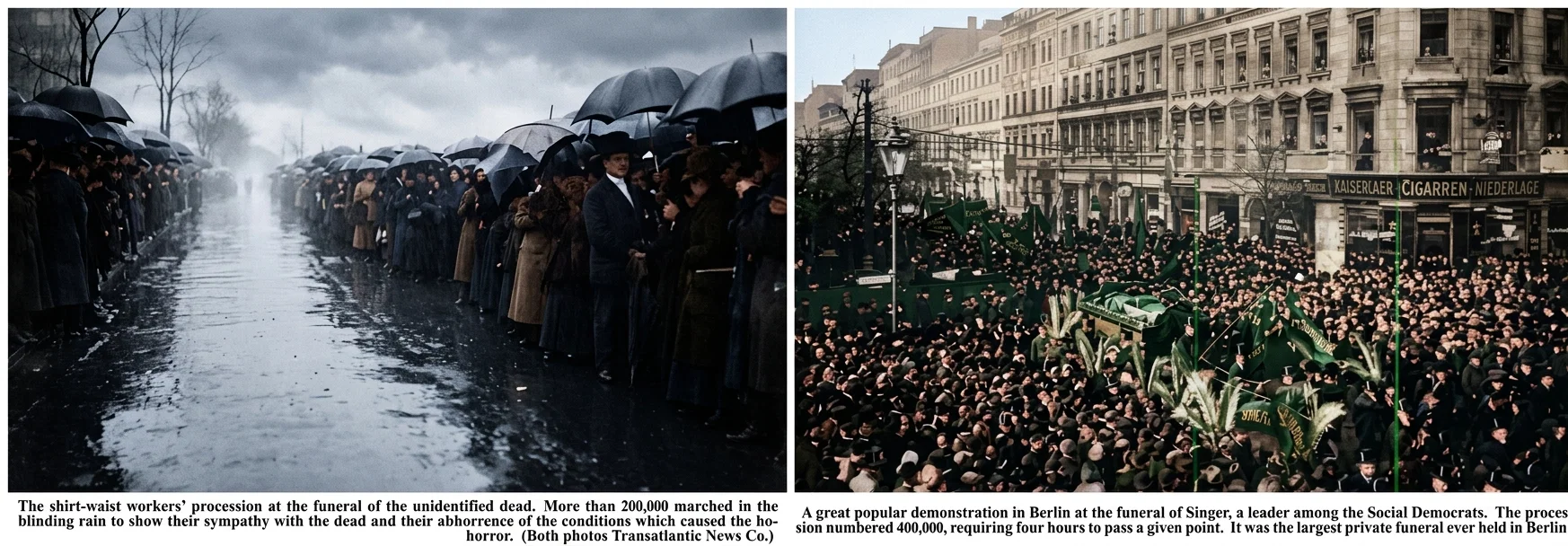
The shirt-waist workers' procession at the funeral of the unidentified dead. More than 200,000 marched in the blinding rain to show their sympathy with the dead and their abhorrence of the conditions which caused the horror. (Both photos Transatlantic News Co.) A great popular demonstration in Berlin at the funeral of Singer, a leader among the Social Democrats. The procession numbered 400,000, requiring four hours to pass a given point. It was the largest private funeral ever held in Berlin.
Our readers are more or less familiar with the awful horror in Washington Place, New York, on March 25, when nearly 150 lives were snuffed out in fifteen minutes. The cause at the bottom of the thing is dominating covetousness, which rises above all regard for human rights and human lives; which creates the sweat-shops and the slums; which seemingly would rather expend five hundred dollars for police protection from infracted law than one hundred dollars for the safety and health of human beings. When property rights are placed above human rights the humans must suffer. The death of those girls was a crime, not an accident. As a crime it is denounced by newspapers generally; but when asked to fix the guilt it is placed upon "society" and "politics," wholly impersonal things. Sometime, wherever man may place the crime, God will bring it home to individuals.
One hundred and forty, mostly young women and girls, were burned to death or leaped to destruction on the pavement 100 feet below. The laws of New York do not demand fire-escapes on fire-proof buildings; yet the laws do demand that doors shall open outward in case of fire; but on one floor the doors were locked that no employees might escape till they were searched before passing out at the close of the day’s work. Our photos above show that the sad catastrophe has brought together into stronger fellowship the workers, and it is hoped that this awful price paid for criminal neglect may result in greater safety and better conditions for the workers.